Rambus Lensless Sensor Presentation

online engineering degree/engineering degree online/online engineering courses/engineering technology online/engineering courses online/engineering technician degree online/online engineering technology/electronic engineering online
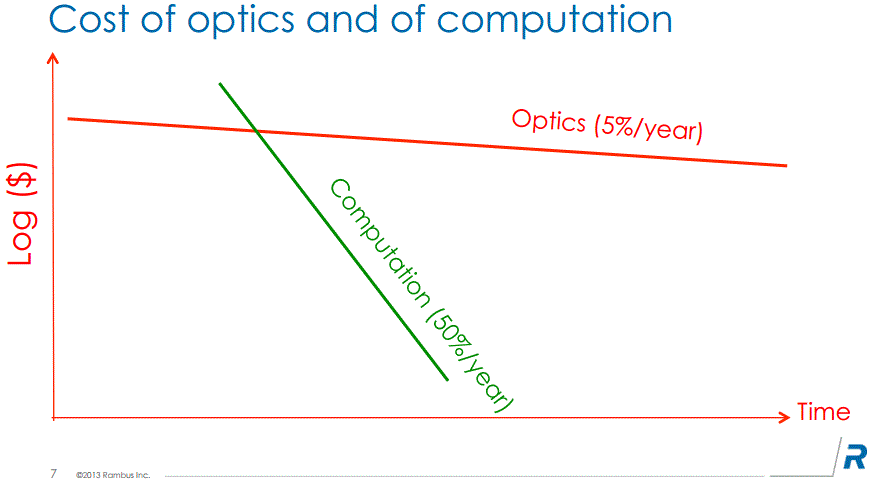
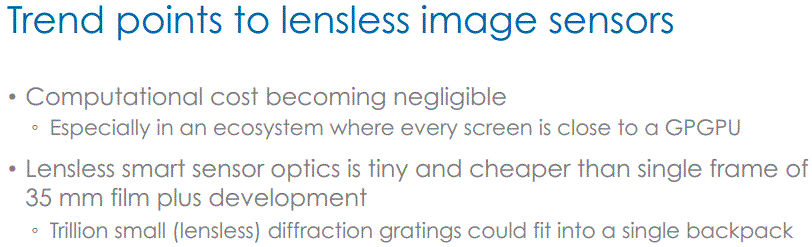
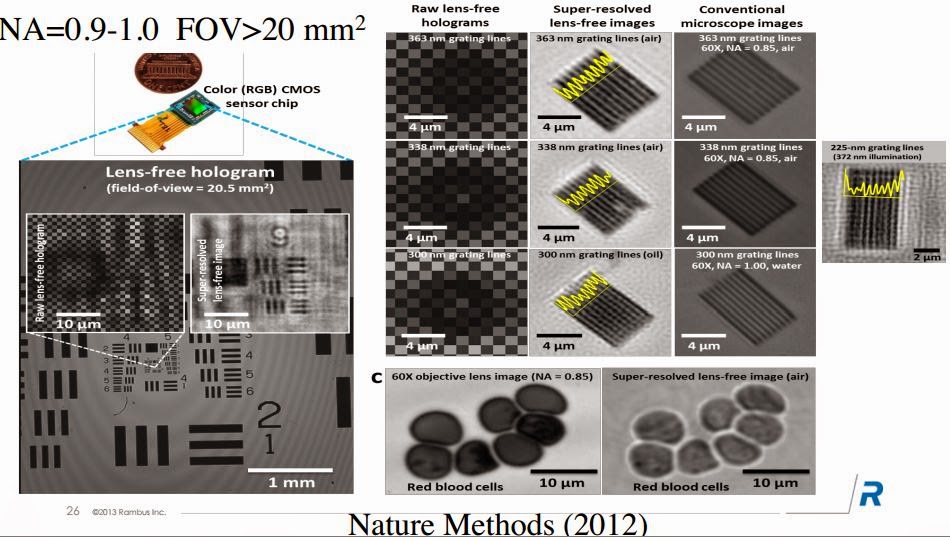
Trillion Sensors Summit held on Nov. 12-13, 2014 in San Diego, publishes Rambus presentation "Lensless Computational Image Sensors as a Foundation for New Opportunities in Biotech" by David Stork. Few slides out of 32:


CEA-Leti too presented its lens-free biomedical imaging, although little details on the operating principle were given.
10:51 AM

High Camera Resolutions Become Privacy Threat

online engineering degree/engineering degree online/online engineering courses/engineering technology online/engineering courses online/engineering technician degree online/online engineering technology/electronic engineering online
BBC reports that a member of the Chaos Computer Club (CCC) hacker network, Jan Krissler, has been able to replicate the fingerprint of German defense minister Ursula von der Leyen using pictures taken with a "standard photo camera". Krissler had no physical print from Ms von der Leyen. He only had obtained a close-up photo of Ms von der Leyen's thumb and had also used other pictures taken at different angles during a press event that the minister had spoken at in October.

A Youtube video (in German) presents the idea:

1:08 PM

VC Mobile Imaging Investments Down

online engineering degree/engineering degree online/online engineering courses/engineering technology online/engineering courses online/engineering technician degree online/online engineering technology/electronic engineering online
CBInsights tracking VC investments registers reduced interest in mobile imaging opportunities. Whereas in Q2 2012 mobile video and photo were the major investment areas, they have disappeared from the Q3 2014 chart:

11:14 AM

Senior Piping Designer – WoodGroups Abu Dhabi

online engineering degree/engineering degree online/online engineering courses/engineering technology online/engineering courses online/engineering technician degree online/online engineering technology/electronic engineering online
Vacancy Title:Senior Piping Designer Company:WGPSN Location: Abu Dhabi United Arab Emirates PO BOX 105828 Discipline: Mechanical/Piping Job Description: Brief Posting Description We are currently recruiting for a Senior Piping Designer on a residential (live-in) basis located at our client's office in Abu Dhabi. The position will involve occasional visits to the Client’s

SSRM Pictures Image Sensor Doping

online engineering degree/engineering degree online/online engineering courses/engineering technology online/engineering courses online/engineering technician degree online/online engineering technology/electronic engineering online
Bruker publishes a IMEC's Peter De Wolf presentation of the Scanning Surface Resistance Microscope (SSRM) useful for TCAD tools calibration, among many other things:

1:09 PM

Thesis on Image Sensor Noise

online engineering degree/engineering degree online/online engineering courses/engineering technology online/engineering courses online/engineering technician degree online/online engineering technology/electronic engineering online
Shizuoka University, Japan published a PhD Thesis "A Study on Noise Reduction in CMOS Image Sensors using High-Gain Front-end Readout Circuits" by Mohd Amrallah bin Mustafa, dated by Aug. 2013. The thesis goes through a quick overview of the major noise sources, including RTN:


Then, thesis goes through the ways to reduce the noise, like correlated multiple sampling (CMS), high gain ADC combined with PGA, and Histogram-based RTN Suppression and Averaging (HRS):


Then, a pixel with two amplifiers is proposed, where a selection circuit chooses the least noisy amplifier out of the two:

12:53 PM

Sony Next Generation Global Shutter Sensors

online engineering degree/engineering degree online/online engineering courses/engineering technology online/engineering courses online/engineering technician degree online/online engineering technology/electronic engineering online
Toshiba Teli's presentation at Vision Show 2014 reveals details of the new Sony Pregius image sensors with 3.45um global shutter pixels:


Thanks to CM for the pointer!
10:44 AM

Red-Light Cameras: Proceed With Caution

online engineering degree/engineering degree online/online engineering courses/engineering technology online/engineering courses online/engineering technician degree online/online engineering technology/electronic engineering online

The Latin phrase "Quis custodiet ipsos custodes?" means "Who will guard the guards themselves?" It may have originated with the Roman poet Juvenal, who flourished around the first century A. D., but the problem it highlights is much older than that.  Those who are charged with enforcing a law always experience a temptation to abuse the power that enforcement confers.  The case in point here is the use—and abuse—of so-called red-light cameras that photograph alleged runners of red lights and produce traffic citations that are mailed to the registered owner of the vehicle in question.

By the 1990s, the technology making these devices practical was sufficiently advanced that cities began installing them.  According to an article in a recent issue of National Review, over 500 cities in about half the states in the U. S. now use them.  Although the professed reason for adopting red-light cameras is to reduce the number of red-light runners, studies have shown that the evidence for lowering accident rates at intersections with red-light cameras is mixed.  Traffic engineers have noted a perverse counter-incentive at intersections where drivers know a red-light camera is installed.  Some drivers get so jumpy at seeing a yellow light at a camera-equipped intersection that they jam on their brakes prematurely and get rear-ended by a less paranoid driver behind them. 

What is not in dispute is that the red-light cameras are real moneymakers, both for the municipalities that install them and for the companies that often install and operate them for the government free of charge, taking a portion of the fine proceeds as payment.  The city of Newark, New Jersey gets $4 million per year in revenue from red-light cameras, while Chicago averages about $50 million a year.  Chicago's city government does not have a reputation for being squeaky-clean, so it is not surprising that earlier this month a man named Martin O'Malley was convicted of giving a $2 million bribe to a city transportation official.  The money came from Redflex Traffic Systems, which up to last year operated the city's red-light cameras. 

Redflex also offers a related service to school-bus systems:  a stop-arm violation camera.  In most states, it is illegal to pass a stopped school bus while its red flashing lights are on and the stop-arm is extended, but many people do it anyway.  Redflex will install video cameras and wireless downloading and evaluation systems free of charge on every school bus in exchange for a percentage of the fines assessed for violations.  This type of system has also proved popular and has been installed on school buses across the country, including right here in San Marcos, Texas. 

The red-light and stop-arm cameras can be viewed simply as technological aids to conventional means of law enforcement.  But they differ from other security-camera systems such as those that catch convenience-store robbers in one significant respect:  the absence of a police officer at the scene.  If a live patrolman pulls you over for speeding, there is a human-to-human interaction, and technically you can haul the officer into court and subject him to cross-examination at trial.  The fact that most people don't bother doesn't change the principle.  But when there is nothing but photographic evidence for a violation, there is nobody to subpoena, and correcting mistaken identifications and other errors can become a more complex matter. 

Besides the potential for error, there is the temptation to shorten the duration of yellow lights to increase revenue.  City governments in Florida and Illinois have been caught quietly lowering the duration of yellow signals below the federal guideline of three seconds at red-light-camera-equipped intersections, and in Florida things got so bad that the state legislature passed a law prohibiting the practice. 

Beyond the immediate temptation to abuse the system in government's favor at the expense of private citizens, there is the larger question of whether it is a good thing to use technology in a way that incentivizes governments to enforce laws, not mainly because enforcement benefits society as a whole, but because it generates revenue for the government. 

We have just experienced the Christmas season.  According to the Gospels, Joseph and Mary, the mother of Jesus, had to travel from their home in Nazareth to Bethlehem, where Jesus was born, to fill out some government tax form.  In ancient Rome and its colonies, taxes were collected by private contractors called publicans.  The deal was that publicans would bid for the right to collect a specified amount of taxes in a given region.  If you won the bid, it was up to you to collect at least the amount of taxes you were assigned, and anything you collected over your expenses and what Rome needed was yours to keep.  The potential for abuse in such a system is obvious, which may be why Jesus in later life used the hated figure of a publican in a parable as an example of someone who would have plenty of sins to ask forgiveness for. 

Firms such as Redflex are not exactly in the position of the publicans of ancient Rome, but the system under which they operate is edging toward a publican-like tendency of open-ended revenue collection that profits both the firm and the government it works for, at the expense of the public at large.  The abuses of the publican system came to an end with the Roman republic itself.  I am not recommending such a radical fix here.  But we can take the advice and examples of Juvenal and Jesus to give a hard look at technological systems that create perverse revenue incentives that reward abuse on the part of governments and firms that provide the technology.

Sources:  John J. Miller's article "The Red-Light District" appeared in the Dec. 31, 2014 print edition of National Review, pp. 24-26.  I also referred to an article on stop-arm cameras posted by a Fox News TV station in Washington, DC at
http://www.myfoxdc.com/story/23344373/2013/09/04/redflex-takes-aim-at-violators-of-school-bus-stop-arms, and to the Wikipedia articles on Juvenal and "Quis custodiet ipsos custodes?"

Intel RealSense Cameras

online engineering degree/engineering degree online/online engineering courses/engineering technology online/engineering courses online/engineering technician degree online/online engineering technology/electronic engineering online
Intel has shown its front and rear RealSense cameras in its IDF 2014 presentation:


As another Intel presentation from April 2014 tells, the company invests quite a lot into 3D vision development:

11:08 AM

nanoLambda Spectrometer

online engineering degree/engineering degree online/online engineering courses/engineering technology online/engineering courses online/engineering technician degree online/online engineering technology/electronic engineering online
In continuation to the previous post, JS commented that nanoLambda has a similar to Hamamatsu small size spectrometer. NanoLambda's presentation at last year's Trillion Sensors Summit gives some background about the company, its product and applications:


Update: There is a newer nanoLambda presentation from Nov. 2014 build mostly around the emerging consumer applications. The presentation also shows the small spectrometers competition:

10:43 AM

Hamamatsu Predicts Rise of Consumer Spectrometers

online engineering degree/engineering degree online/online engineering courses/engineering technology online/engineering courses online/engineering technician degree online/online engineering technology/electronic engineering online
Hamamatsu announces C12666MA, a new compact and cost-effective spectrometer for consumer applications:


The company says: "There is a trade-off relation between the spectrometer size and performance characteristics. As the size becomes smaller, the resolution deteriorates and the performance also declines. Our microspectrometer employs a method that diffracts the light after internally reflecting it one time, and is designed to exhibit the highest possible performance that achieves both satisfactory size and performance characteristics in this type of spectrometer."

"a further step forward was needed in both size and price in order to have them accepted for widespread use in the consumer electronics market... Small spectrometers can be built into compact devices. For example, we can expect to see new applications linked to smartphones or medical devices used at home."


The only company I've heard of working on consumer spectrometer products is Consumer Physics, completed its Kickstarter campaign in May 2014:

9:19 AM

Andor Compares EMCCD and CMOS Cameras

online engineering degree/engineering degree online/online engineering courses/engineering technology online/engineering courses online/engineering technician degree online/online engineering technology/electronic engineering online
As Rob pointed in comments, there is a nice Andor webinar comparing trade-offs in EMCCD and sCMOS camera design:

3:17 AM

2015 IEEE JAVA Project Titles || JAVA Project titles

online engineering degree/engineering degree online/online engineering courses/engineering technology online/engineering courses online/engineering technician degree online/online engineering technology/electronic engineering online

TITLE
DOMAIN
Oruta: Privacy-Preserving Public Auditing for Shared
Data in the Cloud
CLOUD COMPUTING

Expressive, Efficient, and Revocable Data Access Control for Multi-Authority Cloud Storage
CLOUD COMPUTING
Probabilistic Consolidation of Virtual Machines in Self-
Organizing Cloud Data Centers
CLOUD COMPUTING
Hybrid Attribute- and Re-Encryption-Based Key
Management for Secure and Scalable Mobile Applications in Clouds
CLOUD COMPUTING
A Hybrid Cloud Approach for Secure Authorized
Deduplication
CLOUD COMPUTING
Decentralized Access Control with Anonymous
Authentication of Data Stored in Clouds
CLOUD COMPUTING
Distributed, Concurrent, and Independent Access to
Encrypted Cloud Databases
CLOUD COMPUTING
Privacy-Preserving Multi-Keyword Ranked Search over
Encrypted Cloud Data
CLOUD COMPUTING
Key-Aggregate Cryptosystem for Scalable Data Sharing
in Cloud Storage
CLOUD COMPUTING
A Stochastic Model to Investigate Data Center
Performance and QoS in IaaS Cloud Computing Systems
CLOUD COMPUTING

Scalable Distributed Service Integrity Attestation for Software-as - a-Service Clouds
CLOUD COMPUTING
PACK: Prediction-Based Cloud Bandwidth and Cost
Reduction System
CLOUD COMPUTING
Improving Fairness, Efficiency, and Stability in HTTP-
Based Adaptive Video Streaming With Festive
NETWORKING
A Study on the Performance of a Three-Stage Load-
Balancing Switch
NETWORKING
Stochastic Bandwidth Estimation in Networks With
Random Service
NETWORKING
Cost-Effective Resource Allocation of Overlay Routing
Relay Nodes
NETWORKING
Secure Data Retrieval for Decentralized Disruption-Tolerant Military Networks
NETWORKING
Enabling Trustworthy Service Evaluation in Service-
Oriented Mobile Social Networks
NETWORKING
Keyword Query Routing
KNOWLEDGE & DATA
ENGINEERING
Data mining with big data
KNOWLEDGE & DATA
ENGINEERING
A Cocktail Approach for Travel Package
Recommendation
KNOWLEDGE & DATA
ENGINEERING
Accuracy-Constrained Privacy-Preserving Access Control
Mechanism for Relational Data
KNOWLEDGE & DATA
ENGINEERING
BestPeer++: A Peer-to-Peer Based Large-Scale Data
Processing Platform
KNOWLEDGE & DATA
ENGINEERING
Fast nearest Neighbor Search with Keywords
KNOWLEDGE & DATA
ENGINEERING
Privacy-Preserving and Content-Protecting Location
Based Queries
KNOWLEDGE & DATA
ENGINEERING

Security Evaluation of Pattern Classifiers under Attack
KNOWLEDGE & DATA
ENGINEERING
Supporting Privacy Protection in Personalized Web
Search
KNOWLEDGE & DATA
ENGINEERING

Cooperative Caching for Efficient Data Access in Disruption Tolerant Networks
MOBILE COMPUTING

Efficient Authentication for Mobile and Pervasive Computing
MOBILE COMPUTING
Enabling Spectrum Sharing in Secondary Market
Auctions
MOBILE COMPUTING
Friendbook: A Semantic-based Friend
Recommendation System for Social Networks
MOBILE COMPUTING
Investigating the Privacy versus Forwarding Accuracy
Tradeoff in Opportunistic Interest-Casting
MOBILE COMPUTING
Cooperative Caching for Efficient Data Access in
Disruption Tolerant Networks
MOBILE COMPUTING
Efficient and Privacy-Aware Data Aggregation in Mobile
Sensing
SECURE COMPUTING
Captcha as Graphical PasswordsA New Security
Primitive Based on Hard AI Problems
SECURE COMPUTING
PROFILR: Toward Preserving Privacy and Functionality in
Geosocial Networks
SECURE COMPUTING
Ensuring the Performance of Apache HTTP Server
Affected by Aging
SECURE COMPUTING
Human Effects of Enhanced Privacy Management
Models
SECURE COMPUTING
Private Searching on Streaming Data Based on Keyword
Frequency
SECURE COMPUTING
A Scalable and Modular Architecture for High-
Performance Packet Classification
PARALLEL &
DISTRIBUTED SYSTEMS
LocaWard: A Security and Privacy Aware Location-Based
Rewarding System
PARALLEL &
DISTRIBUTED SYSTEMS
Signature Searching in a Networked Collection of Files
PARALLEL &
DISTRIBUTED SYSTEMS
TRACON: Interference-Aware Scheduling for Data-
Intensive Applications in Virtualized Environments
PARALLEL &
DISTRIBUTED SYSTEMS
SOS: A Distributed Mobile Q&A System Based on Social
Networks
PARALLEL &
DISTRIBUTED SYSTEMS
Trajectory Improves Data Delivery in Urban Vehicular
Networks
PARALLEL &
DISTRIBUTED SYSTEMS