Free Computer Vision Book

...
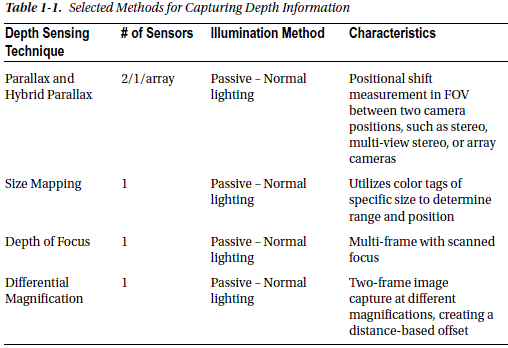
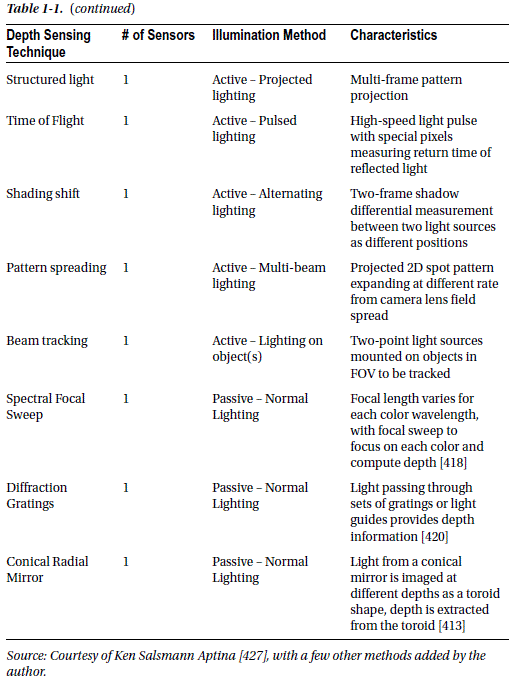
APress publishes "Computer Vision Metrics" free ebook by Scott Krig, having a nice summary of image sensor basics in the first chapter. For instance, here is the table on 3D vision approaches:


Other APress' free ebooks are available here.
Thanks to TL for the link!
1:08 PM

Grand View on Thermal Imaging Market

...
Grand View Research publishes "Thermal Imaging Market Analysis And Segment Forecasts To 2020." "The market has undergone a shift towards commercial applications such as surveillance & security, thermography and transportation systems. High investment, availability of cost effective thermal cameras due to mass production, and a range of diverse applications integrating thermal imaging technology are expected to be the key market drivers. The global thermal imaging market was valued at USD 3,250 million in 2012."

3:39 AM

Toshiba Presents 1080p60 HDR Sensor for Security Applications

...
With no official announcement, Toshiba publishes a flyer of 1/3-inch 1080p60 TCM3232PB CMOS Sensor with >100dB DR for security/surveillance applications. Toshiba's single-frame, alternate-row, dual-exposure HDR implementation in the TCM3232PB is said to be well suited for capturing fast-moving objects compared to conventional multi-framesystems. The 2.7μm pixel size coupled with CNR processing improves low light color quality. The sensor is designed for long-term use, operating 24 hours a day.

2:17 AM

ST Officially Closes Camera Module Business

...
ST Micro Q3 2014 Earnings Report talks about cost-cutting measures in its imaging business:

"We are discontinuing our commodity camera module products, while reinforcing our imaging efforts on prioritized customer projects and opportunities."

"Effective in the fourth quarter of 2014, the existing Digital Convergence Group (DCG) and Imaging, Bi-CMOS and Silicon Photonics Group (IBP) will be combined under one single organization, called Digital Product Group (DPG). DPG will focus on ASSPs addressing home gateway and set-top box, as well as FD-SOI ASICs for consumer applications; FD-SOI and mixed process ASICs, including silicon photonics, addressing communication infrastructure; and differentiated imaging products.

In parallel, ST announced a plan to achieve $100 million in annualized savings, upon completion of the plan during the course of the third quarter of 2015. A portion of the savings coming from the identified initiatives will leverage the synergies from the combination of the DCG and IBP product groups. Other new initiatives include the disengagement from ST’s commodity camera module products as part of the re-positioning of ST’s imaging strategy and a global workforce review within the Embedded Processing Solutions perimeter to affect about 450 employees worldwide.
"

Electronics Weekly talks about the possible layoffs at ST's Edinburgh, Scotland site, although they do not appear to affect the imaging group.

From 2012 ST marketing brochure:

2:19 PM

Lattice Semiconductor, Fairchild Imaging and Helion Vision Demo FPGA-Based Image Sensor Solution

...
BusinessWire: Lattice Semiconductor, Fairchild Imaging and Helion Vision demonstrate a new image sensor solution based on Fairchild Imaging’s HWK1910A image sensor and Helion Vision’s IONOS IP cores at VISION 2014 in Stuttgart, Germany, November 4-6.

Lattice HDR-60 Video Camera Development Kit utilizes the Fairchild HWK1910A image sensor, a Lattice ECP3TM FPGA and Helion Vision’s IONOS Imaging pipeline. The solution delivers up to 120dB DR in a single frame at 30fps. Other security camera systems typically stack frames to achieve WDR, causing negative side effects such as image blur, reduced frame rate and decreased integration times. Those issues are solved by the capabilities of this trailblazing solution.

“The HDR-60 showcases the strengths of the HWK1910A sensor, including its exceptionally low read noise and its massive intra-scene dynamic range,” said Vern Klein, Director of Marketing and Sales, Fairchild Imaging. “We are excited to be part of this ecosystem of Lattice and Helion Vision to deliver the high-performance imaging technologies from Fairchild Imaging.”

“Our HDR-60 based reference design enables OEMs to quickly evaluate the HWK1910A image sensor and develop and roll out high-definition camera systems with excellent low-light and WDR performance ideal for security, surveillance and intelligent transportation applications,” said Kambiz Khalilian, Marketing Director, Industrial and Automotive Solutions, Lattice Semiconductor.

Fairchild Imaging HWK1910A sCMOS 2.0 Sensor
12:07 PM

Interview with Pelican Imaging CTO

...
Waskul.tv publishes a 18 min-long interview video interview Pelican Imaging’s Founder and CTO Kartik Venkataraman where he discusses strengths and weaknesses of the company's array camera technology.
10:34 PM

Piping Engineer III - JACOBS

...


Job Title: Piping Engineer III (Upstream)

Location: Houston, TX, US

Primary Job Responsibilities:

Works under the direction of the Piping Engineering Lead Engineer and in training for the duties of lead piping engineer at the project level to accomplish the following:


Develops conceptual layouts and cost studies,


Produces detailed design calculations, hand calculations or

e2v Launches Low Noise, High Sensitivity Onyx Sensors with 5.3um Global Shutter Pixels

...
e2v launches the first member of its Onyx family of low-light CMOS sensors for outdoor camera applications where illumination budgets are restricted and industrial machine vision applications where high-speed inspection is required.

The new Onyx EV76C771ABT/ACT is a 2/3-inch 1080p 2MP CMOS sensor featuring lower readout noise than e2v’s previous Sapphire and Ruby CMOS sensor families. The Onyx 5.3µm pixels have improved global shutter with Parasitic Light Sensitivity of 4000:1, a higher full well for a wider linear dynamic range, and some non-linear modes to enable image scenes well in excess of 100db to be captured. It also features an on-chip temperature sensor.

e2v also offers the ProxOnyx module, which forms a convenient demonstration platform for customers requiring only the sensor. The ProxOnyx board solution offers some unique and exclusive application features to enable active imaging in fog, smoke and other diffusing environments as well as a Digital Double Sampling (DDS) feature for less than 6e- of total readout noise in global shutter mode, and real-time WDR for imaging in the harshest of climatic conditions.

The Onyx 2MP full HD image sensor will be sampling from mid-November onwards, and full production is planned before the end of this calendar year, with further market variants planned for the near future.

12:37 PM

MTF vs Aperture

...
Albert Theuwissen continues his series of tutorials on MTF. The latest part discusses the MTF change dependence on the lens F#.
12:34 PM

Sr. Piping/ Mechanical Engineer – QP Qatar

...


JOB / POSITION
Job ID: EFD/07/012
Position Title: Senior Piping/ Mechanical Engineer
Business Division: Offshore Engineering


Primary Purpose of the Job:

Proven technical competency in piping/mechanical design/engineering and ability to carry out safe and fit-for-purpose designs.
Knowledge on material selection for equipment and piping items and facilities.
Presentation

Forza Announces Reconfigurable Image Sensor Technology

...
Business Wire: Forza Silicon announces a fully reconfigurable stacked image sensor design with multiple programmable features and functions in a single chip. This flexibility provides a platform, which can be used to connect smart sensors to the Internet and enable a variety of “Internet of Things” (IoT) product applications.

The reconfigurable image sensor can be programmed to perform multiple monitoring and decision-making tasks at the sensor “edge.” It can be configured to integrate into different product applications and can be reconfigured to include more features and capabilities in the existing device.

The new image sensor enables a range of I/O and processing functions. The programmable logic can be configured to enable camera functionality not supported by existing microprocessor chips. It is configurable for different system interfaces [network connections (Ethernet/Wi-Fi/Bluetooth), memory processors, PC, USB] and image processing [color, HDR, motion detection, object/facial recognition, other biometric applications]. The onboard ADC is adjustable for different frame rates, power conservation and noise limits for improved performance.

Additionally, the reconfigurable image sensor architecture allows the manufacturer to provide upgrades to product firmware through its network connection in which product features are added or enhanced. The value of this feature has already been documented in instances where existing IoT devices did not have a reconfigurable capability requiring either the disarming of a product feature or product recall.

To demonstrate the sensor’s capabilities, Forza Silicon developed a platform in which a single reconfigurable sensor device was used in tandem with a smoke detector to monitor, detect and stream video confirmation of a fire event within a household to the homeowner’s mobile phone. The device integrated a compact, low-power image sensor with a low-power MachXO2-7000 FPGA from Lattice Semiconductor. The customizable Lattice MachXO2-7000, with its high functional density, was particularly well suited to this application’s high-bandwidth, low-latency requirements, minimizing power and network bandwidth needs.

“The sensor’s expansive programmability enables the next generation of smarter applications in the car, home, factory, environment and more,” says Barmak Mansoorian, president and co-founder at Forza Silicon. “Our reconfigurable image sensor technology can facilitate endless possibilities for smart applications in this growing network of sensors, from smart cars to smart electricity grids.”

A Youtube video explains the reconfigurable technology features:

11:41 AM

Galaxycore Announces TSI Technology Developed with TSMC

...
GalaxyCore, the largest CMOS sensor fabless company in China, announces it successfully developed Through-Silicon-Illumination (“TSI”) technology for image sensor manufacturing on 12-inch wafer based on TSMC 90nm process, and will commence volume production shortly.

GalaxyCore owns wide scope of of TSI technology IP, including analog design, pixel layout, and pixel-related process technology. The TSI applies to manufacturing of image sensors with pixel size of 1.75um to 1.1um, and will further extend to 0.9um pixel size node. GalaxyCore expects to launch 5MP, 8MP and 13MP TSI products in 2014 and 2015.

TSI technology features:

  • High performance: TSI significantly improves sensitivity and signal-noise ratio, meanwhile it significantly reduces thermal noise, dark current, and crosstalk.
  • High speed and low power: TSI technology adopts 90nm TSMC technology with fine-tuned process parameters. Combined with the optimal analog and digital design, it is said to achieve high speed and low power consumption at the same time, which leads to high frame rate as well as low thermal noise (probably, due to less heating).
  • Cost efficiency: By utilizing Galaxycore's proprietary pixel process technology, TSI is said to achieve excellent image performance with fewer process steps.

“We are very excited about the timely success in TSI technology development and its outstanding performance revealed so far,” said GalaxyCore CEO Zhao Lixin, “I would like to thank TSI R&D team in GalaxyCore for their excellent job and thank TSMC for their great supports. We will promptly launch 5-Megapixel, 8-Megapixel and 13-Megapixel image sensors utilizing this TSI technology with 1.1 – 1.4um pixel size in the next a few months. We dedicate to offer high performance and cost efficient world-class image sensors products for the fast-growing market of mobile devices such as smartphones and tablets.”

Slideshare gives a snapshot of GalaxyCore business from Feb. 2014:

2:29 PM

Gesture Recognition for Smart TV

...
PRWeb: MarketsandMarkets' report "Gesture Recognition For Smart TV Market 2013-2018" forecasts "the gesture recognition module in Smart TV is expected to reach $479.88 Million by the end of 2018 at a CAGR of 131.26%. The key players in the gesture recognition module in Smart TV market are Eyesight Tech (Israel), Leap Motion Inc. (U.S.), LG Electronics Inc. (South Korea), PointGrab Ltd. (Israel), Samsung Electronics Co. Ltd. (South Korea), and many more."

Source: MarketsandMarkets analysis
12:11 PM

Omnivision Launches Sensor for Security Applications

...
PR Newswire: OmniVision announces the 1/-3-inch 1.2MP OV9750 for security applications. Using OmniVision's latest 3.75um OmniPixel3-HS FSI technology, the OV9750 captures both visible and NIR video in HD format at 60fps at 10b bit output or 45fps at 12b output.

"The OV9750 reflects OmniVision's ongoing commitment to developing innovative, high-performance imaging technologies for the fast-growing surveillance markets," said Paul Gallagher, senior director of marketing and business development. "The OV9750, a dedicated security image sensor, comes to market at a time when traditional analog CCTV cameras are quickly transitioning to 960H resolutions. At the same time, HD analog and IP cameras continue to see strong consumer and commercial demand. Tailored for these market trends, the OV9750's advanced capabilities are calculated to provide a considerable competitive advantage for surveillance solutions as the market continues to develop."

The OV9750 fits into a 6.3 x 5.2 mm package. It is currently available for sampling and is expected to enter volume production in the beginning of 2015.

11:57 AM

Do Not Sit Here: The Exploding Airbag Recall

...

Airbags are a required safety feature on cars sold in the U. S. since at least 1998.  They have undoubtedly saved lives, especially in situations where the driver or passengers neglected to use seatbelts.  So whatever else we say about them, we should bear in mind that overall, cars are probably safer with airbags than without them.  But only if the airbags themselves are safe.  And lately, some drivers have found that the airbag cure was much worse than the accident disease.

Over a hundred injuries and at least two fatalities have been attributed to defective airbags made by Japanese supplier Takata.  According to the New York Times, in 2009 a 33-year-old mother of three ran into a mail truck in Richmond, Virginia, and her airbag deployed.  The injuries from the wreck itself were minor.  But a piece of shrapnel from the metal canister containing the airbag explosive shot through her neck and she allegedly bled to death as a result. 

For an airbag to be an effective cushion during a collision, it has to deploy in well under a tenth of a second.  This involves creating a large volume of high-pressure gas in a short time.  The early airbags used an explosive called sodium azide, but the residue was toxic. So in the 1990s, manufacturers began to research other chemicals that would be less noxious and also allow for a smaller propellant package. 

Takata, one of the largest airbag suppliers in the world, developed a compound based largely on good old ammonium nitrate (the same chemical involved in the West, Texas explosion on April 17, 2013), along with other components designed to moderate the tendency of this substance to detonate and to absorb moisture.  The manufacture of any product involving explosives requires rigorous adherence to procedures that maintain the integrity of the ingredients all the way from the raw materials to the finished item.  But as various documents have indicated, Takata has not always been sufficiently diligent in their manufacturing processes.

As Takata has responded to inquiries by automaker customers and regulatory agencies, it has admitted to several manufacturing errors over the years.  Again according to the Times, one set of defective airbags was attributed to workers in a Mexican assembly plant who allowed moisture-sensitive explosive ingredients to sit on the plant floor too long in a humid environment.  Other documents show rusty propellant containers and foreign objects in the propellant cans may have been responsible.  Problems with the airbags began to show up as long ago as 2004, and in a series of widening recalls in the last few months, eleven automakers have recalled over 14 million vehicles for replacement of suspect airbags made by Takata.  Many of the vehicles being recalled are in the most humid states in the U. S., which indicates that deterioration due to high humidity is the main culprit here.  Toyota has told its dealers that if the replacement airbags on a recalled vehicle are not immediately available, they should put a sticker on the dashboard next to the defective airbag.  The sticker reads "Do Not Sit Here."  Good luck with that.

This particular story comes close to home, personally.  In our Honda household we operate both a Civic and an Element.  They are very good cars, but neither has been in a major collision that set off the airbags.  For this I am grateful.  I checked their VINs(vehicle identification numbers) at a U. S. government website designed to let owners know of any recalls out on their vehicles, and hit the jackpot both times.  I don't think I'll wait for the dealer to write me.  My 89-year-old father-in-law rides in the passenger seat of the Element.  It would be a shame for a World War II U. S. Navy veteran of the Pacific theater to be cut down by a defective Japanese airbag.  But it could happen, at least until I get those airbags replaced. 

As hazards go, this one is not worth lying awake nights about, unless maybe you work for Takata or one of the affected automakers.  As long as you're not in a wreck, apparently the airbags won't spontaneously combust, and most of them appear to work properly, especially if you don't live in an area that's particularly humid (watch out, Houstonians!).  But even a few defective airbags are too many. 

We won't know for some time why it took so long to uncover the problems and do something about them.  But some contributing factors are apparent already.  First, the problem arose not in a particular automaker's design (as was the case with the GM ignition recall), but with a supplier's manufacturing process.  It is impossible to test an airbag non-destructively, so except for sample testing, which automakers may or may not do, I'm not sure how they could have caught the problem by incoming inspections of Tanaka's product. 

People can be injured even by airbags that work properly and have no design or manufacturing defects, so sorting out incidents that involve defective airbags from those that don't is not a trivial problem, except in the glaringly obvious cases when metal shards from the airbag tear it to ribbons and slice into passengers.  And while the automakers did the minimum required when they received word about the airbag injuries, which was to notify the National Highway Traffic Safety Administration (NHTSA) within five days, they don't have to give a lot of details.  And if the feds choose not to follow up the notification, the matter ends there, as it did for most of the last ten years.  Only when lawsuits and headlines began to pop up about the matter did the automakers start issuing recalls and pressured Takata to shape up.

I don't know what Takata's market share in the airbag industry is, but my guess is it's pretty high.  Companies that sell products to large OEM (original equipment manufacturer) firms often develop too-chummy relationships with their few customers, who in turn are reluctant to threaten to take their business elsewhere if problems arise.  It's the old monopoly problem, but in this case the consumer is harmed not by exploitative prices—I'm sure the automakers pressured Takata to keep their prices down—but by defective merchandise.  Unfortunately, there is no easy solution for this type of structural problem, except for buyers and regulators to be increasingly vigilant for signs that there is a manufacturing problem.

If you happen to drive one of the fourteen million vehicles affected by the recall, here's hoping you get your car to the dealer soon—and you get it back with something better than a "Do Not Sit Here" sticker.

Sources: Car and Driver magazine's online edition carried a report on the recall that I referred to, at http://blog.caranddriver.com/massive-takata-airbag-recall-everything-you-need-to-know-including-full-list-of-affected-vehicles/.  I also referred to the New York Times article published online on Sept. 11, 2014 at http://www.nytimes.com/2014/09/12/business/air-bag-flaw-long-known-led-to-recalls.html.  The U. S. NHTSA's VIN recall website is at https://vinrcl.safercar.gov/vin/.

Ocean Temperature Rise

...
Ocean Temperatures

Of all excess heat resulting from people's emissions, 93.4% goes into oceans. Accordingly, the temperature of oceans has risen substantially.

Globally, the average September ocean temperature marked a record high for that month in 2014, at 0.66°C (1.19°F) above the 20th century average, breaking the previous record that was set just one month earlier. On the Northern Hemisphere, the temperature of the ocean in September 2014 was 0.83 °C (or 1.49 °F) above the 20th century, 


The anomaly was 0.84 °C in August 2014, as illustrated by the image below.

On specific days, anomalies were much higher. On August 19, 2014, the Northern Hemisphere showed a sea surface temperature anomaly of 1.78 °C, while the North Atlantic sea surface temperature was 1.82 °C above average (CFSR 1979-2000 Baseline) on October 16, 2014, as illustrated by the image below.


Sea surface temperature anomalies are at the top end of the scale in many places in the Arctic, as well as off the coast of North America. The danger is that the Gulf Stream will keep carrying ever warmer water from the North Atlantic into the Arctic Ocean, threatening to unleash huge methane eruptions from the Arctic Ocean's seafloor, in turn causing even higher temperatures and more extreme weather events, wildfires, etc.


Above image shows methane levels as high as 2666 ppb, as measured by the MetOp-2 Satellite at 14,385 ft (~4.4 km) altitude on October 26, 2014 am.

Is 2666 ppb as high as it will get?

Sadly, methane releases from the seafloor of the Arctic Ocean are becoming increasingly larger around this time of year and they look set to get even larger than this. Note that the amount of methane actually erupting from the seafloor of the Arctic Ocean is even larger than what is visible on above image, for the following three reasons.

  1. No data were available for some areas, as the IASI (Infrared Atmospheric Sounding Interferometer) instrument measuring methane only covers a certain width. The white shapes showing up on above images are areas where no measurements were taken, resulting from the way the polar-orbiting satellite circum-navigates the globe, as pictured on the image on the right.

    Furthermore, quality control failed in the grey areas on above images, indicating reading difficulties due to high moisture levels (i.e. snow, rain or water vapor), as also discussed in an earlier post. Accordingly, high methane levels (above 1950 ppb) as show up in the yellow areas could also be present in the many grey areas over the Arctic Ocean.

    When also looking at methane levels on days following the high 2666 ppb reading, methane is persistently present over most of the Arctic Ocean, as illustrated by the above October 29, 2014, combination image, confirming that high methane levels were likely present in areas where no data were available on October 6, 2014.
       
  2. Much of the methane that is released from the Arctic Ocean's seafloor is broken down by microbes as it rises up in the water. The SWERUS-3 research team recently found methane in the waters of the East Siberian Sea at levels that equate to atmospheric levels of  3188 ppb.
       
  3. Much methane is broken down in the atmosphere by hydroxyl, as illustrated by the image below, showing carbon dioxde levels on October 27, 2014, that indicate that large amounts of methane are broken down at higher latitudes on the Northern Hemisphere.

The latter point could explain the sudden recent rise in carbon dioxide levels, as also detected at Mauna Loa, Hawaii, as illustrated by the image below.


In conclusion, the amount of methane that is erupting from the seafloor of the Arctic Ocean is larger than what is visible on satellite images, and the water will be highly saturated with methane at locations where the methane is escaping from the seafloor, highlighting the danger that, in case of large abrupt releases from the Arctic Ocean's seafloor, microbes and hydroxyl will quickly get depleted locally, resulting in little of the methane being broken down, as discussed at an earlier post.

Why are such huge amounts of methane starting to get released from the Arctic Ocean's seafloor now?  

As the image below shows, temperature at 2 meters was below 0°C (32°F, i.e. the temperature at which water freezes) over most of the Arctic Ocean on October 26, 2014. The Arctic was over 6°F (3.34°C) warmer than average, and at places was up to 20°C (36°F) warmer than average.


Above image illustrates the enormous amount of heat that has until now been transferred from the waters of the Arctic Ocean to the atmosphere. Underneath the surface, water temperatures are much higher than they used to be and, as around this time of year the Arctic Ocean freezes over, less heat will from now on be able to escape to the atmosphere. Sealed off from the atmosphere by sea ice, greater mixing of heat in the water will occur down to the seafloor of the Arctic Ocean.

As land around the Arctic Ocean freezes over, less fresh water will flow from rivers into the Arctic Ocean. As a result, the salt content of the Arctic Ocean increases, making it easier for ice in cracks and passages in sediments at the seafloor of the Arctic Ocean to melt, allowing methane contained in the sediment to escape. Furthermore, the sea ice makes that less moisture evaporates from the water, which together with the change of seasons results in lower hydroxyl levels at the higher latitudes of the Northern Hemisphere, in turn resulting in less methane being broken down in the atmosphere over the Arctic.

This situation will continue for months to come. Salty and warm water (i.e. warmer than water that is present in the Arctic Ocean) will continue to be carried by the Gulf Stream into the Arctic Ocean, while less heat and moisture will be able to be transferred to the atmosphere.

In conclusion, high methane levels threaten to further accelerate warming in the Arctic, in a vicious cycle escalating into runaway warming and resulting in death, destruction and extinction at massive scale.

So, what can be done to reduce the risk?

Climate Plan

- Emission Cuts

It is imperative that large emissions cuts are made quickly. The Climate Plan calls for 80% emission cuts by 2020, as one of multiple lines of action that need to be implemented in parallel.

- Greenhouse Gas Removal and Storage

The IPCC points at the need for carbon dioxide removal and also warns about ocean warming continuing for centuries (text below).


Indeed, even if all emissions by people could somehow be brought to an abrupt end, this alone will not stop the rise of ocean temperatures, at least not for a long time. For starters, air temperatures would start rising within days, in response to the disappearance of aerosols that now mask the full wrath of global warming. Furthermore, such a temperature rise would further accelerate feedbacks such as snow and ice decline, methane hydrate destabilization, etc., in turn feeding further temperature rises.

The Climate Plan therefore calls for carbon dioxide removal, as well as for active removal of other greenhouse gases from the atmosphere, and for further lines of action.

- Further Action

Again, merely implementing the above lines of action will not suffice to quickly bring down ocean temperatures. Paleo-climate records show that falls in temperature go hand in hand with falls of carbon dioxide in the atmosphere to levels under 280 ppm, as opposed to current carbon dioxide levels that are around 400 ppm.


Raising Funding for Further Action

The Climate Plan calls for comprehensive and effective action that includes additional lines of action. Such additional action will require U.N. supervision, which may make it hard for the necessary action to obtain sufficient funding.

In earlier posts, it was suggested that, besides having fees imposed on facilities that burn fossil fuel and on sales of fossil fuel itself, additional fees could be imposed on commercial international flights. As long as it seems too hard to substantially reduce emissions associated with such flights, it seems appropriate to explore further ways to minimize such flights, e.g. by imposing additional fees that could help fund further action.

There are a number of ways such fees could be implemented. Such fees could be calculated based on the distance traveled or as a percentage of the fare.

Fees could also be calculated on the basis of the traveler's flying history, e.g. in the form of frequent flyer fees. Such fees could be collected either by the respective airline or airport.

In the box on the right, Ekta Kalra gives further details about how the latter idea could be implemented.

What do you think?


References and related posts

- Four Hiroshima bombs a second: how we imagine climate change
http://arctic-news.blogspot.com/2013/08/four-hiroshima-bombs-second-how-we-imagine-climate-change.html

- Arctic Methane Release and Rapid Temperature Rise are interlinked
http://arctic-news.blogspot.com/2013/11/arctic-methane-release-and-rapid-temperature-rise-are-interlinked.html

- Climate Change Accelerating
http://arctic-news.blogspot.com/2014/10/climate-change-accelerating.html

- NOAA, Global Analysis - September 2014
http://www.ncdc.noaa.gov/sotc/global/2014/9

- NOAA Ocean temperature anomalies
http://www.ncdc.noaa.gov/cag/time-series

- Methane Hydrates
http://methane-hydrates.blogspot.com/2013/04/methane-hydrates.html

- Climate Plan
http://climateplan.blogspot.com


Java Project Titles|| Java Projects 2014 Free || IEEE Data Mining Project Titles - Abstracts

...

1. Decentralized Access Control with Anonymous Authentication of Data Stored in Clouds

Abstract 

       We    propose    a    new    decentralized access control scheme for secure data storage in clouds that supportsanonymous authentication. In the proposed scheme, the cloud verifies the authenticity of the series without knowing the user’s identity before storing data. Our scheme also has the added feature of access control in which only valid users are able to decrypt the stored information. The scheme prevents replay attacks and supportscreation, modification, and reading data stored in the cloud. We also address user revocation. Moreover, our authentication and access control scheme is decentralized and robust, unlikeother access control schemes designed for clouds  which are centralized. The communication, computation, and storage overheads are comparable to centralized approaches.

2. Modeling   of  Distributed      File Systems    for Practical Performance Analysis

Abstract—Cloud   computing   has   received significant attention recently. Delivering quality guaranteed services in clouds is highly desired. Distributed file systems(DFSs) are the key component of any cloud-scale data processing middleware. Evaluating the performance of DFSs is accordingly very important. To avoid cost for late life cycle performance fixes and architectural redesign, providing performance analysis before the deployment of DFSs is also particularly important. In this paper, we propose a systematic and practical performance analysis framework, driven by architecture and design models for defining the structure andbehavior of typical master/slaveDFSs. We put forward a configuration guideline for specifications of configuration alternatives of such DFSs, and a practical approach for both qualitatively and quantitatively performance analysis of DFSs with various configuration settings in a systematic way. What distinguish our approach  from  others  is  that  1)  most  of existing     works     rely     on     performance measurements under a variety of workloads/strategies, comparing with other DFSs or running application programs, but our approach is based on architecture and design level modelsand systematically derived performance models; 2) our approach is able to both qualitatively and quantitatively evaluate the performance of DFSs; and 3) our approach not only can evaluate the overall performance of a DFS but also its components and individual steps. We demonstrate the effectiveness of our approach by evaluating Hadoop distributed file system (HDFS). A series of real-world experiments on EC2 (Amazon Elastic Compute Cloud),Tansuo and Inspur Clusters, were conducted to qualitatively evaluate the effectiveness of our approach. We also performed a set of experiments of HDFS on EC2 to quantitatively analyze the performance and limitation of the metadata server of DFSs. Results show that our approach can achieve sufficient performance analysis. Similarly, the proposed approach could be also applied to evaluateother DFSs such as MooseFS, GFS, and zFS.

3. Balancing Performance, Accuracy,    and Precision for Secure Cloud Transactions

Abstract—In       distributed       transactional database systems deployed over cloud servers, entities cooperate to form proofs of authorizations that are justified by collections ofcertified credentials. These proofs and credentials may be evaluated and collected over extended time periods under the risk of having the underlying authorization policies orthe user credentials being in inconsistent states. It therefore becomes possible for policy-based authorization systems to make unsafe decisionsthat might threaten sensitive resources. In this paper, we highlight the criticality of the problem. We then define the notion of trusted transactions when dealing with proofs of authorization. Accordingly, we propose several increasingly stringent levels of policy consistency constraints, and present different      enforcement      approaches      to guarantee the trustworthiness of transactions executing on cloud servers. We propose a Two-Phase Validation Commitprotocol as a solution, which is a modified version of the basic Two-Phase Validation Commit protocols. We finally analyze the different approaches presented using both analytical evaluation of the overheads and simulations to guide the decision makers to which approach to use.

4. A  Scalable  Two- Phase  Top-Down Specialization Approach   for Data Anonymization Using MapReduce              on Cloud

Abstract—A large number of cloud services require users to share private data like electronic health records for data analysis or mining, bringing privacy concerns. Anonymizing data sets via generalization to satisfy certain privacy requirements such as kanonymity is a widely used category of privacy preserving techniques. At present, the scale of data in many cloud applications increases tremendously in accordance with the Big Data trend, thereby making it a challenge for commonly used software tools to capture, manage, and process such large- scale data within a tolerable elapsed time. As a result, it is a challenge for existing anonymization approaches to achieve privacy preservation on privacy-sensitive large-scale data sets due to their insufficiency of scalability. In this paper, we propose a scalable two-phase top-down specialization (TDS) approach to anonymize large-scale data sets using the MapReduce framework on cloud. In both phases of our approach, we deliberately design a group of innovative MapReduce jobs to concretely accomplish the specialization computation in a highly scalable way. Experimental evaluation results demonstrate that with our approach, the scalability and efficiency of TDS can be significantly improvedover existing approaches.

5. Dynamic Optimization   of Multiattribute Resource Allocation  in Self-Organizing Clouds

By    leveraging    virtual    machine    (VM) technology which provides performance and fault isolation, cloud resources can be provisioned on demand in a fine grained, multiplexed manner rather than in monolithic pieces.  By  integrating  volunteer  computing into cloud architectures, we envision a gigantic self-organizing cloud (SOC) being formed to reap the huge potentialof untapped commodity computing power over the Internet. Toward this new architecture where each participant may autonomously act as bothresource consumer and provider, we propose a fully distributed, VM-multiplexing resource allocationscheme to manage decentralized resources. Our approach not onlyachieves maximized resourceutilization using the proportional share model  (PSM), but also delivers provably and adaptively optimalexecution efficiency. We also design a novel multi attribute range query protocol for locating qualified nodes. Contrary to existing solutionswhich often generate bulky messages per request, our protocol produces onlyone lightweight query message per task on the Content Addressable Network (CAN). Itworks effectively to find for each task its qualified resources under a randomized policy that     mitigates     the     contention     among requesters. We show the SOC with our optimized algorithms can make an improvement by 15-60 percent in system throughput than a P2P Grid model. Our solution also exhibits fairly high adaptability in a dynamic node-churning environment.

6. Scalable and Secure Sharing of Personal     Health Records in Cloud Computing Using Attribute-Based Encryption

Personal health record (PHR) is an emerging patient-centricmodel of health information exchange, which is often outsourced to be stored at a third party, such as cloud providers. However, there have been wide privacy concerns as personal health information could be exposed to thosethird party servers and to Un authorized parties. To assure the patients' control over access to their own PHRs, it is a promising methodto encrypt the PHRs before outsourcing. Yet, issues such as risks of privacy exposure, scalability in key management, flexible access, and efficient user revocation, have remained the most important challenges toward             achieving             fine-grained, cryptographically     enforced     data     access control. In this paper, we propose a novel patient-centric framework and a suite of mechanisms for data access controlto PHRs stored in semitrusted servers. To achieve fine- grained and scalable data access controlfor PHRs, we leverage attribute-based encryption (ABE) techniquesto encrypt each patient's PHR file. Different from previous works in secure data outsourcing, we focus on the multiple data owner scenario, and divide the users in the PHR system into multiple security domains that greatly reduces the key management complexity for owners and users. A high degree of patient privacy is guaranteed simultaneously by exploiting multiauthority ABE. Our scheme also enables dynamic modification of access policies or file attributes, supports efficient on-demand user/attributerevocation and break-glass access under emergency scenarios. Extensive analytical and experimental results are presented     which     show     the     security, scalability,  and  efficiency  of  our  proposed scheme.

7.On  Data  Staging Algorithms for Shared Data Accesses in Clouds

In  this  paper,  we  study  the  strategies  for efficiently achieving data staging and caching on a set of vantage sites in a cloud system witha minimum cost. Unlikethe traditional research, we do not intend to identify the access patterns to facilitate the future requests. Instead, with such a kind of information presumably known in advance, our goal is to efficiently stage the shared data items to predetermined sites at advocated time instants to align with the patterns while minimizing the monetary costs for caching and transmitting the requested data items. To this end, we follow the cost and network models in [1] and extend theanalysis to multipledata items, each with single or multiple copies. Our resultsshow that under homogeneous cost model, when the ratio of transmissioncost and caching cost is low, a single copy of each data item can efficiently serve all the user requests. While in multicopy situation, we also consider the tradeoff between the transmission cost and caching cost by controlling the upper bounds of transmissions and copies. The upper bound canbe given either on per-item basis or on all-item basis. We present efficient optimal solutions based on dynamic programming techniques to all these cases provided that the upper bound is polynomially bounded by the number of service requests and the number of distinctdata items. In addition to the homogeneous cost model, we also briefly discuss this problem under a heterogeneous cost model with some simple yet practical restrictions and present a 2-approximation algorithm to the general case. We validate our findings by implementing a data staging solver, whereby conducting extensive simulation studies on the behaviors of the algorithms.