Omnivision Agrees to Be Acquired for $1.9b

...
Reuters, Bloomberg: OmniVision announces that it agrees to be acquired by a consortium composed of Hua Capital Management, CITIC Capital, and GoldStone Investment (collectively, the “Consortium”). Under the terms of the agreement,
OmniVision stockholders will receive a total of approximately $1.9 billion. The agreement was unanimously approved by OmniVision’s Board of Directors.

“We are pleased to have reached this agreement, which we believe realizes significant value for our stockholders and offers new opportunities for our employees to develop more innovative solutions for customers.” said Shaw Hong, chairman and CEO of OmniVision. “Our Board unanimously concluded that partnering with Hua Capital Management, CITIC Capital and GoldStone Investment was the best choice for OmniVision, as this transaction will provide our stockholders with significant and immediate cash value. Further, Hua Capital Management, CITIC Capital and GoldStone Investment are highly regarded China-based private equity firms with deep experience in the semiconductor industry. With our new partners’ knowledge and insight and the added flexibility that we will have as a private company, OmniVision will be able to focus on reaching the next level of growth, which will benefit our employees, customers and business partners.”

“We are excited to partner with OmniVision as they embark on this next phase of growth,” said Yue Liu, a managing director at Hua Capital Management. “We believe our unique industry knowledge and operational expertise can help accelerate OmniVision’s presence both in China and globally.”

“We are very pleased to be making this investment and are excited about the opportunity to work with OmniVision’s outstanding management team. With the strong backing of the consortium and the leadership of the company’s management, we believe OmniVision will continue to be well-positioned to achieve significant growth through its innovative and superior digital imaging technologies and its commitment to building long-term success,” said Yichen Zhang, Chairman and CEO of CITIC Capital.

OmniVision CEO Shaw Hong is expected to remain with OmniVision in the same capacity. The transaction, which is expected to close in the third or fourth fiscal quarter of fiscal year 2016, is subject to approval by OmniVision stockholders, regulatory approvals, including antitrust review in the U.S. and China, review and clearance by the Committee on Foreign Investment in the U.S., clearance or approval under applicable Taiwan law, and other customary closing conditions. In order to obtain clearance or approval under applicable Taiwan law, OmniVision will divest certain of its investments in Taiwan, including certain of its interests in a joint venture.

Update: As usual in public company acquisition cases, a number of law firms start investigations on grounds that the acquisition price is too low and not in shareholders interests. See the PRs of Tripp Levy PLLC, Bronstein, Gewirtz & Grossman LLC, Wolf Popper LLP, Kahn Swick & Foti LLC, Robbins Arroyo LLP, Harwood Feffer LLP, and, probably, some more.
10:29 PM

Microsoft Hololens Cameras

...
Yesterday's Microsoft presentation of the Hololens AR glasses has shown a complex camera system inside. Each Hololens contains at least 6 different cameras, as far as I can count. If Hololens becomes a mass market device, it could be the single biggest market for image sensors:


A company Youtube video presents the Hololens internal design:


Update: MSDN publishes a video interview with Alex Kipman talking about the Hololens design challenges.
8:40 AM

Light Reveals More Details

...
Light startup officially announces that it has entered into a strategic relationship with Foxconn's FIH Mobile Ltd. As part of the strategic partnership, FIH Mobile Ltd. has licensed the Light technology and made an equity investment in Light.

Calvin Chih, CEO of FIH Mobile, says "We see tremendous potential for Light’s technology, and are excited to work with Dave and the Light team. We continue to strive to help consumers and OEM partners enhance their experiences and product offerings pertaining to high quality imaging."

Paul Jacobs, Executive Chairman of Qualcomm and Light investor and board member says "Light’s product will overcome the current limits of capturing high-quality images in small form factors and will enable people to capture great images while they are on the go without trading image quality for convenience."

ExtremeTech publishes more details on Light technology:

"Light is planning to use an array of small cameras — very similar to those you would find in a smartphone today — to mimic a larger camera. By precisely aligning and calibrating the individual cameras, the images from them can be combined to produce a single image of very high quality. By having some of the cameras feature a wide-angle lens, and some a telephoto lens, an optical zoom capability is also possible.

Light’s CTO, Rajiv Laroia, explains that by treating the ten or more small sensors as pieces of a single, large sensor, Light’s camera module can add together all the photons that reach a particular location in each of the sensors to mimic larger photosites. By adding the signals, the ratio of signal to noise is greatly increased.

Light has also come up with a very clever way to mimic zoom capability using an array of fixed-focal-length (prime) lenses. Its arrays feature both wide-angle and telephoto lenses (it’s planning to have 35mm and 70mm lenses in its first smartphone-sized module) in an overlapping configuration. The telephoto lenses are mounted sideways in the module, to keep thickness to a minimum and allow for a small mirror that can be used to aim the telephoto lenses at different portions of the wide-angle view.
"


Light uses overlapping fields of view to emulate
a single-lens optical zoom. Mirrors move the multiple
70mm lenses to create an overlapping field of view to
provide effective focal lengths between 35mm and 70mm.
The 35mm lenses provide a wide field of view image to
assist in aligning the telephoto images.

Update: As written in comments, Imaging Resource publishes an interview with Light founder, their background and their projections into the future of mobile photography.
3:59 AM

Image Sensor Market Shares

...
WSJ article "How Sony Makes Money Off Apple’s iPhone" shows TSR 2014 pie chart on image sensor market shares:


WSJ writes:

“Unlike memory chips, making image sensors requires craftsmanship, and that’s not something competitors can copy in the short term,” says Hideaki Miwa, analyst at Techno Systems Research Co.

According to the Tokyo research firm, Sony sold 40% of all image sensors last year, up from 35% in 2013. OmniVision’s market share was 16%, followed by 15% for Samsung. Total sales of image sensors grew to an estimated $8.65 billion last year, up more than 80% since 2009.

Some analysts say keeping up with demand might be Sony’s biggest immediate challenge. In the long run, Sony could be vulnerable because of its dependence on Apple, which sometimes has shifted suppliers with little warning.

Satoru Oyama, a semiconductor analyst at research firmIHS Inc., says Apple likely would consider buying image sensors for iPhones elsewhere if another company could match Sony’s quality and price.

“Sony can keep its position for at least a few years, but five years from now? There are no guarantees,” Mr. Oyama says.


In an interview to WSJ, Sony CEO Kazuo Hirai says:

"I think one of the things we certainly pride ourselves on with our image sensors is our commitment to stay at least several years ahead of the competition and to make sure that we make the heavy R&D investments to make sure that we are there, ahead of the competition. Whether it’s a device that goes into other manufacturers’ products, or sometimes our own, if there’s innovation there, and innovation therefore means a business opportunity, that’s something I get excited about, and so do the people who run our device business."
10:00 PM

Thermal Diode Array Technology?

...
Consumer grade thermal cameras keep coming. After FLIR One with microbolometric imager, Seek Thermal came with Raytheon microbolometric sensor, and now Hema Imaging is closing a successful Kickstarter campaign.

Hema Vision camera utilizes 82x62 Heimann Sensor GmbH thermal sensor based on the new "thermal diode array technology." Hema Imaging writes: "Heimann Sensor GmbH is a developer and manufacturer of thermopile arrays for thermal sensing and other infrared sensors, and leads the world in thermopile array technology and now are the experts in thermal diode array technology."

It should be fairly cheap to fit the consumer camera bill, so exotic materials like CMT are probably not an option. So, I wonder how do these "thermal diodes" work?

7:28 AM

Sony CCD End-of-Life News

...
The post has been deleted by Sony request. Sorry for the confusion.
7:20 AM

Sony Exmor Generations

...
Framos publishes a nice explanation of Sony Exmor generations. Sony uses Exmore trademark for sensors with column-parallel ADC architecture with dual CDS (analog comparator auto-zero and up/down counting in digital domain). Framos infographics below explains the evolution and improvements from 1st to 6th generation of Exmor:

12:39 PM

Fast and High Resolution 3D Imaging

...
PMA Newsline overviews the Northwestern University Comp Photo Lab work on fast and high resolution 3D depth imaging. The main idea of the paper "MC3D: Motion Contrast 3D Scanning" by Nathan Matsuda and Mohit Gupta, presented on April 24 at the IEEE International Conference on Computational Photography is to limit the structured light laser scanning by the area where the 2D camera detects a change. That way the static areas are not scanned. A Vimeo video explains the advantages of this approach:

9:34 AM

STMicro Strikes Go On

...
Electronics Weekly reports that strikes at ST, Crolles, France, facilities continue. The union is calling for the French government to start an investigation into ST management. Union talk about increasing "brain drain" from ST. Crolles is the location of ST fabs that manufacture image sensors, and also ST pixel design group.
9:09 AM

Ownership, Access, and Freedom: The Role of Technology

...

Let me present a contrast between an ownership lifestyle and an access lifestyle.

Exhibit A for the ownership lifestyle is my late father-in-law Ben.  Following his marriage in 1946, he built not one, but three different small houses with his own hands, selling each one and building another while holding down surveying and drafting jobs.  Once he found steady employment with the Texas Highway Department, he bought a new contractor-built house in a growing subdivision and a new 1955 Oldsmobile, which he still owned when he died earlier this year.  From that point on, he lived the American dream of ownership.  Anything he needed and could afford, he bought:  TVs, lawnmowers, appliances, and (much later in life) computers for his wife to pursue her genealogy hobby with.  

Contrast that lifestyle with that of a hypothetical 30-something single living in Austin—call him Brad.  He rents a stylish apartment near the Metro rail that he rides to work, so he doesn't own a car.  He calls vehicle-for-hire services like Uber when he needs to go anywhere that he can't get to in the city with public transportation.  His biggest single expenditure this year was for a three-week European tour with some friends.  His most expensive single possession is a mechanical watch.  Brad spends most of his discretionary income on experiences and services rather than things.  He pays for access, not for stuff.

Brad is part of the reason that rates of new-vehicle ownership, home ownership, and even possession of a driver license are all declining in the age group of U. S. citizens centered around 30, according to an article by James Poulos in a recent issue of The New Atlantis.  Poulos is concerned that the decline of ownership among young people will lead to a corresponding decline in freedom.  Will it?

Before exploring that question, we should admit that technology has played a major role in the rise of the access economy.  Technically, software is leased, not owned.  "Buying" software (already a fading trend in contrast to ongoing service contracts favored by many software firms) really just gives you the privilege of using it.  The planned obsolescence of many products, whose useful life is measured in months rather than years, is enabled by rapid advances in digital technology and manufacturing techniques, even when hardware is involved.  The services so favored by Brad and his friends are usually intermediated by the Internet, and would be much harder or impossible to offer without it.  So if we are looking for guilty parties in the case of the movement from ownership to access, technology is a prime suspect.

To the question of whether Brad, the access guy, is more free than Ben, the ownership guy, one might respond, free to what?  And here we step into some deep philosophical waters. 

Superficially, Brad looksa lot more free—no burdensome car or house payments or other long-term obligations (unless you count student loans), free to up and run off to Antigua or Bermuda or you name it for a vacation—the ideal young-urban-professional life.  Only, if everybody in the country acts like Brad, with no wife or kids and no plans for same in the future, the country would die out in a generation.  Something like this is already happening in Japan, whose population declined by 268,000 (0.2%) in 2014. 

Even people Brad's age seem to have a sense that they are missing something that an earlier generation had, without knowing exactly what it is.  I've been invited to the upcoming wedding of a Brad-generation couple who have erected an elaborate wedding website, complete with a list of things to do for out-of-town guests coming to Dallas.  One of the items is a visit to a museum about the assassination of President Kennedy in 1963, and the prospective couple attached this curious comment to it:  "As many of y'all know we were born in the wrong era."  What does it mean when a whole generation thinks it was born in the wrong era?

To answer the question of human freedom, you must have some idea of what human beings are for.  There are varying opinions on the purpose of human life.  In 1992, as part of its decision in Planned Parenthood vs. Casey, the U. S. Supreme Court regarded the core of liberty as the right to "define one’s own concept of existence, of meaning, of the universe, and of the mystery of human life.”  That idea would be fine with Brad, whose concept of existence may change from year to year, or even month to month, as he ponders his next appealing experience. 

But there are others who regard human beings as marked with the divine image.  I came across a fine word the other day in a book by the English professor and translator of Dante, Anthony Esolen.  The word is "theomorphic," meaning "formed in the image of deity."  Esolen says that "the right of private property is grounded, not in practical economics, but in the theomorphic nature of man."  Because man is made in the image of God, anything that is a product of man's labor is owned, and ownership is something only humans can lay claim to.

And only people can choose whether to use their ownership of the fruits of their labor to live lives of superficial pleasure, spending their income on transient experiences and then ultimately passing out of existence, like Windows 98; or to found a family—either literally or by playing the role of father or mother to the younger generation—and serving those who come after us, passing the torch of human life and its best meanings to those who come after us. 

Doing the latter requires a longer-term vision than the next expensive vacation.  Those who work simply to enjoy the access to services provided by giant concentrations of ownership, are ultimately slaves to the owners of those service providers, whether it feels like slavery or not.  The classic image of this type of slavery is Aldous Huxley's dystopian novel Brave New World.  But those who work not just for themselves, but to provide for others, using ownership as a means of providing for a real or metaphorical family—they are those who, while appearing to lose their lives in service to others, can actually save them. 

Sources:  John Poulos's article "Losing Liberty in an Age of Access" appeared in the Summer/Fall 2014 issue (No. 42) of The New Atlantis, pp. 13-22.  The statistic on Japan's declining population was obtained from the website http://www.npr.org/blogs/thetwo-way/2015/01/01/374382369/japans-population-declined-in-2014-as-births-fell-to-a-new-low.  The Esolen quote appears on p. 140 of his book Reclaiming Catholic Social Teaching (Manchester, NH:  Sophia Institute Press, 2014).  The U. S. Supreme Court decision Planned Parenthood vs. Casey (1992) contains the famous "mystery clause," which was quoted in the website http://www.heritage.org/initiatives/rule-of-law/judicial-activism/cases/planned-parenthood-v-casey.

Methane levels as high as 2845ppb

...
Methane levels as high as 2845 parts per billion (ppb) were recorded on April 25, 2015, as illustrated by the image below.


This is an extremely high peak. The average daily peak in 2015 until May 1 was 2371 ppb, while the highest daily mean ranged from 1807 ppb (January 10) to 1829 ppb (April 22). Daily peaks and daily highest mean levels in 2015 are shown on the image below.


These peaks are much higher than they were in previous years, as illustrated by the image below, from an earlier post and showing the average highest peak readings in 2013 and 2014 at selected altitudes..


Peak readings in above image are averages over April 2013 and April 2014. On specific days, peak readings could be much higher, e.g. on April 28, 2014, methane levels were recorded as high as 2551 ppb at 469 mb. As said, methane levels as high as 2845 ppb were recorded on April 25, 2015, while the average peak for the first four months of 2015 was 2371 ppb, and this average was calculated from peaks across altitudes.

The table below shows the altitude equivalents in mb (millibar) and feet.
56,925 ft44,689 ft36,850 ft30,569 ft25,543 ft19,819 ft14,383 ft8,367 ft1,916 ft
74 mb147 mb218 mb293 mb367 mb469 mb586 mb742 mb945 mb

Peak levels in April appear to be rising strongly each year, following higher peak readings during previous months, especially at higher altitudes, i.e. especially the Arctic Ocean. It appears that much of the additional methane originating from the higher latitudes of the Northern Hemisphere has moved closer to the equator over the past few months, and is now accumulating at higher altitudes over the continents on the Northern Hemisphere, i.e. Asia, Europe, North America and north Africa.

Further analysis of the rise in global mean methane levels appears to confirm the above. The image below shows methane levels on April 22, over three years. While there appears to be little or no rise in mean methane levels at low altitudes, the rise is quite profound at higher altitudes.  

[ click on image to enlarge ]
Things look set to get worse. As shown by the image below, from an earlier post, global methane levels have risen sharply from a low of 723 ppb in 1755. Mean methane levels were as high as 1839 ppb in 2014. That's a rise of more than 254%.
As that post concluded a year ago, it appears that the rise of methane in the atmosphere is accelerating. What can we expect? As temperatures can be expected to continue to rise and as feedbacks start to kick in, this may well constitute a non-linear trend. The image below shows a polynomial trend that is contained in IPCC AR5 data from 1955 to 2011, pointing at methane reaching mean global levels higher than 3000 ppb by the year 2030. If methane starts to erupt in large quantities from clathrates underneath the seafloor of the Arctic Ocean, this may well be where we are heading. 


The situation is dire and calls for comprehensive and effective action, as discussed at the Climate Plan.


The 2845 ppb recorded on April 25, 2015, is an extremely high peak. The average daily peak in 2015 until now was 2372...
Posted by Sam Carana on Monday, April 27, 2015

Yole on Apple Acquisition of LinX

...
Yole Developpement publishes its thoughts on the recent Apple acquisition of LinX Imaging. Yole believes that computational imaging is moving toward the mainstream, and dual cameras will appear in many products:

1:12 PM

Pelican CEO Interview

...
Inside AR Conference, to be held in San Francisco on May 20-21, 2015, publishes an interview with Pelican Imaging CEO Chris Pickett. Few quotes:

"I’ll be talking about how critical depth and 3D data is for the AR market.

Acquiring depth data is especially critical for AR and VR headsets, since the interactive user experience depends on knowing where objects are in space.

My gut says that AR will find its way into the mass market in the next 5 years. That prediction is also backed by market data.

I’ve seen some pretty amazing stuff from a few companies that Pelican is working with, but I can’t really talk about those yet.
"
12:47 PM

VLSI Symposium Preview

...
VLSI Symposium tipsheet offers a preview of two image sensor papers:

A 3D stacked CMOS Image Sensor with Global-shutter mode and high speed capturing mode:
The paper by Toru Kondo et al. from Olympus Corp. will describe a 16MP 3D stacked CMOS image sensor with pixel level interconnections using 4 million micro bumps. The two semiconductor substrates are bonded by a 7.6um pitch micro-bump array, and the storage node array is comprised on the bottom substrate to improve parasitic light sensitivity (PLS). Both a 16Mpixel global-shutter mode with a -180dB PLS and 2Mpixel 10,000fps high speed image capturing are achieved.


A 3D stacked CMOS Image Sensor with a low noise technique:
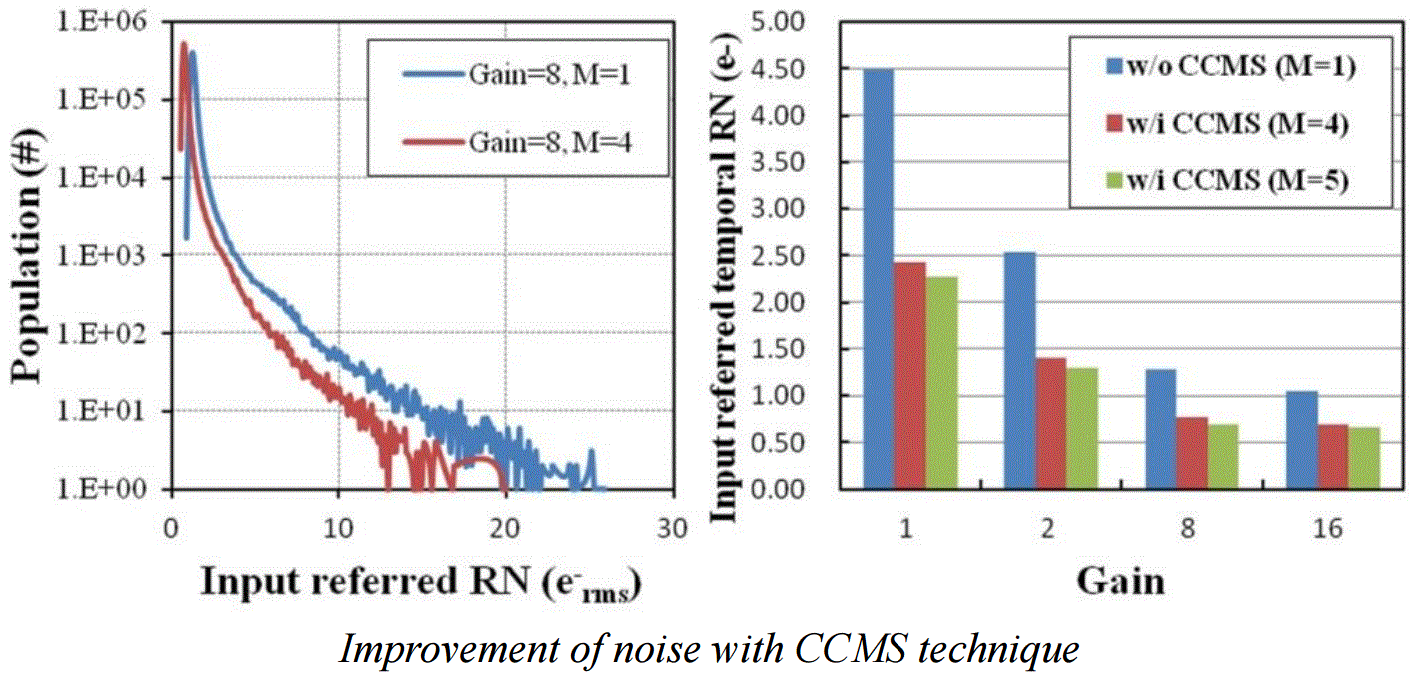
The paper by Shang-Fu Yeh, et al., of TSMC will describe an 8Mpixel 3D-stacked low noise CMOS image sensor with Conditional Correlated Multiple Sampling (CCMS) technique. This technique is proposed to solve the low frame rate issue by using multiple small-range voltage ramps. A 0.66e-rms input referred temporal readout noise is obtained with a 5-times CCMS technique, and also both thermal noise and the random telegraph signal (RTS) noise can be
reduced by using CCMS technique.

11:30 AM

Eye-Tracking Tech Company Tobii Valued $244M at IPO

...
Tech.eu: Stockholm, Sweden-based eye-tracking technology company Tobii IPO today gives it a market cap of SEK 2.1 billion (about $244M). Tobii says the offering was over-subscribed multiple times. Tobii will receive gross proceeds of approximately SEK 400 million ($46.5M) through the issue of new shares as part of the IPO, before a possible exercise of the over-allotment option.

The company has about 570 employees across its offices in Sweden, the US, China, Germany and other countries.

12:30 PM

Pentax DSLR Features Pixel Shift Demosaic

...
Imaging Resource: New Pentax K-3 II DSLR features Ricoh pixel shift resolution enhancement that removes the need for Bayer demosaicing, first presented at CP+ a month ago.

Pentax IS actuator shifts the sensor by 1 pixel in 4 directions. "The result is an image which has full color information at every pixel location -- and thus improved resolution and a greater resistance to false color artifacts -- but only a relatively modest increase in file size...

As an added bonus, images shot in the Pixel Shift Resolution mode should also have a cleaner, tighter noise pattern. The reason for this is twofold. First, since multiple exposures are involved, noise can be averaged out across those exposures. Secondly, in a Bayer-filtered sensor, two out of three colors at each pixel location must be interpolated (read: guessed) from the values of surrounding pixels. When that happens, noise from adjacent pixels is likewise spread across their neighbors, resulting in a less film-like and blotchier, more objectionable noise pattern. With full color information at each pixel, a Pixel Shift Resolution shot's high ISO grain pattern is finer, and we're guessing easier to clean up post-capture, too.
"


Pentax Youtube video calls this mode "Pixel Shift Resolution". It's somewhat similar to one appeared in the previous Pentax DSLR model, but then it used to be a high frequency 500Hz vibration, whereas now it's said to provide a higher resolution for static objects:

10:28 PM

Galaxycore Ranked High Among China Semiconductor Companies

...
PWC report "A decade of unprecedented growth: China’s impact on the semiconductor industry, 2014 update," dated by January 2015, ranks Galaxycore #10 on revenue basis among Chinese semiconductor companies. Other image sensor vendors in China, such as Superpix and Brigates have not make it even in the list of 50 largest companies.


Nomura report "Greater China Semi" places Galaxycore at #8 among semiconductor design houses in China:

9:29 PM

Ziptronix Lost Lawsuit Against Omnivision and TSMC

...
Finnegan: Ziptronix has lost its 2010 lawsuit against Omnivision and TSMC on infringement on its 9 patents on direct wafer bonding.

"In Ziptronix, Inc. v. OmniVision Technologies, Inc. a Taiwanese contract manufacturer and its U.S. subsidiary moved for summary judgment of no infringement because the allegedly infringing activity occurred only in Taiwan, with the exception of negotiations and contracting in the United States. The district court granted summary judgment, finding that even if negotiation and contracting occurred in the United States, there could be no direct infringement under U.S. patent law because the contracts contemplated delivery and performance to take place solely abroad. Additionally, the patent holder failed to present evidence that the Taiwanese manufacturer's customer, OmniVision, committed an underlying act of direct infringement. Thus, the court concluded, the Taiwanese manufacturer and its U.S. subsidiary did not commit or induce infringing acts "within the United States."

For those who skilled in legal language and logic, the full text of California Court summary judgement from Oct. 21, 2014 can be downloaded here. More discussions on patent law gray areas, apparently involved in this case, can be found in another Finnegan article.
6:08 AM

8K UHDTV Adoption Milestones

...
Ikegami has collaborated NHK to develop an 8K UHDTV camera, the "SHK-810", and achieved significant size reduction and light-weight design for field and live production, which can be operated at the same level as the current broadcast camera systems. The camera employs a single 33MP Super 35 CMOS sensor, achieving 4,000TVL horizontal and vertical resolution. The color filter on the sensor uses the dual-green SHV color arrangement.

According to the roadmap of Japan Ministry of Internal Affairs and Communications (MIC), test-broadcast of 4K/8K by BS satellite television will start in Rio 2016 Olympic and Paralympic Games, and 8K on-air broadcast will start as soon as possible by 2018 in Japan. The 4K/8K broadcasting is targeted at the Tokyo 2020 Olympic and Paralympic Games. Per MIC, by the year 2020, 4K/8K broadcasting should be shared by public viewing points in Japan, and 4K/8K television sets should be widespread in the consumer market by that time.

Ikegami SHK-810
4:02 AM

It's time to 'Do the math' again

...
By David Spratt

Have we gone mad? A new report released today explains why contemporary climate change policy-making should be characterised as increasingly delusional.

As the deadline approaches for submissions to the Australian government's climate targets process, there is a flurry of submissions and reports from advocacy groups and the Climate Change Authority.

Most of these reports are based on the twin propositions that two degrees Celsius (2°C) of global warming is an appropriate policy target, and that there is a significant carbon budget and an amount of "burnable carbon" for this target, and hence a scientifically-based escalating ladder of emission-reduction targets stretching to mid-century and beyond.

A survey of the relevant scientific literature by David Spratt, "Recount: It's time to 'Do the math' again", published today by Breakthrough concludes that the evidence does not support either of these propositions.

The catastrophic and irreversible consequences of 2°C of warming demand a strong risk-management approach, with a low rate of failure. We should not take risks with the climate that we would not take with civil infrastructure.

There is no carbon budget available if 2°C is considered a cap or upper boundary as per the Copenhagen Accord, rather than a hit-or-miss target which can be significantly exceeded; or if a low risk of exceeding 2°C is required; or if positive feedbacks such as permafrost and other carbon store losses are taken into account.

Effective policy making can only be based on recognising that climate change is already dangerous, and we have no carbon budget left to divide up. Big tipping-point events irreversible on human time scales such as in West Antarctica and large-scale positive feedbacks are already occurring at less than 1°C of warming. It is clear that 2°C of climate warming is not a safe cap.

In reality, 2°C is the boundary between dangerous and very dangerous climate change and 1°C warmer than human civilisation has ever experienced.

In the lead up to the forthcoming Paris talks, policy makers through their willful neglect of the evidence are in effect normalising a 2.5–3°C global warming target.

This evidence in "Recount: It's time to 'Do the math' again" demonstrates that action is necessary at a faster pace than most policy makers conceive is possible.


Related

- It's time to 'Do the math' again
http://www.climatecodered.org/2015/04/its-time-to-do-math-again.html

- RECOUNT - It's time to 'Do the math' again
http://media.wix.com/ugd/148cb0_938b5512abfa4d4e965ec8cc292893f7.pdf

- Two degrees of warming closer than you may think
http://arctic-news.blogspot.com/2015/02/two-degrees-of-warming-closer-than-you-may-think.html

- The real budgetary emergency and the myth of "burnable carbon"
http://arctic-news.blogspot.com/2014/05/the-real-budgetary-emergency-and-the-myth-of-burnable-carbon.html

It's time to 'Do the math' again | by David Spratt http://arctic-news.blogspot.com/2015/04/its-time-to-do-math-again.html

Posted by Sam Carana on Thursday, April 23, 2015

Principal Engineer – Piping Tecnimont ICB

...
Principal Engineer - Piping Job Description Candidates should be graduate in Mechanical / Chemical Engineering having08 to 25 years experience preferably in engineering / consulting companies with at least 4 major projects executed performing similar tasks. The candidates should be familiar with the industry norms, Indian and International Codes and Standards specific to the field of working.
1:09 PM

Sony Ups its Profit Forecast

...
WSJ, Bloomberg: Sony revises upward its profit forecast for its fiscal year ended on March 31, 2015. One of the reasons for revision is higher than expected image sensor sales. The final yearly results will be reported on April 30.

“The demand for front-facing camera modules is going through the roof, because everyone wants to take high-quality selfies, and that doubles the market size for Sony,” said Amir Anvarzadeh, a manager of Japanese equity sales at BGC Partners Inc. in Singapore. “The auto segment of the market is also beginning to boom. Cars potentially may have more than five modules per car.”
9:04 AM

Sharp Presents High End Sensors

...
Sharp's March 2015 catalog reveals new high end products. The company presents RJ5DY1BA0LT, a 1-inch 13MP CMOS sensor capable of 4K 60fps video:


One can also buy an off-the-shelf 21MP camera module with 4K 30fps video and F2.0 lens:


Also, Sharp greatly expands its CCD product line, announcing no less than 19 new CCDs, and another 4 marked "under development."
7:07 AM

Image Sensors at 2015 VLSI Symposia

...
VLSI Symposia to be held in June 2015 in Kyoto, Japan publishes its advance program. Few notable papers on image sensors:

VLSI Circuit Symposium has 5 image sensor papers. Probably, the most interesting one comes from Olympus:

A 3D Stacked CMOS Image Sensor with 16Mpixel Global-Shutter Mode and 2Mpixel 10000fps Mode Using 4 Million Interconnections
T. Kondo, Y. Takemoto, K. Kobayashi, M. Tsukimura, N. Takazawa, H. Kato, S. Suzuki, J. Aoki, H. Saito, Y. Gomi, S. Matsuda and Y. Tadaki, Olympus, Japan

A 16Mpixel 3D stacked CMOS image sensor with pixel level interconnections using 4,008,960 micro bumps at a 7.6μm pitch, which set no layout restriction and causes no harm to sensor characteristics, was developed to achieve both a 16Mpixel global-shutter mode with a -180dB PLS and 2Mpixel 10000fps high speed image capturing mode.

The second most interesting paper is one from Tohoku University:

A Linear Response Single Exposure CMOS Image Sensor with 0.5e- Readout Noise and 76ke- Full Well Capacity
S. Wakashima, F. Kusuhara, R. Kuroda and S. Sugawa, Tohoku Univ., Japan

A linear response single exposure CMOS image sensor approaching to the photon countable sensitivity and a high full well capacity is developed using lateral overflow integration capacitor architecture with dual gain column amplifiers, small floating diffusion capacitance and low noise in-pixel source follower signal readout technologies. The fabricated 5.5 um pitch 360H x 1680V pixel prototype image sensor exhibited 240 μV/e- conversion gain with 76 ke- FWC resulting in 0.5 erms readout noise and 104 dB dynamic range under room temperature operation.

Image Sensor/Digital Logic 3D Stacked Module Featuring Inductive Coupling Channels for High Speed/Low-Noise Image Transfer
M. Ikebe*, D. Uchida*, Y. Take**, M. Someya*, S. Chikuda*, K. Matsuyama*, T. Asai*, T. Kuroda** and M. Motomura*, *Hokkaido Univ. and **Keio Univ., Japan

This paper proposes 3D stacked module consisting of image sensor and digital logic dies connected through inductive coupling channels. Evaluation of a prototype module revealed radiation noise from the inductive coils to the image sensor is less than 0.4-LSB range along with ADC code, i.e., negligible. Aiming at high frame rate image sensor/processing module exploiting this attractive off-die interface, we also worked on resolving another throughput-limiter, namely power consuming TDC used in column parallel ADCs. Novel intermittent TDC operation scheme presented in this paper can reduce its power dissipation 57% from conventional ones.

A 0.66e-rms Temporal-Readout-Noise 3D-Stacked CMOS Image Sensor with Conditional Correlated Multiple Sampling (CCMS) Technique
S.-F. Yeh, K.-Y. Chou, H.-Y. Tu, C. Y.-P. Chao and F.-L. Hsueh, TSMC, Taiwan

A conditional correlated multiple sampling (CCMS) technique for low noise CMOS image sensor (CIS) is proposed to reduce noise and address low frame rate issue caused by the conventional correlated multiple sampling (CMS) technique. An 8Mpixel 3D-stacked CIS with 1.1um pixel pitch is designed and verified. Measurement results show this technique can achieve 0.66erms at 36.1 kHz A/D sampling rate per pixel with analog gain at 16 and 5-times multiple sampling. The resulting DNL is within -0.49/+0.45LSB.

A 0.4V Self-Powered CMOS Imager with 140dB Dynamic Range and Energy Harvesting
A. Y.-C. Chiou and C.-C. Hsieh, National Tsing Hua Univ., Taiwan

This PWM imager operates at a lowest reported supply 0.4V with a 0.42x smaller pixel size, 1.5x larger fill factor, 0.58 smaller random noise, and 3x better iFoM than previous work. With proposed dual-exposure extended-counting (DEEC) scheme, the prototype achieves a high dynamic range of 140dB with a 58dB boost. Optical energy harvesting (OEH) design is implemented to generate 60.3pW per lux per mm2 and 1.28x higher efficient than current design. A self-powered imager is demonstrated with 15fps under 100klux.

VLSI Technology Symposium has one image sensor paper:

Energy Efficient 1-Transistor Active Pixel Sensor (APS) with FD SOI Tunnel FET
N. Dagtekin and A. M. Ionescu, EPFL, Switzerland

This paper presents the first energy efficient highly compact concept of active pixel sensor built with a single partially-gated tunnel FET (TFET). Experimental results show that the transistor characteristics of the investigated TFETs are nonlinearly modulated by optical excitation and an optical gain is reported for the first time. A memory effect is observed and exploited when the back-gate is used as a secondary gate to control charge storing mechanism in the body, similarly to back gate illuminated photodiode pixels. Compared to CMOS, 1T-TFET pixels offer high sensitivity (detection limit < 2pW/μm2 in visible light), low power operation, improved temperature stability and high compactness (1T architecture with pixel size of ~10x1μm2 in this work).
1:36 PM

Shareholders Settlement with Omnivision

...
GlobeNewsWire: The Shareholders Foundation, Inc. reveals its version of the story in a class action lawsuit against OmniVision:

"The plaintiff alleged that OmniVision allegedly failed to disclose that it had lost its lucrative, high-profile, and exclusive contract with Apple Inc, that competition was eroding its "leadership position" in the smartphone industry, that delays in the development of its 8-megapixel product line were threatening its prospects, and that it lacked a reasonable basis for its statements about its bright prospects in the smartphone market.

On August 25, 2011, OmniVision announced its results for the fiscal first quarter of 2012 and provided guidance for the fiscal second quarter of 2012. OmniVision also disclosed delays in the production of its new 8-megapixel product line.

The plaintiff claimed that based on OmniVision's guidance, analysts recognized that OmniVision would not be the exclusive producer of camera components for Apple's iPhone 4S set for release in the fall of 2011. The plaintiff claimed that on that day the iPhone 4S became available for sale experts determined that based on a logo stamped on the inside of the camera sensor that Sony--and not OmniVision -- had supplied the CMOS sensor for the iPhone 4S.

After more than three years of litigation the settlement was announced in March 2015. The settlement provides a total recovery of $12.5 million in cash for certain OmniVision investors.
"
11:28 AM

Wearable Cameras Sales to Reach 30.6M Units in 2020

...
EETimes quotes Tractica market research forecasting that wearable camera shipments will increase from 5.6M in 2014 to 30.6M units annually by 2020, representing a CAGR of 33%.

“Wearable camera adoption will be strongest in areas where there is a clear and specific use case or context in which the camera is used,” says research director Aditya Kaul. “While GoPro is driving the market for sports and adventure enthusiasts, we expect usage of consumer lifelogging cameras like those from Narrative to mature over time to capture specific moments and support video streaming. The public safety sector is also experiencing growth in the adoption of body-worn cameras for police officers provided by companies like Taser, Vievu, and Digital Ally. In addition, enterprise users are experimenting with applications like user experience research in retail and hospitality.”
12:46 PM

TowerJazz and Gpixel Announce BSI CMOS Image Sensor for Scientific Applications

...
GlobeNewsWire: TowerJazz and China-based Gpixel announce what they call the world's first scientific BSI CMOS image sensor, GSENSE400-BSI, manufactured using TowerJazz's TS18IS process. The new sensor is aimed to spectrometry, biometric, fluorescence, surveillance, industrial inspection, forensic, and astronomy applications.

GSENSE400-BSI features:
  • 11um pixel pitch
  • 2048x2048 resolution
  • extremely low dark current: 1e-/p/s at 0C , 0.03e-/p/s at -50C
  • read noise as low as 1.3e-
  • linear full well charge as high as 91Ke-
  • DR of 96dB
  • QE: 74%@280nm or 90%@400nm
  • Frame rate: 48fps@STD, 24fps@HDR
Gpixel's BSI scientific CMOS sensor features very high sensitivity from 270nm – 300nm for its UV-optimized version, and from 300nm – 400nm for its VIS-optimized version:


"We have been working with TowerJazz since the start of Gpixel, because of its unprecedented leadership in CMOS image sensor technology," said Xinyang Wang, Founder & CEO, Gpixel, Inc. "This latest BSI sensor's performance has exceeded my expectation. I believe this is one of the most unique CMOS products currently available in the market and will create very serious competition with many existing BSI CCD sensors."

"We are very pleased to see the success of Gpixel in the market. We have known Dr. Wang for many years and have full confidence in his ability to grow his company to become a major high end CMOS image sensor supplier," said Avi Strum, VP & GM, CMOS Image Sensor Business Unit, TowerJazz. "Gpixel is unique in the Chinese market as it concentrates on the high end market which fits very well with our strategy."

The UV-optimized and VIS-optimized GSENSE400-BSI are starting sampling immediately. These two products are planned to be in production in Q3 2015.
11:48 AM

Chipworks Publishes Samsung Galaxy S6 Teardown Report

...
Chipworks' openly available teardown report of Samsung Galaxy S6 has pictures of front and rear camera modules:

Front camera with Samsung S5K4E6 sensor

Rear camera module

Other than that, Chipworks publishes Seek Thermal/Raytheon microbolometric pixel picture, and Omnivision's first automotive BSI sensor OV10640 with 4.2um split HDR pixel:

Seek Thermal - Raytheon pixels
OV10640 automotive BSI sensor
11:33 AM

West Two Years Later: The Cause Above Everything

...

Today, impossible heroes and implausible villains are to be found mainly in video games, but back in the 1930s, one of the largest-selling series of adventure books for boys was based around a young inventor character named Tom Swift.  Great literature it was not, but there was plenty of action, the good guys were always good, and the bad guys were really bad, although sometimes it was hard to tell what they were being bad about.  I particularly remember the closing scene of one book in which, after Tom foils a complicated attempt by an evildoer to wreak havoc on an entire city, the bad guy is led away in handcuffs muttering, "The Cause!  The Cause above everything!"  The reader was left in the dark as to what the Cause was, but it didn't matter—it was merely a placeholder, an unnamed motivation so that the bad guy could move the plot along.

In Texas, fiction sometimes becomes reality more than we'd like it to.  For example, who would have the nerve to write a book in which the president of the Texas Ag Industries Association would be named—I kid you not—Donnie Dippel?  But that's his name.  It's right here in the paper, the Austin American-Statesman for Friday, April 17, a date which marked the two-year anniversary of the ammonium nitrate fertilizer explosion that devastated the town of West, Texas, killing 15 and causing an estimated $100 million in damage.  After the explosion, the accident was thoroughly investigated amid outcries for tighter regulation of fertilizer storage facilities, of which there are dozens all over the state. 

As you might expect from a blast that was so strong it registered on seismographs hundreds of miles away and dug a crater ten feet deep, any evidence as to what caused the fire that led to the explosion was pulverized and scattered almost beyond recognition.  The official investigation by the Texas State Fire Marshal's Office listed the cause as "unknown," which is true in a technical sense.  But what is known is that somehow, a fire started in a wooden structure housing around 270 tons of ammonium nitrate, which can detonate in milliseconds under the wrong conditions.  And many of those conditions—such as storage of the chemical in wooden bins, lack of adequate automatic fire control systems such as sprinklers, and keeping flammable materials such as fuel, batteries, and seed grains near ammonium nitrate stocks—still prevail in many of the other fertilizer facilities in Texas.

But no, we cannot say with iron-clad certainty exactly what started the fire that made the ammonium nitrate explode at West.  And for Mr. Dippel, it's the cause above everything.

The twisted logic he seems to be following goes like this:  If you don't know the cause of an accident, you can't place the blame, and if you can't place the blame, you can't take actions such as legislation to improve the safety of fertilizer facilities.  That's the only way I can see that a person of otherwise sound mind could come up with the following statement, which I quote exactly as it appears in the paper: 

"We don't know what happened at West, and we wish somebody could determine what happened so we make sure to correct what happened so it never happens again."

But unless somebody determines what happened, the official position of the Texas Ag Industries Association is that they do not want a bunch of new rules about how to store ammonium nitrate.

No one determined "the cause" (in Mr. Dippel's sense) of the fire aboard the cargo freighter Grandcamp, which was carrying 2,300 tons of ammonium nitrate when its cargo detonated, wrecking most of the port of Texas City and killing over 500 people, including all but one member of the Texas City fire department.  This was back in 1947, sixty-six years and a day before the West explosion.  But the absence of an exact known cause didn't stop the port of Texas City from banning the transportation of ammonium nitrate in any form through its port facilities two years after the disaster. 

One definition of "cause" is that state of affairs which, if removed from a situation, would prevent the effect from occurring.  A lot of dangerous circumstances prevail in cities and towns where ammonium nitrate is stored, and if those circumstances are removed, the effect of another such explosion is less likely to happen.  If the owners of the plants and the first responders in their surrounding communities won't voluntarily take new safety measures (a few have, but many haven't), maybe changes in laws will.

In this year's Texas legislative session, several bills have been introduced to help prevent another West-style fertilizer disaster.  One of the most sensible, filed by Texas Rep. Kyle Kacal of College Station, would give the Texas State Fire Marshal authority to inspect locations where ammonium nitrate is stored.  At the very minimum, information shared from these inspections would help local fire departments plan for firefighting and evacuation, if necessary, in the case of fires at these facilities.  Other bills, such as the one by Rep. Eddie Rodriguez, would go farther and increase the mandatory amount of liability insurance carried by such plants.

To my mind, the single worst failing in the West disaster was lack of information.  The first responders apparently didn't know how dangerous the West Fertilizer Company fire was.  And the town had no plans for evacuation in case of a fire at the plant.  A similar fire in College Station led to the evacuation of a large area of town, fortunately without an explosion occurring.  Two simple measures—allowing inspections, and sharing information and training with first responders—could have prevented most of the loss of life and injuries at West, but not the millions in property damage.  To make sure such explosions don't happen in the future, fertilizer firms that store ammonium nitrate will have to clean up their act with improvements that will cost them money. 

One test of a society's ability to function is to watch how it deals with major disasters, and how well it acts to prevent them in the future.  Texas and Texans have dealt with major tragedies successfully in the past—hurricanes, tornadoes, oil-refinery explosions, and many other natural and self-inflicted messes—and I like to think that we come together in the aftermath to do the right, sensible, and just thing.  Perhaps this is a foolish hope, but I hope that suitable legislation is passed to make the West, Texas tragedy the last ammonium-nitrate disaster that Texans ever experience.

Sources:  The Austin American-Statesman carried the article "Despite West blast, industry crackdown unlikely," in its Friday, Apr. 17, 2015 print edition on pp. A1 and A8.  (The online edition is accessible only by subscription.)  I also used information from The Texas Observer's online article "West, Texas Blues" at http://www.texasobserver.org/west-tragedy-little-progress-ammonium-nitrate/.  The Texas City disaster is described in impressive detail by Bill Minutaglio in his 2003 book (HarperCollins) City on Fire, and the Texas City ban on ammonium nitrate is reported in that book on p. 270.  I also referred to the CNN article www.cnn.com/2013/04/23/us/texas-explosion/ for the size of the crater and to the Wikipedia articles on the West Fertilizer Company explosion and the Texas City disaster.