Sony Proposes Photon Counting Pixel

online engineering degree/engineering degree online/online engineering courses/engineering technology online/engineering courses online/engineering technician degree online/online engineering technology/electronic engineering online
Sony patent application US20150021461 "Image sensor and electronic device" by Toshiyuki Nishihara and Hirofumi Sumi proposes a buried channel TG and binary detector to reduce influence of TG surface traps in very low light image sensors:

"since a pixel signal is extremely weak when weak light is detected, it is desirable to reflect electrons generated from photoelectric conversion on intensity of the pixel signal while losing as few electrons as possible. In general, however, when electrons generated in a photodiode are transferred to a floating diffusion, carriers (electrons) are doped at an interface level generated due to a defect present on a gate oxide film interface (interface defect) of a transfer transistor."

"there is provided an image sensor including pixels each configured to include a transfer transistor configured as an embedded channel type MOS transistor and to output a pixel signal based on a charge transferred to a floating diffusion from a photodiode by the transfer transistor in an on state, and a determination unit configured to convert the output pixel signal to a digital value, then compare the converted digital value to a threshold value, and thereby make a binary determination on presence or absence of incidence of a photon on the pixel that has generated the pixel signal. Accordingly, the image sensor that makes a binary determination on presence or absence of incidence of a photon on a pixel exhibits the effect of reducing influence of an interface state on the transfer transistor."

9:45 PM

Rambus Announces Supply Noise Monitor

online engineering degree/engineering degree online/online engineering courses/engineering technology online/engineering courses online/engineering technician degree online/online engineering technology/electronic engineering online
Rambus introduces an interesting IP block, the On-chip Noise Monitor, potentially useful for debugging the on-chip noise problems. The monitor is available in TSMC 40G/LP and GF28HPP/SLP processes and have a noise resolution on 200uV/LSB in bandwidth up to 3-6GHz. LabStation software enables fully automated measurements, post-processing, and data visualization, including noise spectrum:


A short Youtube video demos the system:

1:42 AM

Omnivision to Benefit from Selfie Trend

online engineering degree/engineering degree online/online engineering courses/engineering technology online/engineering courses online/engineering technician degree online/online engineering technology/electronic engineering online
Barron's: Rosenblatt Securities‘s analyst Brian Blair forecasts:

"We believe the most critical trend for OmniVision’s business this year is what we are calling the selfie trend. The basic idea is that front facing cameras on smartphones have generally been VGA – 1MP over the last 5 years. We believe that this is shifting in 2015 to 5MP — 13MP sensors for front-facing cameras. We expect to initially see this at the high end of the market, but we anticipate the trend will quickly filter into mid-tier models as well. We recently saw evidence of this trend at CES with a few models that had 5MP – 13MP front facing cameras (from Samsung and HTC notably) and we expect MWC in early March to showcase numerous additional models. This trend is critical, as it meaningfully lifts dollar content per handset and raises overall ASPs/ revenues, and provides a bump to gross margins as well."
12:26 AM

Intel Releases More Details on its F200 RealSense Camera

online engineering degree/engineering degree online/online engineering courses/engineering technology online/engineering courses online/engineering technician degree online/online engineering technology/electronic engineering online
Intel publishes more info on its F200 structured light front camera.

RealSense F200 camera

The IR Laser Projector emits a structured pattern of Class 1 infrared light used to determine the dimensional characteristics of objects by the depth camera:

Laser projected structured light patterns are quite unusual

Intel explains that the right (green) pattern is, in fact, changing at fast speed, so that if one makes a picture of it at 1/30s exposure, it blurs into the left (gray) pattern. EETimes says that the projector emits 16 different patterns.

A Youtube video talks about the camera capabilities:

1:07 PM

ON Semi Videos

online engineering degree/engineering degree online/online engineering courses/engineering technology online/engineering courses online/engineering technician degree online/online engineering technology/electronic engineering online
ON Semiconductor publishes a series of short videos showing its image sensor solutions:


3:30 AM

Why are methane levels over the Arctic Ocean high from October to March?

online engineering degree/engineering degree online/online engineering courses/engineering technology online/engineering courses online/engineering technician degree online/online engineering technology/electronic engineering online

Water temperatures at different depth

Why are methane concentrations in the atmosphere over the Arctic Ocean so high from October through to March?

The image below, replotted by Leonid Yurganov from a study by Chepurin et al, shows sea water temperature at different depths in the Barents Sea.


Above image illustrates that, while Arctic sea water at the surface reaches its highest temperatures in the months from July to September, water at greater depth reaches its highest temperature in the months from October to March. Accordingly, huge amounts of methane are starting to get released from the Arctic Ocean's seafloor in October.

Surface temperatures in October

As the image below shows, temperature at 2 meters was below 0°C (32°F, i.e. the temperature at which water freezes) over most of the Arctic Ocean on October 26, 2014. The Arctic was over 6°F (3.34°C) warmer than average, and at places was up to 20°C (36°F) warmer than average.
  
Image from 'Ocean temperature rise'
At the same time, continents around the Arctic Ocean are frozen. Surface temperatures over the Arctic Ocean were higher than temperatures on land at the end of October, due to the enormous amounts of heat being transferred from the waters of the Arctic Ocean to the atmosphere. This was the result of ocean heat content, which in 2014 was the highest on record, especially in the Arctic Ocean, which also made that at that time of year the sea ice extent was still minimal in extent and especially in volume. 

Start of freezing period

In October, the Arctic Ocean typically freezes over, so less heat will from then on be able to escape to the atmosphere. Sealed off from the atmosphere by sea ice, greater mixing of heat in the water will occur down to the seafloor of the Arctic Ocean.

Less fresh water added to Arctic Ocean

The sea ice also seals the water of the Arctic Ocean off from precipitation, so no more fresh water will be added to the Arctic Ocean due to rain falling or snow melting on the water. In October, temperatures on land around the Arctic Ocean will have fallen below freezing point, so less fresh water will flow from glaciers and rivers into the Arctic Ocean. At that time of year, melting of sea ice has also stopped, so fresh water from melting sea ice is no longer added to the Arctic Ocean either. 

Rising salt content

As addition of fresh water ends, the salt content of the water in the Arctic Ocean starts to rise accordingly, while the Gulf Stream continues to push salty water into the Arctic Ocean. The higher salt content of the water makes it easier for ice to melt at the seafloor of the Arctic Ocean. Saltier water causes ice in cracks and passages in sediments at the seafloor of the Arctic Ocean to melt, allowing methane contained in the sediment to escape. 

Pingos and conduits. Hovland et al. (2006)
The image on the right, from a study by Hovland et al., shows that hydrates can exist at the end of conduits in the sediment, formed when methane did escape from such hydrates in the past. Heat can travel down such conduits relatively fast, warming up the hydrates and destabilizing them in the process, which can result in huge abrupt releases of methane.

Heat can penetrate cracks and conduits in the seafloor, destabilizing methane held in hydrates and in the form of free gas in the sediments.

Less hydroxyl in atmosphere

Besides heat, open water also transfers more moisture to the air. The greater presence of sea ice from October onward acts as a seal, making that less moisture will evaporate from the water. Less moisture evaporating, together with the change of seasons (i.e. less sunshine) results in lower hydroxyl levels in the atmosphere at the higher latitudes of the Northern Hemisphere, in turn resulting in less methane being broken down in the atmosphere over the Arctic.

Gulf Stream

Malcolm Light writes in this and this earlier posts that the volume transport of the Gulf Stream has increased by three times since the 1940's, due to the rising atmospheric pressure difference set up between the polluted, greenhouse gas rich air above North America and the marine Atlantic Air. 

The increasingly heated Gulf Stream with its associated high winds and energy rich weather systems then flows NE to Europe where it is increasingly pummeling Great Britain with catastrophic storms, as also described in this earlier post, which adds that faster winds means more water evaporation, and warmer air holds more water vapor, so this can result in huge rainstorms that can rapidly devastate the integrity of the ice. The image below further illustrates the danger of strong winds over the North Atlantic reaching the Arctic.


Branches of the Gulf Stream then enter the Arctic and disassociate the subsea Arctic methane hydrate seals on subsea and deep high - pressure mantle methane reservoirs below the Eurasian Basin - Laptev Sea transition. This is releasing increasing amounts of methane into the atmosphere where they contribute to anomalously high local temperatures, greater than 20°C above average.

From: The Biggest Story of 2013
Emissions from North America are - due to the Coriolis effect - moving over areas off the North American coast in the path of the Gulf Stream (see animation on the right).

The Gulf Stream reaches its maximum temperatures off the North American coast in July. It can take almost four months for this heat to travel along the Gulf Coast and reach the Arctic Ocean, i.e. water warmed up off Florida in early July may only reach waters beyond Svalbard by the end of October.

Waters close to Svalbard reached temperatures as high as 63.5°F (17.5°C) on September 1, 2014 (green circle). The image below shows sea surface temperatures only - at greater depths (say about 300 m), the Gulf Stream can push even warmer water through the Greenland Sea than temperatures at the sea surface.


Since the passage west of Svalbard is rather shallow, a lot of this very warm water comes to the surface at that spot, resulting in an anomaly of 11.9°C. The high sea surface temperatures west of Svalbard thus show that the Gulf Stream can carry very warm water (warmer than 17°C) at greater depths and is pushing this underneath the sea ice north of Svalbard.
Through to March the following year, salty and warm water (i.e. warmer than water that is present in the Arctic Ocean) will continue to be carried by the Gulf Stream into the Arctic Ocean, while the sea ice will keep the water sealed off from the atmosphere, so little heat and moisture will be able to be transferred to the atmosphere. 

Start of melting period

This situation continues until March, when the sea ice starts to retreat and more hydroxyl starts getting produced in the atmosphere. Increased sea ice melt and glaciers melt, the latter resulting in warmer water flowing into the Arctic Ocean from rivers, will cause salinity levels in the Arctic Ocean to fall, in turn causing methane levels to fall in the atmosphere over the Arctic Ocean. Furthermore, the water traveling along the Gulf Stream and arriving in the Arctic Ocean in March will be relatively cold.  


References


- Chepurin, G.A., and J.A. Carton, 2012: Sub-arctic and Arctic sea surface temperature and its relation to ocean heat content 1982-2010, J. Geophys. Res.-Oceans., 117, C06019, DOI: 10.1029/2011JC007770. http://onlinelibrary.wiley.com/doi/10.1029/2011JC007770/abstract 

- Combination image created by Sam Carana with Climate Reanalyzer, from: Temperature Rise, http://arctic-news.blogspot.com/2014/10/ocean-temperature-rise.html 

- Submarine pingoes: Indicators of shallow gas hydrates in a pockmark at Nyegga, Norwegian Sea, by Martin Hovland and Henrik Svensen (2006) http://www.sciencedirect.com/science/article/pii/S0025322705003968

- Sea surface temperature west of Svalbard,
created by Sam Carana with
http://earth.nullschool.net


Lead Piping Designer CH2M

online engineering degree/engineering degree online/online engineering courses/engineering technology online/engineering courses online/engineering technician degree online/online engineering technology/electronic engineering online


Lead Piping Designer (Industrial and Municipal Water) - Abu Dhabi, UAE

Location: Abu Dhabi, United Arab Emirates

Description and Desired Qualifications


CH2M HILL Lead Piping Designer (Industrial and Municipal Water) - Abu Dhabi, UAE

Job Purpose:

The challenge? Help develop and provide high quality, leading edge sustainable engineering solutions to our clients in the industrial (power,
7:53 PM

Yole Updates CMOS Sensor Market Report

online engineering degree/engineering degree online/online engineering courses/engineering technology online/engineering courses online/engineering technician degree online/online engineering technology/electronic engineering online
Yole Developpment releases an update to its CMOS sensor report with the new market data:

"Driven by mobile and automotive applications, the CIS industry is expected to grow at a CAGR of 10.6% from 2014 - 2020, reaching a market value of US$16.2B by 2020."

"Automotive is the big story this year, as car manufacturers like Tesla, Nissan and Ford are showing off their first camera-enabled features. Market traction is particularly impressive, with most CIS players enjoying growth rates of 30% - 50%. But this is only the beginning, with most CIS players looking at this market, total revenue should reach US$800M in 2020 – for CIS sensors only. Automotive’s emerging importance promises profound implications for the CIS ecosystem. As CIS moves from a “for display” application towards a “for sensing” application, new players such as processor and software providers will become key partners for sensor design and marketing."

"Since 2010, Yole Développment has well documented the rise of back side illumination (BSI), which has now become a mainstream technology that’s captured more than 50% of CIS production... Size constraints in mobile have pushed 3D stacking BSI, which currently has 20% of the market."

9:50 AM

Samsung Technology Interests

online engineering degree/engineering degree online/online engineering courses/engineering technology online/engineering courses online/engineering technician degree online/online engineering technology/electronic engineering online
Samsung has held Innovation Days on Jan. 19-21, 2015 in Dresden, Germany. The event was envisioned to be the "focal point for the purchase of innovative technologies in Europe." The list of the technologies that Samsung interested in is dominated by imaging items:

New technologies & innovations for wearable devices:
  • New user scenarios
  • Next generation User Experience (UX)
  • Low power components

New technology for camera products:
  • Auto focus / MEMS actuator
  • Optical image stabilisation
  • Active Lens technology
  • Actuators
  • High efficiency IR sensing image sensor

New material technology:
  • Transparent barrier / film
  • NIM (Nano Insulation Material) Organic
  • Heating surface
  • Material transmitting IR rays
  • Sapphire coating
  • 5 axis CNC
  • Technology for waterproofing / water repelling

MEMS Sensors:
  • Touch Sensor, Dust or particle, Fingerprint, Force, Reed, GSR Sensors
  • Ambient light / RGB Sensor
  • Gesture: Optical proximity sensor / 3D time of flight -TOF
  • Inertial Sensors: Accelerometers, Gyroscopes, Pressure sensor, Humidity sensor & Magnetometer
  • Vital Sign Sensors (for healthcare devices): non-contact, non-invasive, motion cancelling, low power

Sensors:
  • Fibre detection (cloth)
  • Thermopile Sensors: Non-contact temperature sensing
  • ToF = Time of Flight (measuring distance / length): non-contact distance measuring sensor
  • PIR / TIR Bolometer (IR) Sensor
  • Pressure
  • Temperature / humidity
  • Ultrasound sensor
  • Flex Sensor
  • Radon sensor
  • Non contact sleep detection sensor

Update: Here is the UK version of the list, dated by June 16, 2014.
1:22 PM

Grand View Research on CMOS Sensor Dominance

online engineering degree/engineering degree online/online engineering courses/engineering technology online/engineering courses online/engineering technician degree online/online engineering technology/electronic engineering online
Grand View Research report "Image Sensors Market Analysis By Technology (CCD, CMOS, CIS), By Application (Automotive, Consumer Electronics, Defense & Aerospace, Industrial, Medical, Surveillance) And Segment Forecasts To 2020" dated by Aug. 2014 shows that CCD market share shrunk to 14.5% in 2012:

CIS is Contact Image Sensor here

The global market was valued at $8,450M in 2012, and is expected to grow at a CAGR of 4.6% from 2014 to 2020.
1:04 PM

ST SPAD Array Captures Light in Flight

online engineering degree/engineering degree online/online engineering courses/engineering technology online/engineering courses online/engineering technician degree online/online engineering technology/electronic engineering online
ST 32x32 SPAD array developed under EU funded FP6 project Megaframe with University of Edinburgh and partners is the basis of Heriot-Watt University 20 billion fps-fast camera. The open access Nature Communications' paper "Single-photon sensitive light-in-fight imaging" by Genevieve Gariepy, Nikola Krstajić, Robert Henderson, Chunyong Li, Robert Thomson, Gerald Buller, Barmak Heshmat, Ramesh Raskar, Jonathan Leach & Daniele Faccio.

A laser pulse is reflecting off multiple mirrors, passing three times
across the field of view of the SPAD camera (35 35 cm2).
The same laser is used to create a trigger sent to the camera.
The SPAD camera collects scattered photons from the laser pulse.
The field of view does not contain the mirrors because the
scattered light coming from the mirror surfaces is much more
intense than the Rayleigh-scattered light during propagation.
The histogram indicates the time of arrival of the laser pulse as
measured by pixel (22, 21). The time frames, shown at 0, 1, 2, 3
and 4 ns, show the evolution of the pulse in time as it propagates
across the scene. The integration of all frames gives the total
path followed by the light, similarly to what can be acquired
by an EMCCD camera at maximum gain for an exposure time of 7 s.

A Youtube video shows the light propagation process:


New Scientist too publishes an article on the new camera.

Thanks to LG for the link!
10:58 AM

2nd International Symposium on Microoptical Imaging and Projection

online engineering degree/engineering degree online/online engineering courses/engineering technology online/engineering courses online/engineering technician degree online/online engineering technology/electronic engineering online
2nd International Symposium on Microoptical Imaging and Projection (MIPS 2015) id to be held on March 24-26, 2015 in Jena, Germany. The symposium's call for papers mentions many invited speakers on image sensor technology:
  • Bernd Buxbaum, pmdtechnologies gmbh
  • Jacques Duparré, Pelican Imaging Corp.
  • Tigran Galstian, Université Laval
  • Flavien Hirigoyen, ST Microelectronics SA
  • Ryoichi Horisaki, Osaka University
  • Bernard Kress, Google [X] Labs
  • Christian Perwaß, Raytrix GmbH
  • Markus Rossi. Heptagon
  • Sabine Süßtrunk, EPFL, IC-IVRG
Thanks to AT for the link!
10:33 AM

Rain Storms Devastate Arctic Ice And Glaciers

online engineering degree/engineering degree online/online engineering courses/engineering technology online/engineering courses online/engineering technician degree online/online engineering technology/electronic engineering online
by Veli Albert Kallio


The Norwegian Svalbard Islands are located just few hundred miles from the North Pole. It is a unique environment for glaciers: Here glaciers can survive almost at sea level. This means that ice is constantly brushed by thick low-altitude air, which also dumps increasinlgy rain instead of snow.

As a result of high ocean temperatures and of precipitation nowadays falling as rain for months, the melting of these glaciers now occurs 25 times faster than just some years ago.

This also spells bad news for Northern Greenland's low lying glaciers, which will face increasing summertime flash floods as the Arctic Ocean becomes ice free and warms up, and as precipitation falls in the form of rain, rather than snow.

Sea surface temperature of 17.5°C, west of Svalbard
click on image to enlarge
Last summer, for example, sea water west of the Svalbard reached +18C, which is perfect for swimming - but extremely bad for the cold glaciers on shore which mop up the warm moisture and rainfall from the warmed up ocean.

Flash floods falling on glacier soften the compacted snow very rapidly to honeycombed ice that is exceedingly watery and without any internal strength.

Such ice can collapse simply under its own weight and the pulverised watery ice in the basin forms a near frictionless layer of debris.

Darkening of the melting ice also hastens its warming and melting.

Aggressively honeycombed glacier ice floating on meltwater lake in nearby Iceland.   Image credit: Runólfur Hauksson


click on image to enlarge

Changes to the Jet Streams

As the Arctic continues to warm, the temperature difference between the equator and the Arctic declines. This slows down the speed at which the polar vortex and jet streams circumnavigate the globe and results in more wavier jet streams that can enter and even cross the Arctic Ocean and can also descend deep down over the continents, rather than staying between 50 and 60 degrees latitude, where the polar jet streams used to be (as discussed in a recent post).

Such deep descent over continents can cause very low temperatures on land, while at the same time oceans remain warm and are getting warmer, so the temperature difference between land and ocean increases, speeding up the winds between continents. On January 9, 2015, jet streams reached speeds between continents as high as 410 km/h (255 mps), as shown on above image. Also note the jet stream crossing the Arctic Ocean.

Faster winds means more water evaporation, and warmer air holds more water vapor, so this can result in huge rainstorms that can rapidly devastate the integrity of the ice.

[image and text in yellow panels by Sam Carana]


I suspect that climatically-speaking we are currently entering a methane-driven Bøllinger warming state with the Northern Cryosphere now entering a phase of rapid warming and melting of anything frozen (snow, sea ice, permafrost and sea bed methane clathrates).

This will be rapidly followed by a Heindrich Iceberg Calving event when the warmed and wet ice sheet in Greenland gives away to its increased weight (due to excessive melt water accumulation within and beneath the ice sheet).

This dislodges the ice sheet’s top, due to accumulation of “rotten ice” (honeycombed, soft ice with zero internal strength) at the ice sheet’s base and perimeters.

A huge melt water pulse to the ocean ensues with Jōkullhaups and ice debris loading the ocean with vast amounts of cold fresh water.

Within weeks an immense climatological reversal then occurs as the ocean gets loaded up with ice debris and cold water leading to the Last Dryas cooling and to world-wide droughts.

This loading of the ocean with ice and water leads to severe climatic flop, as the ocean and atmosphere cool rapidly and as falling salinity and sea water temperature briefly reverse all of the current Bøllinger warming, until the climatic forcing of the greenhouse gases again takes over the process, in turn leading to a new melt water pulse as another ice sheet or shelf disintegrates by the next warming.

Today’s rapid melt water lake formation in Greenland and the ultra-fast melting of glaciers are suggestive of near imminent deglaciation process in the Arctic.

Germany’s and Japan’s recent decisions to remove all their nuclear reactors from the sea sides may prove their worth sooner than many think in the far more conservative US and UK where “glacial speed” still means “eons of time”. Good luck UK/US!

I think cold 'Dryases' are not real Ice Ages, but hiatuses in a progressive melting process which results from changes in sea water salinity and temperature due to increases of meltwater and ice debris runoff from continental snow and ice that melt. As ocean gets less saline and colder the sea ice and snow cover temporarily grows.

But in the long run the greenhouse gas forcing and ocean wins and the warmth and melting resumes until the next big collapse of ice shelf and/or ice sheet. Hence there are meltwater pulses (such as 1a, 1b, 1c) and Heindrich Ice Berg Calving surges (2, 1, 0 - the last one being also called "Younger Dryas" as the Arctic Dryas octopetala grew in South once again after Ice Ages).

The next cooling from collapse of Greenland ice dome would be Heindrich Minus One as the zero has already been allocated to Younger Dryas ice berg surge. Here is an article worth reading on this risk. In Antarctica we see currently (already) a sea ice growth hiatus driven by increased runoff of melt water and ice debris from the continent and its surrounding ice shelves that are rapidly disintegrating.


Abrupt climate change happened in just one year

A 2008 study by Achim Brauer et al. of lake sediments concluded that abrupt increase in storminess during the autumn to spring seasons, occurring from one year to the next at 12,679 yr BP. This caused abrupt change in the North Atlantic westerlies towards a stronger and more zonal jet, leading to deglaciation.

A 2009 study by Jostein Bakke et al. confirmed that increased flux of fresh meltwater to the ocean repeatedly resulted in the formation of more extensive sea ice that pushed the jet south once more, thus re-establishing the stadial state. Rapid oscillations took place until the system finally switched to the interglacial state at the onset of the Holocene.

References

- An abrupt wind shift in western Europe at the onset of the Younger Dryas cold period, Brauer et al.
http://www.nature.com/ngeo/journal/v1/n8/abs/ngeo263.html

- Rapid oceanic and atmospheric changes during the Younger Dryas cold period, Bakke et al.
http://www.nature.com/ngeo/journal/v2/n3/abs/ngeo439.html


Camera-Based Random Number Generator

online engineering degree/engineering degree online/online engineering courses/engineering technology online/engineering courses online/engineering technician degree online/online engineering technology/electronic engineering online
The paper on camera-based random number generator has been published half a year ago. Now the same group of researches from University of Geneve, Switzerland publishes their deck of slides "Quantum random number generation on a mobile phone" by Bruno Sanguinetti, Anthony Martin, Hugo Zbinden, and Nicolas Gisin.


And here is Youtube video of the presentation:

12:59 PM

Teledyne DALSA Announces 9MP 99um Pixel X-ray Sensor

online engineering degree/engineering degree online/online engineering courses/engineering technology online/engineering courses online/engineering technician degree online/online engineering technology/electronic engineering online
Teledyne DALSA announces Rad-icon 3030 CMOS X-Ray sensor featuring 3096 x 3100 pixel resolution, an active area of 30.6 x 30.7 cm, and 99um pixel size. The sensor delivers real-time frame rates of up to 30 fps, a very high frame rate for such a huge area sensor weighting 9KG with package:

12:38 PM

Rambus CEO on Lensless Image Sensor Platform

online engineering degree/engineering degree online/online engineering courses/engineering technology online/engineering courses online/engineering technician degree online/online engineering technology/electronic engineering online
SeekingAlpha: Rambus CEO Ron Black talks about lensless image sensor project status: "Coming up in early March in Barcelona Spain is the Mobile World Congress or MWC, which is the premier wireless conference. If you recall last year at the conference, we launched our Lensless Smart Sensor, the smallest, lowest power, lowest cost image sensor on the planet and won a Best of Show from Tom's Hardware, something that frankly surprised us and that we're exceedingly proud of.

Last year's show sparked enormous interest, especially with press from prominent outlets such as the MIT Technology Review and Gizmondo, and we work inundated with interest from all segments of the industry from medical to automotive, to industrial, to consumer.

Many of the parties requested us to provide a platform for the industry at large and especially the maker community in which to innovate. At the risk of leaking too much, we will be launching such a platform at this year's MWC and hope to generate even more interest and more importantly some commercial relationships for the Lensless Smart Sensor this year and next.
"

Later, he says that Rambus is considering "various monetization options for our Binary Pixel and Lensless Smart Sensor solutions."
11:20 AM

Sr. Piping/Mechanical Engineer - Qatar

online engineering degree/engineering degree online/online engineering courses/engineering technology online/engineering courses online/engineering technician degree online/online engineering technology/electronic engineering online
Sr. Piping/Mechanical Engineer Location: Middle East: QatarType: ContractPosted: 25 Jan 2015Reference: 36938 Qualification: Bachelor's degree in Mechanical Engineering from an internationally recognised University. A Chartered Engineer status or membership with a Professional Institution is preferred. Experience: A minimum of 15 years of post graduate experience in Oil & Gas industry in
11:16 AM

Planetary Genocide - Ecocide between 2023 and 2031

online engineering degree/engineering degree online/online engineering courses/engineering technology online/engineering courses online/engineering technician degree online/online engineering technology/electronic engineering online
by Malcolm Light


click on image to enlarge


References and Further Reading

- State Of Extreme Emergency, by Malcolm P.R. Light

- Focus on Methane, by Malcolm P.R. Light
http://arctic-news.blogspot.com/2014/07/focus-on-methane.html

- Arctic Atmospheric Methane Global Warming Veil, by Malcolm P.R. Light, Harold Hensel and Sam Carana
http://arctic-news.blogspot.com/2014/06/arctic-atmospheric-methane-global-warming-veil.html


Andrew Harvey Interviews Guy McPherson

online engineering degree/engineering degree online/online engineering courses/engineering technology online/engineering courses online/engineering technician degree online/online engineering technology/electronic engineering online

Andrew Harvey, founder & director of the Institute for Sacred Activism, interviews Dr. Guy McPherson on the topic of how to live with death in mind. Harvey reads excerpts from his foreword in Dr. McPherson and Carolyn Baker's new book, 'Extinction Dialogs: How to Live With Death in Mind'.


Links

Follow Guy McPherson's European Trip March/April 2015
https://www.facebook.com/pages/Guy-McPherson-European-Trip-MarchApril-2015/1381860682059663

Nature Bats Last at Youtube
https://www.youtube.com/channel/UCyerZPyOwZdwRQtV66L6VTA

Andrew Harvey
http://www.andrewharvey.net

Guy McPherson
http://guymcpherson.com

Interview with Andrew Harvey

Pixpolar Pixel Simulations Paper

online engineering degree/engineering degree online/online engineering courses/engineering technology online/engineering courses online/engineering technician degree online/online engineering technology/electronic engineering online
Journal of Instrumentation publishes Pixpolar's paper "Characterization of double modified internal gate pixel by 3D simulation study" by A. Aurola, V. Marochkin, and T. Tuuvab. "As it will be shown in this work thick fully depleted BSI deep buried channel double MIG image sensors have several benefits: they offer NDCDSR, interface generated dark noise and image lag free operation, very low 1/ f and RTS noise, 100% fill factor, excellent QE for low energy Xrays up to several keV as well as for NIR and visible light, very low crosstalk, inherent vertical anti-blooming mechanism, very fast operation, as well as good manufacturability with existing CMOS manufacturing lines." Unfortunately, only simulations with no measurement results have been shown.

11:32 AM

High Time for Satellite Tracking of All International Flights

online engineering degree/engineering degree online/online engineering courses/engineering technology online/engineering courses online/engineering technician degree online/online engineering technology/electronic engineering online

This coming March 8 will mark one year since Malaysia Airlines Flight 370 disappeared from radar en route from Kuala Lumpur to Beijing somewhere over the Indian Ocean.  The wreckage has never been found, although communications experts used some almost accidental satellite-transponder data to estimate the last known location of the plane.  At the time, I recall thinking that if I was an airline and owned a number of high-value mobile assets known as airliners, I would want some way of knowing where each one was every minute or so, anywhere in the world.   After all, the technology for tracking the much cheaper assets called semi-trailer trucks has been around for years.  The little white domes on truck cabs report minute-by-minute locations to a data center where operators can pay a monthly fee to any one of a number of firms to keep tabs on shipments, and truck drivers too, for that matter.  But there is no international requirement for airlines to do the same.

Last week, the U. S. National Transportation Safety Board (NTSB) waded in with a recommendation for all passenger airliners to be equipped with improved location technology.  The board admitted it was motivated partly by Flight 370's disappearance, and called both for improvements in in-flight tracking and in "black-box" technology. 

The in-flight tracking part seems to be pretty straightforward technologically.  It would operate more or less the same way as the truck-tracking system.  Every minute or so, a GPS receiver on the plane would send its location to a satellite in view, and the satellite would relay that information to a data center, where it would be logged and made available in the event of an incident of interest.  The only slightly tricky part would be identifying which satellite to use.  But there are already geostationary satellites in orbit such as Inmarsat which provide virtually world-wide coverage, and the missing bits of Earth near the poles could be made up for by linking to numerous low-earth-orbit satellites in polar orbits. 

The technology is not nearly so much a hurdle as the cost and the peculiar structure of international aviation regulations.  The NTSB's recommendations went to the U. S. Federal Aviation Administration, and if the FAA adopts them they will be obligatory for all U. S. airlines—but nobody else.  Because the U. S. operates only a fraction of international flights over large bodies of water where the technology would be most useful, the idea will not succeed without international cooperation, and that means the International Civil Aviation Organization, or ICAO.

The ICAO is a United Nations body in charge of international standards for, well, civil aviation, as you might expect.  As such, its rulings have no force of law in individual countries unless the countries' own aviation regulations require that its carriers follow ICAO rules as well, which most do.  It was a 2008 ICAO ruling, for example, that required all air traffic controllers and flight crew members involved in international flights to be proficient in English.  I'm rather surprised that it took until 2008, but after all, everything takes a while at the UN.

The question is whether and when the ICAO might follow the NTSB's lead if the NTSB prevails with the FAA to make international-flight GPS tracking mandatory.  Enough alphabet soup for you?  The whole process—from tragic accident to technical recommendations to changes in laws and regulations—is typical of how safety technology develops in coordination with regulations requiring its use.  And the regulatory part is particularly tricky when it involves spending money.  The requirement that pilots speak English can be met by changing hiring practices, but GPS tracking will involve both up-front and ongoing expenses for new hardware—which itself needs to be standardized somehow—and rental fees to the commercial firms that operate the satellite transponders used to convey the location data.  Fortunately, we are not talking about large bandwidths here—the equivalent of a single cellphone text message every minute or so would be sufficient.  But coordinating all this will take some doing, and coordination of any kind at the level of the ICAO is a challenging and slow-moving process at best.  If they took till only seven years ago to agree on a common language for radio communications from international flights, the ICAO isn't going to churn out new GPS-location rules overnight, you can be sure. 

The other part of the NTSB recommendations concerns the nature of the onboard flight data recorders.  Now that video cameras and recording equipment are so inexpensive, the NTSB says we should have cockpit video as well as audio recorders, and that controls for the entire system should be inaccessible from the cockpit.  (There is some suspicion that the radar-transponder system of Flight 370, which works only within range of ground-based tracking radars, was intentionally disabled by the pilot.)  Also, the NTSB floated the idea (so to speak) that the flight recorders should be housed in buoyant housings and ejected upon impact so that they can remain on the surface, where their radio signals could be more easily received than the limited-range and limited-time sonar emissions that the units currently send out underwater. 

All these are good ideas, and if the FAA adopts them they will make an already safe U. S. air-travel system even safer, or at least increase the likelihood of finding any flights that go down in deep water.  And the information from such accidents is always valuable in preventing the next one, whether it was caused by mechanical failure, human error, or evil intent.

Nevertheless, I am not going to be holding my breath until the ICAO follows suit.  You would think that the international carriers themselves would have adopted something similar to the truck-tracking systems years ago, but there may be a mentality in place that makes such a system seem unnecessary because of the vanishingly small number of incidents in which it would turn out to be useful.  But once GPS tracking for international flights is in place, I bet folks find other uses for it, for things like fuel-economy efforts and even weather tracking.  But first, the ICAO has to get in gear, so stay tuned.

Sources:  The article "NTSB:  Planes Should Have Technologies So They Can Be Found" by Joan Lowy of the Associate Press was carried by numerous outlets, including ABC News on Jan. 22 at http://abcnews.go.com/Politics/wireStory/ntsb-planes-technologies-found-28409934.  I also referred to Wikipedia articles on Malaysia Airlines Flight 370, Inmarsat, and the ICAO.

Addendum Feb. 1:  Edwin Doetzal wrote me on Jan. 31 as follows:

"Your analysis of MH370 contained a couple issues:
Airliners do often have SATCOM tracking 'like trucks'.  On MH370, this system was turned off along with the radio transponder.
ADS-B is the new satellite based air traffic control system that will replace the radio based air traffic control system and is already being implemented through efforts by NAVCanada and ICAO.
What is currently in discussion are new systems such as AFIRS that would stream amounts of data automatically or by trigger in an emergency as well as explosive jettisoned FDR/CVR units.  Knowing where an aircraft was is of course not enough without the detailed DAQ information that might explain why the emergency happened and what action was taken by the flight crew.  A truck's limited DAQ can be retrieved from the ditch.  Please be assured that an airliner is a much more sophisticated system than a truck.
It was somewhat troubling to see such an article on an 'engineering ethics' blog.  With respect, it would seem that you are speaking outside your professional scope.  A retraction would appear appropriate.
Regards,

Edwin Doetzel

Lay Person"


It was careless of me to imply that airliners had no such tracking systems, and I apologize
for leaving that impression.  In the space I had, I meant to concentrate not so much on the technology as on the international coordination that would be needed to implement it uniformly so that flights such as MH370 would not slip through the cracks.  My thanks to Mr. Doetzel for the correction.  

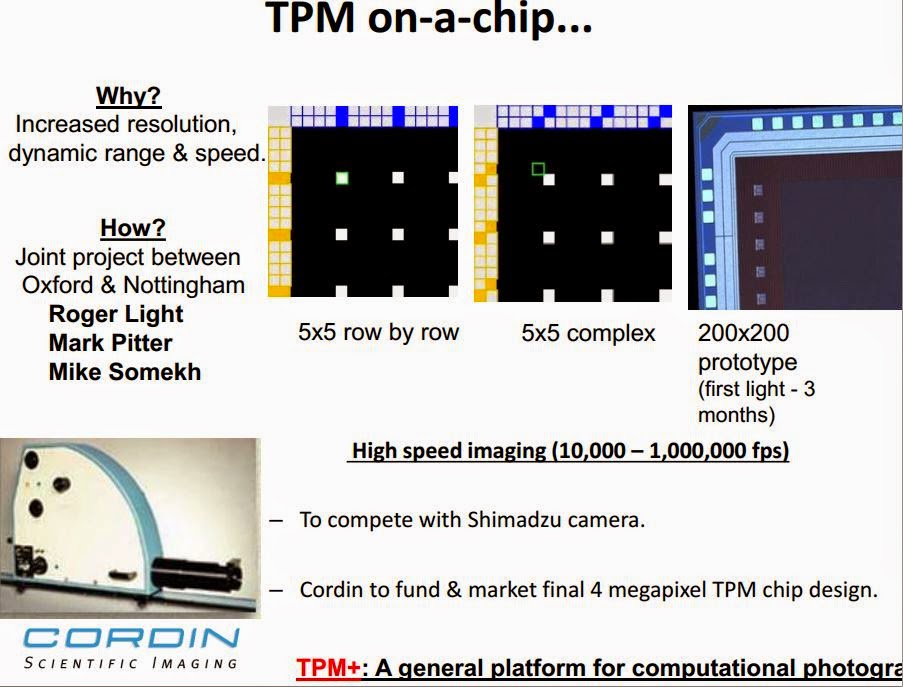
Temporal Pixel Multiplexed Imaging

online engineering degree/engineering degree online/online engineering courses/engineering technology online/engineering courses online/engineering technician degree online/online engineering technology/electronic engineering online
Gil Bub, Oxford, UK University Research Lecturer presents fast and high resolution imaging approaches, one of them being Temporal Pixel Multiplexing (TPM):

9:25 PM

Rumor: Microsoft New ToF Camera

online engineering degree/engineering degree online/online engineering courses/engineering technology online/engineering courses online/engineering technician degree online/online engineering technology/electronic engineering online
I was told that the strange medallion that Alex Kipman wore on his jacket during the HoloLens presentation is in fact the newest version of Microsoft ToF camera, designed in Israel:


The same medallion appears in the Dallas Morning News and the Verge:

1:27 AM

Omnivision Proposes Feedback to Reduce FD Voltage Swing

online engineering degree/engineering degree online/online engineering courses/engineering technology online/engineering courses online/engineering technician degree online/online engineering technology/electronic engineering online
Omnivision patent application US20150015757 "Image sensor pixel cell readout architecture" by Trygve Willassen says "The sum of the floating diffusion voltage swing and pinning voltage typically limits the supply voltage for the active pixel sensor to a minimum of 2.5-3 Volts. However, there is a continuing demand for active pixel sensors with a supply voltage of less than 2.5-3 Volts as the demands for further miniaturization of active pixel sensors increase." So, the proposal is to reduce the FD swing by a capacitive feedback through Cfb 116:

1:58 PM

Reports: Microsoft AR HoloLens Controlled by 4 Cameras

online engineering degree/engineering degree online/online engineering courses/engineering technology online/engineering courses online/engineering technician degree online/online engineering technology/electronic engineering online
Microsoft presents a augmented reality HoloLens headset mixing the real world with computer data, featuring in a Youtube video:


Another Youtube video shows Microsoft HoloLens demo driven by gesture control:


Engadget says "There are at least four cameras or sensors on the front of the HoloLens prototype." Mashable writes "Based on a quick look at the headset, it appears to have four front-facing cameras that could be used to detect the positions of the user's hands as she interacts with holographic objects."

Another Mashable article says "The augmented-reality headgear is full of sensors, but the most powerful one may be the 3D depth sensor. It’s the same one you’ll find in the Kinect and it is capable of building a detailed 3D mesh map of a room and everything in it. Once HoloLens knows what’s in the room, it can essentially drape 3D imagery over it so that it looks as if the digital objects and textures are part of the same environment as real world walls and furniture."

Microsoft HoloLens

Another Microsoft video briefly shows HoloLens internal design:

HoloLens internals

Wired reports that "the headset is still a prototype being developed under the codename Project Baraboo, or sometimes just “B.” Hololens chief inventor, Alex Kipman has "been working on this pair of holographic goggles for five years. No, even longer. Seven years, if you go back to the idea he first pitched to Microsoft, which became Kinect."

Seattle Times reports "The company isn’t saying how much a HoloLens will cost or when it will be broadly available but it’s likely to cost less than a high-end computer. Chief Executive Satya Nadella said it’s intended to be accessible to consumers as well as business users, though the latter seems to be a primary target."
12:54 PM

Leap Motion CTO on Future Human-Machine Interfaces

online engineering degree/engineering degree online/online engineering courses/engineering technology online/engineering courses online/engineering technician degree online/online engineering technology/electronic engineering online
David Holz, Leap Motion CTO, presents his vision on future human-machine interaction in this Youtube video:

12:43 PM

Image Sensors London Conference

online engineering degree/engineering degree online/online engineering courses/engineering technology online/engineering courses online/engineering technician degree online/online engineering technology/electronic engineering online
Image Sensor conference to be held on March 17-19, 2015 in London, UK, has published its final agenda:

Workshop – If you can’t make it global, then let the shutter roll!
Dr Albert Theuwissen, Founder, Harvest Imaging

This workshop will deal with needs, advantages, disadvantages and characteristics of several shutter that are being used with CMOS image sensors. Most devices on the market do have a rolling shutter, but there is a need to have a global shutter like it was the case for CCDs.

Fast moving objects in the scene do deform when read out in rolling shutter mode. But switching from a rolling shutter to a global shutter is not straight forward, for sure not in the case today's characteristics of the rolling shutter devices need to be maintained (correlated-double sampling, anti-blooming, electronic shuttering, low dark current). Two global shutter types are introduced in commercial products: storage of the signals in the charge domain or in the voltage domain.

The first part of the workshop will concentrate on the basic properties of the two shutter types, as well as on the effect the rolling and global shutter have on the imager characteristics. In the second part of the workshop two existing solutions, resp. of the global shutter in the charge domain as well as the global shutter in the voltage domain will be analyzed and compared with each other. Finally a look into the future will close the workshop.


Technology push, or market pull – perspectives on maximising opportunities from technology development
Giora Yahav, General Manager - Advanced Imaging Technology Organisation, Microsoft
  • So you have a great idea, what now?
  • Finding a niche, or letting the niche find you
  • Where next in 3D imaging, technology push or market pull in 2015 and beyond
Patenting an idea
Daniel Doswald, Examiner, EPO
  • Familiarize yourself with IP - How to search for patents
  • Is my idea patentable?
  • Disclosure and scope of protection of a patent
  • Inside the mind of a patent examiner
  • Challenging a competitor’s patent in an early stage
Protecting your IP in today’s fast moving image sensor marketplace
Keith Beresford, European Patent Attorney, Beresford & Co
  • Quick guide to patents and why they are important for your business
  • Best practice for integrating IP protection into your R&D workflow and business strategy
  • Experiences from the front lines – what happens if you draft your specification poorly
  • Combatting patent trolls – what you can do to prevent and deter this activity
Beyond Bayer rolling shutter CMOS image sensors
Eiichi Funatsu, Senior Director, OmniVision
  • CMOS image sensor market and development trend
  • Super high sensitivity by RGBC solution
  • RGB-IR for man-machine interface
  • Global shutter for machine vision
Stacked image sensors - the new image sensor standard
Paul Enquist, CTO, Ziptronix
  • State of play with chip stacking
  • Comparison of stacking using TSV's vs. hybrid bonding
  • Technical benefits of the stacking approach
The role of ADCs in imaging applications - novel approaches
Prof Ángel Rodríguez-Vázquez, R&D Director, AnaFocus
  • CIS technology trends and the need for ADCs in emerging applications
  • ADC options and how to implement
  • Limitations and areas for further study
Optical filter glass for image sensors
Prof Steffen Reichel, Development / Application, Advanced Optics, Schott
  • Challenges for IR cut filters with BSI chips
  • Evaluation of IR filers glass materials and lens design
  • Recommendation for materials specifications and performance parameters for plano-plano IR filters
Image sensor device testing needs with high yield performances
Satoshi Takahashi, Senior Engineer, Advantest
  • Growing manufacturing and demand requirements drive the need for test systems
  • The key factors to realize high yield device testing for CIS device manufacturing
  • Architecture and performances of test system capable of measuring 64 devices simultaneously at up to 2.5Gbps.
Security imaging today and tomorrow
Dr Anders Johannesson, Senior Expert Engineer, Axis Communications
  • Historical development of security cameras from grainy images to self-contained systems with 4K resolution and beyond
  • Defining the imaging challenges in security applications
  • Key aspects for further improvement in security cameras
Advances in cooled/uncooled IR sensors for security applications
Claire Valentin, VP Marketing, Sofradir

Image sensors for low light levels with active imaging features
Pierre Fereyre, Image Sensor Design, and Gareth Powell, Strategic Marketing Manager, e2v
  • Five transistor pixel CMOS sensor for range-gated active imaging to extend usability of intelligent cameras in the most difficult conditions
  • Advanced state of the art image sensors and embedded features, with emphasis on size, weight, power and cost benefits
  • New applications that are enabled
Image sensor planetary space mission
Dr Harald Michaelis, Head of Department, DLR Institute of Planetary Research
  • Image capture aims of the Rosetta mission
  • Camera and sensor specifications, performance parameters, design considerations
  • Results from the mission
  • Future planetary imaging plans and aspirations and next generation camera design
Future of computational imaging
Raji Kannan, Founder, LensBricks
  • Hardware developments
  • Advanced in processing and impact at a system level
  • Market opportunities
Image Fusion - how to make best use of broad spectrum data
David Connah, Research Associate in Visual Computing, University of Bradford / CoFounder, Spectral Edge
  • Challenges in fusing multiple data channels into one single image for display
  • Mapping the contrast (structure tensor) of a multi-channel image is mapped exactly to a 3-channel gradient field
  • The problem of mapping N-D inputs to 3-D (RGB) outputs
  • Applications in hyperspectral remote sensing, fusion of colour and near-infrared images and colour visualisation of MRI Diffusion-Tensor images
Lensless ultra-miniature computational sensors and imagers: using computing to do the work of optics
Dr David Stork, Fellow and Research Director of the Computational Sensing and Imaging Group, Rambus Labs
  • Computational optical sensors and imagers that do not rely on traditional refractive or reflective focusing
  • Computing images from raw photodiode signals
  • Imager performance, features, and applications
High performance smart automotive camera system
Tarek Lulé, Automotive Camera System Consultant, ST Microelectronics
  • Automotive camera needs: power, size, ambient requirements
  • High sensitivity, hdr pixel architecture: choice of pixel and resulting performance
  • Imager system architecture: 1.3mpix raw image sensor with 130db dynamic range and excellent low light performance
  • Automotive hdr image processor: very low power companion chip for hdr colorization, with embedded video analytics and automotive interfaces
Depth sensing solutions for consumer electronics
Markus Rossi, Chief Innovation Officer, Heptagon Advanced MicroOptics
  • Drivers for optical depth sensing in consumer applications and review of current technologies
  • Hardware solutions for depth sensing concepts
  • Case examples
Cameras in medical applications - novel applications and innovative camera designs
Thomas Ruf, Manager Sales and New Business, First Sensor E²MS
  • Medical cameras come in all shapes and sizes – what challenge does this present?
  • Examples of innovative camera design for X-ray apparatus, computer tomographs and stereo endoscopes
  • Enabling technologies for design and assembly of complex and unique camera systems
High end camera systems for multi imager applications
Marcus Verhoeven, Managing Director, aSpect Systems
  • Implementing hardware, software, mechanics, temperature control, optics and imaging technology for high performance imaging applications
  • Example 1: Per pixel energy dispersive X-Ray architecture with a resolution of 400x400 pixels (250µm), a frame rate of 10.000 FPS which supports an energy resolution of 1keV in a range from 3-220keV
  • Example 2: A new detector for proton therapy of cancer based on a stack of 12 crossed strip detectors and 24 layers of CMOS imagers
An insider's outside view of image sensor development past, present and future
Jed Hurwitz, Technologist, Advanced Measurement Systems, Analog Devices
  • The beginning of CMOS
  • The glory years!
  • Progress viewed from the outside
  • Perspectives on the future of digital imaging
12:23 PM

IEEE BIO- medical - BRAIN-COMPUTER INTERFACE & EEG project topics

online engineering degree/engineering degree online/online engineering courses/engineering technology online/engineering courses online/engineering technician degree online/online engineering technology/electronic engineering online
bio medical project topics

1.) Development of Wireless Brain Computer Interface With Embedded Multitask Scheduling and its Application on Real-Time Drivers Drowsiness Detection and Warning
2.) A Multi-class BCI using MEG
3.) A Miniature Robot for Isolating and Tracking Neurons in Extracellular Cortical Recordings
4.) Adaptive brain interface (ABI) : A portable non-invasive brain-computer interface
5.) An adaptive neuro-fuzzy method (ANFIS) for estimating single-trial movement-related potentials
6.) A Brain Computer Interface based on Steady-State Visual Evoked Potential
7.) Prosthetic Control by an EEG-based Brain-Computer Interface (BCI)
8.) EEG Signal Classification for Brain Computer Interface Applications
9.) Estimating cognitive state using EEG signals for BCI design
10.) EEG-based control of reaching to visual targets
11.) EEG-Based Brain-Computer Interaction: Improved Accuracy by Automatic Single-Trial Error Detection
12.) Mental Task Classification for Brain Computer Interface Applications
13.) Vibrotactile Feedback in the context of Mu-rhythm Based BCI
14.) BCI device for paralysed patient
15.) PC & Pocket PC based BCI architectures
16.) EEG based brain computer interfaces
17.) Rapid Prototyping of an EEG-based Brain-Computer Interface (BCI)
18.) Signal extraction for Brain computer interface
19.) Statistical modelling for adaptive Brain computer interface
20.) A flexible Brain Computer Interface for applications ranging from video game to virtual environment
21.) Classification of Brain computer interface data
22.) Functional Near IR spectroscopy for adaptive BCI
23.) The non-invasive Brain-Computer Interface: Fast Acquisition of Effective Performance in Untrained Subjects
24.) Development of a neuronal motor prosthesis for the restoration of movement in paralyzed people
25.) Discriminating sounds from the human electrocorticogram for brain-computer interfaces
26.) Performance and control error related neuronal signals in human ECoG recordings
27.) Decoding Performance for Hand Movements: EEG vs. MEG
28.) Movement onset related changes in ECoG recordings
29.) Human brain-machine interfacing based on epicortical field potentials
30.) Neuronal encoding of movement in motor cortical networks
31.) Prediction of Arm Movement Trajectories from ECoG-Recordings in Humans
32.) Hand movement direction decoded from MEG and EEG
33.) Movement Related Activity in the High Gamma Range of the Human EEG
34.) Applicability of hand movement decoding in MEG-based Brain-Machine-Interfaces
35.) Identification of Natural Grasps in Human ECoG Signals
36.) Representation of arm movement parameters in the EEG
37.) Unsupervised adaptive kalman-filter for decoding non-stationary brain-signals
38.) Human brain-machine interfacing based on epicortical field potentials
39.) Spatiotemporal mapping of information about arm movement direction using high-resolution EEG
40.) Decoding of movement from electrocorticographic (ECoG) recordings in human sensorimotor cortex – a potential basis for a brain-machine interface
41.) Portable Electroencephalogram Biofeedback Device
42.) Design and development of visual evoked potentials recording system for diagnosis of optic nerve diseases
43.) Wireless neural data acquisition system
44.) Design and evaluation of Human computer interaction using electro-oculography
45.) Development and Performance Evaluation of a Neural Signal-based Assistive Computer Interface
46.) Non-invasive brain actuated control of a mobile robot using human EEG
47.) Brain Computer Interface Cursor Measures for Motion-impaired and Able-bodied Users
48.) Brain-Computer Interface for a Prosthetic Hand Using Local Machine Control and Haptic Feedback
49.) Brain-computer interfaces for 1-D and 2-D cursor control: designs using volitional control of the EEG spectrum or steady-state visual evoked potentials
50.) Control of a two-dimensional movement signal by a noninvasive brain-computer interface in humans
51.) Single channel EEG based prosthetic hand grasp control for amputees
52.) Rapid Prototyping of a Single-Channel Electroencephalogram-Based? Brain- Computer Interface
53.) Real time eye blink suppression using neural adaptive filters for EEG based BCI
54.) Frequency component selection for EEG based BCI
55.) Designing and Fitting FES and Prosthetic Systems in a Virtual Reality Environment
56.) Artifact EEG detection in sleep EEG recording
57.) Integrated system for analysis and automatic classification of sleep EEG
58.) On-Line Evaluations of the LF-ASD BrainComputer Interface With Able-Bodied and Spinal-Cord Subjects Using Imagined Voluntary Motor Potentials
59.) Detection of event-related potentials for development of a direct brain interface
60.) Identification of finger flexions from continuous EEG as a brain computer interface
61.) Separability of EEG signals recorded during right and left motor imagery using adaptive autoregressive parameters
62.) De-trended fluctuation analysis of EEG in sleep apnea using MIT/BIH polysomnography data
63.) Artifact Removal from Electroencephalograms Using a Hybrid BSS-SVM Algorithm
64.) Pre-processing and time-frequency analysis of newborn EEG seizures
65.) Feature Attraction and Classification of Mental EEG Using Approximate Entropy
66.) Analysis of Sleep Fragmentation and Sleep Structure in Patients With Sleep Apnea and Normal Volunteers
67.) P300 Detection for Brain-Computer Interface from Electroencephalogram contaminated by Electrooculogram
68.) Simple Gesture Recognition of Bio-Potential Signals and Its Application to Hands-Free Manipulation System

69.) Prediction of Multiple Movement Intentions from Contingent Negative Variation (CNV) Signal for Multi-Dimensional BCI