Senior Piping Designer (12 Months)–McDermott Dubai

...
Senior Piping Designer (12 Months) United Arab Emirates - DU - Dubai Job Description Provides equipment layout piping design, checking and isometric generation utilizing PDMS software. - Produces equipment arrangements. - Produces Piping plans. - Sections and isometrics. - Conducts design reviews with project personnel. - Responsible for designs from initial conceptuals through

Piping Designer–Dubai McDermott

...
Piping Designer United Arab Emirates - DU - Dubai Job Description Piping Engineering Assistant Job Requirements 'Ideally trained in SPMAT system for ident creations, Spec Generation, BOM processing and to raise requisitions thru SPMAT. Basic knowledge of piping materials to idendify the base material of the components and also to identify the required parameters on component buying

Piping Draftsman–McDERMOTT, Dubai

...
Piping Draftsman United Arab Emirates - DU - Dubai Job Description Prepares piping fab support deliverables such as pipe spool drawing, Pipe support cutlist/ detail sheets Able to read and interpret layout/piping drawings. Well versed in PDMS, MDS, AutoCAD, micro station (i.e. can produce fab drawing using them). Good in time management and can work under pressure/ Job Requirements

Lead PIPING LAYOUT ( Mumbai )

...
Job Description   Lead PIPING LAYOUT ( Mumbai ) Graduate / Post Graduate in Mechanical / Chemical Engineering & having 12 to 25 years' design experience in detail engineering/Consultancy Services in leading the team of piping engineers/designers for execution of refinery / petrochemicals / fertilizers projects. Salary:INR 15,00,000 - 30,00,000 P.A Industry:Oil and Gas / Energy / Power

Piping Checker - 6 Months Contract

...
Job Description We are urgently looking for a Piping Checker for 6 months contract. The ideal candidate should be a Diploma Holder in Mechanical / Chemical with 20 yrs of experience in Piping and ISO Checking. The position is for Value Engineering Department. BE/BTech or ME/MTech with 15 yrs experience may also apply Should have very good experience of 3D Softwares / MTO / Model review. 

Omnivision 12MP Stacked Sensor for High-End Smartphones

...
PRNewswire: OmniVision announces the OV12890, a new 1.55um big-pixel stacked sensor with 12b ADC and PDAF and HDR support for flagship smartphones. The OV12890 uses OmniVision's PureCelPlus-S pixel technology to capture full resolution 12MP images and video at 45fps, 4K2K video at 60fps, and 1080p video at 240fps via high speed D-PHY and C-PHY interfaces.

The OV12890 can fit into 10 x 10 mm modules with a z-height of 6 mm. The sensor is currently available for sampling and is expected to enter volume production in Q4 2016.

"As cameras for premium smartphones continue to improve, we see the resolution race slowing down and increasing emphasis placed on pixel performance and image sensor size as key to ever-higher quality mobile images and video," said James Liu, senior technical marketing manager at OmniVision. "The OV12890 is our newest big-pixel stacked die image sensor for the mobile market, and represents one of our strongest offerings for premium smartphones. The feature-rich OV12890 captures exceptional images and video in a compact package, making it a top-flight imaging solution for flagship mobile devices."

1:04 PM

Particle and Photon Detection: Counting and Energy Measurement

...
The open-access Sensor Journal publishes a review paper "Particle and Photon Detection: Counting and Energy Measurement" by James Janesick and John Tower, SRI-Sarnoff.

"The challenges to extend photon counting into the visible/nIR wavelengths and achieve energy measurement in the UV with specific read noise requirements are discussed. Pixel flicker and random telegraph noise sources are highlighted along with various methods used in reducing their contribution on the sensor’s read noise floor. Practical requirements for quantum efficiency, charge collection efficiency, and charge transfer efficiency that interfere with photon counting performance are discussed. Lastly we will review current efforts in reducing flicker noise head-on, in hopes to drive read noise substantially below 1 carrier rms."


"we are trying a proprietary non-imaging gate oxide process offered by Jazz Semiconductor that claims to lower MOSFET 1/f RTN noise by 4 to 5 times compared to 0.18 um processing that is used now."
1:07 PM

Too Much Bang For the Buck: Exploding E-Cigarettes

...
-->
Last June, a man named Hamid Sadeghy was installing a car windshield in Austin, Texas when he felt a vibration in his pocket.  Sadeghy, who owns his own auto-glass company, is a responsible person who had been trying to cut back on his cigarette habit for the previous month or so by using electronic cigarettes (also called e-cigs or vapes).  Suddenly, in Sadeghy's words "It was like a firecracker.  It made the same exact noise.  A hissing sound and then burning sensation."  An e-cigarette in his pants pocket had exploded.  He suffered severe burns on his thigh which caused him to have difficulty walking, and was not able to return to work for three weeks following the accident. 

Sadeghy is one of dozens if not hundreds of people who have been affected by e-cigarette explosions.  Ironically, many people use e-cigarettes for the same reason Sadeghy did:  as a less harmful alternative to conventional smoking.  Although the jury is still out on the health hazards of e-cigarettes, there may be something to this idea.  But it changes the picture if every time you light up you're taking a chance that what you're smoking will turn into a pipe bomb.

The phenomenon of e-cigarettes showed up in the U. S. around 2007, and a 2015 poll showed that about 10% of U. S. adults now use the product at least occasionally. Vape shops have sprung up in many places, and most convenience stores carry them.  (Interestingly, the major tobacco companies dominate the convenience-store market channel.)  So if even a few hundred people have had their e-cigarette blow up on them, it is still a very rare occurrence, on the order of one incident per year for every 10,000 to 100,000 users.

Still, the tip of the injury iceberg of e-cigarettes is pretty grim, not to mention the property damage caused by fires.  A recent article on Buzzfeed shows graphic photos of Joseph Cavins, whose exploding e-cigarette destroyed one eye, and Thomas Boes, who lost three teeth in a disfiguring explosion from the same cause.  It's not clear whether such highly publicized stories are responsible for a recent slowdown in the growth of the e-cigarette market, but it's certainly possible.  It's well known that a few really exotic and gruesome accidents can cause more popular fear than a much larger number of less chilling mishaps.  This is why some people will get in a car without thinking but refuse to fly under any circumstances, even though the risk of accidents per mile traveled are much greater in automobiles.

A federal agency called the U. S. Fire Administration (USFA) did a study in 2014 of accidents and fires caused by e-cigarettes, and found that about four out of five happened during charging.  Most of the units use a universal-type USB connector to charge the lithium-ion battery that provides the power to heat the vaporizing element.  Unfortunately, this connector will fit pretty much any USB outlet, including power sources that were not designed to charge the particular battery that the e-cigarette uses.  The USFA thinks that most of the fires happened when the user tried to charge their unit with a power source not designed for it.

Lithium-ion batteries are nasty chemically, even when they are not enclosed in a cylindrical metal structure that unintentionally forms a pipe bomb.  The electrolyte is flammable.  If such a battery is charged too fast, it overheats, the liquid electrolyte vaporizes and breaches the battery case, and the thing catches fire.  The fire raises the pressure inside the metal tube of the e-cigarette, and here's where the pipe-bomb analogy comes in.  Small tubes can contain much higher pressures than other shapes, and so the tube doesn't give out on the sides.  Instead, the end cap or caps blow off, but only after the pressure has built up to an extremely high level.  When a cap lets go, the flaming electrolyte shoots it off with the force of a projectile and sprays itself all over whatever is nearby.  If the unit's being charged, that may be only things like flammable paper or wood. 

But in the fairly rare cases when the battery fails while in use, this sequence of dire events can go off in your face, with tragic and disfiguring results.  Properly designed and manufactured lithium-ion batteries don't explode spontaneously as they are charged or discharged, but the technology is being pushed pretty hard even when an e-cigarette operates normally.  A current of an amp or more is needed to heat the vaporizing element, and some counterfeit or shoddily made batteries can't handle that reliably and end up with an internal short due to overheating.  The result is pretty much the same as with overcharging:  electrolyte vaporizing and an explosion.

The Buzzfeed report says that the U. S. Food and Drug Administration (FDA) is moving to regulate e-cigarettes, bringing them under the same regulatory umbrella as conventional tobacco products.  Their plan is to require sellers to apply for authorization to sell the units, with approval hinging on safety features such as overcharging protection circuitry.  Of course, this would make the units cost more, but the present situation that makes it easy to connect an e-cigarette to the wrong charger is clearly a bad one.

Fire has a way of showing up in the early stages of many electrical products.  For a few years I worked at a division of Motorola which made two-way radios for first responders, and learned something about the history of the company, which goes back to the early days of radios installed in automobiles around 1930.  Back then it seems that the company rushed some auto radios into production that were not sufficiently safety-tested, and the resulting burned-up cars nearly killed Motorola.  Fortunately, they figured out what was wrong and fixed it, and car radios became one of the company's mainstays for many years.

The vaping industry needs to clean up its safety act by changing the charging method so consumers can't accidentally make little time bombs by plugging an e-cigarette into the wrong charger.  This will require coordination among the dozens of largely Chinese e-cigarette makers that up to now are probably engaged in cut-throat competition, and may not happen unless the FDA imposes the requirement on them.  So it will be interesting to see what happens in that regard.  In the meantime, if you happen to be a vape-er (?), be sure to use only the charger that came with the unit.  And it might not be a bad idea to wear safety glasses while you smoke.

Sources:  I thank my wife for pointing out to me the article on Buzzfeed from which I learned of this problem, posted on May 26, 2016 at  
-->https://www.buzzfeed.com/josephbernstein/burned?utm_term=.tbvvL7kEL#.mr0E63qy6.  I also referred to a vaping website called IEC where an (admittedly unscientific) survey of thirty e-cigarette accidents is reported at http://info-electronic-cigarette.com/e-cigarette-explosions-an-in-depth-investigation/.  This site refers to the USFA study, which is available at https://www.usfa.fema.gov/downloads/pdf/publications/electronic_cigarettes.pdf.  Mr. Sadegh's story was reported by Fox News on June 30, 2015 at http://www.fox7austin.com/news/4664501-story, and the statistic that about 10% of U. S. adults use e-cigarettes is from http://www.reuters.com/article/us-usa-ecigarette-poll-analysis-idUSKBN0OQ0CA20150610.
Note added July 18, 2016:  A reader named Jason Artman read the above post and brought my attention to his website http://ecigone.com/featured/e-cigarette-explosions-comprehensive-list/, where he is maintaining a comprehensive list of over 100 e-cigarette explosion incidents.  

Robustness of CMOS Technology and Circuitry Outside the Imaging Core : Integrity, Variability, Reliability

...
Albert Theuwissen announces the 4th Harvest Imaging Forum "Robustness of CMOS Technology and Circuitry outside the Imaging Core : integrity, variability, reliability" by Harry Veendrick. The forum is to be held in December, 2016 in Voorburg (the Hague), the Netherlands. The 2016 Forum is meant to present an overview on the importance of understanding all aspects that determine the robustness of CMOS integrated circuits present “around” the imaging core of a CMOS image sensor.

CEI-Europe announces few more image sensor courses by Albert Theuwissen.
10:53 AM

Omnivision Announces 3rd Generation 13MP Sensor

...
PRNewswire: OmniVision announces the OV13855, its third-generation 13MP 1.12um pixel sensor with significant improvements in low-light performance, color crosstalk reduction and angular response when compared with previous-generation 13MP sensors. The OV13855 is built on PureCel-Plus pixel technology with PDAF and aimed to mainstream smartphone rear-facing cameras as well as front-facing and dual cameras.

"The 13-megapixel resolution segment is becoming the minimum box specification for rear-facing cameras in mid- to low-end smartphones. Recent market research suggests that the 13-megapixel smartphone camera module market may grow at a CAGR of 16 percent through 2020," said Badri Padmanabhan, product marketing manager at OmniVision. "With its compact form factor and advanced feature set, the OV13855 provides pioneering OEMs with an excellent opportunity to integrate 13-megapixel image sensors into their high-end smartphones for front-facing or dual camera applications."

The OV13855 captures full-resolution 13MP still images at 30fps and records 4K2K video at 45fps, 1080p at 60fps, or 720p HD at 90fps. With its compact design and two-sided bond pad layout, the OV13855 can easily be integrated into 8.5 x 8.5 mm autofocus modules with z-heights of less than 5 mm for main cameras, and 7.5 x 7.5 mm fixed focus modules with z-heights of less than 4.5 mm for high-end front-facing cameras.

The OV13855 is currently available for sampling, and is expected to enter volume production in Q2 2016. The sensor is available in non-PDAF (OV13858) and monochrome (OV13355) versions to support front-facing and dual-camera applications.
1:49 PM

How Much Warming Have Humans Caused?

...
How much did temperatures rise since 1900?

Differences in baseline (reference period) can result in dramatic differences in temperature rise. The U.K. Met Office HadCRUT4 dataset typically presents temperature anomalies relative to a 1961-1990 baseline. NASA typically uses a 1951-1980 baseline, but the NASA website allows for different baselines to be selected. When selecting a 1961-1990 baseline, the temperature of the past period of six months was 1.05°C (1.89°F) higher than this baseline, as illustrated by the NASA map in the left panel of the image below. But when compared to 1890-1910, the temperature of the past period of six months was 1.48°C (or 2.664°F) higher, as illustrated by the NASA map in the right panel of the image below.


A polynomial trend can reduce variability such as caused by volcanoes and El Niño events. The graph below was created with the NASA L-OTI monthly mean global surface temperature anomaly, which has a 1951-1980 baseline, and then with 0.29°C added, which makes the anomaly 0°C in the year 1900 for the added polynomial trend.


This gives an idea of how much temperatures have risen since the year 1900, with a rise for both February and March 2016 showing up that was more than 1.5°C, as also illustrated by the image below. The trend further points at temperature anomalies that will be more than 1.5°C (from 1900) within a decade and more than 2°C soon thereafter.


Temperature Rise before 1900


To see by how much temperatures have risen compared to pre-industrial levels, we need to go back further than 1900. The graph below shows that carbon dioxide concentrations have gone up and down between roughly 180 ppm and 280 ppm over the past 800,000 years and did recently reach a peak of 411 ppm (peak hourly average on May 11, 2016).


The graph below, from an earlier post, shows how in the past, over the past 420,000 years, temperatures (and levels of CO2 and CH4) have gone up and down by some 10°C, in line with the Milankovitch cycles.


Historically, carbon dioxide rises of 100 ppm have gone hand in hand with temperature rises of some 10°C. The recent rise in carbon dioxide concentrations is a 131 ppm rise (from some 280 ppm to 411 ppm). The rise in methane concentrations is even steeper. Could we therefore expect a temperature rise of more than 10°C to happen, and if so how soon could this eventuate? As described below, warming caused by humans could result in a temperature rise of more than 10°C (18°F) within a decade.

The graph on the right, created by Jos Hagelaars, shows that temperatures started rising some 20,000 years ago, reaching a peak some 7000 years ago (in the blue part of the graph). For more detail, also see the comic added at the end of this post.

The graph underneath, based on work by Marcott et al., focuses on this blue part of the graph, while using a 1961-1990 baseline. Temperatures reached a peak some 7000 years ago, and then came down to reach a low a few hundred years ago.

The peak and the bottom temperatures (highlighted in red on image on the right below) for that period suggest there was a fall of more than 0.7°C.

So, a few hundred years ago, temperatures were falling and they would have kept falling, in line with the Milankovitch cycles, had there been no warming caused by humans.

From that bottom point, temperatures first rose by about 0.4°C, overwhelming the downward trend that would otherwise have taken temperatures down further, and then there was an additional rise of at least 1.05°C, when using a baseline of 1961-1990, indicating that humans caused a total of at least 1.45°C warming.

Lewis & Maslin (2015) suggest that, since CO2 began to rise from a low point in 1610, that year could be taken as the start of the Anthropocene. The image on the right also shows that the year 1750 was a low point for CO2 levels and temperature, i.e. well below the baseline of 1961-1990.

The image on the right, from BerkeleyEarth.org, shows CO2 levels and temperatures rising hand in hand from 1750.

Humans have caused even more warming

The situation looks to be even worse than what the above figures may suggest. Indeed, the bottom low point in the Marcott graph would have been even lower had there been no warming by humans. 

The fact that humans did cause substantial warming between 1800 and 1900 is illustrated by the graph below, from a recent post by Michael Mann, who adds that some 0.3°C greenhouse warming had already taken place between the year 1800 and the year 1900.
Some 0.3C greenhouse warming had already taken place by 1900, and some 0.2C warming by 1870
Further studies suggest that humans also caused substantial warming well before 1800, as illustrated by the image on the right. While this study focuses on Europe, it does suggest a rise from 1600 to 1800.

Another example of warming caused by humans before 1800 is presented in research by Dull et al., which suggests that burning of Neotropical forests increased steadily in the Americas, peaking at a time when Europeans arrived in the late fifteenth century. By 1650, some 95% of the indigenous population had perished. Regrowth of forests led to carbon sequestration of some 2 to 5 Pg C, thereby contributing to a fall in atmospheric carbon dioxide recorded in Antarctic ice cores from about 1500 through 1750.

Since at least the fourth century A.D., coal has
been burned in China. W. F. Ruddiman further points in a 2007 paper at human emissions from burning biomass and irrigation, livestock and human waste, and the resulting climate system feedbacks. As illustrated by the image on the right, this had already caused substantial warming prior to the industrial revolution.

In conclusion, substantial warming took place before 1900, making that temperatures were higher than what they would have been had humans caused no warming. Greenhouse gases emitted by people held off a temperature fall that would otherwise have naturally occurred, and they caused a temperature rise on top of that.

Paris Agreement

NASA data suggest that it was 1.48°C (or 2.664°F) warmer than in 1890-1910 for the period from November 2015 to April 2016. Note again that this 1890-1910 baseline is much later than pre-industrial times. The Paris Agreement had pledged to limit the temperature rise to 1.5°C above pre-industrial levels. On land on the Northern Hemisphere, it was 1.99°C (or 3.582°F) warmer (right map of the image below).

[ Temperature anomalies for the period from November 2015 to April 2016, see also comments ]
The above images only account for a half-year period (November 2015 to April 2016), so they are only indicative for what the total rise will be for the year 2016. Nonetheless, when taking into account warming caused by people before 1900, the year 2016 looks set to hit or even exceed the guardrails that the Paris Agreement had pledged would not be crossed. The situation looks even worse when considering that temperatures measured in ice cores already included a substantial amount of warming due to humans even before the start of the Industrial Revolution.

February 2016 was 1.67°C (3°F) warmer than 1890-1910
Again, at the Paris Agreement nations pledged to hold the increase in the global average temperature to well below 2°C above pre-industrial levels and to pursue efforts to limit the temperature increase to 1.5°C above pre-industrial levels.

When looking at a single month, February 2016 was 1.67°C (3°F) warmer than 1890-1910 (see image right). When adding a mere 0.34°C to account for warming before 1900, total warming in February 2016 did exceed 2°C. Looking at it that way, the guardrails set in Paris in December 2015 were already crossed in February 2016.

Situation

So, what is the situation? On the one hand, there's the current observed temperature rise (∆O). This rise is typically calculated as the difference between the current temperature and the temperature at a given baseline.

However, this ∆O does not reflect the full impact of human emissions. Temperatures would have been lower had there been no emissions by humans. The full warming impact due to people's emissions therefore is ∆E. This ∆E is higher than the often-used observed rise, since the baseline would have been lower without warming caused by humans.

At the same time, part of global warming caused by people is currently masked due the aerosol emissions (∆A). Such aerosol emissions result mainly from burning of fossil fuel and biomass. There's no doubt that such emissions should be reduced, but the fact remains that the current temperature rise may increase substantially, say, by half when the masking effect disappears.

Thus, the full (unmasked) current warming caused by humans is the sum of these two, i.e. ∆E + ∆A, and the sum could be as high as 3°C or even more than 5°C.

In addition, there is a future temperature rise that's already baked into the cake (∆F). Some feedbacks are not yet very noticeable, since some changes take time to become more manifest, such as melting of sea ice and non-linear changes due to feedbacks that are only now starting to kick in. Furthermore, the full effect of CO2 emissions reaches its peak only a decade after emission, while even with the best efforts, humans are likely to still be causing additional emissions over the coming decade. All such factors could jointly result in a temperature rise greater than ∆E + ∆A together, i.e. ∆F could alone cause a temperature rise of more than 5°C within a decade.

In summary, total warming caused by humans (∆E + ∆A + ∆F) could be more than 10°C (18°F) within one decade, assuming that no geoengineering will take place within a decade.

The situation is dire and calls for comprehensive and effective action as described in the Climate Plan.

[ image from xkcd.com/1732 ]


Links

- Methane Erupting From East Siberian Arctic Shelf
http://arctic-news.blogspot.com/2014/11/methane-erupting-from-east-siberian-arctic-shelf.html

- Jos Hagelaars' graph, created with graphs by Shakun et al., Marcott et al. and more, is at:
https://ourchangingclimate.wordpress.com/2013/03/19/the-two-epochs-of-marcott/

- Global warming preceded by increasing carbon dioxide concentrations during the last deglaciation, by Shakun et al. http://www.nature.com/nature/journal/v484/n7392/full/nature10915.html

- A Reconstruction of Regional and Global Temperature for the Past 11,300 Years, by Marcott et al.
http://science.sciencemag.org/content/339/6124/1198

- The Columbian Encounter and the Little Ice Age: Abrupt Land Use Change, Fire, and Greenhouse Forcing, by Dull et al., in:
https://www.sciencenews.org/article/columbus-arrival-linked-carbon-dioxide-drop

- Arctic Climate Records Melting
http://arctic-news.blogspot.com/2016/05/arctic-climate-records-melting.html

- 2500 Years of European Climate Variability and Human Susceptibility, Ulf Büntgen et al. (2011)


Invisage Announces 2K SAM Camera

...
BusinessWire: InVisage announces its Spark Authentication Module (SAM) NIR camera module. SAM is powered by the previously announced SparkP2 2MP NIR sensor. Sized 8.0 x 8.0 x 3.1 mm, the SAM module is custom built for authentication systems such as Microsoft Windows Hello. In addition to blocking interference from direct sunlight, SAM enables authentication at a greater distance of beyond 100cm from a tablet, laptop or phone so that users are not constrained to a small space in front of their device. Because it operates at the 940nm wavelength, SAM also eliminates an intrusive red glow from LEDs.

SAM is said to be the only system that can deliver 2K resolution in a tiny module while consuming 50 times less system power. Existing NIR cameras operate in conjunction with high wattage LEDs to overcome low CMOS sensitivity and ambient infrared in sunlight. The resulting high power consumption and heat generated by such bright LEDs has made outdoor performance a challenge for mobile face recognition systems that operate with lighter batteries. In contrast, SAM, powered by SparkP2, leverages low-power pulsed LEDs synchronized with an extremely short global shutter exposure, allowing for accurate imaging without battery drain. At 50 times lower power consumption, overall system temperature is also up to 20 degrees cooler.

“For authentication, mobile device makers demand compact modules that produce sharp images enabling smooth user verification with minimal false negatives or false positives, regardless of whether the user is indoors or out,” said Jess Lee, InVisage President and CEO. “It also needs to work within a reasonable range so that users can say ‘Hello’ without having to plant their eye or face just a few centimeters from the screen.”

With a photosensitive layer 10 times thinner than a typical silicon infrared sensor, the SparkP2 sensor powering SAM provides QE of 35% at 940nm wavelength. This greater sensitivity results in sharper images and an expanded operational radius of beyond 100 centimeters, but it also enables minimal crosstalk in a thinner, 3.1-millimeter module with a 72-deg FOV. IR in particular suffer from blur due to high levels of crosstalk, or misdetection of light in nearby pixels. Crosstalk typically limits camera thinness by requiring a minimum distance between the lens and the photosensitive layer, but the SparkP2 lens in the SAM module can be much closer to the sensor without increasing crosstalk and preserving a higher level of sharpness.

SAM and SparkP2 are optimized for authentication systems that operate at 850nm (with a visible red glow) and 940nm (invisible with a tenfold improvement in sun irradiance rejection).

Taiwan-based DIY publishes a 940nm comparison picture:

4:07 AM

Microsoft Hololens Cameras

...
EETimes quotes Ilan Splillinger, CVP of HoloLens and silicon at Microsoft, revealing the company's AR glasses hardware details:


"The HoloLens sensor bar (above) packs four environmental cameras for tracking head movements and gestures used to control the display. A depth sensor is a Kinect scaled to a fraction of its size and power consumption. It supports a short range mode for tracking gestures within a meter and a long range mode for mapping the room. A 2MPixel high def video camera projects images the user sees."
1:21 PM

Rumor: Sony & LG Innotek to Supply Dual Camera Module for iPhone 7

...
Barron's quotes Nomura Securities and Citi Research saying that all the new 5.5″ iPhones 7 coming this fall will have dual cameras. Nomura’s Chris Chang thinks Sony is now behind schedule, which means that Apple will have to go to LG Innotek for assembly:

"We think Sony may not be able to deliver its full share of dual cameras to Apple due to: (1) lower-than-expected yield, and (2) damage to its production facility from the April earthquake in Kumamoto. As a result, we think LGI will gain majority share of the initial dual camera orders from Apple...
We expect a sharp increase in camera module ASP from 2H16F as we think: 1) dual camera module is likely to command 2.5x ASP premium vs. single-cam, and 2) OIS (optical image stabilisation) will also be equipped in the new 4.7” iPhones – currently only the 5.5” model has OIS.
"
12:19 PM

Piping Team Leader - Vietnam

...
Piping Team Leader Ho Chi Minh City, Vietnam Your new job As a Team Leader - Piping you are responsible for the further development of the of the Piping team. Your team will work on multi-disciplinary projects in various markets as per our client needs. You will take responsibility and supervise the realization of a quality design & engineering of piping systems, including drawings,

Design Engineer (Process Pipelines)–Tebodin

...
Design Engineer (Process Pipelines) Rostov-on-Don, Russia Your new job You work at the Engineering department, which is mainly concerned with the execution of process studies and making process designs of installations for clients in energy, waste treatment, chemicals, oil and gas, pharmaceuticals and the food industry. You create process pipelines designs for installations and plants,

Principal Piping Materials Engineer–WorleyParsons

...
Principal Piping Materials Engineer - ARC002L Company: WorleyParsons Primary Location : USA-CA-Arcadia Job : Piping Schedule : Full-time Employment Type: Staff Job Level: Experienced Job Posting : May 19, 2016 Reporting Manager Title: Supervising Material Engineer - Piping Design : We engineer for lasting impact. At WorleyParsons we are creating value all around the world, and our

Rooftop Views

...
In class, I have been studying different types of green roofs. this week we read an article about the growth and benefits of rooftop farms and gardens in Chicago. This article relates to what I'm learning because rooftop gardens and farms are excellent examples of green roofs. It is important to learn about these topics so we can be properly informed while designing our own homes, whether for a project or real life, as well as generally understanding what may well be the future of agriculture.

Green Roofs for Healthy Cities (GRHC), an organization that promotes green roofs, has decided to target the city of Chicago for development for a number of reasons. One reason is that Chicago was already known for its green development and rooftop gardens, so the organization had a start to work from. Another reason is that there were already green organizations reaching out to the city and they could be even more successful in their green developments by forming partnerships. These reasons, among others, were deciding factors in GRHC’s choice of Chicago.

The phenomenon known as the Urban Heat Island Effect describes how an urban area is warmer than a rural one. It is caused by a variety of factors, including lack of vegetation that would otherwise filter and cool the air, artificial materials and vibrant colors that absorb and radiate heat, and the exhaust from our cars and factories. The Urban Heat Island Effect affects humans by amplifying the amount of energy we need to cool our buildings, which in turn has a significant effect on our economy and by increasing health hazards such as heatstroke. It also affects the environment as a whole, since the increased need of energy uses up resources and the overall increase in heat contributes to global warming.

Albedo is the amount of light or radiation reflected by a surface. The albedo of a surface ranges from 0 to 1, 0 representing a surface that absorbs all the light that reaches it while 1 represents a surface that reflects all the light that reaches it. Albedo affects communities in relation to the Urban Heat Effect - a rooftop or wall with lower albedo will absorb heat, contributing to a warmer urban area, while a surface with higher albedo will reflect it. So, if as a builder and/or consumer you are designing or choosing the roof of your house, it makes sense to consider the albedo of the surface material you choose.

A rooftop farm is pretty much what it sounds like - a green way to grow food on your roof. There are many benefits to having them, such as much greater efficiency in food production, opportunity for city-dwellers to reconnect with nature and agriculture, and reduced seasonal limitations. Because of these reasons, rooftop farms are becoming more and more popular. 

Overall, rooftop gardens and farms and a firm understanding of how the Urban Heat Effect and the concept of albedo affect these green rooftops is a great way to learn how to improve the green quality of the home you're buying or designing. 

Sony Earthquake Impact Estimated at 115b Yen

...
Reuters, Sony: Sony estimates the impact from the quake on its image sensor and digital camera operations would total 105 billion yen this business year. It says the impact on the company as a whole would be 115 billion yen. The devices division, which includes image sensors, is to book an operating loss of 40 billion yen, compared with the previous year's loss of 29.3 billion yen. Sony also says, without elaborating, that the expected loss at its devices segment factored in a 30 billion yen loss from cancelling development of some camera modules:

"In addition, Sony decided to terminate the development and manufacturing of high-functionality camera modules for external sale, the mass production of which was being prepared at the Kumamoto Technology Center, as a result of a reconsideration of the strategy of this business from a long-term perspective. Approximately 30 billion yen in expense is expected to be incurred due to this termination."

1:37 AM

More Details on SPI Color Night Vision Sensor

...
SPI Infrared publishes few more details on its X27 4K color night vision sensor. Few statements from SPI Infrared site:

"Unlike other technologies, the x27 low light color security camera always images full 390-1200Nm without having to switch camera functions, the user always gets the full broadband.

The x27 low light color sensor has extremely large pixel pitch cells for high light gathering capabilities and is very sensitive in the IR spectra region. The high 5 Million equivalent ISO system has outstanding low lux capabilities with a whopping 85,000x luminance gain.

High definition 10 megapixel sensor works in the daytime and accepts a wide array of standard off the shelf commercially available lenses. The X27 low light sensor produces 4K high definition color imagery even at 1 millilux low light levels.

The x27 low light color security camera vastly outperforms any exsisting low light color technology like CMOS, Scmos, CCD, EMCCD, EBAPS and traditional military grade intensified technologies.

Current day CMOS extreme low light color sensors reach a peak maximum quantum detection limit, an inevitable quality to these sensors are RGB or color filters that must reside on the sensor to produce a nice color image, along with other filters that enhance color image quality. These filters cut down photons and sensitivity dramatically, but must be present to produce a nice color image. The Solid-state x27 color low light night vision sensor utilizes specialty video processing on chip and on the filters, as well as advanced electronic vis-nir image enhancement algorithms that allow it to collect an incredible amount of light, and retain full sensitivity without loss of a brilliant color image, furthermore the x27’s BSTFA (Broad Spectrum Thin Film Array) high fidelity, large pixel pitch sensor architecture achieves incredible bright as day, true color imagery at real time full tv frame rates, without image lag and minimal image noise or grain.

Another drawback to traditional sensors is the infrared cut filter, this filter sits in front of the sensor and cuts out all infrared wavelengths which is needed for a good color image. By cutting out the infrared spectrum from the sensor, the camera does not pick up infrared signals which have added benefits to a good night vision image and also cuts the ability to see infrared lasers, pointers, Illuminators and designators. The removal of the infrared cut filter from traditional sensors produce a pink/red image and displays a non optimal picture. The specialized x27 sensor sees well into the infrared region as well as produces a nice true brilliant color image allowing the user to see a full broadband extended dynamic range image that includes visible to infrared wavelengths. The x27 outperforms any low light technology in existence today within the visible to SWIR spectral region.

Back side illumination of chip technology is another area that allows the chip to output higher performance in low light, the x27’s color night vision detectors bsi backside illumination is yet another aspect that makes it desirable for Imaging at never before seen extreme low light conditions. The x27 ultra extreme low light color night vision complementary metal oxide semiconductor (CMOS) integrated circuit (IC) is a vital proven technology.
"

Preliminary Technical Specifications:
  • Sensor & Parameters: Maintenance free, no moving parts, Solid State non intensified BSTFA Extreme low light color FPA w/column amplification
  • Large Format, large pixel pitch architecture w/5,000,000 equivalent ISO
  • Backside Illuminated for light utilization efficiency
  • Extreme low SNR – High Dynamic Range, Photoconductive & photoresponse gain
  • Very high ISO w/Extremely Low read Noise
  • Auto Black Level Calibration
  • Auto Exposure w/excellent color fidelity
  • Excellent image uniformity
  • Auto hot pixel correction
  • Frame Rate: 60 FPS / optional 120 FPS
  • Day Night Mode: Auto Imaging/Auto Switching
  • Bright light/Blooming compensation: Automatic
  • Photodetector Array Size: 10 Megapixel / HD 4320 x 2432
  • Temperature Range: -30C to +80C
  • Wavelength: 390-1200 Um broadband Extreme High Sensitivity
  • IR Response: Yes

Here is one of the recent Youtube demos showing the sensor's night vision capabilities:

12:29 PM

EgyptAir Flight 804: Clues to a Tragedy

...

Early last Thursday morning, May 19, EgyptAir Flight 804, an Airbus A320 carrying 56 passengers and 10 crew members, went down in the Mediterranean on its way from France's Charles De Gaulle International Airport to Cairo.  The plane apparently broke up in the air and there are no survivors.  Search parties have begun to recover pieces of the wreckage, and data transmitted from the plane suggests that a bomb might have caused the crash.  But a definitive conclusion about the cause will have to await the recovery of the flight data recorders, if they can be found.

Generally speaking, commercial aviation safety has been a spectacular success story.  If you drive to the airport, the risky part of your journey is over once you park the car.  But determined terrorists can evade security measures to bring a plane down, and no amount of design improvements can make a modern airliner 100% secure against attacks.  In the case of Flight 804, we are fortunate to have information transmitted by the Aircraft Communications Addressing and Reporting System (ACARS) that has provided material for early speculation about the cause of the crash.

Within a day, a number of sources provided news media with ACARS data transmitted for a period of about two minutes around the time of the crash.  Two indicators associated with windows on the right side of the cockpit and several smoke alarms went off.  An aviation expert cited in The Telegraph (UK) speculated that a bomb in or near the right side of the cockpit could have blown out a window, and the resulting cabin depressurization at cruising altitude would have caused condensation fog that can set off smoke alarms.  As the plane broke up, the ACARS system could have kept working, which explains the length of time between the initial transmission and when communication was lost.

ACARS has been helpful in investigating other crashes, such as the Malaysian Air Flight 370 that went down over the Indian Ocean on Mar. 8, 2014.  Although numerous pieces of that plane have been recovered in widely separated locations, the underwater search for the main body of the aircraft continues to this day. 

The part of the Mediterranean over which EgyptAir Flight 804 went down includes some of its deepest waters, over 3000 meters (more than a mile) deep.  So it will be a challenge to find the flight data recorders, especially if the search takes longer than 30 days, which is about as long as the recorder underwater locator beacons operate. 

The continuing mystery of the Malaysian Air Flight 370 crash led to calls for live streaming of flight-recorder data in addition to hard-copy logging on the plane, and in the ACARS data that was recovered for the EgyptAir flight, we see that even in the absence of regulations requiring such streaming, airlines have begun to take advantage of digital communications channels to transmit data that can be helpful both for maintenance and in case of a crash.  Other improvements that could be made to flight-recorder technology include automatic ejection and flotation, as is already done for recorders on military aircraft.  Instead of sinking with the plane, military flight recorders are ejected during the crash and automatically deploy flotation devices which makes them much easier to locate on the water's surface.  Since national governments usually bear the burden of paying for underwater searches, you would think that they would see the logic in offering to reimburse airlines for the additional expense of military-style flight recorders.  But logic isn't the only consideration in international politics.

If the flight recorders and cockpit voice recorders are recovered, the question of whether the crash was deliberate will probably resolve itself pretty quickly.  If it was indeed a deliberate act, the question then becomes one of criminal investigation, and the security at De Gaulle International Airport will come under scrutiny.  As long as airliners are flown by human beings, the trustworthiness of the pilots is an essential link in the security chain.  Assuming the pilots were not themselves part of a conspiracy, that leaves the possibility that someone planted a bomb somewhere in the cockpit.  While cockpits are now typically sealed off from the rest of the plane during flight, it's possible that maintenance workers or others can get into them while a plane is on the ground.  The Telegraph reported that the short stopover in France may not have allowed security personnel enough time to give the plane a thorough going-over before it took off for Cairo.

Whatever the cause of the crash turns out to be, we will learn something from it.  If it was mechanical failure, which seems unlikely but is still possible, it may affect all A320 Airbuses out there, but if there is such a problem it hasn't shown up more than once, apparently.  If, as seems more likely, there was a deliberate act of sabotage, the technique used by the saboteurs will have to be guarded against in the future. 

Either way, sixty-six lives have been lost in what was in all probability an avoidable tragedy.  Most of the time, the vastly complex systems of design engineering, maintenance, operations, and security for air travel work essentially perfectly, and when we get on a plane we don't usually give much thought to the question of whether we'll be getting off  under our own power or not.  But the price of such liberty is eternal vigilance, and I hope the lessons eventually learned from this tragedy make future ones even less likely.

Sources:  I referred to reports from CNN.com at http://www.cnn.com/2016/05/21/middleeast/egyptair-flight-804-main/and The Telegraph (UK) at http://www.telegraph.co.uk/news/2016/05/21/egyptair-crash---smoke-detected-inside-the-aircraft-cabin-as-sea/, as well as the Wikipedia articles on Aircraft Communications and Addressing System, flight recorders, and Malaysia Airlines Flight 370.

Difference Between Binning and Averaging

...
Albert Theuwissen publishes a blog post explaining a difference between different ways to bin pixels and average them:

"Conclusion : charge domain binning is more efficient in increasing the signal-to-noise ratio compared to binning/averaging in the voltage domain or binning in the digital domain. The explanation of binning and averaging as well as the discussion about signal-to-noise ratio in this blog takes into account that the noise content of the pixel output signals is dominated by readout noise. The story becomes slightly different is the signals are shot-noise limited. This will be explained next time."
12:34 PM

NHK on Future Image Sensor Technologies

...
NHK publishes a flyer toward its Open House event traditionally held at the end of May:


The research on back-illuminated small-size image sensors is jointly being conducted with Shizuoka University. The pixel-parallel processing three-dimensional integrated imaging devices research is jointly being conducted with the University of Tokyo. The organic image sensors research is jointly being conducted with Kochi University of Technology.
12:22 PM

Sharp Changes Reporting

...
Sharp reports the results of its fiscal 2015 year, ended on March 31, 2016. One of the largest product categories "CCD/CMOS Imagers" in the previous reports, now disappears. The camera modules group is reported instead:

11:21 AM

Arctic Climate Records Melting

...
An intensely warm winter and spring are melting climate records across Alaska, reports NOAA in the post 'Arctic set for record-breaking melt'. The January-April 2016 period was 11.4°F (6.4°C) warmer than the 20th century average, reports NOAA. The NOAA image below further illustrates the situation.
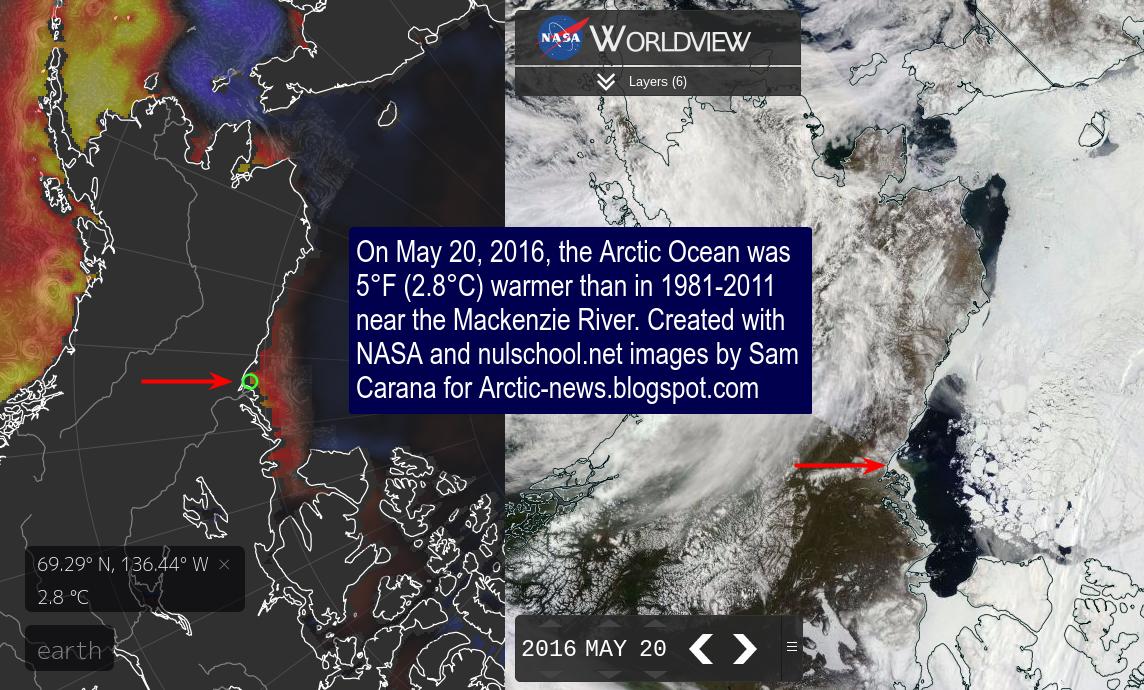
The sea ice is melting rapidly. Warm water from the Mackenzie River contributes to dramatic melting in the Beaufort Sea, as illustrated by the image below, showing that on May 20, 2016, the Arctic Ocean was 5°F (2.8°C) warmer than in 1981-2011 at the delta of the Mackenzie River.


The image below shows that on May 20, 2016, sea ice extent was 10.99 million square km, compared to the 12.05 million square km extent of the sea ice in May 20, 2012, as measured by JAXA. 


Sea ice reached a record minimum extent of 3.18 million square km on September 15, 2012, and chances are that the sea ice will be largely gone by September 2016.

The year 2016 is an El Niño year and insolation during the coming months of June and July is higher in the Arctic than anywhere else on Earth. Higher temperatures come with increased danger of wildfires. Greenhouse gases are at record high levels: in April and may, CO2 was about 408 ppm, with hourly peaks as high as 411 ppm (on May 11, 2016). Methane levels are high and rising, especially over the Arctic. Smoke and methane are speeding up sea ice melting, as illustrated by the image below showing smoke from wildfires in Canada extending over the Beaufort Sea (main image), in addition to high methane levels that are present over the Beaufort Sea (inset). 


Ocean heat is also very high and rising. Oceans on the Northern Hemisphere were 0.93°C (or 1.7°F) warmer in the most recent 12-months period (May 2015 through April 2016) than the 20th century average.

The image below shows sea ice extent as measured by the NSIDC, confirming that melting of the sea ice in 2016 is way ahead on previous years.


Here's an animation comparing sea surface temperatures of the North Atlantic between May 25, 2015, and May 25, 2016.


Arctic sea ice extent was 10.7 million km2 on May 25, 2016, 1.1 million km2 less than it was on May 25, 2012, as the update below shows.


The situation is dire and calls for comprehensive and effective action, as described in the Climate Plan.