FrinGOe Unveils Consumer FT Spectrometer

...
FrinGOe announces a cheap Fourier Transform spectrometer of consumer applications. The optical part of the spectrometer is a passive add-on for iPhone or Raspberry Pi camera. The company's whitepaper explains how it works:

Regular FTIR spectrometer
Mach-Zehnder FTIR spectrometer with moving mirrors
Passive array of Mach Zehnder interferometers with
path difference fixed at different values.

"FrinGOe uses innovative crystal technology to create a low cost 2D array of Mach Zehnder Interferometers and patented optical configuration to map the array onto the camera sensor. This allows an all-passive and compact optical add-on (as small as 4mm by 4mm by 2mm) that can be mounted onto any imaging platforms such as a mobile phone camera, Raspberry Pi camera or other OEM devices." One of the prototypes of the FT spectrometer has a spectral resolution of ~1 nm @ 400nm wavelength.

FrinGOe on the back of iPhone 5s is switchable between spectroscopic
and imaging modes

In June, the company plans to launch FrinGOe at the Laser World of Photonics (Munich) exhibition and at the same time start an Indiegogo campaign to kick-start the mass production efforts. FrinGOe's Youtube video shows the spectrometer operation:

11:35 AM

Arctic Methane Skyrocketing

...
The map below shows observatories in the Arctic.


    'Arctic methane skyrocketing' is the title of a video by Paul Beckwith discussing recent rises in methane levels in the Arctic.


    Paul's description: "I discuss how ground level flask measurements of methane have been spiking upwards over the last few years. I analyze the implications to the breakdown of climate stability, causing jet stream fracturing and weather regime change. I believe that this behaviour will rapidly worsen as Arctic temperature amplification continues, leading our planet to a much warmer and unrecognizable climate over the next 5 to 10 years."

    Below are some NOAA images showing methane levels (surface flasks) recorded at Arctic observatories.


    Below is an image showing hourly average in situ measurements at Barrow, Alaska, including one very high reading, from an earlier post.


    The image below shows sea surface temperature anomalies in the Arctic on May 30, 2015.


    The situation is dire and calls for comprehensive and effective action, as discussed at the Climate Plan page.


    Sea surface temperature anomalies in the Arctic on May 30, 2015. From the post: 'Arctic Methane Skyrocketing' http://arctic-news.blogspot.com/2015/05/arctic-methane-skyrocketing.html

    Posted by Sam Carana on Sunday, May 31, 2015

    Target and Carrefour Test VLC

    ...
    Electronics360: Carrefour SA, the largest retailer in Europe, is experimenting with visible light communications, becoming the first major retailer to install Philips’ connected lighting system with LED-based indoor positioning at its newly refurbished supermarket in Lille, France. The Carrefour news comes about a month after it was reported that U.S. retailer Target will use indoor positioning, widely believed to be VLC-based, to power its in-store app to help customers navigate its stores.

    The Carrefour supermarket system has 800 LED fixtures that use Philips VLC technology to transmit location. Philips software and cloud-based location database are integrated into Carrefour’s mobile app.

    Update: Philips posted infographics of how it works:


    Philips also posted a Youtube video showing its Carrefour trial:


    “We are leading the way with connected lighting for retail with Carrefour,” comments Gerben van der Lugt, Head of LED-based indoor positioning at Philips Lighting. “Our connected lighting system has the potential to transform shopping into a more interactive and personalized experience. At the same time it will enable retailers to differentiate themselves, enhance customer loyalty and provide new services to shoppers.”
    11:29 PM

    Omnivision Reports Quarterly and Yearly Results

    ...
    PRNewswire: Omnivision reports quarterly results for its fiscal quarter ended on April 30, 2015.

    Revenues for the fiscal year ended April 30, 2015 were $1.4 billion, as compared to $1.5 billion in fiscal 2014. GAAP net income for fiscal 2015 was $93.4 million, as compared to $95.0 million a year ago.

    Revenues for the last quarter were $285.9 million, as compared to $292.3 million in the previous quarter, and $331.0 million a year ago. GAAP net income in the last quarter was $6.0 million, as compared to net income of $14.0 million in the previous quarter, and $15.1 million a year ago. GAAP gross margin for the last quarter was 22.4%, as compared to 22.1% for the previous quarter and 20.1% a year ago. The Company ended the period with cash, cash equivalents and short-term investments totaling $524.2 million, an increase of $11.4 million from the previous quarter.

    Based on current trends, the Company expects revenues for the next quarter will be in the range of $310 million to $340 million.

    SeekingAlpha publishes a trascript of Omnivision's earnings call. There was no Q&A session for some reason. Shaw Hong, Chairman and CEO, says on the acquisition news: "by partnering with the consortium and operating as a private company, we will have more flexibility to innovate and develop new solutions for our customers, which will benefit our employees, customers and business partners. We expect the transaction will close within the next nine to 12 months.

    As of today, we have not obtained all the necessary approval, nor have we met the closing conditions. As such, there's no assurance that the proposed acquisition by the consortium will close.
    "
    11:18 PM

    Pelican Imaging Expands into Array of Different Cameras

    ...
    Up to now, Pelican Imaging camera components in the array had the same FOV and viewing direction. Its new patent application US20150146029 "Array Camera Configurations Incorporating Multiple Constituent Array Cameras" by Kartik Venkataraman and Jacques Duparré, presents integration of "a plurality of constituent array cameras, where each constituent array camera has a distinct field of view and/or a distinct viewing direction." The main advantage of that is implementation of zoom feature:


    Now it becomes fairly similar to Corephotonics and Linx Imaging proposals.
    1:01 PM

    Ximea on Hyperspectral Imaging

    ...
    German machine vision camera vendor Ximea CEO Max Larin discusses hyperspectral imagers approaches and applications in this Youtube video:

    12:31 PM

    Arctic Sea Ice in Uncharted Territory

    ...
    On May 27, 2015, Arctic sea ice extent was merely 11.973 million square kilometers, a record low for the time of the year since satellite started measurements in 1979.


    This fall in sea ice extent follows heat waves in Alaska and the north of Canada, as illustrated by the image below.

    Temperature in Alaska on the afternoon of May 23, 2015, when a temperature of 91°F (32.78°C) was recorded in Eagle. 
    High temperatures extended over the Beaufort Sea and Chukchi Sea. The image below shows the difference in sea surface temperatures between May 13, 2015, and May 23, 2015.


    The large amounts of meltwater flowing into Beaufort Sea and the Chukchi Sea is illustrated by the image below, showing the difference in sea surface salinity between May 17, 2015, and May 24, 2015.


    Sea ice has retreated dramatically in the Chukchi Sea and the Beaufort Sea, and in Baffin Bay, with high sea surface temperature showing up where rivers flow into the Arctic Ocean and where the Gulf Stream carries warm water from the Atlantic Ocean into the Arctic Ocean.

    The size-reduced navy.mil animations below show the fall in sea surface salinity (left) and the fall in sea ice thickness (right) in the Beaufort Sea, from May 3, 2015, to June 2, 2015 (run May 27, 2015).

    Sea surface salinity Beaufort Sea
    Sea ice thickness Beaufort Sea
       
    The image below shows sea surface temperature anomalies on May 27, 2015.


    For reference, the animation below, from the Naval Research Laboratory, shows sea ice thickness over a 30-day period, including a forecast up to June 4, 2015.


    Update: here's an image showing Arctic sea ice extent up to May 28, 2015, highlighting that sea ice extent is now well outside 2 standard deviations.


    The situation is dire and calls for comprehensive and effective action as discussed at the Climate Plan.


    Arctic Sea Ice in Uncharted Territory Sea ice has retreated dramatically in the Chukchi Sea and the Beaufort Sea, and...
    Posted by Sam Carana on Thursday, May 28, 2015

    Samsung Presents 1um RWB Pixels

    ...
    PhoneArena quotes Chinese-language MyDrivers.com posting pictures from Samsung image sensor seminar. Samsung presents its 1um RWB color patterned sensors, said to provide much better low light sensitivity:

    1:05 PM

    Canon vs IV Patent Arguments

    ...
    Delaware Intellectual Property Litigation publishes a detailed document on trial where Intellectual Ventures accuses Canon in patent infringement, including two image sensor patents: US6,221,686 "Method of making a semiconductor image sensor" and US6,023,081 "Semiconductor image sensor." Canon has lost the battle, in spite of Eric Fossum and Albert Theuwissen trying to defend it, see pp. 11-19 in the document.
    1:26 PM

    Assorted Market Data

    ...
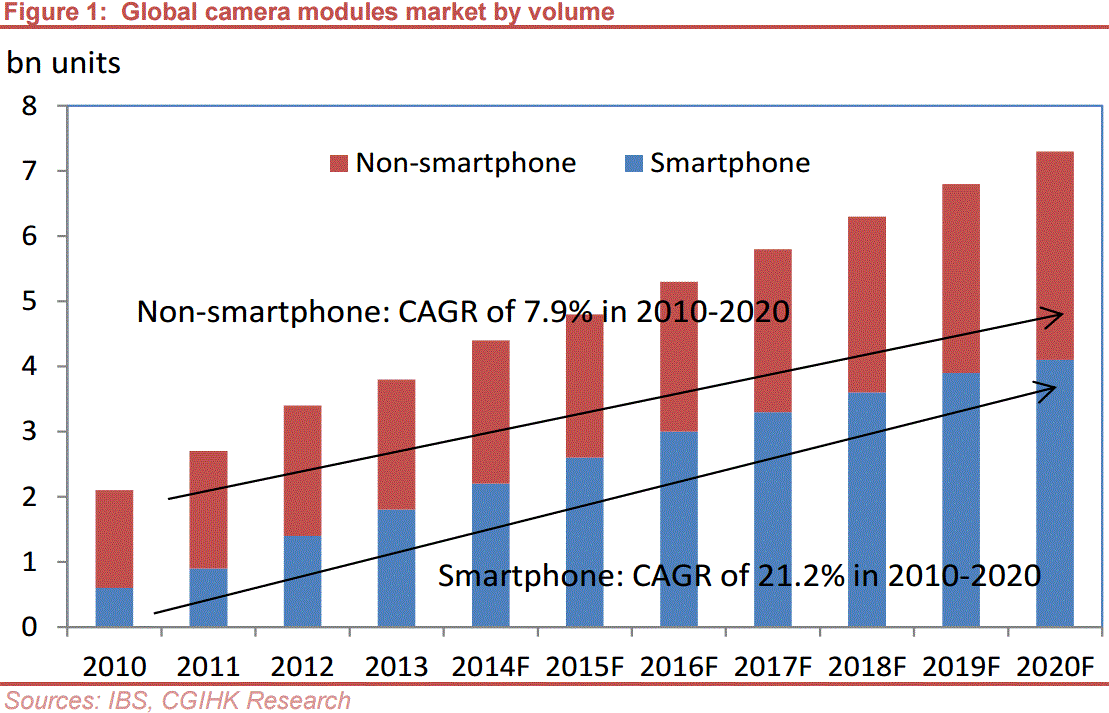
    China Galaxy International comes with a wide collection of market data, primarily about Apple camera module supplier Cowell and the camera module industry in general:

    12:44 PM

    Audi Parners with Gestigon to Develop Gesture Control in Cars

    ...
    gestigon announces that they provide the gesture control software used in Audi’s booth at the CES ASIA in Shanghai. The first result of this cooperation is to, initially, provide an unique user experience for the rear seat passengers of Audi’s luxury car models enabling the user interaction with the multimedia device in front of them.

    Moritz von Grotthuss, CEO of gestigon, says, “we are excited to have won AUDI AG as a partner to develop gesture control solutions for automotive. The application for the rear passengers is a first, appealing step into a multitude of use cases based on ‘active control’ to enable new, innovative and easy-to-use functionalities. With Audi’s unique positioning as one of the leading global premium manufacturers we have found a partner that shares our vision and excitement in regard of skeleton tracking- and gesture control for automotive in their broadest sense.”

    Michael Schlittenbauer, Developer at AUDI AG confirms, „gestigon was able to provide a customized software solution for our targeted use case in the rear of the cabin. We are working on a number of concepts to integrate gesture control into our models and are looking forward to continue to explore the technology as well as use cases to enable a unique driving experience to our customers.”
    12:06 PM

    Sleeping Giant in the Arctic

    ...


    Huge amounts of carbon are contained in sediments, soils and vegetation in the Arctic. Rising temperatures in the Arctic threaten to cause much of this carbon to be released to the atmosphere.

    On May 23, 2015, temperatures in Alaska were as high as 91°F (32.78°C), as illustrated by the image below.

    [ image credit: US National Weather Service Alaska ]
    High temperatures were reached at the city of Eagle, located on the southern bank of the Yukon River, at an elevation of 853 ft (260 m). High temperatures at such a location will cause meltwater, aggravating the situation well beyond the local area.
    A bank of permafrost thaws near the Kolyma
    River in Siberia. Credit: University of Georgia

    Carbon contained in soils will thus become increasingly exposed under the combined impact of rising temperatures and the associated growing amounts of meltwater. The meltwater can additionally cause erosion further downstream, thus making carbon at many locations become more prone to be consumed by microbes and released into the atmosphere in the form of carbon dioxide and methane.

    A recent study found that, at a location where the Kolyma river in Siberia carved into the permafrost and exposed the carbon, microbes converted 60% of the carbon into carbon dioxide in two weeks time.

    Gary Houser, who recently launched the movie Sleeping Giant in the Arctic, elaborates on the threat of emissions from thawing permafrost:
    This immense release would likely feed on itself, raising temperatures that continue melting more and more permafrost in a vicious, frightening, and unstoppable cycle. A tipping point could well be crossed, at which time human intervention is no longer possible. Temperatures across the planet could soar, setting in motion catastrophic levels of drought and food shortage. All life support systems on earth and life forms themselves could be placed under severe stress.

    The colossal scale of the danger - and the observation of those factors lining up that could trigger it - demand that humanity exercise the precautionary principle. All political decision-making related to carbon emissions must be based on the understanding that a catastrophic consequence is looming, and the window of time for prevention quickly diminishing.
    SLEEPING GIANT IN THE ARCTIC:
    Can Thawing Permafrost Cause Runaway Global Heating?
    by Gary Houser


    Sources: 

    US National Weather Service Alaska

    University of Georgia

    Sleeping Giant in the Arctic


    Sleeping Giant in the Arctic http://arctic-news.blogspot.com/2015/05/sleeping-giant-in-the-arctic.html

    Posted by Sam Carana on Monday, May 25, 2015

    For Want of a Spectrum Allocation: The Philadelphia Train Derailment

    ...

    There's a proverb of uncertain origin that begins, "For want of a nail, the shoe was lost, for want of a shoe the horse was lost; and for want of a horse the rider was lost; being overtaken and slain by the enemy, all for want of care about a horse-shoe nail."  That particular version is attributed to Benjamin Franklin, but all the various versions make the same point:  lack of attention to apparently minor details can sometimes have major consequences.  As more information emerges about the tragic AMTRAK train derailment in Philadelphia on May 12, it looks like what began as a minor kerfuffle over frequency allocations may well have kept a new train-control system from preventing the deaths of eight passengers and the injuries of many more.

    At this writing, no one seems to know for sure why the Northeast Regional train heading from Washington, DC to New York City sped up to 106 MPH (169 km/hr) as it entered a curve near a rail intersection called Frankford Junction.  The maximum recommended speed for the curve was 50 MPH (80 km/hr).  All the train's cars left the track, killing eight passengers and injuring at least 200 others.  There were some reports that an object might have hit the train's cab in the minutes before the wreck, but presently the reason for the train's excessive speed is not definitely known.  At the time of the wreck, the train was under the manual control of engineer Brandon Bostian, who was apparently knocked temporarily unconscious in the crash and claims to have no memory of the moments immediately before the derailment.

    In many parts of the U. S. including the Northeast, railroads have installed an automatic system called Positive Train Control (PTC) that could well have prevented the May 12 tragedy.  A fully operational PTC system continuously monitors a train's position by means of radio links to trackside transmitters, and calculates the maximum speed that is allowed at each point along the route.  If the system notes that the train is going too fast, it will automatically apply the brakes to reduce speed. 

    Why wasn't the Northeast Regional using PTC in Philadelphia?  Because AMTRAK hasn't been able to purchase a 220-MHz radio-frequency allocation (channel, essentially) to put it into operation there yet.  And thereby hangs a rather tortuous bureaucratic tale.

    On their own over the past decade or more, railroads have developed pieces of what amounts to PTC using various existing equipment, and the most popular type of train-control radio systems use the 220-MHz frequency band.  For most of its existence since the 1930s, the U. S. Federal Communications Commission (FCC) allocated the limited resource called the radio-frequency spectrum through a purely administrative process, and in principle at least, money had nothing to do with it.  In practice, political pull and other arbitrary factors influenced the FCC's decisions.  Partly in response to accusations of unfairness, in 1994 the FCC began auctioning spectrum slots to the highest bidder, and most observers say that auctions have led to a fairer and more efficient set of allocations.  But in the case of the railroad's need for 220-MHz slots for its PTC system, the market method of frequency allocations may have failed.

    The legal requirement for railroads to use PTC originated with a Congressional mandate passed in 2008 mainly to improve safety.  In that legislation, Congress told the railroads to finish the job by December of 2015.  Most railroads have largely complied by now, despite problems with interoperability of different systems developed by different lines and the fact that one railroad may operate on tracks owned by several other railroads.  When PTC was passed into law, the most common frequency band used for these types of train control and monitoring operations was 220 MHz, so the railroads decided to use their existing 220-MHz hardware and to require all PTC equipment to use that band.  If more bands were used, a single train might have to carry equipment that works with three different bands, for example, and as PTC was already costing billions of dollars to implement, they stuck with 220 MHz.

    That was fine for most areas, but the railroads ran into a snag in some regions, including Philadelphia.  There the 220-MHz slots were either not available, or were priced at a prohibitive level.  The railroads asked the FCC simply to allocate the needed frequencies for free, so that they could meet the Congressionally-mandated deadline, but the FCC essentially said tough beans, go buy them like everybody else does.  And Congress did not fund the costs associated with the PTC mandate, so the rail lines have been doing it on their own dime.  So at the time of the Philadelphia crash, PTC was not working, but not because of any hardware problems.  The bureaucracy had simply not done its job yet.

    PTC is not a flawless system, and it is not absolutely certain that it could have prevented the Philadelphia crash even if it had been working at the time.  Putting on the brakes for a train is not as simple as jamming your foot on the brakes of your car.  A friend of mine is a locomotive engineer on an excursion train that operates near Austin.  He has explained to me how the brakes on each car have to be applied at a certain carefully judged rate, and sometimes even in a certain order, so that the train doesn't undergo stresses that can cause severe shocks or even break couplings and separate the cars.  Even just locking the brakes so the train skids along the track can severely damage the wheels, necessitating extensive repairs.  But sometimes it's necessary in an emergency.

    We will never know whether PTC could have prevented the Philadelphia train wreck.  But excessive-speed wrecks are exactly the sort of thing that PTC was designed to prevent.  While making everybody pay for frequency allocations seems to be the fairest way to do things in most cases, the FCC ought to consider making exceptions in situations involving serious safety issues.  Sometimes the old ways are better, and allowing for emergency no-fee allocations in situations where an organization is caught between an FCC rock and a congressional hard place seems like a good idea.  But it won't bring back those who are no longer with us because of what happened in Philadelphia. 

    Sources:  I referred to news articles on Brandon Bostian at http://www.cbsnews.com/news/amtrak-crash-brandon-bostian-cellphone/, a list of fatalities in the wreck at http://6abc.com/news/name-released-of-8th-victim-in-deadly-amtrak-crash/719973/, and the Wikipedia articles "2015 Philadelphia train derailment," "Positive Train Control," and "For Want of a Nail."

    Fluor Arabia: Construction Superintendant - Piping/Welding

    ...
    Construction Superintendant - Piping/Welding Job Description The purpose of this position is to oversee and direct the performance of all field construction activities for assigned craft in conformance with plans, specifications, schedules, and cost estimates. This position requires a working knowledge and background of assigned work, the ability to appreciate and resolve complex situations
    12:26 PM

    Sony and Apple Think Alike

    ...
    Sony patent application US20150129943 "Solid-state imaging device, method of manufacturing a solid-state imaging device, and electronic apparatus" by Nanako Kato and Toshifumi Wakano, presents a stacked global shutter pixel where the storage diode is shielded from the backside illumination:

    Sony stacked GS pixel

    Sony's idea looks quite similar to the one presented by Apple in US20150035028 application:

    Apple stacked GS pixel
    4:51 AM

    IC Insights: Sharp CIS Sales Surge

    ...
    IC Insights posts its updated list of top 20 semiconductor companies. This time, Sharp has entered the list as #19. IC Insight writes: "Although Sharp as a whole is having a difficult time, its semiconductor group, which represents only about 14% of the company’s corporate sales, posted a whopping 62% growth rate (an 88% increase in yen), the best 1Q15 sales increase of any top-20 semiconductor supplier. This sales surge was almost entirely due to the company’s success in the CMOS image sensor market."


    Update: Sharp's medium term management plan dated by May 14, 2015, reveals quite ambitious plans over the next few years:


    The company notes: "Sharp has the leading share in the industry for smartphone camera devices, but since specific customers weight a large proportion of our business, we will aggressively work to expand our sales to new customers, and target 3 times the net sales of Fiscal 2014 by Fiscal 2017."
    12:44 PM