Canon Super-35mm Cinema Sensor Explained

online engineering degree/engineering degree online/online engineering courses/engineering technology online/engineering courses online/engineering technician degree online/online engineering technology/electronic engineering online
Canon published few whitepapers talking about design considerations of its Super-35mm sized CMOS sensor for recently announced EOS C300 video camera. The first one "New 35mm CMOS Image Sensor for Digital Cine Motion Imaging" gives the sensor spec:


The color filter array is the classic Bayer. Canon explains the resolution choice:

Illustrating the separate CFA array and the CMOS imager while also
showing the CFA separated into its component color filters to better expose
the structure of their respective sparsely sampled lattices

"The image sensor readout strategy radically departs from the customary “De-Bayer” deployment of quincunx sampling of the green photosites to maximize the green video resolution (and hence the matriced Luma resolution). The design strategy of this new sensor is to not to seek any form of “4K” resolution — but rather to specifically confine the reconstruction of each of the R,G, and B video components to a full digital sampling structure of 1920 (H) x 1080 (V) — according to the SMPTE 274M HDTV Production Standard."

Showing the concept of structuring the final Green video component within the
pre-processing LSI from the two dual video readouts from the CMOS image sensor

"The dual Green process offers the following significant technical advantages:

  1. Doubles the effective saturation level of the summed Green output video
  2. Increases the noise of the final Green output only by a factor of square root of two
  3. Combination of 1) and 2) increases the effective dynamic range of the green signal — and as a consequence, that of the matriced Luma signal
  4. Increases the effective output green video bit depth
  5. The half-pixel offset between the two separate green sampling lattices — both horizontally and vertically — virtually eliminates the first order sideband spectra associated with the sensor sampling process. This eliminates green aliasing.
  6. Creates an effective FIR* filter within the readout process that aids the optimization of the horizontal MTF and the progressive vertical MTF and associated aliasing."
The summation of two greens is said to increase the DR from 70dB to 73.5dB in green (in fact, from 70.5 to 73.5) or to 72dB in luma (12 stops).

Although the camera frame rate is 24p fps, the readout speed is 1/60s to reduce rolling shutter effects:


In 60i mode each half-frame is read at 1/120s - same per-row speed as in 24p mode.

The low read noise is achieved by limiting the readout amplifier bandwidth, as shown below:


Another Canon whitepaper "RGB Resolution Considerations in a New CMOS Sensor for Cine Motion Imaging" shows advantages of the proposed green processing in resolution extension:

Showing the two separate green 1920 (H) x 1080 (V) photosite lattices
and the horizontal and vertical timing offsets between each of the
two “diagonal” pixels that are summed during the readout process

The resulting horizontal and vertical MTFs of the whole system are improved:


The summary says: "A new CMOS image sensor has been described. It represents a definitive decision by Canon to enter the global field of digital cinematic motion imaging. It is anticipated that there will be many progressive advances in the years ahead. Accordingly, a priority was assigned to taking a first step into this important field of imaging by placing an initial focus on originating a very high quality RGB video component set specifically intended for high-performance High definition video production."

Another whitepaper is titled "Sensitometric Characteristics of EOS C300 Digital Cine Camera" and mainly focused on system processing of the video signal, introduces "Canon-Log" response.
12:25 PM

Samsung IEDM 2011 Paper

online engineering degree/engineering degree online/online engineering courses/engineering technology online/engineering courses online/engineering technician degree online/online engineering technology/electronic engineering online
Eric Fossum put his Samsung IEDM 2011 paper on-line:

"A 192×108 pixel ToF-3D image sensor with single-tap concentric-gate demodulation pixels in 0.13 μm technology"
T.Y. Lee, Y.J. Lee, D.K. Min, S.H. Lee, W.H. Kim, S.H. Kim, J.K. Jung, I. Ovsiannikov,
Y.G. Jin, Y.D. Park, E.R. Fossum, and C.H. Chung

"A 3D-ToF FSI image sensor using novel concentric photogate [CG] pixels with single-tap operation is described. Through the use of CG structure, we are able to achieve high DC at larger pixel pitches. The new CG pixel structure substantially improves DC [demodulation contrast] to 53% at 20MHz at 28 μm pixel pitch. Recent initial results from a backside-illuminated (BSI) implementation of the same sensor show further improved performance and will be reported elsewhere."
2:16 AM

Truesense Imaging Inc. and Digital Optics Corp.

online engineering degree/engineering degree online/online engineering courses/engineering technology online/engineering courses online/engineering technician degree online/online engineering technology/electronic engineering online
As written in comments, the recently acquired Kodak Image Sensor Solutions has been quietly renamed to Truesense Imaging, Inc. Kodak has first used Truesense name for its W-RGB color filter products almost 3 years ago. I wonder if the new company name meant to emphasize the W-RGB products importance.

Meanwhile, Tessera renamed its imaging and optics division into Digital Optics Corporation. The new entity is responsible for wafer-scale optics (former Shellcase), EDoF (former Eyesquad and Dblur), MEMS AF motors (former Siimpel), micro-optics (the original bearer of Digital Optics Corporation name, acquired by Tessera in 2006) and image enhancement software (former Fotonation). It appears that the division has been renamed and separated into the wholly owned subsidiary in June 2011.

Another part of Tessera dealing with chip packaging is separated and renamed too. Its new name is Invensas. In Nov. 2011 Invensas acquired patent assets of California-based TSV foundry ALLVIA. It does not seem to target image sensor applications though.
11:59 PM

1.8 Gigapixel Camera Deployed on Helicopter Drones

online engineering degree/engineering degree online/online engineering courses/engineering technology online/engineering courses online/engineering technician degree online/online engineering technology/electronic engineering online
BBC, US Army: The A160 Hummingbird helicopter-style drones with 1.8 Gigapixel color cameras are being developed by the US Army promising "an unprecedented capability to track and monitor activity on the ground".

A statement added that three of the sensor-equipped drones were due to go into 1-year trial service in Afghanistan in either May or June 2012 as a part of a Quick Reaction Capability, an acquisition approach aimed at delivering cutting-edge and emerging technologies to theater. The army developers and engineers are now finishing up some wiring work on the A160 aircraft and performing ground tests with the ARGUS sensor suite.

Boeing built the first drones, but other firms can bid to manufacture others. The 1.8 Gigapixel ARGUS-IS camera is developed and manufactured by BAE Systems.


The army said that was enough to track people and vehicles from altitudes above 20,000 feet (6.1km) across almost 65 square miles (168 sq km). In addition, operators on the ground can select up to 65 steerable "windows" following separate targets to be "stared at".

DARPA is also working with the UK-based division of BAE Systems to develop a more advanced version of the Argus-IS sensor that will offer night vision. It said the infrared imaging sensors would be sensitive enough to follow "dismounted personnel at night". In addition, the upgrade promises to be able to follow up to 130 "windows" at the same time. The system's first test flight has been scheduled to take place by June 2012.

Thanks to CDM for the link!
11:50 PM

Digitimes: Samsung and Sony to Supply Sensors for Next Generation iPads

online engineering degree/engineering degree online/online engineering courses/engineering technology online/engineering courses online/engineering technician degree online/online engineering technology/electronic engineering online
Digitimes quotes its sources saying that next generation iPad 3 would be released in two versions. The high end version will feature 8MP camera with Sony sensor. As for the mid-range model, Samsung is said to be among the suppliers of its 5MP sensor.

The new iPad 3 tablets are to be announced at iWorld on Jan. 26, 2012, according to the newspaper. The original version of iPad was announced on Jan. 27, 2010, while the iPad 2 was first shown on March 2, 2011.
11:28 PM

Earthquake Reduction project for free

online engineering degree/engineering degree online/online engineering courses/engineering technology online/engineering courses online/engineering technician degree online/online engineering technology/electronic engineering online
Bhuj has an average elevation of 110 metres (360 feet). On the eastern side of the town is a hill known as Bhujiyo that separates Bhuj city and Madhapar town. It has one big lake named Hamirsar and several small lakes. The old city was surrounded by the fort, which had five major gates and one small gate known as "chathi bari" (which means window).


Steps needed to create a plan for earthquake risk reduction are:-
1. evaluation,
2. planning, and
3. implementation.
First, the evaluation must be realistic by reflecting the local conditions.
The planning stage involves identifying effective alternatives or solutions, selecting the best alternatives and developing them into an action plan.
The last stage, the implementation process, applies the results of the evaluation and planning processes.
After this comes collection of information required for assessment:
Data is to be collected on
A. Seismic hazard
B Exposure to hazard
- life
- property
- business / function ( including information on revenue, data, market share and reputation / image)
C. Vulnerability Assessment
Based on above data a Risk Analysis has to be done.
For finding the solution, we should think about which Mitigation method to follow. These can be:
1. Structural
2. Locational
3. Operational
4. Risk Transfer
Mitigating earthquakes is a much broader field than simply designing for earthquakes. Mitigation is a several-stage planning and management process which involves
(1) estimating the potential losses that earthquakes might cause
(2) deciding if the potential losses are acceptable or not
(3) if not, examining alternative loss reduction techniques, which involves identifying the effectiveness of each alternative in reducing losses and the associated cost.
(4) setting some criteria for deciding which alternative is the most effective, such as benefit-cost, lives saved, least regret, or other paradigms, and applying the criteria to select the most effective package of alternatives.
(5) developing a design and implementation program for the package of alternatives.
Experience would show that the following factors or contexts are necessary prerequisites for the instrumentation of adequate risk management strategies and procedures. Some or all of these may be used in constructing management .


Bhuj city map and details

Current population of Bhuj is 184,429, mainly people live in the outskirts of the city,but as of now they are residing into the city and the city is also developing well since people from many countries come for study earthquake assessment and many other historical places resembling Mohan jo daro and other things. there are small businesses and factories, about half of each in weak masonry and older reinforced concrete buildings. Zone B also contains the schools, electric generating plant, the major telephone and radio broadcast stations, City Hall and other vital infrastructure (except the port), all of which are older reinforced concrete buildings
Mostly there are earthen buildings in and Old masonry RC buildings at the outskirts of the city, counting of houses is not possible as it deems into an venture of glooming places, though in the main taluk , there are better construction with enhanced work.
Though bhuj is not a industrial city hence there are not many industries , there are small businesses and factories, about half of each in weak masonry and older reinforced concrete buildings. Some of the industries set up are of mineral and allied industries. Bhuj is a famous destination for shopping of handicraft work. Artists of nearby villages bring their art work for sale in Bhuj. Important landmarks for people wishing to study and know more about Kutchi embroidery are Shrujan, Kutch Mahila Vikas Sangathan (KMVS), Kalaraksha and Women Artisans' Marketing Agency (WAMA, Bandhini. Krantiguru Shyamji Krishna Verma Kachchh University is located in Bhuj. University has 28 colleges affiliated, seven of them are in Bhuj
There are walls within walls, attractive crenellated gateways, old palaces with intricately carved wooden pavilions, and striking, brightly decorated Hindu temples. Bhuj resembles much of India before the tourist invasion.
Bhuj was within 20km of the fault break, and suffered very severe damage during the earthquake . The palace complex is in the old walled city. It consists of a collection of buildings in a variety of styles, dating from the 18th century. Some of the buildings are of random masonry construction, and have suffered extensive damage and collapse.

art of the north east corner of the perimeter walls, about 2m wide, have collapsed. The central three pairs of timber columns on the north side are tilted outwards (ie north) by about 5% to 7.5% (figure 14b), pushing the flat roof strip on this side about l50mm across the top of the external wall, which is also sloping outwards, but only by about 3%. The opposite wall is leaning by about the same amount in the same direction. The timber columns on all four corners of the grid are vertical; the other columns have a variety of tilts up to 2%, but usually much less. There is no evidence of structural distress in the timber columns; one member of the roof truss is bowed and slightly split at one point, but generally there is no other sign of structural distress or of material deterioration in the timber. The central roof slab has sagged very significantly, probably between trusses.Swami narayan temple was also devastated
Thus many of the historical structures have been disrupted, though retrofitting method was used to strengthen the structures. This was the only way to enable most of damaged buildings including hospitals to restore back as this procedure was a bit expensive but total cost benefit analysis was taken before the work started.
Violent ground shaking was felt in Bhuj for nearly 85 seconds with several minutes of lower level shaking. There are major earthquake faults near Bhuj , Slippage is believed to have occurred on the south dipping North Wagad reverse fault in the failed rift. This has been further confirmed by aftershock studies following the earthquake. Initial speculation held the Kutchh Mainland Fault (KMF) responsible, however, further studies and field observations show that it might have been caused on the previously unknown NWF lying in the vicinity of the KMF. Slip is believed to have totaled between 1 metre to 4 metres.

Vulnerability is the propensity of things to be damaged by a hazard. People’s lives and health are at risk directly from the destructive effects of the hazard. Their incomes and livelihood are at risk because of the destruction of the Buildings, crops, livestock or equipment which these depend on. Each type Of hazard puts a somewhat different set of elements at risk The next step is to understand the vulnerability of buildings and infrastructure to these earthquake hazards. Earthen (e.g., adobe) and masonry (stone or brick) buildings are typically the most vulnerable to shaking. Local experience is a good guide to what is vulnerable in a society, and the list of potentially vulnerable elements should be supplemented by a study of written reports and the knowledge (often never recorded) of those who lived through previous disasters.

The buildings most badly damaged in the earthquake were earthen buildings ,old masonry buildings and simple reinforced concrete frame buildings . The statistics of damage from the earthquake identified the vulnerability of a range of building type characteristics to earthquakes of different strength likely to occur in the future. By identifying buildings with high vulnerability factors ,where these buildings also have large
numbers of residents, they will contribute both to casualties if they collapse, and to homelessness if they become uninhabitable. The buildings with highest projected future earthquake losses are graded into primary and secondary priority for attention.


Mitigation measures

include engineering measures to build more hazard-resistant structures, physical planning to locate important facilities away from hazards, economic measures to protect earnings, management structures to ensure protection measures are carried through and societal measures to encourage the public to support mitigation measures. Measures like establishing building codes for new construction, strengthening existing buildings, land-use controls, and improving
preparedness planning are generally costly to apply, whether it is
individuals, private companies or the general tax-payer who will ultimately
be responsible.


Proper implementation, monitoring and sustainability of the ERRP is very necessary as lack in attention would deprive a heavy loss to the system, ERRPs may be developed by different persons or organizations, depending on how the risk arises, and who bears the risk. Typically, within an organization, persons responsible for the facilities will develop an ERRP – this might be the engineer of a school district or the manager of facilities for a company. They may develop the ERRP themselves, or retain experts to develop the ERRP for them. All the efforts and time invested in evaluating the earthquake risk of a city and defining action plans to manage that risk will be wasted if nothing is actually implemented. Throughout the risk management project, several activities have to be carried out to set up the political, legal, financial, and cultural conditions that will facilitate the implementation of the plans and programmes prepared by the project and, most importantly, promote the institutionalization of earthquake risk management in the city. Among these activities are the following:


• Incorporation of all the community sectors in the project: representatives of the institutions and sectors of the community should have an active participation throughout the project
• Proper information and dissemination of results: effective collaboration with the mass media throughout the project should be promoted so that the whole community is properly informed about what the project is doing for the city and what the project results are
• Search for funding: strong efforts to generate funds, especially local funds, have to be made by approaching the industrial, commercial and financial sectors of the community as well as international aid organizations with offices in the country
• Creation of an organization to coordinate risk management activities: an organization must be selected (or created if a suitable one does not exist) to coordinate, monitor, and advocate risk management efforts in the city .
11:23 PM

Microsoft Proposes Double Helix PSF for Depth Sensing

online engineering degree/engineering degree online/online engineering courses/engineering technology online/engineering courses online/engineering technician degree online/online engineering technology/electronic engineering online
Microsoft patent application US20110310226 "Use of wavefront coding to create a depth image" by Scott McEldowney proposes a fresh idea to acquire image depth information.

Here is the original description:

"[A] 3-D depth camera system includes an illuminator and an imaging sensor. The illuminator creates at least one collimated light beam, and a diffractive optical element receives the light beam, and creates diffracted light beams which illuminate a field of view including a human target. The image sensor provides a detected image of the human target using light from the field of view but also includes a phase element which adjusts the image so that the point spread function of each diffractive beam which illuminated the target will be imaged as a double helix. [A] ...processor ...determines depth information of the human target based on the rotation of the double helix of each diffractive order of the detected image, and in response to the depth information, distinguishes motion of the human target in the field of view."

Actually, it's much easier to understand this idea in pictures. Below is the illuminator with a diffractive mask 908:


There is another mask 1002 on the sensor side:


Below is the proposed double-helix PSF as a function of distance. One can see that the two points line angle changes as a function of depth:


The orientation angle of the PSF points depends on wavelength (not shown here, see in the application) and the distance (shown below):


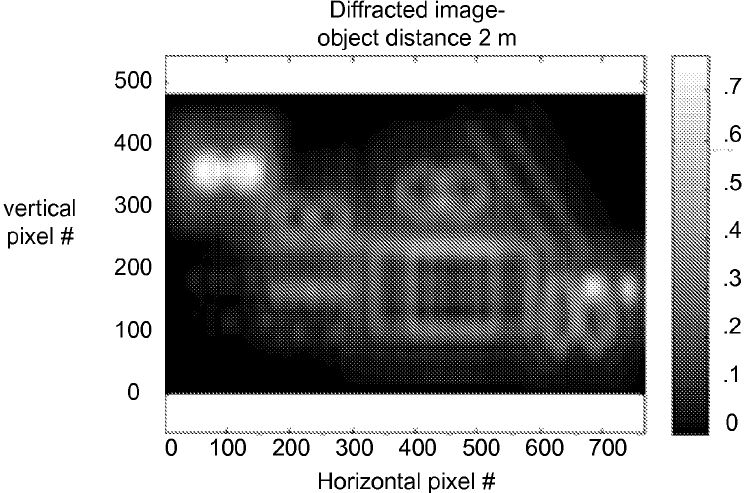
From this angle the object distance can be calculated - this is the idea. Microfoft gives an image example and how it changes with the distance in what looks like Wide-VGA sensor plane:


Update: As written in comments, University of Colorado, Denver has been granted a patent US7705970 on a very similar idea. A figure in the patent looks very similar:

11:14 PM

Sugar cane trash processing for heat and power production

online engineering degree/engineering degree online/online engineering courses/engineering technology online/engineering courses online/engineering technician degree online/online engineering technology/electronic engineering online
Abstract:

The paper summarizes an investigzation into methods for treating sugar cane trash in preparation for combustion in a spreader stoker boiler designed for bagasse and supplementary fuel oil. Due to the herbaceaous nature of sugar cane trash, water leaching was proposed and investigated as a means of reducing the slagging and fouling potential of the raw fuel.
Download
7:50 AM

Highway Linear Collision Prevention in Automobiles

online engineering degree/engineering degree online/online engineering courses/engineering technology online/engineering courses online/engineering technician degree online/online engineering technology/electronic engineering online
Abstract:
The main objective of this project is to avoid collisions between vehicles which results in losses in massive proportions to life and economy. We will be specifically dealing with accidents caused when a multitude of vehicles travelling in a linear manner collide

*DOWNLOAD PROJECT
7:48 AM

Fuzzy Controlled Anti-Lock Braking System

online engineering degree/engineering degree online/online engineering courses/engineering technology online/engineering courses online/engineering technician degree online/online engineering technology/electronic engineering online
This thesis describes an intelligent approach to control an Antilock Braking System (ABS) employing a fuzzy controller.  Stopping a car in a hurry on a slippery road can be very challenging. Anti-lock braking systems (ABS) take a lot of the challenge out of this sometimes nerve-wracking event. 

DOWNLOAD
7:47 AM

latest list of 101 Mechanical Projects

online engineering degree/engineering degree online/online engineering courses/engineering technology online/engineering courses online/engineering technician degree online/online engineering technology/electronic engineering online


Projects are based on Automation and Mechatronics
  1. Fabrication of Remote operated weapon System
  2. Automatic double axis Pneumatic JCB
  3. Automatic Car Parking System for apartment Building
  4. PLC based automatic Multi-machine Lubrication System
  5. Electronic Fuel Injection (EFI) system for Two wheeler
  6. Cell phone controlled pick and place robot
  7. Automatic boring mechanism using foundries
  8. SMS based automatic pneumatic Punching and riveting machine
  9. Fabrication of Automatic grease Gun
  10. Video Analyzing remote controlled vacuum Cleaner
  11. SMS based automatic vehicle accident information system
  12. Automatic Differential unit Locking System for four wheeler
  13. Automatic Distance Measurement and Braking System By using Ultrasonic Waves
  14. SMS based Bomb detecting robot
  15. Fabrication of Automatic Shot blasting machine
  16. Automatic wind mill blade pitch controlling system
  17. Automatic Vegetable (or) Lemon Cutting machine
  18. Fabrication of Automatic Vehicle Over speed controlling system for School Zone
  19. Remote controlled air craft (Flying Model)
  20. GPS based vehicle root tracking system
  21. Fabrication of Microcontroller Based Self centering Four-jaw Chuck
  22. Fabrication of Automatic temperature controller with cooling system
  23. Remote controlled material handling motorized crane
  24. GPS based blind people path announcement system
  25. Button operated electro-magnetic gear shifting system for two wheeler
  26. Automatic sensor based wall painting robot
  27. Auto Indexing gear cutting attachment for pneumatic shaping Machine
  28. Automatic accident avoiding system for machines
  29. GSM Based two wheeler security system
  30. Electronic assisted hydraulic braking system
  31. Two Wheeler Automation with security System
  32. SMS based automatic pneumatic punching machine
  33. Automatic hand break release
  34. Fabrication of Queries controlling system for two wheeler
  35. Automatic Pneumatic Grinding Machine
  36. Fabrication of Unaided Guided Vehicle (UGV)
  37. Automatic Power Saving Conveyor for Industrial Application
  38. Automatic Visitor Guided with Material Handling Vehicle
  39. Automatic Break Failure and Engine Over Heating Indication
  40. Sensor Based Material loading/unloading system for different section
  41. Automatic rotating table with sequence operating machine
  42. SMS based Automatic two wheeler locking system
  43. Digital locking (Fuel, ignition, side lock) system (Password) for Two wheeler
  44. Over speed indication and Automatic accident Avoiding System for four wheeler
  45. Fabrication of sub marine (Model)
  46. Auto head-lamp Alignment system for automobile
  47. Railways accident Avoiding System – (Level crossing and Fire Alarm)
  48. Fabrication of Automatic Magnetic Accident preventer for Train
  49. SMS based automatic drilling machine
  50. Car or Bus reverse Operation Navigation System by using IR Rays
  51. Fabrication of Solar automatic cell phone charger with pay system
  52. Fabrication of Automatic car overtaking system
  53. CNC Pick and place sequence operated Robot
  54. Remote controlled boiler flame on/off with flame adjustment system
  55. Material Dimensions Analyzing Robot
  56. CNC pneumatic Auto feed punching Machine
  57. PC based Automatic sheet cutting Machine
  58. Sensor Based Inspection Conveyor
  59. Remote controlled Video Analyzing pick and place Robot
  60. Cell Phone Controlled Video Analysing Robot
  61. Automatic Vehicle Accident Information System
  62. Automatic Dam shutter controlling system
  63. Automatic Paint Spaying Equipment
  64. Remote controlled Bomb detecting robot
  65. Fabrication of Intelligent Braking System (IBS)
  66. Fabrication of Emergency Braking System (EBS)
  67. Fabrication of Anti-lock Braking System (ABS)
  68. Fabrication of Automatic Electro hydraulic Jack
  69. Automatic Pneumatic stand for two wheeler
  70. Automatic Bottle Washing Machine
  71. SMS controlled pick and place robot
  72. Aero plane Controlling System (Flying Model)
  73. Automatic drunken drive avoiding system for automobile
  74. Intelligent active Suspension system for two wheeler
  75. Automatic Packing control Machine for Industrial Application
  76. Automatic Double Axis Welding Machine
  77. Automatic Pneumatic Paper cup folding Machine
  78. Automatic Wheel chair cum bed
  79. Automatic Sky Car parking System
  80. Automatic Pneumatic Reciprocating Water Pumping System
  81. SMS controlled Material handling robot
  82. Remote controlled Vacuum Cleaning Robot
  83. Automatic Scrap Collecting Vehicle
  84. Automatic Fire fighting cum material handling vehicle
  85. Sensor Based Automatic paint marking machine for sprocket Industries
  86. Automatic railway track crack detecting Vehicle
  87. Remote controlled tilting Wheel chair
  88. Automatic Three axis hydraulic modern Trailer
  89. SMS based Pick and place Robot
  90. Automatic Spring End Grinding Machine
  91. Automatic Pneumatic vice and jack
  92. Fabrication of Automatic typical Pipe Cutting Machine
  93. SMS controlled automatic pneumatic ramming machine
  94. Fabrication of Automatic cold chamber Die Casting Machine
  95. Design & Fabrication of Conveyor Automation
  96. Automatic Car Parking System for apartment Building
  97. Intelligent active Suspension system for two wheeler
  98. Automatic Packing control Machine for Industrial Application
  99. Automatic Double Axis Welding Machine
  100. Automatic Pneumatic Paper cup folding Machine
  101. Automatic Pneumatic Reciprocating Water Pumping System


7:27 AM

Latest Mechanical Engineering Projects List(phD)

online engineering degree/engineering degree online/online engineering courses/engineering technology online/engineering courses online/engineering technician degree online/online engineering technology/electronic engineering online


Below is the List of Mechanical PhD projects

  • Single Molecule Detection using Micro and Nano Systems
  • BioMEMS for Cell Studies
  • Nanocomposite material and coating design for micro-sensor and microacturator applications
  • New Materials and Processes for Micro- and Nano-Devices
  • Microdeivces based on shape memory alloys and polymers for biological applications
  • Microfluidic lab-on-chip device based on acoustic wave technology
  • Carbon Dioxide Storage
  • Statistical process control of thermal spray coatings using acoustic emission
  • Compressor fault detection and management
  • Investigation of lubrication and wear in engines using acoustic emission
  • Photovoltaics and Solar Energy: Renewable-energy Powered Desalination Systems
  • Optimisation of Low Concentrating Line-axis Dielectric Photovoltaic Concentrator
  • Heat transfer in magnetic liquids
  • Oscillating vapour bubbles and heat transfer
  • Design of a 5-axis micromachining centre
  • Physics-based modelling for analysis and diagnostics
7:26 AM

ELECTRONICS AUDIO PROJECTS

online engineering degree/engineering degree online/online engineering courses/engineering technology online/engineering courses online/engineering technician degree online/online engineering technology/electronic engineering online
6:04 AM

RIAA Corrector

online engineering degree/engineering degree online/online engineering courses/engineering technology online/engineering courses online/engineering technician degree online/online engineering technology/electronic engineering online

RIAA Corrector
author: Gabor Toth - tothgszeyahoo.co.uk

 
Description

To listen old vinyl LP's in a correct sounding on a sassy with dynamic cartridge you need a circuit, named RIAA corrector. This circuit you can find in old amps, but it isn't embedded in home cinema equipments or amplifiers can be obtained nowadays. Also, if you want to archive your vinyl LP's in your computer it is necessary to use this RIAA corrector. It is good, if this corrector has a little built-in amplifier to drive small control speakers, or earphones. Schematic of circuit  built for this express purpose can be found hier. It has two parts, corrector and amplifier part.
The corrector part contains NE5532 integrated circuit with extreme small noise. Resistors are 1% metal film 0,6W types, condenser's of this corrector section must be 5% or better, 63 - 100 V types. Corrector section has direct output to external amp or computer. Amplifier section contains integrated amp IC LM1877. It deliver to speakers 2W/channel output power with very low distortion. Potentiometer P1 is for control the output power of the amp section.
The whole circuit works from external 12-16 V DC supply. Schematic, photos and PCB layout of the circuitry can be found attached. Short mathematics description of RIAA curve and basics of LP's production also can be found in attached document.

Schematic


Download Schematic in PDF format


Parts List


Component Type pcs
Resistor                  1% MF0207 27 ohm 0,6W 2
Resistor                  1% MF0207 1,1 K 0,6W 2
Resistor                  1% MF0207 10K 0,6W 2
Resistor 1% MF0207 22K 0,6W 2
Resistor                  1% MF0207 33K 0,6W 1
Resistor                  1% MF0207 47K 0,6W 2
Resistor                  1% MF0207 100K 0,6W 4
Resistor                  1% MF0207 1M 0,6W 6
Potentiometer                                   2 x 50K Log 1
Condenser 5% MKT RM2 1,5 nF 63V 4
Condenser 5% MKT RM2 3,3nF 63V 2
Condenser 10% MKT RM2 100nF 63V 4
Condenser 10% MKT RM2 220nF 63V 2
Condenser 10% MKT RM2 470nF 63V 2
ELKO 5x11 mm RM1 1uF 50V 2
ELKO 4x7 mm RM1 10uF 35V 4
ELKO 5x11 mm RM1 33uF 35V 2
ELKO 6x11 mm RM1 100uF 25V 1
ELKO 10x20 mm RM2 1000uF 25V 1
ELKO 10x30 mm RM2 2200uF 16V 2
IC LM1877N-9 1
IC NE5532 1
ZENER BZX55C9V1 9,1V 0,5W 1
RCA PCB connector, single, red (right channel) 2
RCA PCB connector, single, white (left channel) 2
PCB power connector 5x2,5 mm 1
PCB jack type stereo phone connector 1
External power supply 12V/5W min 1


PCB


Download Layout in PDF format


Download PCB in PDF format or in Protel format


RIAA Curve


LP's are engraved with reduced bass levels and increased treble levels.
For the same sound level, a low frequency requires a larger groove which gives two drawbacks:
- Less recording time
- Difficulties for the cartridge to follow it and thus, higher distortion

At the other end of the spectrum, the contact between the stylus and the groove makes noise, a high frequency noise. By increasing the high frequencies level during recording we can obtain a better signal/noise ratio as the noise is reduced by the playback curve.

Several other curves did exist before the RIAA but it replaced them completely during the 60'.

Here is the formula to obtain the original RIAA curve:


Where:
N=level in dB
f=frequency
t1=treble time constant, 75uS
t2=medium time constant, 318uS
t3=bass time constant, 3180uS
In 76', IEC introduced a modification of this curve by introducing a new time constant that modifies only the extreme bass. It is known as the RIAA/IEC curve.
This correction has never obtained a big success, the original RIAA curve is still the most widely used.
For information, here is the formula:
Where: t4=extreme bass time constant, 7950uS
The RIAA reproduction curve:


Hz
RIAA
IEC
20
19.36
16.35
22
19.24
16.62
25
19.04
16.89
28
18.83
17.04
31
18.61
17.09
35
18.29
17.06
39
17.96
16.95
44
17.54
16.73
49
17.12
16.45
55
16.61
16.07
62
16.02
15.59
70
15.37
15.03
79
14.67
14.40
89
13.93
13.72
100
13.18
13.01
110
12.54
12.39
120
11.94
11.82
130
11.38
11.27
150
10.36
10.28
170
9.46
9.40
190
8.67
8.62
210
7.97
7.93
240
7.04
7.01
270
6.25
6.23
300
5.57
5.55
340
4.80
4.79
380
4.16
4.15
430
3.49
3.48
480
2.93
2.92
540
2.38
2.38
610
1.86
1.86
680
1.43
1.43
760
1.02
1.02
850
0.63
0.63
950
0.26
0.26
1100
-0.23
-0.23
1200
-0.52
-0.52
1300
-0.79
-0.79
1500
-1.31
-1.31
1700
-1.80
-1.80
1900
-2.27
-2.27
2100
-2.73
-2.73
2400
-3.39
-3.39
2700
-4.04
-4.04
3000
-4.65
-4.65
3400
-5.43
-5.43
3800
-6.17
-6.17
4300
-7.02
-7.02
4800
-7.82
-7.82
5400
-8.70
-8.70
6100
-9.64
-9.64
6800
-10.50
-10.50
7600
-11.39
-11.39
8500
-12.30
-12.30
9500
-13.22
-13.22
11000
-14.44
-14.44
12000
-15.17
-15.17
13000
-15.85
-15.85
15000
-17.07
-17.07
17000
-18.14
-18.14
19000
-19.09
-19.09
21000
-19.95
-19.95


Download this circuit in PDF
6:00 AM