PIPE SUPPORT DESIGNER - AIBEL

...
Pipe Support Designer Aibel AS is one of the largest Norwegian services companies that engineer, build, maintain and modify oil and gas production facilities. Aibel’s long experience, skills and expertise help the clients to achieve more efficient energy production. Your responsibilities: Perform pipe support design using PDMS 3D modelling, PDMS Draft tools and MicroStation draft

Omnivision Proposes DTI with Charge Transfer Assist

...
Omnivision patent application US20150048427 "Image sensor pixel cell with switched deep trench isolation structure" by Sing-chung Hu, Rongsheng Yang, Gang Chen, Howard E. Rhodes, Sohei Manabe, and Hsin-chih Tai proposes a BSI pixel with DTI, filled by a lightly doped poly. A negative pulse applied to the DTI poly allows increasing PD doping and full well while maintaining a low image lag:

10:41 AM

The Mechanism

...

What is the mechanism behind accelerated warming of the Arctic Ocean, huge abrupt methane eruptions from the seafloor of the Arctic Ocean and skyrocketing temperatures?


1. Potential for Methane Release in Arctic

Vast amounts of methane are stored in hydrates under the seafloor of the Arctic Ocean. Furthermore, vast amounts of methane in the form of free gas are contained in sediments under the seafloor of the Arctic Ocean. Thirdly, vast amounts of carbon are frozen in the permafrost and much may enter the atmosphere in the form of methane as the permafrost continues to thaw.

Natalia Shakhova et al. in 2010 estimated the accumulated potential for the East Siberian Arctic Shelf (ESAS) region alone (image on the right) as follows:
- organic carbon in permafrost of about 500 Gt
- about 1000 Gt in hydrate deposits
- about 700 Gt in free gas beneath the gas hydrate stability zone.

In early 2014, Sam Carana estimated annual methane emissions from hydrates and permafrost at 100 Tg (i.e. 0.1 Gt). This methane will contribute to further warming of the air over the Arctic and the North Atlantic, causing further extreme weather events, such as heatwaves and storms along the path of the Gulf Stream from the North Atlantic into the Arctic Ocean, in turn triggering further releases from hydrates at the seafloor of the Arctic Ocean and threatening to escalate into runaway global warming.


Such methane eruptions are caused by warming water of the Arctic Ocean, which in turn is due to emissions by people. Some elements of the mechanism causing methane to erupt from the seafloor are described in more detail below.

2. Ocean Heat
From: Ocean Temperature Rise continues
Above graph, based on NOAA data, shows a polynomial trendline pointing at an October Northern Hemisphere sea surface temperature anomaly rise of more than 5°C (9°F) by 2050, compared to the 20th century average, from an earlier post.

Waters at greater depth are also warming rapidly, as illustrated by the image on the right, from an earlier post, showing a rise in ocean heat up to 2000 m deep that has more than doubled over the past decade. Data from 2005 through to 2014 contain a polynomial trendline that points at a similar rise by 2017, followed by an even steeper rise.

The North Atlantic is warming rapidly, with sea surface temperature anomalies as high as a 12°C (21.6°F) recorded east of North America earlier this year, as illustrated by the image below.

A warmer North Atlantic is a major contributor to the rapidly warming waters of the Arctic Ocean, since the Gulf Stream keeps carrying warmer water into the Arctic Ocean all year long.

A further contributor is a warmer North Pacific.

Further contributions come from the combined impact of numerous feedbacks, in particular changing winds and currents, cryosphere changes and methane releases, as further described below.

From: Watch where the wind blows

3. Feedbacks: Changing Winds and Currents, Cryosphere Changes and Methane

- Changed Winds and Currents

Emissions by people are not only causing temperatures of the atmosphere and oceans to rise, they are also causing winds and ocean currents to change. Such changes can in turn result in heatwaves that are more intense and that persist for prolonged periods. Furthermore, strong northbound winds, combined with strong precipitation and waves can speed up the volume of warm water carried by Gulf Stream into the Arctic Ocean, as discussed in an earlier post. 

- Arctic Sea Ice

A warming atmosphere, warming oceans and decline of the Arctic snow and ice cover all go hand in hand. The IPCC concluded in AR5 that, for RCP8.5, the Arctic Ocean will likely be nearly ice-free in September before mid-century. Prof. Peter Wadhams warned, back in 2012, that the Arctic Ocean could be virtually ice-free within a few years. An exponential trendline based on sea ice volume observations shows that sea ice looks set to disappear in 2019, while disappearance in 2015 is within the margins of a 5% confidence interval, reflecting natural variability, as discussed at the FAQ page.


- Permafrost

Permafrost decline will cause Arctic temperatures to rise, due to albedo change and due to carbon that is contained in the permafrost and that can be expected to be released in the form of methane or carbon dioxide as the permafrost thaws. The image below pictures permafrost decline as foreseen by the IPCC in AR5. 


Obviously, rapid decline of the sea ice will come with albedo changes that will also make the permafrost decline more strongly than the IPCC foresees, while they will also cause even more extreme weather events. One of the dangers is that huge amounts of warmer water will flow from rivers into the Arctic Ocean, as discussed below.

- Warmer Water From Rivers

More sunlight getting absorbed in the Arctic will accelerate warming of the Arctic Ocean directly, while there will also be warmer water flowing into the Arctic Ocean from rivers in Siberia and North America, fueled by stronger and longer heatwaves, storms and wildfires. 

map from: http://en.wikipedia.org/wiki/File:Rs-map.png
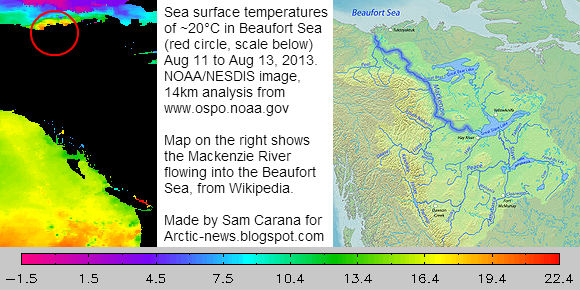
Above map shows that a number of large rivers in Siberia end up in the Arctic Ocean. Another large river is the Mackenzie River, which ends in the Beaufort Sea, north of Alaska, where sea surface temperatures of about 20°C (68°F) were recorded in 2013, as the image below illustrates.


Another area of concern, also marked with a purple oval in the image below, is located in the north of Canada.


More extreme weather events include heat waves, storms, floods and wildfires, all of which can contribute to more rapid warming of the Arctic Ocean.

The combined effect of all the above will be that methane that is now contained in the form of free gas and hydrates in sediments under the Arctic Ocean, can be expected to be increasingly released as the Arctic Ocean warms further.

- Methane 

Of the vast amounts of methane stored in the Arctic, much of it is prone to be released with further temperature rises, as discussed in this earlier post and in this earlier post. Cracks in sediments used to be filled with ice. Warmer water is now melting the ice that used to sit in cracks. This ice has until now acted as a glue, holding the sediment together. Moreover, the ice in the cracks has until now acted as a barrier, a seal, that prevented the methane contained in those sediments from escaping. In a video interview with Nick Breeze, Natalia Shakhova mentions a sample of sediment taken from the ESAS seafloor in 2011 that turned out to be ice-free to a depth of 53 m at water temperatures varying from -0.6˚C to -1.3˚C. Back in 2008, Natalia Shakhova et al. considered release of up to 50 Gt of predicted amount of hydrate storage as highly possible for abrupt release at any time.

The image below, based on data from the IPCC and the World Metereological Organization (WMO), with an added observation from a NOAA MetOp satellite image, illustrates the recent rise of methane levels and the threat that methane levels will continue to rise rapidly.


When looked at from a longer range of years, above image fits in the black square on the image below.


The image below shows exponential rise based on data of East Siberian Arctic Shelf (ESAS) releases alone, as discussed in an earlier post.


Non-linear rise is supported by the fact that methane's lifetime increases as more methane enters the atmosphere. As the image below shows, peak methane levels have been very high recently.


All these feedbacks can interact and amplify each other in non-linear ways, resulting in rapid and intense temperature rises, as illustrated by the image below.

Diagram of Doom - for more background, see Feedbacks

4. Runaway Global Warming

The threat is that such rapid temperature rises will appear at first in hotspots over the Arctic and eventually around the globe, while also resulting in huge temperature swings that could result in depletion of supply of food and fresh water, as further illustrated by the above image, from an earlier post, and the image below, from another earlier post.

Rapidly rising temperatures will cause stronger evaporation of sea water. Since water vapor is one of the strongest greenhouse gases, this can further contribute to the non-linear temperature rises pictured above.

In conclusion, the situation is dire and calls for comprehensive and effective action, as discussed at the Climate Plan blog.


ISSCC 2015 Report: Shizuoka University Compressive Imager

...
Albert Theuwissen continues to post his reports from ISSCC. Shizuoka University presents a 200 million fps compressive imager. The imager consists of 15 pixel sub-arrays, each of them exposed at the differing times. In the end, a 200Mfps image sequence is recovered.
11:56 AM

Principal Piping Engineer (Lead) - Jacobs

...
Job Title:  Principal Piping Engineer (Lead) Location: ALK,SA Primary Job Responsibilities Brief Description of Job: Responsible for getting the timely preparation, review, and delivery of all required design and engineering deliverables. Discipline lead assigns originators for deliverables from the design project team and ensure that all project staff providing engineering support

Cista and SMIC Start Mass Production of 0.13um-Process BSI Sensors

...
PR Newswire: Remember Cista, a mysterious image sensor startup founded by ex-Omnivision employees? SMIC and Cista System Corp. jointly announce a mass production start of two CIS-BSI products, of 1.3MP resolution with 1.75um pixel and 8MP resolution with 1.4um pixel, respectively. Both sensors are based on SMIC's 0.13um BSI process.

SMIC's 0.13um CIS-BSI technology is said to be independently developed and offers competitive performance. Based on a low leakage process, it only uses three aluminum metal layers for reduced cost and supports pixel sizes down to 1.4um for 8MP resolution CIS. SMIC also provides full in-house turn-key service which includes CIS wafer fabrication, color filter & micro-lens processing, TSV-CSP and testing to help customers shorten the supply chain with fast cycle time and low cost.

"Through working with our partner, Cista System Corp., we are very pleased with the achievement of the production phase for BSI technology," said Dr. Shiuh-Wuu Lee, EVP of Technology Development of SMIC. "Tests on the two sensors have shown great performance which demonstrates our readiness in 0.13-micron BSI technology platform. SMIC is also developing 1.1-micron pixel BSI for 13MP resolution and above, and 3D stacked BSI for high-end applications. With these new sets of products, we hope to provide high-quality CMOS Image Sensors to our customers at a competitive price."

"We are excited to partner with SMIC on launching the CIS-BSI sensors," said Wilson Du, CEO and President of Cista System Corp. "This partnership draws us one step closer to our goal of becoming more integrated with domestic industry resources in developing the image sensor sector. As we move forward, we hope to see more of our designs used in wider applications such as consumer electronics, telecommunications, medical equipment, automotive industry, automation and other applications."

So far, Cista web site only lists 1MP and 2MP products, with others, up to 13MP, are said to come soon. The 2MP C2580 and C2590 SoC specs look similar, and both sensors appear to be frontside-illuminated:


The 1MP C1680 has a similar block diagram and spec, but uses BSI technology:

3:31 AM

CEVA Announces 4th Gen Vision Platform

...
PR Newswire: CEVA unveils the CEVA-XM4, its fourth-generation imaging and vision processor IP. CEVA-XM4 achieves up to 8x performance improvement with 35% greater energy efficiency, compared to the previous generation CEVA-MM3101.

The new IP's capabilities include real-time 3D depth map generation and point cloud processing for 3D scanning. In addition, it can analyze scene information using the most processing-intensive object detection and recognition algorithms, ranging from ORB, Haar, and LBP, all the way to deep learning algorithms that use neural network technologies such as convolutional neural networks (CNN). The architecture also features a number of unique mechanisms, such as parallel random memory access and a patented two-dimension data processing scheme. These enable 4096-bit processing -- in a single cycle -- while keeping the memory bandwidth under 512bits for optimum energy efficiency.

In comparison to today's most advanced GPU cluster (points to NVIDIA, I guess), a single CEVA-XM4 core will complete a typical 'object detection and tracking' use-case scenario while consuming approximately 10% of the power and requiring approximately 5% of the die area.

Taking computer vision one step closer to human vision, the CEVA-XM4 also supports a wide range of computational photography algorithms that enhance the video or image, including refocus, background replacement, zoom, super-resolution, image stabilization, noise reduction and improved low-light capabilities.

12:14 AM

Omnivision Reports Quarterly Results

...
PR Newswire: OmniVision reports results for its fiscal quarter ended on January 31, 2015. Revenues for the quarter were $292.3M, as compared to $394.0M in the previous quarter, and $352.0M a year ago. GAAP net income in the quarter was $14.0M, as compared to net income of $28.0M in the previous quarter, and $30.6M a year ago. GAAP gross margin for the quarter was 22.1%, as compared to 22.0% for the previous quarter and 19.6% a year ago. The Company ended the period with cash, cash equivalents and short-term investments totaling $512.8M, a sequential decrease of $12.4M that resulted primarily from the use of cash in operating activities.

Based on current trends, the Company forecasts revenues for the next quarter in the range of $265M to $295M.

"As we continue to expand in Asia and find new opportunities in emerging economies, our results may continue to be volatile, at least in the near-term," said Shaw Hong, CEO of OmniVision. "However, it is important for us to participate in these markets as they are integral to our strategy. We remain confident about our long-term growth prospects."

SeekingAlpha publishes Omnivision's earnings call transcript. Shaw Hong says on the acquisition prgress: "I would like to comment on the proposed acquisition from Hua Capital Management Ltd., or HCM, a Beijing-based investment management company. A few months ago, we received a preliminary non-binding proposal letter from HCM, pursuant to which a group of investors led by HCM proposed us to acquire all of the outstanding share of common stock of the company in cash at US$29 per share. While the company's board of directors is reviewing and evaluating HCM's proposal, no decision has been made with respect to the proposed transaction. There is no assurance that this or any other transaction will be consummated."

Few other quotes from Aurelio Cisneros - SVP, Worldwide Sales & Sales Operations:

"In a special case, an innovative dual sensor main camera design featuring our 8-megapixel product line was launched by a major Tier 1 China customer. This represents a major potential technology shift where dual camera designs are built for a multitude of reasons such as improved sensitivity, slim compact design requirements and innovative 3D data capture. If this trend spreads, the total available opportunity in the already enormous handset market could surge to higher volumes because dual camera designs could be used for the main camera as well as for the front-facing camera slot. The benefits of a dual camera design are applicable to either case."

"In our third fiscal quarter, we shipped 198 million units as compared to 246 million units in our prior quarter. The average selling price in our fiscal third quarter was $1.46 as compared to $1.60 in our prior quarter. The drop in ASP was attributed to the product mix and aggressive price erosion in some product categories, primarily products shipped to the China market.

Unit sales of 8-megapixel and above represented approximately 10% of total shipments in the fiscal third quarter, compared to approximately 12% of total shipments in the prior quarter. Unit sales of 3-megapixel to 5-megapixel category represented approximately 41% of total shipments, as compared to 42% in the prior quarter for the same category. Unit sales of 2-megapixel and below represented approximately 49% of total shipments, as compared to 46% in the prior quarter.
"
11:33 PM

Framos Survey on Machine Vision Market

...
Framos 2014 survey on machine vision market paints an interesting picture. "The study is based on answers from 54 respondents based in 13 countries, 10 manufacturers and 44 users, with the main focus on German-speaking countries and Europe. Respondents were ranked in terms of relevance, based on the production or purchase volumes on which they were surveyed. 40% of the manufacturers produce up to 500 cameras a year, 20% over 10,000 cameras. Principal sales areas are North America and Asia. 80% of users purchase fewer than 100 cameras a year, only 5% require more than 1000 cameras. The main area of use is Europe, at 75%, due to the focus of this survey."

Here is the respondents view on CCD vs CMOS market evolution:


"In respect of sensor brands and their future use in imaging systems, camera manufacturers and users are agreed on their decline or rise. Sensors from Sony may have less usage in percentage, but continue to be the most trusted brand, with a predicted market share of 35% in 2016. In particular, considerable growth is expected for the brands Aptina and Truesense Imaging (both now under one roof, belonging to OnSemi), to a market share of 13% and 19% respectively."

12:45 PM

AlliedSens to Represent Caeleste in Asia and America

...
AlliedSens becomes an official representative of Caeleste for custom design CMOS image sensor in Asia and America.

Patrick Henckes, CEO of Caeleste says “With the growing demand of custom design sensors, it is critical for Caeleste to rely on the best possible partners to expand our activities worldwide.“

Eiji Watanabe, CEO of AlliedSens says “We are happy to have Caeleste’s cutting edge custom image sensor into our product line in order to fulfill the rapid growing demand of high performance image sensors for industrial, medical and automotive applications in Asia and Americas.”

AlliedSens also represents CMOSIS, PixelPlus and Awaiba.
12:04 PM

ISSCC 2015 Report - Forza & NHK Sensor, Samsung

...
Albert Theuwissen continues his report from ISSCC imaging session. The second part presents Forza and NHK 133MP 60fps sensor in 35mm FF format. 484 12b SAR ADCs support that high pixel rate. The pixel size is 2.45 um, 2×1 shared, 2.5T/pixel.

Samsung presents an always on low power sensor having an ultra-low power, low resolution, low quality mode, but waking up as soon as there is any movement in the scene and switching to a normal higher resolution, higher quality mode.
11:38 AM

ON Semi Announces PDAF Technology

...
Business Wire: ON Semiconductor (Aptina) successfully demonstrated its second generation Phase Detect Auto Focus (PDAF) technology featuring a unique pixel micro-lens technology that enables fast focus at 25 Lux light levels. This PDAF has been implemented on a 13MP test chip with 1.1µm pixels and will be utilized in a new product introduction for mobile end-market customers later this year.

The PDAF technology uses two pixels to measure phase information from the target image. This phase information is then used to calculate the direction and the amount the lens needs to move to focus in less than 0.3 seconds, depending on focus actuator speed. Furthermore, ON Semiconductor has implemented a unique pixel micro-lens structure which maintains sensitivity in the PDAF pixels and ensures enough light is captured for PDAF to perform in low-light conditions as low as 25 Lux (similar to a dimly lit room). Competing technologies on the market employ methods that compromise pixel sensitivity and low light auto focus performance.

“ON Semiconductor’s PDAF technology is the result of innovations in both pixel and optical stack design,” said Shung Chieh, VP Mobile and Consumer Division for ON Semiconductor. “The outcome is a reduction of auto focus time by nearly a factor of four and delivers a great experience to the mobile device user. The leading low-light capability of our technology enables smartphone manufacturers to deliver a fast AF experience across all light levels to their customers.”
11:29 AM

Toshiba Starts Mass Production of 8.1MP 1.12um Pixel Sensor

...
Business Wire: Toshiba started mass production of the previously announced 8MP, 1.12um pixel T4KA3 BSI sensor.

The sensor has a new low power circuit design that cuts power consumption to 46% that of Toshiba’s previous generation 8MP T4K35, an improvement over the earlier announcement that only stated 15% improvement. The sensor fits into 6.5mm square camera module, said to be the smallest in the class of 8MP sensors. The 8MP output at 30fps is possible using 2 Lane MIPI interface. The sensor incorporates "Bright Mode" that boosts image brightness up to four times, realizing HD video capture at 240 fps equivalent.

11:04 AM

Allied Vision Confirms Sony CCD Discontinuation

...
Allied Vision, vendor of machine vision cameras, confirms Sony plans to stop CCD production. Michael Cyros, Chief Commercial Officer of the company, says in an interview: "Many in the industry had expected this to happen sooner or later. As you know, CMOS sensors have become more and more popular in the last couple of years. With greatly improved image quality, sensitivity, dynamic range and speeds, they have outpaced CCD technology of late. Sony’s decision is a logical step in that context to provide further capacity for CMOS growth."

Thanks to PJ for quoting the link in comments to the earlier post.
9:30 PM

ISSCC 2015 Report

...
Albert Theuwissen starts publishing his overview of ISSCC 2015 imaging session. The first part talks about the new Sony 20MP/1.43um stacked sensor with two ADCs per column. The dual ADC can be used:
  • for increased readout speed (120fps in 16MP/10b mode)
  • for 3db noise improvement
  • to achieve 1.3e- noise level by multiple reads
  • simultaneous stills and video capture
12:41 PM

More on Sharp Colorized IR Camera

...
Optics.org publishes an article on AIT and Sharp development of a colorized IR-illuminated camera: "The technology performs the color processing based on the weak correlation between the reflectance properties in the visible light region of objects and those in the infrared region, and obtains color images of the objects in the same or similar colors as the colors of the objects in visible light." The AIT colorizing algorithms require a modification of image sensor in the camera, but article gives no details on what kind of modification is needed.

Left- nightime image with no active IR illumination
Right - IR illumination is on and colorizing algorithms enabled
11:25 AM

Analysis and Design of Phase-Shifted Dual H-Bridge Converter with a Wide ZVS Range and Reduced Output Filter

...

Abstract—In this paper, a phase-shifted dual H-Bridge converter, which can solve the drawbacks of existing phase-shifted full-bridge converters such as narrow zero-voltage-switching (ZVS) range, large circulating current, large duty-cycle loss, and serious secondary-voltage overshoot and oscillation, is analyzed and evaluated. The proposed topology is composed of two symmetric half-bridge inverters (TSHBIs) that are placed in parallel on the primary side and are driven in a phase-shifting manner to regulate the output voltage. At the rectifier stage, a center-tap-type rectifier with two additional low-current-rated diodes is employed. This structure allows the proposed converter to have the advantages of a wide ZVS range, no problems related to duty-cycle loss, no circulating current, and the reduction of secondary-voltage oscillation and overshoot. Besides, the output filter’s size becomes smaller compared to the conventional phase-shift full-bridge converters. This paper describes the operation principle of the proposed converter and the analysis and design consideration in depth. A 1-kW 320-385-V input 50-V output laboratory prototype operating at a 100-kHz switching frequency is designed, built, and tested to verify the effectiveness of the presented converter.

Contact us for full paper


OmniVision and eyeSight Partner on Gesture Recognition

...
PR Newswire: OmniVision and eyeSight announced their co-development of next-generation gesture recognition technology in the industry's smallest form factor. eyeSight's gesture recognition technology, together with OmniVision's OVM6211 global shutter camera solution brings gesture recognition to a wide range of applications. The OVM6211 CameraCubeChip is a complete camera solution with a lens, sensor and packaging that uses a 3um OmniPixel3-GS global shutter pixel to capture 400 x 400 pixel video at 120fps.

"One of the frustrations with gesture recognition solutions in the market today is that they tend to work poorly in low light conditions," said Gideon Shmuel, CEO at eyeSight. "OmniVision's easily integrated OVM6211 global shutter sensor, working in tandem with our gesture recognition technology, can overcome the inherent challenges of recognizing gestures in difficult lighting conditions. This is critical for enhancing user experience and further broadening the scope of potential applications."
9:15 PM

ON Semi Presents Imaging Solutions

...
Business Wire: ON Semiconductor presents 1/2.7-inch AR0230CS image sensor aimed to 1080p IP cameras with data rates up to 60fps. The sensor features 3um DR-Pix pixels, an integrated support for HDR video, improved motion compensation, advanced local tone mapping (ALTM), and digital lateral overflow (DLO) that minimizes motion artifacts and enhances HDR colors:


The company also presents AF controller LC898214XD and AF/OIS controller LC898123XC having quite a complex internal structure with 32b DSP and relatively large memories:

AF/OIS controller block diagram
11:32 AM

Samsung Techwin Sells off Its Imaging Patents

...
PR Web: ICAP Patent Brokerage announces for sale of Samsung Techwin Co., Ltd. imaging patents. The portfolio is directed to methods and apparatuses for camera phone modules, including:
  1. Nine patents directed to a lens system. These address reduction of an entire length, correction of distortion, increase in viewing angle, high resolution power, securing similar optical performance with fewer lenses, and reduction of variation of resolution power in automatic zooming, etc.
  2. Six patents directed to the structure and driving mechanism of the lens module. These allow for the minimization of the size of an optical system, auto-focus or zooming module, cost-saving of materials, and facilitation of electrical connection, etc.
  3. Four patents directed to the sliding structure. These address compact size with less thickness, reduction of friction, increase in sliding stroke, user convenience, smooth sliding operation, and better readability of a key pad, etc.
  4. One software patent addresses improvement of user convenience in combining images for panorama image.
10:15 PM

Kinect-2 ToF Sensor Demo

...
ISSCC posts the 2014 demo of Microsoft Kinect-2 ToF sensor on Vimeo:

10:10 PM

LEAD PIPING ENGINEER – ABU DHABI

...
LEAD PIPING ENGINEER Location: United Arab Emirates: Abu DhabiType: ContractPosted: 15 Feb 2015Reference: 37773  A major oil operator is seeking a Lead Piping Engineer. The position will be working on an Oil Train. The project is currently in Pre-Feed. The ideal candidate will have operator and EPC experience, strong design experience and experience through the different phases of the project.

Sony to Discontinue CCD Products?

...
This info originally appeared in a number of forums, such as this one, but it has no official confirmation. The info can be a hoax.

Said all that, it seems that Sony intends to discontinue its entire line of CCD products. The story started unfolding at the end of January with closing the production line for the complementary color filters and the Kagoshima 200mm wafer production line. Last week, Framos, one of the Sony CCD distributors, sent the following email to its customers:

"Dear Customer!

This message is to inform that SONY decided to discontinue all their CCD image sensor products! Attached please find the official letters from SONY!

The CCD End-of-Life plan of SONY is the following:
- customers need to order their last-time-buy quantities by end of Aug 2015
- SONY fab will shut-down March 2017
- deliveries can be made until March 2020

Please note: for new designs, especially with CMOS sensors we can offer in-depth technical support and are able to provide reference designs etc to you under certain conditions. Especially we are already working on reference designs of the upcoming IMX25x-series.

If there are any questions or any further need, please contact your FRAMOS account manager, or sales@framos.com as soon as possible!
"

Before that, Sony reportedly sent to its customers two announcements dated by the end of January:


Thanks to NA for the info!

Update: According to Sony Semiconductor flyer dated by Feb. 4, 2015, CCD used to be manufactured at Kagoshima and Kumamoto fabs:

5:28 AM

Temperance, Net Neutrality, and the FCC

...

Later this week, on Feb. 26, the U. S. Federal Communications Commission (FCC) is going to vote on a proposal to enforce net neutrality.  Net neutrality, according to some, is the idea that all bits are created equal, and that communications firms using or operating parts of the Internet should not discriminate against or for certain types of services, providers, or customers.  If I could do one thing to help the FCC decide wisely on this proposal, I'd bring back Aristotle and ask him to explain to the commissioners what he means by egkrateia, which is usually translated as "temperance" or "moderation."  The Internet has to be one of the most influential and beneficial engineering developments of all time, and it would be a shame for the FCC to cripple it.  But if they don't exercise temperance, that's just what they might do.

Writing in the electrical engineering professional journal IEEE Spectrum, Jeff Hecht points out that wireless technologies, where a lot of the most exciting new Internet developments are happening, need careful technical management to work.  It has to do with the fact that all data on the Internet travels in little chunks called packets.  When the Internet was founded, most data was not that time-sensitive.  If data for email or a webpage shows up in pieces spaced even several seconds apart, it's no big deal.  But as highly time-sensitive services such as telecommunications (phones) and video began to switch to the Internet, and as new time-sensitive services such as multiplayer games developed, timing became a big deal.  Hecht points out that a delay of only twenty milliseconds can disrupt a phone conversation, and if a sound that short goes missing it can turn "can't" into "can" and lead to all kinds of problems.  The same goes for video, which gets jerky with such delays, or game apps, which slow down and aren't that fun anymore.

Delays like this and speed-slowing bottlenecks are especially hard to avoid in two places: (1) where internet service providers (ISPs) connect to the Internet's "backbone," or (2) where wireless is used, such as when you access the Internet from your phone or mobile device.  In the latest generation of mobile phone service, called 4G LTE, providers have developed a way to label packets with what amounts to a digital ship-by date.  Packets that spoil fast—phone conversations, video, game-player data, and time-sensitive system control data—get shipped the fastest, while packets that represent email or webpages have to wait longer in line. 

This technical packet-labeling is called "priority coding" and it's a critical ingredient in the new high-fidelity phone service called VoLTE (LTE, by the way, stands for "long-term evolution"). 

Here's where the moderation comes in.  Reportedly, the FCC is planning to reclassify the Internet as a "common carrier."  Currently the FCC views it through a different legal lens, as an "information provider," which allows the government fewer regulatory options.   But the common-carrier class includes the highly regulated telecommunications industry, and so the FCC's proposed rule changes could allow it to regulate the Internet much more closely than it does now.  Depending on what the FCC means by net neutrality, the commission (or a sneaky lawyer wielding the Commission's new rules) could use its new legal chops to break the new 4G LTE by making priority coding illegal.  After all, if every bit is created equal, shoving some to the front of the line in front of others could be viewed as discrimination.

Any time a government agency decides to extend its regulatory authority, you have to hope that it won't go overboard and stifle the industry it's allegedly trying to help.  This is where Aristotle's virtue of temperance can help.  As has happened in many other fields, the Internet's technology has in many ways outstripped the legal frameworks that were set up to regulate communications systems in the past.  I think it's good for the FCC to acknowledge that the communications world has changed, and that pretending the Internet is just an information provider is outdated.  But an attempt at heavy-handed populist-style regulation in the name of absolute net neutrality could do more harm than good.

Moderation on all sides is called for.  Free-market enthusiasts may worry that the FCC is going to tax or regulate the Internet to death with its new proposed powers.  This is unlikely.  But at the same time, a more subtle danger to watch out for is the co-opting of government authority by big corporate players in a way that favors their interests over those of small firms who want to innovate, but whose innovations pose a threat to the big guys.  This can't happen in a lightly-regulated industry, which so far the Internet has been, for the most part.  I think the FCC is smart enough not to issue rules that would flat-out break the 4G LTE technology.  But any extension of regulatory authority can lead to manipulation of that authority by vested interests.  And I think that is what Aristotle would caution us about the most.  But first, we'd have to explain to him what the Internet is.

Sources:  Jeff Hecht's article "Net Neutrality's Technical Troubles" was posted on the IEEE Spectrum website on Feb. 12, 2015 at http://spectrum.ieee.org/telecom/internet/net-neutralitys-technical-troubles/.  On Feb. 4, FCC Chairman Tom Wheeler declared his intentions with regard to net neutrality in the online edition of Wired at
http://www.wired.com/2015/02/fcc-chairman-wheeler-net-neutrality/.  I also referred to an article on The Daily Dot about the FCC's Title II authority (which allows it to regulate common carriers such as telecomm companies) at http://www.dailydot.com/politics/what-is-title-ii-net-neutrality-fcc/.  I most recently blogged on net neutrality on Nov. 24, 2014 in "How Neutral Is the Net?"

DISCIPLINE ENGINEER-PIPING WORLEYPARSONS

...


Discipline Engineer - Piping

Company: WorleyParsons


Primary Location:Al Khobar, Saudi Arabia


Job
: Floating Systems


Schedule
: Full-time

Employment Type: Staff

Job Level: Experienced

International Transfer Opportunity: Yes


Job Posting : Feb 22, 2015


Reporting Manager Title: Piping Manager


DISCIPLINE ENGINEER-PIPING


WorleyParsons is a dynamic, entrepreneurial EPCM

Multiple Benefits Of Ocean Tunnels

...
By Sam Carana and Patrick McNulty

Comprehensive climate action will do more than just cutting emissions, it will also take further action, as pictured in the image below.

Comprehensive and effective action is discussed at the Climate Plan blog
Taking a broad perspective makes it easier for proposed projects to be assessed on their benefits in a multitude of areas.

Ocean tunnels can capture vast amounts of energy from ocean currents, such as the Gulf Stream and the Kuroshio Current. These locations are close to areas with high energy demand, such as the North American East Coast and the coast of East Asia, which can reduce the need for long distance transmission lines.

Ocean tunnels provide clean energy continuously, i.e. 24 hours a day, all year long. This makes that they can satisfy demand for electricity both at peak and off-peak usage times.

  • Their ability to supply large amounts of electricity at times of peak demand will benefit the necessary transition from polluting to clean ways of generating electricity.
  • Their ability to also supply large amounts of electricity at off-peak usage times will help to reduce the price of electricity at such times, thus opening up opportunities for a number of activities that can take place at off-peak hours and that require large amounts of energy.

    Such activities include large-scale grinding of olivine rock and transport of the resulting olivine sand, and large-scale production of hydrogen through electrolysis to power transport (box right). Electrolysis can also create oxygen-enriched water that can improve the quality of waters that are oxygen-depleted.  
Hydrogen to power Shipping

Ocean tunnels can make electricity cheap at off-peak times. This will reduce the cost of recharging batteries of electric vehicles at night.

It will also reduce the cost of producing hydrogen at off-peak hours. To power ships crossing the oceans, hydrogen looks more cost-effective, as such ships cannot return to base for a nighly battery recharge. Such ships have plenty of cargo space to carry hydrogen, even when the hydrogen is not highly compressed. Some of the world's largest ports are close to strong ocean currents.


Ocean tunnels can generate electricity in two ways, i.e. by capturing the kinetic energy contained in the flow of ocean currents, and by means of Ocean Thermal Energy Conversion (OTEC) using temperature differences between cooler deeper parts of the ocean and warmer surface waters to run a heat engine to produce energy. 

Besides generating energy, ocean tunnels can assist with further activities, which will increase the value of ocean tunnels in the fight against climate change. Such activities include the following:
  • By reaching deeper parts of the ocean, OTEC can pull up sunken nutrients and put them out at surface level to fertilize the waters there, while the colder water that is the output of OTEC will float down, taking along newly-grown plankton to the ocean depths before it can revert to CO2, as described in the earlier post Using the Oceans to Remove CO2 from the Atmosphere.
  • Ocean tunnels can be used to distribute olivine sand in the water. The force of the currents and the turbines will help the process of transforming olivine into bicarbonate. This can reduce carbon dioxide levels in the water by sequestering carbon, while also reducing ocean acidification. Olivine sand contains silicate and small amounts of iron, allowing diatoms to grow that will capture additional carbon dioxide, while also raising levels of free oxygen in the water. The latter will stimulate growth of microbes that break down methane in the water before it reaches the atmosphere. Further nutrients can be added, as also discussed in this earlier post. 
  • Ocean tunnels can also assist with albedo changes. Ocean tunnels can act as the infrastructure to create water microbubbles along their track. Increasing water albedo in this way can reduce solar energy absorption by as much as 100 W m − 2, potentially reducing equilibrium temperatures of standing water bodies by several Kelvins, as Russel Seitz wrote back in 2010. There may also be potential for ocean tunnels to be used to spray water vapor into the air with the aim of brightening clouds over areas where it counts most.
  • The turbines in tunnels will also reduce the flow of ocean currents somewhat, thus reducing the flow of warm water into the Arctic. Furthermore, tunnels can be shaped in ways to guide the flow of warm water away from the Arctic Ocean down a southwards course along the Canary Current along the coast of West Africa. thus diverting warm water that would otherwise end up in the Arctic Ocean. This could also reduce the chance of hurricanes hitting the east coast of North America, as Sandy did in 2012.  
The Gulf Stream, carrying warm water all the way into the Arctic Ocean


Sony Low-Cost Global Shutter Sensor

...
Sony IMX249 low-cost global shutter sensor has already appeared in Point Grey cameras. Now Sony publishes an official IMX249 flyer. There is a difference between Point Grey's announced speed of 41fps and Sony's official 30fps at full 2.35MP resolution. However, on the sample photograph Sony states 60fps for FHD resolution:

9:35 PM

Omnivision Applies for Si Photomultiplier Patent

...
Omnivision patent application US20150041627 "Partitioned silicon photomultiplier with delay equalization" by Eric A. G. Webster proposes 3-wafer stacked photomultiplying imager. The top wafer has photomultiplier diodes with quenchers, the bottom wafer has the readout electronics, while the mid interposer-wafer ensures equal-length interconnects to ensure the equal delay between the PDs in each pixel, and so improve the timing resolution:

5:56 AM

poLight TLens Datasheet

...
poLinght publishes its TLens brief datasheet.

The POL10-3215 TLens Silver features:
  • Suitable of 1/4-inch sensors
  • Supports 3MP to 8MP resolutions
  • Easy to add on camera module
  • ESD and stray light protection option
  • Package size: 4.8mm x 4.8mm
  • Minimize additional thickness at fixed focus camera module level
  • Centering accuracy < +/-0,05mm
  • Response time down to 1ms
  • Power consumption as low as 1mW
  • Small footprint 3.2mm x 3.2mm
  • Focus distance from infinity down to 10cm
  • No sensitivity to gravity
  • Voltage range at Bottom electrode: 0V to 5V
  • Voltage at Top electrode: 0V to 40V
  • Maximum applied current: 1mA
  • Operating temperature from -10°C to 60°C

5:18 AM

Videantis and Gestigon Partner

...
Videantis and Gestigon partner to team Videantis’s low-power vision processing IP platform with Gestigon’s tracking and gesture recognition. The main aim of the cooperation is to bring gesture and pose recognition technology to the automotive market, which is rapidly adopting a wide variety of vision-based technology. More and more image sensors are entering cars, including depth-sensing technologies. These sensors can be used for skeleton tracking inside and around the car. The driver and passenger’s poses, behavior, and signals can be used for “classical” gesture control but also for more advanced, UX-focused comfort and security features.

“Videantis is the perfect partner for gestigon”, gestigon CEO, Moritz von Grotthuss, says. “Their scalable, efficient processor IP already powers millions of cars on the road, and is a great target for low-power implementations of our algorithms that enable an innovative state-of-the-art user experience. The partnership is a perfect match -- both companies excel in their field of work and have already built a significant customer network among global automotive Tier 1s and OEMs.”

Videantis products
2:36 AM

Broadcom Proposes to Involve Internet Data to In-Camera Processing

...
Broadcom patent application US20150042843 "Systems and methods for improving images" by Ike Aret Ikizyan and Noam Sorek proposes to use network connectivity to improve smartphone camera image processing:

"Systems and methods are provided for improving image accuracy and/or perceptual quality by using supplemental data from sources external to an image sensor and/or a light sensor of an imaging device without requiring users to manually enter this data. The supplemental data, for example, may include lighting condition information retrieved from databases that provide general weather information, color temperature models, images in a similar environment, control setting information of those images, statistical information of those images, and/or any other information that may be used to improve the accuracy and/or perceptual quality of an image that was or will be captured. In some aspects, if the image has not yet been captured, the supplemental data may be used by the imaging device to adjust appropriate control settings (e.g., a color balance setting, a flash setting, an aperture setting, a shutter speed setting, an exposure compensation setting, an ISO setting, a light frequency setting, a noise reduction setting, a sharpening setting, etc.) such that the image can be captured accurately and/or with higher perceptual quality. In some aspects, if the image has already been captured, the supplemental data may be used to adjust the image itself so that it accurately reflects the environment in the image and/or improves the perceptual quality.

...environment identification module 202 may determine the environment using a global positioning system (GPS) sensor, a Wi-Fi-based positioning system (WPS) sensor, a gyroscopic sensor, an accelerometer, a magnetometer, and/or other sensors. One or more of these sensors may be part of imaging device 102.
"


One could expect such kind of patents come from Apple, Broadcom is a surprising source for that.
1:16 AM