Teledyne DALSA Announces Full-Frame 32MP CCD Family

...
Teledyne DALSA releases a new FTF7046 family of full frame image sensors with 32MP. Using the latest 5.2um pixel, the company says it is able to preserve DR (>72dB linear), QE, and FF (>90%) in the FTF7046 even as they reduced pixel size to deliver 32MP in a 35mm optical format. The FTF7046 image sensors are available in color (RGB) and monochrome models. The sensor's frame rate is 1.2fps with 2 x 25MHz parallel outputs.

12:57 PM

IHS: iPhone 5s Camera Gets Cheaper

...
Electronics360: Andrew Rassweiler, senior director of Teardown Analysis and Cost Benchmarking Service at IHS Electronics & Media, presented cost analysis of the new iPhone 5s and 5c, with both rear and front cameras taking roughly 6-7% of the BOM:

Preliminary Cost Estimate for iPhone 5s
Preliminary Cost Estimate for iPhone 5c

This is somewhat lower than IHS' last year estimation of $16.40 for the rear camera of iPhone 4s:

iPhone 4s Cost Analysis

Now I wonder how IHS came to the conclusion that iPhone 4S' 8MP 1.4um-pixel BSI camera module is cheaper than 5S' set of front and rear cameras 1.2MP+8MP, where the rear one has 1.5um pixel stacked sensor? Where do they find the savings? My guess is that they just estimated the chip areas, and, naturally, the stacked sensor came out smaller.
12:44 PM

Sony Playstation 4 to Support Gesture Control

...
IGN, Forbes: At Tokyo Game Show, Sony confirmed the PlayStation 4 will support gesture control via the PlayStation Camera, similar to Xbox One’s Kinect. But while Kinect will come bundled with the console, Playstation 4 users will need to buy the optional gesture recognizing camera separately.
12:12 PM

STMicro Develops B&W+R Sensor for Automotive

...
EETimes: STMicroelectronics develops B&W automotive image sensors for ADAS. An interesting feature is that it's able to single-out the red colored details, while everything else is B&W. When asked why red, ST BU director Martin Duncan said, "Red indicates a lot of important information - such as red traffic light, red road signs, brake lights, and tail lights."
11:40 AM

Nokia Publishes More Lumia 1020 Camera Details

...
The official Nokia Conversations blog published few more 41MP Lumia 1020 camera details coming from Eero Salmelin, Nokia’s Head of Imaging:

"First we have the optics system with its six element lens, which... is the highest performing optics ever been put into a Nokia device."

"In Nokia’s OIS solution the whole lens system is resting on ball bearings. The special gyro components are very accurate and fast in detecting how the phone is moving and the lens is moved by the motors in the opposite direction very quickly to compensate for the handshake."

"The camera module is the casing that packages everything together so that it slots neatly inside the Lumia 1020. It measures 25mm by 17mm and contains well over 130 individual components. Every single camera component is tested, calibrated and the quality is verified. We make sure that each module performs extremely well."

Lumia 1020 camera module
11:59 PM

Fujifilm and imec Develop New Photoresist for Organic Image Sensors

...
Fujifilm and imec have developed a new photoresist for organic semiconductors that enables the realization of submicron patterns and does not hurt the light sensitivity of the organic photodetectors. For technical verification, Fujifilm and imec developed organic photo detectors (OPD) using the new photolithography technology, and tested their performance. Organic semiconductor materials were patterned to produce OPD composed of fine light receiving elements down to 200μm×200μm size (for some reason marked as 300um x 300um on the graph below). Generally, patterning of organic semiconductor materials degrades the property of converting light into electricity, but the OPD developed in this case were patterned without degradation:

Organic semiconductor materials were patterned to form OPD
of 300μm×300μm size, and photoelectric conversion property
with irradiation of artificial sunlight (AM1.5G) (red dotted line)
was examined. When compared with photoelectric conversion
property without patterning organic semiconductor materials (red
solid line), it did not show degradation due to patterning.
Similarly, there was no difference between with patterning (black
dotted line) and without patterning (black solid line) for
unirradiated dark current.
10:47 PM

Toshiba Announces Stereo 3D Depth-Enabled Camera Module

...
Business Wire: Toshiba announces what it says the industry’s first dual camera module for smartphones, tablets and mobile devices. TCM9518MD incorporates twin 1/4 inch optical format 5MP camera modules (5MP x 2 arrays) and simultaneously outputs recorded images and depth data. Images captured with the module can subsequently be manipulated to change the depth of field and point of focus. Samples will be available by January 2014, with mass production scheduled for April 2014.

The dedicated companion LSI of the “TCM9518MD” measures and appends depth data to objects in the image. These data can be used for a wide variety of applications, including focus and defocus, and even to extract and erase objects from the picture. Used in combination with customers’ applications, the module supports the creation of new functions.

The companion LSI generates 13MP images by upscaling images taken by the twin 5MP cameras, realizing a lower module height than that of conventional 13MP camera modules. The TCM9518MD brings high resolution and computational camera functionalities to the CMOS image sensor market for smartphones, tablets and mobile devices.

The pixel size is 1.4um and the camera module measures 8.0 x 12.0 x 4.65 mm according to the PR (or 18 (W) × 12 (D) × 4.65 (H) mm according to the company's product page):

4:17 PM

LensVector Partners with Hosiden

...
Marketwired: LensVector and Hosiden announce an agreement for Hosiden to be LensVector's manufacturing partner. Production is scheduled to start early in 2014 in Hosiden's Shiga, Japan LCD facility. The agreement expands LensVector's manufacturing capabilities to serve the market for smartphones and other mobile devices. Hosiden will be using their LCD production technology, developed over a 40-year history of LCD production, to manufacture autofocus camera components to meet the quality and volume needs of the mobile phone market.

"Partnering with a world class manufacturer like Hosiden is an important step in establishing LensVector as the premier provider of solid-state autofocus lenses," said Howard Earhart, CEO, LensVector. "LensVector's manufacturing strategy is to merge high quality, low cost mature LCD panel manufacturing with our proprietary thin film process. This combination will provide very high capacity from existing Fabs yielding arrays of thousands of lens elements per panel."
12:20 AM

PDS PIPING DESIGNER - WORLEYPARSONS

...
Job Title: PDS Piping Designer Job Type: Full-time Location of Job: Al-Khobar, AQ SA (Primary) Job Description: WorleyParsons is a dynamic, entrepreneurial, empowered EPCM employing over 40,800 people across 41 countries.  With a recognized global reputation as a provider of professional services to the energy, resources and complex process industries, WorleyParsons continues to push the

Why There is No Camera Startups

...
Wired publishes an article by Marc Barros, the co-founder and former CEO of Contour, an action hands-free camera company. Marc discusses difficulties of creating a hardware company from scratch using camera startup as an example:

"Take cameras, for example. To make an amazing product you need: (1) a quality lens, (2) the latest image sensor, and (3) a powerful processor.

The best lenses are made in Japan (often by the camera makers themselves), so access to these components begins with $500K up front in engineering services and a guaranteed minimum order well into the thousands. Meanwhile image sensor companies are quickly being consolidated — so if a purchasing company isn’t a big name, it can’t even get access to the good stuff. For processors at least, the U.S. companies who created them are willing to provide access (to their true roadmap, SDK documentation, and engineering services), because they understand the importance of helping entrepreneurs build a product that maximizes their platform.

Overall, however, this lack of components means a hardware startup has to build volume with a crappy camera before they can make a really good one.

And of course, the established hardware players know their advantage in components is a massive barrier to entry. A few of them, like Sony and Samsung, are willing to sell other companies the same components used in their products as long as they don’t directly compete with them. Other companies, like Canon, build their own components to get ahead of the competition.
"
11:50 PM

TSMC Develops Hardmask for Deep Implants

...
TSMC is going to present its recent developments in hardmask for deep implants in small pixel sensors at NMDC, Taiwan on Oct 6-9, 2013. The paper is titled "Nanotechnology Development for CMOS Image Sensor Applications" by C.C. Wang, T.H. Hsu, S.F. Ting, C.Y. Chen, K.C. Huang, J.C. Liu, S. G. Wuu. TSMC has developed a nice hardmask process for pixel size of order of 1um:

12:05 PM

Advanced Scotch Yoke Design Increases Service Life

...
ROTEX recently replaced some old "orange" scotch yoke actuators with the DRS series. The customer is a major international producer and marketer of food and agricultural products.  The "orange" actuators were experiencing high wear and had to be rotated out and serviced every few months. After the ROTEX DRS actors were installed, at last count, they had 125,000 cycles without any internal corrosion or degradation.

Let's examine the design improvements that allow this superior performance:
  • Pneumatic cylinders are lined with hard chrome plating. Smooth to eliminate wear of piston seals, the surface is very hard, for long life.
  • Springs are lifetime lubricated and epoxy coated.
  • Inside the pneumatic module, dual oversized tie rods are protected from external corrosion. Where the tie rods pass through the piston head, ROTEX has improved the design by providing a slide bearing, where most designs don’t. This bearing is important to help maintain alignment and assure smooth operation.
  • Inside the frame module, the yoke is supported by life time lubricated bearings. Needle roller bearings ensure the most efficient torque transmission. The piston shaft is supported on each side of the frame module by solid bearings that ensure proper alignment and smooth operation.
  • Each piston shaft of the ROTEX DRS is equipped with two Flexijoints. These specially designed joints compensate for movement and changes in alignment to reduce internal stresses and increase output torque. The thrust transmitted through the Flexijoints ensures no side thrust on the cylinder walls and bearings.
  • Piston seal is ROTEX 3X design. Flexibility of the sealing material reduces friction, prevents leakage, and extends actuator life. The 3X shaped seal is wear compensating, and the unique shape of the seal retains the grease for longer periods. The piston is guided by a PTFE thrust bearing, which helps keep the piston centered, and seal wear to a minimum.
  • The tie rod seal is also of the ROTEX 3X design. Old fashioned O-rings are replaced by these flexible, low friction, resilient seals to reduce the failure rate of tie rod seals. Also reduces the wear and tear to the tie rods themselves.
  • ROTEX has also replaced the standard O-ring of the shaft seal. In this position, we provide a proven V-seal design. This self-energized, wear compensating seal guarantees low hysteresis and minimum friction. Like the X seal of the piston and tie rod seals, the inherent shape of the V-seal helps keep the grease where it needs to be.

In 13 months, the ROTEX DRS went 125000 cycles without internal corrosion nor significant wear.

Samsung Announces ISOCELL Pixel Technology

...
Business Wire: Samsung announces its new pixel technology, ISOCELL. "This new technology substantially increases light sensitivity and effectively controls the absorption of electrons [I'd guess they meant collection of electrons], resulting in higher color fidelity even in poor lighting conditions."

"Previous sensor technology developments focused on improving the light absorption of each pixel, and have progressed pixel technology from FSI (Front Side Illumination) to BSI (Back Side Illumination) which places photodiode at the top to maximize photoelectric efficiency. While being very effective at the time, this BSI technology also faced limitations in improving image quality as pixel sizes continued to decrease.

Building on these past advances and continuing the push toward higher quality image sensors for mobile devices, Samsung has developed ISOCELL the next generation of pixel technology, which is patent pending. ISOCELL technology forms a physical barrier between neighboring pixels – isolating the pixel. This isolation enables more photons to be collected from the micro-lens and absorbed into the correct pixel’s photodiode minimizing undesired electrical crosstalk between pixels and allowing expanded full well capacity (FWC).

Compared to conventional BSI pixels, the ISOCELL pixels decrease the crosstalk by approximately 30 percent which results in higher color fidelity to reproduce the original color with sharpness and richness, and increase the full well capacity (FWC) by 30 percent which leads to greater dynamic range.

Additionally, an imager designed with ISOCELL can feature a 20 percent wider chief ray angle (CRA), reducing the height of the camera module. This makes it suitable for slim and small form factor mobile devices with challenging low z-height requirements.

As the first Samsung image sensor to adopt this new technology, the S5K4H5YB 8Megapixel imager utilizes a 1.12um ISOCELL pixel and has a 1/4inch optical format. The S5K4H5YB is currently sampling to customers with mass production scheduled for Q4 2013.

According to market research firm Techno System Research, in 2014, approximately 66 percent of smartphones will feature image sensors with 8Mp or higher resolution.
"

Samsung Tomorrow, the official Samsung blog, publishes ISOCELL vs BSI comparison picture (click to expand):

11:25 PM

IR on Aliasing Artifacts

...
Imaging Resource posted an interesting note on the recent trend to remove optical low pass filters over the sensors:

"There's been a strong move in the camera industry lately to remove low-pass filters (aka anti-aliasing filters or LPFs) from cameras, in pursuit of greater image sharpness... At IR, we feel strongly that eliminating low-pass filters is a bad idea, and a mistake for the industry. While the vast majority of natural subjects aren't subject to aliasing and moiré issues, many man-made objects have the sort of regular patterns that trigger the problem."

Imaging Resource supports its claim by real-world examples shot by one of the recent cameras with no optical anti-aliasing filter:

Example of color aliasing, caused by the fine thread patterns in the model's outfit.
Example of luminance moiré in the form of the swirly lines
in what should be diagonal louvers on the building's front.
10:59 AM

Isometric Symbols for Pipe supports

...

Pipe support symbols are shown in ISOMETRIC drawings as a stress input.
The following Pipe support symbols are useful.


Pipe support symbols used for Isometric

Symbols of Pipe supports includes Anchor, Rest, guide, Line Stop, Spring hanger, Spring base mounted, Hold down, Hold down and guide, hold down guide & line stop, rest & guide, Rest & Line stop, Rest guide & line stop, trunnion rest,

Pelican Imaging Publishes Full Resolution Original Images

...
Pelican Imaging publishes its oncoming paper at SIGGRAPH Asia 2013, including many high resolution images straight out of their reference system:

PiCam: An Ultra-Thin High Performance Monolithic Camera Array
Kartik Venkataraman, Dan Lelescu, Jacques Duparré, Andrew McMahon, Gabriel Molina, Priyam Chatterjee, Robert Mullis, and Shree Nayar

The full resolution pictures on Pelican's site are 3264 x 2448 and over 30MB in size, too large to post here. A down-scaled version of 1000 x 750 and full resolution crop of one of the images are below:


There are many more original images on the Pelican site, including ones taken at 30-50lux/15fps and 5-10lux/7fps ones. It's quite rare that an image sensor manufacturer posts the official full-resolution samples, including ones shot in the difficult lighting conditions.

An official press release is expected tomorrow. Thanks to LG for giving me a heads-up!

Update: The official PR is published on PRNewswire now.
10:24 AM

Aptina Clarity+ Patent Application

...
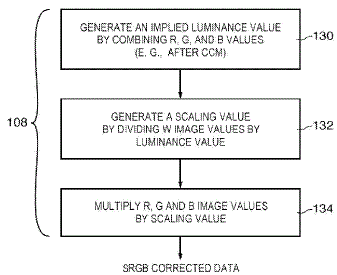
Aptina's Clarity+ RB-WW color filter processing appears to be described in US20130242148 patent application "Imaging Systems with Clear Filter Pixels" by Marko Mlinar and Brian Keelan:

10:31 AM

Aptina Applies for a Gated-Clock ISP Patent

...
Aptina's patent application US20130235239 "Power Saving Techniques for Image Sensors" by Vickie Wu describes a gated clock arrangement in image processing pipeline:

10:16 AM

iFixIt: iPhone 5S Sensor Probably Made by Sony

...
iFixit team teared down the new Apple iPhone 5S. The conclusion regarding the main camera is:
  • We uncover the iSight camera.
  • The back of the iSight camera is labeled DNL333 41WGRF 4W61W.
  • According to our good friend Jim Morrison, Vice President of the Technology Analysis Group at Chipworks, "the DNL markings are consistent with the markings on the camera modules housing the Sony IMX145 we saw in the iPhone 4s and on the iPhone 5. The marks on the side of the module are different, but our industry insiders tell us this is Sony's again"
  • As Apple has stated the pixel pitch on this camera is 1.5 µ, this sensor should not be the IMX145, but a newer variant.


Update: Chipworks reverse engineering confirmed Sony sensor inside iPhone 5s camera. It's a stacked sensor:

12:56 AM

Superpix Publishes Flyer of its DSLR Sensor

...
Superpix has published a flyer of its 12MP DSLR sensor, said to be the first China-made DSLR product and the first Chinese sensor beyond 10MP:

11:59 PM

What is a Rack & Pinion Actuator?

...
According to Wikipedia, "A rack and pinion is a type of linear actuator that comprises a pair of gears which convert rotational motion into linear motion. A circular gear called "the pinion" engages teeth on a linear "gear" bar called "the rack"; rotational motion applied to the pinion causes the rack to move, thereby translating the rotational motion of the pinion into the linear motion of the rack."

Image courtesy of Wikipedia

When applied as a pneumatic valve actuator, opposing racks are attached to pistons in a cylinder. When one side is pressurized, the pinion bearing turns in one direction. When air or spring tension is applied to the opposite side, the pinion bearing turns in the other direction, thus allowing rotational motion in both directions.
ROTEX Rack and pinion actuator
Transparent actuator showing opposing pistons (ROTEX)

rack and pinion bearing
Pinion bearing and rack with piston and seal (ROTEX)
Housing which forms outer pneumatic cylinder walls (ROTEX)
Advantages of pneumatic rack and pinion actuators are compactness and space savings, reliability, durability and life cycle. Disadvantages are gear and bearing wear, piston seal fatigue and stem seal leakage.

Here is a great article on rack and pinion actuators from Valve Magazine.


IHS Predicts Fast Growth in Automotive Gesture Recognition Systems

...
IHS forecasts that the global market for automotive proximity and gesture recognition systems to control in-car infotainment with a simple wave of their hand will grow to more than 38M units in 2023, up from about 700,000 in 2013. Nearly 40% of all new automobiles sold worldwide in 2023 will come with some degree of proximity or gesture recognition, according to a new IHS Automotive report entitled "Emerging Technologies: New Human-Machine Interface Trends."

Gesture recognition is defined as the use of cameras or sensors to track and convert a user’s movements into inputs for the infotainment system without any physical touch input. This would include things like waving a hand to the left or right to change radio presets or go to the next song in a playlist, or turning the hand clockwise or counterclockwise to raise or lower the volume.

9:49 PM

A*STAR IME and nanoX Imaging to Develop MEMS X-ray Imager

...
Singapore A*STAR's Institute of Microelectronics (IME) and Japan-Israel-USA startup nanoX Imaging are to jointly develop a MEMS X-ray imager based on field emission detection. "We are confident that that the partnership with IME will be long-standing. In this first collaboration, we look forward to present to the medical industry an ideal solution of an imaging system that will offer high performance at low radiation risks," said Hitoshi Masuya, CEO of nanoX Imaging.
9:32 PM

OMRON to Launch Imaging System for Interpretation of People's Intentions and Conditions

...
OMRON announces its Human Vision Component (HVC), a new image sensing component that can be embedded in a variety of devices and equipment. The HVC integrates ten algorithms from OKAO Vision and a camera module to a system capable of recognizing the intentions and conditions of people through face recognition, estimation of facial expressions, age estimation, gaze estimation, hand detection, and other functions. Launch of the standard-type HVC is scheduled for December. From next year onward, OMRON plans to introduce a succession of application-specific HVC products, which will incorporate optimized hardware and optical systems to enable customized functions that meet the requirements of each specific industry.

Examples applications include air conditioners capable of automatically adjusting the temperature to the level that people feel most comfortable; lighting products with efficient automatic control depending on the presence of people, their movements, or other conditions; automatic vending machines that suggest a product that matches the preference of a specific consumer; home appliances controllable via hand movements; robots that can react to the facial expressions of users; cars that prevent drowsy or inattentive driving by recognizing signs of fatigue in the driver's face; and more.

The ten functions to recognize the intentions and conditions of people are:
  1. face detection
  2. human body detection
  3. gender estimation
  4. age estimation
  5. gaze estimation
  6. facial pose estimation
  7. face recognition
  8. estimation of facial expressions (satisfied, unsatisfied, five different expressions: happiness, surprise, anger, sadness, and neutral)
  9. hand detection
  10. blink estimation
9:20 PM

What is a Scotch Yoke Pneumatic Valve Actuator?

...
According to Wikipedia, "The Scotch yoke is a mechanism for converting the linear motion of a slider into rotational motion or vice-versa. The piston or other reciprocating part is directly coupled to a sliding yoke with a slot that engages a pin on the rotating part. The shape of the motion of the piston is a pure sine wave over time given a constant rotational speed."
Animation of Scotch Yoke (courtesy of Wikipedia)

In a pneumatic actuator, the scotch yoke mechanism converts linear motion (provided by an air supply and pistons) to rotary motion. A return spring sets the rotation in the opposite direction.

Diagram of Scotch Yoke Internals (courtesy of ROTEX Controls)


Scotch yoke mechanism provides a great torque curve for many valve types and are most often used on larger valves. Additionally, as valve torque requirements increase, a scotch yoke actuator becomes a more economical choice considering production cost.

The disadvantages of scotch yoke actuators are typically the wear and tear on the pin and bearing mechanism. Manufacturers like ROTEX Controls have reduced this issue with innovative design improvements that reduce friction and wear.
ROTEX Controls DRS Scotch Yoke Actuator


Toward Secure and Dependable Storage Services in Cloud Computing

...

— Cloud storage enables users to remotely store their data and enjoy the on-demand high quality cloud applications without the burden of local hardware and software management. Though the benefits are clear, such a service is also relinquishing users’ physical possession of their outsourced data, which inevitably poses new security risks toward the correctness of the data in cloud. In order to address this new problem and further achieve a secure and dependable cloud storage service, we propose in this paper a flexible distributed storage integrity auditing mechanism, utilizing the homomorphic token and distributed erasure-coded data. The proposed design allows users to audit the cloud storage with very lightweight communication and computation cost.
hardware requirements:

— 
—Processor  -Pentium –III
—Speed  -    1.1 Ghz
—RAM  -    256 MB(min)
—Hard Disk  -   20 GB
—Floppy Drive  -    1.44 MB
—Key Board  -    Standard Windows Keyboard
—Mouse  -    Two or Three Button Mouse
—Monitor  -    SVGA
FOR FULL CODE CONTACT US!!..
—
 
5:14 AM