Powerchip to Build 12-inch CIS Fab in China

...
CTimes: Powerchip has signed a cooperation agreement with China Anhui Hefei government, to set up a joint venture “Hefei Jinghe”, a 12-inch fab located in Hefei with monthly production capacity of 40,000 wafers, with total investment of 13.53 billion yuan. The new joint venture will have 0.15um, 0.11um and 90nm processes, and will manufacture image sensors, among other things.
9:33 PM

ESPROS Publishes its QVGA ToF Demo, Detailed Datasheet

...
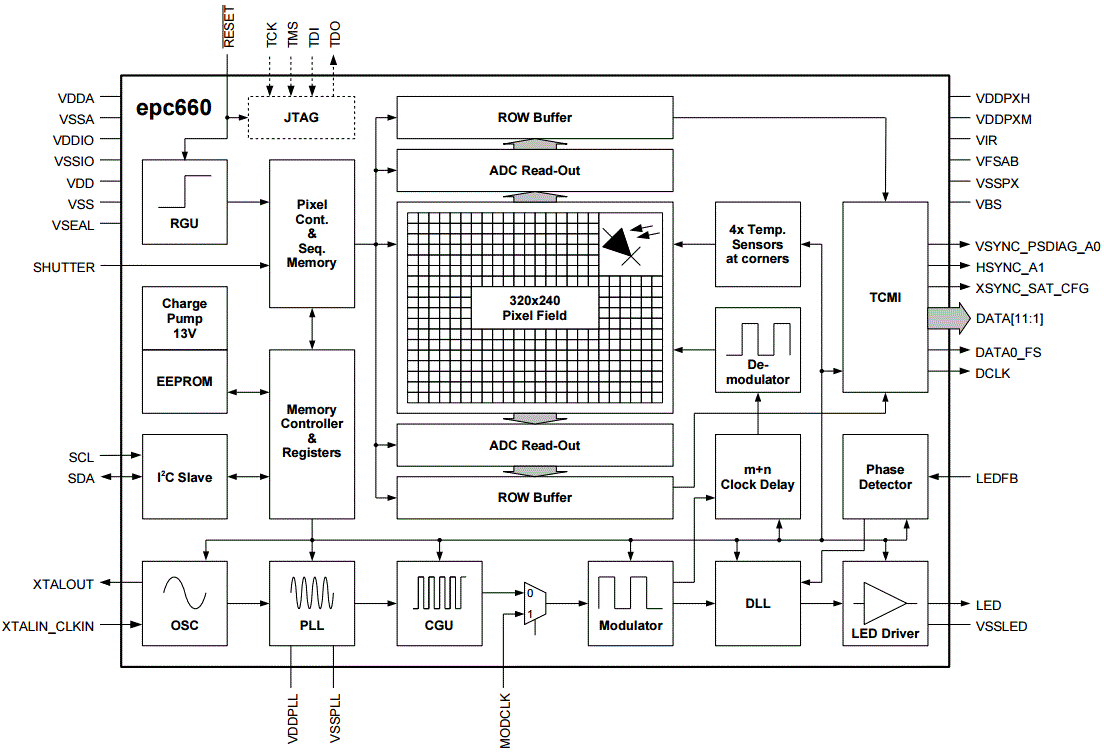
ESPROS epc660 BSI ToF sensor is probably the world's only ToF device having its detailed datasheet (106 pages) openly available at the company's FTP site.


ESPROS also publishes a Youtube video with a demo of its sensor's capabilities:


Update: Other than the ToF sensor datasheet, ESPROS publishes the detailed board and system design guide, and eye safety analysis.
12:26 PM

Sony to Raise ~$3.6 Billion to Invest in Stacked Sensor R&D and Production

...
Reuters: Sony announces its plans to raise $3.6 billion via new shares and bonds to expand stacked image sensor R&D and production. It's Sony's first new share issue in 26 years, worth close to a tenth of its current market value. The company expects to raise 321 billion yen ($2.62 billion) from a public stock offering and a further 119 billion yen from a convertible bond issue to fund a boost in sensor output capacity at its advanced plants in Japan.

For some reason, Sony PR document blocks copy/paste function, so I'm showing a snapshot of it:

10:45 AM

Dramatic Sea Ice Decline In Beaufort Sea in June 2015

...
The image below illustrates the dramatic fall in sea ice thickness (in m) in the Beaufort Sea over the past month. The left panel shows sea ice thickness on May 29, 2015, and the panel on the right shows sea ice thickness on June 29, 2015.


The 30-day animation below further illustrates this dramatic fall in sea ice thickness (from June 8-29, with forecast up to July 7, 2015).


Another perspective is sea ice concentration. The image below shows the high concentration back on May 1, 2015.


The 30-day animation below shows the dramatic fall in sea ice concentration (from June 8-29, with forecast up to July 7, 2015).


Below an interview by Judy Sole with Professor Peter Wadhams, held May 15, 2015, and entitled 'Our time is running out - The Arctic sea ice is going!'


Meanwhile, very high temperatures keep showing up within the Arctic Circle. On July 1, 2015, a temperature of 36°C (96.8°F) was reached near the Kolyma River that ends in the East Siberian Sea, as illustrated by the images below (green circle).


The image below also shows the location where this high temperature was reached (red marker), as well as the depth of the seabed and the Gakkel Ridge that runs in between the northern tip of Greenland and the Laptev Sea.


Related

- High Methane Levels over Laptev Sea
http://arctic-news.blogspot.com/2013/10/high-methane-levels-over-laptev-sea.html

- Accelerated Warming in the Arctic
http://arctic-news.blogspot.com/2015/06/accelerated-warming-in-the-arctic.html

- Gulf Stream brings ever warmer water into Arctic Ocean
http://arctic-news.blogspot.com/2015/06/gulf-stream-brings-ever-warmer-water-into-arctic-ocean.html

- High Temperatures in the Arctic
http://arctic-news.blogspot.com/2015/06/high-temperatures-in-the-arctic.html

- Heat Wave Forecast For Russia Early June 2015 
http://arctic-news.blogspot.com/2015/06/heat-wave-forecast-for-russia-early-june-2015.html

Dramatic Sea Ice Decline In Beaufort Sea in June 2015 http://arctic-news.blogspot.com/2015/06/dramatic-sea-ice-decline-in-beaufort-sea-in-june-2015.html
Posted by Sam Carana on Tuesday, June 30, 2015

Next iPhone Dual Camera Rumors

...
DPReview quotes Business Weekly Taiwan newspaper speculations that the next Apple iPhone might have a dual rear camera, similar to HTC M9+ and Huawei Honor 6+ phones. The original article talks about an interview with Largan CEO Linen Ping and the chances that Largan business would surge in future. No credible source was cited for these rumors.
9:34 PM

Plasmonic Color Filters Review

...
Glasgow University, UK thesis "Structured Photonic Materials for Multi-Spectral Imaging Applications" by Iain James Hugh McCrindle presents a nice overview of the progress in plasmonic and metamaterials-based color filter designs. There are still not really competitive with pigment-based CFAs, but might improve over time:

Plasmonic CFA response (on planar surface)
11:53 AM

IFTLE on Stacking Technology Progress

...
Insights From Leading Edge blog overviews image sensor stacking progress and recent publications. "Given the continued, aggressive stacked CIS development underway from independent device manufacturers (IDM) and foundries it’s predictable that stacked chip adoption will occur very rapidly over the next few years."

Sony ISX014 Stacked dice (Chipworks)
11:34 AM

Residential Solar Energy: Power to How Many People?

...

A friend of mine recently installed an array of solar panels (photovoltaic generation) on his roof.  It's part of an Austin Energy plan that makes it straightforward for well-heeled consumers to get a turnkey installation done.  After a stretch of sunny days he'll meet me for lunch and tell me how much power he sold to the utility that week. 

I was reminded of this when I read a recent article by environmental writer Bill McKibben in The New Yorker.  Entitled "Power to the People," McKibben describes how residential solar-power installations such as the one at my friend's house are getting cheap enough so that ordinary blue-collar workers and other middle-class types can afford them, at least when their electric utility cooperates in various ways.  McKibben starts his piece with the story of a couple in Vermont who had their house made over for energy conservation and production:  better insulation, a heat-pump heating unit, all-LED lighting, and a solar panel on their garage.  After the installations, their electricity usage for a heating season (October to January) went down by 16%, and they were able to get by without starting up their old oil-burning furnace at all. 

McKibben is supporting the presidential run of Bernie Sanders, the far-left independent senator from Vermont.  But to read his New Yorker piece, you might not guess it—he sounds more like a free-market libertarian.  His main point is that it's starting to make not only environmental and political sense (depending on your view of the environment and politics) but economic sense for more people to go solar and invest in energy-saving technology, simply because it's getting cheaper to do so.  And so McKibben is looking to the free market to do what his years of playing a prophetic Cassandra in the wilderness of environmentalism haven't done so far:  to foster a major move away from fossil fuels and toward renewable energy for electric power.

 While I welcome Mr. McKibben's newfound friendliness toward the market economy, one can question how realistic his optimism is.  As he points out in the article, one of the main obstacles in the way of further adoption of solar power in private housing is the electric utilities themselves.  While some, notably in California and Vermont, have been in the forefront of renewable-energy initiatives, others feel threatened by the idea of home-grown electricity.  And the reason is money. 

Nearly all electric utilities are regulated to some degree by state utility commissions, which allow them to set rates that guarantee a certain profit in exchange for highly reliable delivery of power.  This sort of environment fosters conservative behavior and a set of rules that favors the status quo.  For example, if people start making their own power, who pays for the expensive and maintenance-intensive electric grid, especially if more and more fossil-fuel-burning power plants that feed it are shut down?  The economic incentives built into the system were not designed for power to go backwards, and it's not clear how the organizations that operate distribution networks are going to get paid for what they do in a highly distributed power-generation situation such as the use of extensive solar power would create.

Here in Texas, things are a little less regulated than in other places.  It's not quite true here, as McKibben states in his article, that "utilities are granted exclusive rights to a territory."  That's true for electric distribution companies, but not for electric generation in Texas, where most electric-utility customers can choose from a variety of generation sources, including renewables such as wind power.  And partly due to a recently phased-out subsidy, Texas leads the nation in terms of wind-powered electric generation.  So in a way, there's evidence even in fossil-fuel-friendly Texas that what McKibben hopes will happen is already happening.

But a totally free market for electric power is almost inconceivable, and so we have to look soberly at what it would take for renewables (solar being the newest contender) to make a significant dent in the use of fossil fuels for electric power in the U. S.  According to the U. S. Energy Information Administration, about two-thirds of all electric power in the U. S. is produced by burning coal, oil, or natural gas.  Say we wanted to reduce that fossil-fuel usage by a third, out of concern for climate change and so on.  Anything smaller would be a drop in the bucket  (and we're not even getting into the question of what other countries are doing and whether this U. S. contribution would make a difference globally).  That's about a trillion kilowatt-hours per year (1015watt-hours, for you exponential-notation fans).

Now, suppose everybody—not just upper-class environmentalists, but everybody in every kind of rental and owner-occupied housing in the U. S.—installed solar panels with an average generating capacity of 5 kW, which is the typical size for residential installations.  That is an upper limit, by the way—clouds, nighttime, and other issues mean that you don't get 5 kW twenty-four hours a day.  Even if everybody had solar panels, we would still need the utility network for emergencies, to ship surplus power to places where it was needed, and so on.  The question is, would we be able to make a dent in that trillion kilowatt-hours?

My very sketchy back-of-the-envelope calculations say yes, sort of.  You would still need peak-capacity generators hooked to the grid to deal with hot days and so on.  But yes, you could afford to shutter a lot of old coal-burning power plants if everybody installed solar panels.

And while we're dreaming, how would we pay for all those solar panels?  A typical residential solar installation today is still expensive—$18,000 might be a typical actual cost, not including subsidies, tax breaks, and so on.  While this figure is going to decline in the future, it can't follow the path of Moore's Law and get down to practically zero, because there's a certain amount of labor involved, and even if we could make solar panels for free they don't climb up on the roof by themselves.  Multiply $18,000 by over a hundred million U. S. housing units, and you get $1.8 trillion.  The U. S. federal budget for 2015 is $3.8 trillion.  As you can see, this solar-installation idea is not a trivial deal.  Even if it were spread out over a decade, you'd be spending each year as much on solar panels in the U. S. as one optimistic solar-industry estimate says annual global sales will be by 2021.

Yes, it could be done.  But I think it's clear that unless there is a huge degree of government intervention in the forms of subsidies, incentives, or other external market manipulation, the free market isn't going to put solar panels on everybody's roof any time soon.  Maybe President Bernie Sanders could do it, but offhand I can't think of any other way.
Sources:  Bill McKibben's article "Power to the People" appears in the June 29, 2015 edition of The New Yorker, pp. 30-35.  I used statistics on the fraction of electric energy produced with fossil fuels from the website http://www.eia.gov/tools/faqs/faq.cfm?id=427&t=3.  The Solar Energy Industries Association website www.seia.org has plentiful data on historical and current trends in solar-energy installations.  The 180-billion-sales-by-2021 figure is from http://www.solarmaxtech.com/global-solar-market-could-exceed-180-billion-dollars-by-2021/. 

Free Book on Photon Seeing

...
It came to my attention that The National Academies Press book "Seeing Photons: Progress and Limits of Visible and Infrared Sensor Arrays" (2010) is available for free download. The authors of the book are stated as Committee on Developments in Detector Technologies, Standing Committee on Technology Insight—Gauge, Evaluate, and Review, and Division on Engineering and Physical Sciences. The book is heavily skewed toward military and space applications:


Talking about the progress of single photon detecting technology, the book has predicted in 2010:


There is also in interesting graph comparing DRAM capacity with imager resolution growth:


and a comparison of LWIR technologies:

5:10 AM

Senior Piping Engineer (Specification/MTO) –AMEC Foster Wheeler Saudi Arabia

...
Job Title:  Senior Piping Engineer (Specification/MTO) Country: Saudi Arabia Region:  Al-Khobar Office Location: Al-Khobar Employment Type: Regular - Full Time Business Sector Oil & Gas Business Operation  Middle East & Africa (& CIS) Business Stream/Area  MEA Saudi Arabia Are relocation funds available? No External Job Advert: We currently have a requirement for a Senior

DALSA TurboDrive Compresses Image Data on the Fly

...
Marketwired: Teledyne Dalsa presents TurboDrive, a proprietary and patent-pending data encoding technology that allows some DALSA GigE Vision cameras to achieve breakthrough speeds, increasing throughput by as much as 150% while retaining 100% image data.

"We're pleased to deliver an innovative speed advantage to customers who need to push beyond the current GigE bandwidth limitations with no loss of data," commented Mark Butler, Product Marketing Manager for Teledyne DALSA, "It's available now in our low-cost Linea line scan cameras, and will continue in future area cameras set to launch in the fall."

The company's technology primer explains how the compression works:

"Leveraging neighborhood effect Image entropy is the first principle used in TurboDrive. But to reduce even further the number of bits required to encode pixel information (with no loss of information), TurboDrive considers the neighborhood effect. The neighborhood of a pixel is the collection of pixels that surround it. Although the exact distance of a neighbor can vary, in this analysis, we will limit our example to the adjacent pixels (i.e. those that directly touch the reference pixel).

For most pixels, there is little pixel to pixel variation and a lot of redundancy. Therefore, it is possible to efficiently use the information of the adjacent pixels to more efficiently encode the reference pixel. One way to see this is looking at a high-pass 2D filter implemented using a convolution. A simple high-pass filter has the sum of all of its coefficients equal to 0. The filter we use in our model has a 3x3 mask and it provides the largest weight to the center pixel.


The result of this filter provides the difference between the reference pixel at the center, and four of its closest neighbor. It can be seen that, for a uniform image, the 9 pixels have the same value and the result out of this filtering operation is 0. Essentially, the less pixel to pixel variation, the smaller the value output by this high-pass filter. One can intuitively understand it takes less bits to encode a small value than to encode a large value. Obviously, it is possible to play with the weights of the 9 filter coefficients of this model to adapt to the image content."
11:34 AM

Sharp Launches 14 New Progressive CCDs

...
Sharp keeps investing in CCD development, presenting 14 new products and few more marked "under development:"

11:20 AM

Accelerated Warming in the Arctic

...

Warming in the Arctic is accelerating. On June 25, 2015, high temperatures hit North America. Temperatures as high as 30.3°C (86.54°F) were recorded where the Mackenzie River is flowing into the Arctic Ocean.

June 25, 2015 - High temperatures over North America, close to the Arctic Ocean

On July 1, 2015, temperatures are forecast to be as high as 111.4°F (or 44.1°C) near Chico, north of San Francisco. Temperatures are forecast to be high over most of North America and Eastern Siberia, threatening to further warm up waters of the Arctic Ocean.

Forecast for July 1, 2015 - High temperatures over North America, close to the Arctic Ocean

The image below shows that on June 27, 2015, temperatures of well over 40°C (104°F) were recorded in Europe and in Pakistan, where temperatures earlier this month had reached 49°C (120.2°F) in some places. The heat wave reportedly killed 1233 people in Karachi alone. This in addition to the 2500 people killed earlier in India by high temperatures.

June 27, 2015 - High temperatures over Russia, close to the Arctic Ocean
High temperatures at such locations are very worrying, for a number of reasons, including:
  • They are examples of heatwaves that can increasingly extend far to the north, all the way into the Arctic Ocean, speeding up warming of the Arctic Ocean seabed and threatening to unleash huge methane eruptions. 
  • They set the scene for wildfires that emit not only greenhouse gases such as carbon dioxide and methane, but also pollutants such as carbon monoxide (that depletes hydroxyl that could otherwise break down methane) and black carbon (that when settling on ice causes it to absorb more sunlight).
  • They cause warming of the water of rivers that end up in the Arctic Ocean, thus resulting in additional sea ice decline and warming of the Arctic Ocean seabed. 
June 24, 2015 - Smoke from wildfires in Alaska - from: wunderground.com
The image below shows increased sea surface temperature anomalies in the Arctic. Note the warming in the area of the Beaufort Sea where the Mackenzie River is flowing into the Arctic Ocean.


Very warm water is also flowing from the Pacific Ocean through the Bering Strait into the Arctic Ocean.  As the image below shows, the water that is flowing into the Arctic Ocean from the Pacific is much warmer than it used to be, as much as 6.1°C (10.98°F) warmer.

View the flow of the water on the animated version of above image at earth.nullschool.net
As said above, warm water flowing from rivers into the Arctic Ocean is a major contributor to these sea surface temperature anomalies. As also illustrated by the NOAA image below, rivers carrying warm water into the Bering Strait include the Kobuk River, the Naotak River and the Yukon River that flows all the way from British Columbia, Canada, through Alaska and ends in the Bering Strait. Sea surface temperatures near the coast of Alaska were as high as 19°C (66.2°F) from June 21-24, 2015.

Sea surface temperatures near the coast of Alaska as high as 19°C (66.2°F) from June 21-24, 2015
The Naval Research Laboratory animation below shows changes to Arctic sea ice thickness. Sea ice thickness (in m) down to zero where the Mackenzie River flows into the Arctic Ocean and in the Bering Strait where warm water from the Pacific is entering the Arctic Ocean.


The situation is dire and calls for comprehensive and effective action, as discussed at the Climate Plan.


Related

- Gulf Stream brings ever warmer water into Arctic Ocean
http://arctic-news.blogspot.com/2015/06/gulf-stream-brings-ever-warmer-water-into-arctic-ocean.html

- High Temperatures in the Arctic

- Heat Wave Forecast For Russia Early June 2015http://arctic-news.blogspot.com/2015/06/heat-wave-forecast-for-russia-early-june-2015.html

Sea surface temperature anomalies in the Arctic. Note the warming in the area of the Beaufort Sea where the Mackenzie...
Posted by Sam Carana on Thursday, June 25, 2015

Pixpolar MIG Pixel in Space Applications

...
ESA Technology Exchange: Pixpolar pixel has been considered for ESA space programs, although the original article only mentions "A Finnish company [that] has developed a new image sensor technology based on patented MIG (Modified Internal Gate) pixel architecture."

"The Company has participated in the development of a silicon drift detector (SDD) for X-ray applications within the TRP activity. The main goal of the project was to introduce extremely low noise SDD macro-pixels for X-ray detection applications. The Company is able to produce very low noise photon detectors for X-ray, visible, UV, near infra-red, and particle detection applications. MIG sensors are ideally suited for Space application as they enable simultaneously asteroid tracking as well as direct detection of planets around stars through continuous readout. Increasing the frame rate does not increase the noise, there are no interface issues, and they are tolerant to radiation damage."
11:23 AM

IISW 2015 Review: Stacked Sensors

...
Albert Theuwissen continues his IISW review, this time talking about stacked sensors from Omnivision, Sony, Olympus, TSMC, and NHK.
9:27 PM

IISW 2015 Pictures

...
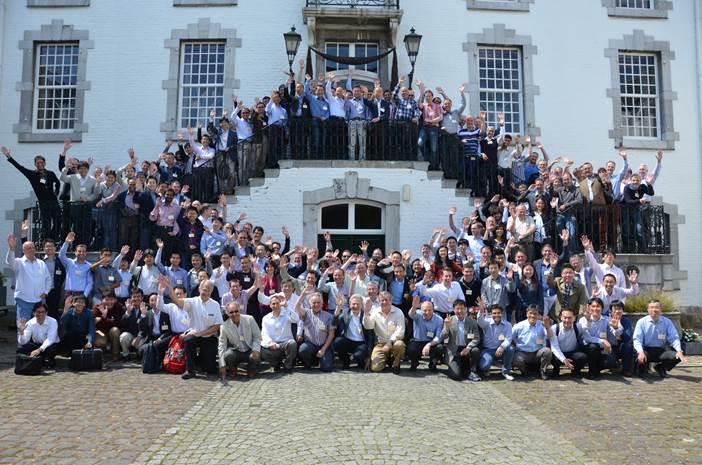
16-megapixel IISW 2015 group picture and few others are posted on the Workshop site. If participants have interesting photos to post they are welcome to email them to jsolhusvik@imagesensors.org to add them to the web page.

1:32 PM

Omnivision Released First C-PHY Image Sensors

...
PRNewswire: Tektronix names Omnivision among early adopters of the new MIPI C-PHY standard, published in September 2014. OmniVision's OV23850 and OV21840 20+ megapixel image sensors for smartphones have implemented the C-PHY 1.0 interface. Using Tektronix C-PHY Essentials analysis software, OmniVision and Tektronix were able to successfully validate and characterize the C-PHY interface used on the two new sensors.

"With an up to 17.1 Gb/s data rate over a nine-wire interface, C-PHY provides the performance needed for high megapixel count image sensors along with low power consumption," said Brian Reich, GM, Performance Oscilloscopes, Tektronix. "Our solution for C-PHY transmitter testing allows engineers to detect issues early on in the product development phase and confidently assures transmitter devices' performance and interoperability."

"OmniVision is excited to have Tektronix's oscilloscope-based C-PHY Essentials software for validating the next generation MIPI interface. With its three-wire signaling, C-PHY represents a significant design and test challenge," said Paul Gallagher, senior director of marketing and business development at OmniVision. "With the help of Tektronix C-PHY Essentials, we were able to easily set up cameras utilizing the OV23850 and OV21840 sensors and confirm the C-PHY interface's compliance with the MIPI specification."

For some reason, the original announcement of OV23850 and OV21840 in Nov. 2014 does not mention C-PHY interface feature.
12:45 PM

e2v IISW 2015 Papers On-Line

...
e2v publishes its IISW 2015 papers on its web site:

"Electron Multiplying Device Made on a 180 nm Standard CMOS Imaging Technology" by Pierre Fereyre, Frédéric Mayer, Mathieu Fournier, Clément Buton, Timothée Brugière, and Rémi Barbier presents electron multiplying CMOS pixel:


e2v also publishes another IISW paper: "CMOS Charge Transfer TDI with Front Side Enhanced Quantum Efficiency" by F. Mayer, S. Pesenti, F. Barbier, H. Bugnet, J. Endicott, F. Devriere, T. Ligozat
11:17 AM

Lead Piping Layout Engineer – WorleyParsons Dubai

...
Lead Piping Layout Engineer - ABU00C9 Company: WorleyParsons Primary Location : ARE-Dubai Job : Floating Systems Schedule : Full-time Employment Type: Staff Job Level: Experienced Job Posting : Jun 17, 2015 Unposting Date : Jul 17, 2015 Reporting Manager Title: Engineering Manager : WorleyParsons delivers projects, provides expertise in engineering, procurement and construction and

SP3D Piping Designer for Gurgoan

...
SP3D Piping Designers are required for Gurgoan location on 6 month extendable contract. position: SP3D piping designerExperience : 6 years+Contract Duration: 6 months extendable.  If interested please forward your CV to rukhmini@aryasystems.com

Sr.Piping Engineer For Petrofac Sharjah

...
Senior. Engineer – Piping (Materials) with 10+ years of experience in Oil & Gas sector. Interested, kindly email your CV to anithaflorence.s@petrofac.com or do refer. On permanent basis. Location: Sharjah

IISW 2015 Review: Image Sensors for Photography

...
Albert Theuwissen continues his review of IISW 2015, now posting the part about image sensors for digital photography. This part talks about Samsung BSI APS-C sensor, Canon and Sony sensors with PDAF in every pixel, and DALSA large area CCD.
12:13 PM

TowerJazz Manufactures Automotive Gated Image Sensors for BrightWay

...
GlobeNewsWire: TowerJazz announces that BrightWay Vision has chosen its TS18IS process to manufacture image sensors for its patented automotive cameras, specifically forward looking cameras in vehicles, to allow visibility in all weather conditions. BrightWay Vision has developed BrightEye, an advanced camera for day and night-time forward facing driver assistance functions based on gated imaging technology.

TowerJazz and BrightWay Vision jointly developed a unique gated pixel, something that until now has never been produced on silicon as it requires extremely fast charge transfer on the pixel. This sensor, based fully on a CMOS process, provides superior performance over competing solutions based on thermal vision technologies, and is much more cost effective. A "gated" sensor allows collecting light that is reflected back from objects at a specific distance from the vehicle, thus eliminating the noise level that is usually associated with ambient light. This sensor also allows the system to accurately measure the distance of certain objects from the vehicle and alert the driver accordingly.

BrightWay's Youtube video compares different vision technologies. The clip consists of three video channels captured simultaneously by three different cameras with the same field of view, positioned in the same direction:

  • Pulsed Light & Gated Image Sensor (BrightWay Vision active-gated imaging technology).
    Outcome: The image is clear and the person in the kayak is noticeable. The backscatter residual signal originating from the reflected signal from nearby droplets is negligible.
  • Continuous Near Infrared Light & HDR Image Sensor.
    Outcome: Backscatter originating from the reflected signal from nearby droplets is masking the image.
  • Passive LWIR.
    Outcome: The emitted signal of objects (e.g. person on the kayak) are masked due to the droplets’ emitted signal.


"We are absolutely thrilled with the performance of our sensor using TowerJazz's leading edge CIS technology," said Ofer David, CEO of BrightWay Vision. "The tight cooperation on the development between our R&D team and the excellent pixel development team of TowerJazz, allowed us to produce a very high performing sensor that is now being evaluated by leading car manufacturers."

"Our distinctive technology and deep knowledge and experience in global shutter pixels allowed us to develop a unique pixel that cannot be found elsewhere and can provide a gated image in a high frame rate with extremely good pixel properties," said Avi Strum, VP and GM of the CIS Business Unit at TowerJazz. "We have very high confidence in BrightWay's capabilities and ability to drive this breakthrough solution into the automotive market."
12:00 PM

Pope Francis' Vision for a New Ecology

...

When the spiritual leader of the largest division of the Christian faith says something about climate change and the problems of technological progress, engineers of all faiths and no faith should take notice.  Last Thursday, Pope Francis released his latest encyclical, Laudato Si', known in English as "On the Care of Our Common Home."

Contrary to some reports, in the encyclical Pope Francis doesn't come out in favor of Marxism, though he does say that international efforts to control greenhouse-gas emissions have failed and that something stronger is needed.  And he doesn't say you can't be a good Catholic if you use air conditioning, though he does use air conditioning as an example of a "harmful habit of consumption."  What he does is to lay out a vision for how humanity can turn around from a lot of wrong paths and get back on the right path, which is all a good sermon does anyway. 

What are the wrong paths?  While most environmental activists concentrate on actions, statistics, and policies, Pope Francis goes to the heart of the problem:  sin.  God's world as originally created was good.  But when man decided he knew better than God, things started to go wrong.  There's nothing new about sin, but what is new in the last couple of hundred years is mankind's ability to transform the environment through technology.  A few hundred thousand cave men armed with spears couldn't make much difference to the global environment no matter what they did.  But seven billion people using massive amounts of organized technological power and treating the earth simply as a raw-material resource can cause tremendous harm, both to the environment and many of the poorest people who try to live in it.

Pope Francis's roots are in the Global South, and his concern for the billions of the poorest people around the world is evident on every page of Laudato Si'.  What if you are the father of a family on the coast of Africa, trying to feed yourself by fishing, and some pollution kills the fish and the ocean rises so much that your land is flooded out?  What if you then move to the city and try to commute to a low-paying job three hours a day on filthy, crowded buses while breathing soot-filled air that gives you a lung disease that makes you so sick that you lose your job?  While the physical environment and the marvelous biodiversity of plant and animal life on our planet come in for mention, Pope Francis's fundamental concern is for people, each one of whom is a child of God and deserving of respect, attention, and love.  But when giant economic and technological systems conspire to deprive millions of their culture, their land, and their livelihood, these folks can no longer receive what they have a fundamental right to as human beings.

What are the answers?  Pope Francis wisely refrains from making explicit scientific pronouncements or calling for specific laws or policies.  Instead, he spends much of his time asking for dialogue between governments and citizens, between the privileged and the empoverished, and between scientists and religious believers.  He hopes—and there are many places where he expresses hope—that men and women of good will, emboldened by a vision of humanity as one family sharing one planetary household, can change their ways for the better.  These changes include everything from family efforts to save energy and recycle products up to stronger international agreements that could make a real difference in the rate at which fossil fuels are being used. 

At the beginning and again at the end of the encyclical, he mentions the saint whose name he bears, St. Francis of Assisi.  St. Francis was a revolutionary figure in the tradition of Martin Luther King, Gandhi, and Jesus himself.  He lived in utter poverty, but with such love for all creatures, both animal and human, that he collected followers who sought to carry out his vision of Christian love in a unique way that was both humble and vastly effective. 

Much of what Pope Francis criticizes is the byproduct of pride, which theologians know is the root sin, the sin that enables all the others.  If we think we have all the answers and that the material world is simply waiting for us to bend it to our whims, we are in fact enslaved to the sin of pride, and all the problems mentioned in the encyclical can be traced in one way or another back to that attitude. 

On the other hand, if we look on the world as a wonderful gift, packed with hidden prizes and meanings to be treasured, not just exploited, we will tread more gently.  We will think before we act, or buy, or sell, or design.  We will bear in mind not only our own family, and our friends and social groups, but also others who might be affected by what we do, or purchase, or waste.  And we will change our ways accordingly.  Among other things, that is what engineering ethics is all about.

With Laudato Si', Pope Francis has not gone off the deep end politically or theologically. The encyclical emerges from a deep consideration of the entire Christian tradition and its meaning for how spiritual beings can best live in a material world, being themselves material as well.  While not many previous popes have made ecological concerns a focus of their ministries, I think Pope Francis has chosen the right time to do so.  And anyone who has any dealings with modern technology, whether as an engineer or an ordinary citizen who simply lives in the modern world, needs to give serious consideration to what he is saying.

UHDTV News: NHK 8K Compact Camera, PERSEUS Codec

...
DigiInfo TV publishes a video of a compact 8K camera and environment presented at NHK Open House days at the end of May:


One of the biggest NHK challenges is implementing the high speed video processing and delivering the broadcast traffic. Videonet article discusses a rapid adoption of PERSEUS codec developed by V-Nova, which possibly solves these problems. The London, UK-based startup V-Nova has been established in 2011, but came out of stealth mode in April 2015 "claiming that PERSEUS completely shifts the bit rate curve and makes it possible to deliver UHD in HD bit rates, HD in SD bit rates and SD in sub-audio bit rates."


V-Nova founders discuss the disruptive nature of their proprietary codec technology in this pre-launch Youtube video:

11:54 AM

Eric Fossum Papers at IISW 2015

...
Eric Fossum posts his papers presented at IISW 2015:

L. Anzagira and E.R. Fossum, Color Filter Array Patterns Designed to Mitigate Crosstalk Effects in Small Pixel Image Sensors, in Proceedings of the 2015 International Image Sensor Workshop, Vaals, The Netherlands, June 8-12, 2015.

L. Anzagira and E.R. Fossum, Two Layer Image Sensor Pixel Concept for Enhanced Low Light Color Imaging, in Proceedings of the 2015 International Image Sensor Workshop, Vaals, The Netherlands, June 8-12, 2015.

S. Masoodian, A. Rao, J.J. Ma, K. Odame and E.R. Fossum, A 2.5pJ Readout Circuit for 1000fps Single-Bit Quanta Image Sensors, in Proceedings of the 2015 International Image Sensor Workshop, Vaals, The Netherlands, June 8-12, 2015.

E.R. Fossum, Multi-Bit Quanta Image Sensors, in Proceedings of the 2015 International Image Sensor Workshop, Vaals, The Netherlands, June 8-12, 2015.
11:32 AM

2015 IISW Recap by Chipworks

...
Chipworks image sensor analyst Ray Fontaine publishes his thoughts on IISW 2015 and related topics, and also covering some parts of Ray's paper at the Workshop. Few quotes:

"As we head into the 3D integration era, I predict packaging inventions will rise as a percentage of the whole. It’s also natural that as the imaging community gains access to lower power and higher density processing all the dreams of years past will come to fruition in the form of innovation at the systems and software level."


"For the time being pixel scaling has essentially plateaued at the 1 µm generation so all the mobile small-pixel leaders have been looking for other knobs to turn. A lot of development has been done to embed color filters into the tungsten aperture grid metal. Sony and ON Semiconductor (Aptina) currently hold the world record (based on Chipworks’ analysis) for getting down to a 1.5 µm thick optical stack, as measured from the back-illuminated (BSI) silicon (Si) surface to the surface of the microlens. There doesn’t seem to be much more to do here, but time will tell."


"Sony has about a two year lead in the domain of stacking image sensor chips... Depending on which flavor of Sony stacked chip system used, the image signal processor (ISP) can be either a homegrown (Sony) 65 nm chip or a TSMC fab’d 40 nm chip... My summary presentation slide and message was: if you aren’t excited about chip stacking, you should become excited about chip stacking!"

Ray's IISW paper can be freely downloaded from Chipworks site.
12:10 PM

Construction Mechanical & Piping Engineer – Mott MacDonlad Abu Dhabi

...
Job position Construction Mechanical & Piping Engineer Job Ref 20118BR Job Category Power Job Profile Mott MacDonald is a £1.2 billion management, engineering and development consultancy with 16,000 staff and a global reach spanning six continents. Our network of 180 principal offices in 140 countries gives us local market insight backed by world class expertise to deliver excellence for

IISW 2015 Review

...
Albert Theuwissen posts his brief review and impressions from IISW 2015 held in Vaals, Netherlands last week. "In conclusion : no major new technologies were introduced, neither any pixel size below 1 um, but everything is getting better in performance and more compact in size."
3:38 AM

SuperPix Presents "the First Excellent Price 8MP 1.12um BSI Pixel Sensor"

...
Beijing, China-based Superpix launches SP8408, "the first excellent price 8-megapixel CMOS image sensor chip, the product in the world’s leading automatic 12 inch BSI process line production, production process without human intervention, to ensure that the product has excellent consistency and stability.

The main performance index of SP8408 is better than other first-class 8M products in the market, the key index sensitivity is 9.5%, and high dynamic range (HDR) camera mode and low illumination enhancement mode. SP8408 pixel size of 1.12um, can be supports 1/4 inch 8 pixel optical lens. SP8408 capacity adequacy, as long as 2.5 months in advance to give demand forecast, can guarantee the stable supply of demand.
"

The company's LinkedIn article lists SP8408 features:

"The 1/4 inch 8-megapixel RAW data image sensor SP8408 is one of SuperPix’s upgrade products of SP84XX series color image sensors. It is a high performance sensor based on advanced 1.12um BSI pixel architecture. The SP8408 is a high cost-performance image sensor product that can be embedded in portable equipment, and is especially suitable for mainstream smart phones and tablet computer applications.

The SP8408 incorporates 3280 x 2464 effective pixels, advanced low power analog circuits (ASP). The on chip ISP circuits performs sophisticated signal processing including picture flip,auto defect pixel correction,picture flip and lens shading correction,etc.SP8408 supports high frame speed up to 30fps at full resolution, 60fps at 1080P, 120fps at 720p format transferred over a 4-lane Interface. The new "Bright Mode" feature delivers high-frame-rate(slow-motion)video without causing a luminance drop.
" (sounds a bit like Toshiba "Bright Mode.")


Another Superpix LinkedIn article presents SP0A38 VGA 2.2um pixel SoC.
12:00 AM

2015 IISW Awards

...
Here is the list of the awards presented at last weeks IISW 2015:

IISS Exceptional Lifetime Achievement Award
This Award is made to a member of the image sensor community who has made substantial sustained and exceptional contributions to the field of solid-state image sensors over the course of their career. (Established 2013). The first recipient ; Gene P. Weckler (2013)

2015 Recipient : Dr. Jaroslav (Jerry) Hynecek
“For the invention and development of significant advances in solid-state image sensors including the VP-CCD, impactron, and BCMD devices”

(Jerry Hynecek received his Dipl. Ing. In EE from the Czech Technical University in Prague in 1962 and Ph.D. from Case Western Reserve in Cleveland Ohio in 1974. He joined Texas Instruments in 1976, becoming a TI Fellow in 1990. In 1998 he founded ISETEX and has consulted for several companies. He has published 61 papers and holds 126 US Patents, and among other awards, won the 2003 Walter Kosonocky Award for the Impactron CCD. He has worked on image sensors for most of career, and his seminal work on pinned CCDs and the use of impact ionization is reflected in most of today’s image sensors. He has also served our community through nearly 10 years of editorial work at IEEE TED, as well as technical program committees, and at IISW.)

IISS Pioneering Achievement Award
The Board of Directors of the International Image Sensor Society (IISS) is pleased to announce the creation of a new award, the Pioneering Achievement Award.
This new award is to recognize a person who made a pioneering achievement in image sensor technology, and judged by at least 10 years of hindsight as a foundational contribution.

2015 Recipient : Peter J.W. Noble
“For seminal contributions to early years of MOS image sensors”

(Peter Noble first worked in sensor arrays starting in May 1966, and rapidly developed the basics of MOS based active pixels and self-scanned arrays, now known as image sensors. The first was a simple 7 pixel linear array, then worked through a range of sizes. He set up his own company in the late 60’s and showed the first working moving image system using a 4,916 pixel square array in the early 70’s. For this his company was awarded the Queen’s Award for Technology in 1974. Throughout he looked at and developed other operating systems experimentally, some not published at the time. The company also made and supplied a variety of sensor arrays and systems. His overall ambition was, and still is, being able to give to blind human beings the ability to see well enough to appreciate the world around them. Peter Noble is a consultant to major companies on the strategy combining technology trends, economics and global situations. He is author of two books, and many papers, articles and patents.)

Walter Kosonocky Award
The Walter Kosonocky Award is presented bi-annually for THE BEST PAPER presented in any venue during the prior two years representing significant advancement in solid-state image sensors. The award commemorates the many important contributions made by the late Dr. Walter Kosonocky to the field of solid-state image sensors. Founded in 1997 by his colleagues in industry, government and academia, the award is also funded by proceeds from the International Image Sensor Workshop.

2015 Recipient : “A 1/4-inch 8Mpixel Back-Illuminated Stacked CMOS Image Sensor” ISSCC Dig. Tech. Papers, pp. 484 - 485, Feb. 2013.
Shunichi Sukegawa(1), Taku Umebayashi(1), Tsutomu Nakajima(1), Hiroshi Kawanobe(1), Ken Koseki(2), Isao Hirota(1), Tsutomu Haruta(1), Masanori Kasai(1), Koji Fukumoto(1), Toshifumi Wakano(1), Keishi Inoue(3), Hiroshi Takahashi(1), Takashi Nagano(1), Yoshikazu Nitta(1), Teruo Hirayama(1), Noriyuki Fukushima(1)
1 : Sony, Atsugi, Japan,
2 : Sony LSI Design, Atsugi, Japan,
3 : Sony Semiconductor, Kumamoto, Japan

Best Poster Award
The best poster presentation is selected by the participants of the IISW.

2015 recipient : “Analysis and Reduction of floating Diffusion Capacitance Components of CMOS Image Sensor for Photon-Countable Sensitivity”
Fumiaki Kusuhara, Shunichi Wakashima, Satoshi Nasuno, Rihito Kuroda and Shigetoshi Sugawa, Toholu University, Japan
10:50 PM

Intel Acquires Smartglass Maker Recon Instruments

...
Intel has completed the acquisition of Vancouver, BC, Canada-based smartglass vendor Recon Instruments for an undisclosed amount. Intel has invested in Recon in 2013, and has a time to learn about the company business. The recent Recon Jet glasses launched in April 2015 has an integrated camera, somewhat similar to Google Glass:

11:35 AM

Mobileye and ADAS Market

...
SeekingAlpha publishes comments of Baron Capital's Ron Baron in CNBC appearance: 13 years of data-collection efforts related to driver-assistance technologies has given the company a "essentially a monopoly" position for its ADAS chips and software. "When there's a tilt in the road, these guys will know about it and able to have the car steer a certain way because they've collected millions of miles of traveling [data]..." Mobileye has relationships with 23 out of the 25 top automakers.

11:19 AM

Edwin Roks Becomes Teledyne DALSA COO

...
Business Wire: Teledyne announces the promotion of Edwin Roks to the position of Chief Operating Officer of Teledyne DALSA. Reporting to Rex Geveden, EVP of Teledyne and President of Teledyne DALSA, Roks will direct the operational activities of Teledyne DALSA and its digital imaging, medical, X-ray and professional imaging, and semiconductor divisions. His responsibilities will include financial performance, strategic planning, business development and research and technology integration. Dr. Roks also remains a VP of Teledyne, and will continue to advise Robert Mehrabian, Teledyne’s Chairman, President and CEO.
10:53 AM

0.3e- Noise Histogram

...
Eric Fossum kindly allowed me to post a histogram of his and Jiaju Ma's image sensor that apparently achieves 0.32 e- rms noise on a single CDS read. It was achieved by minimizing the FD node capacitance as discussed in the March 2015 JEDS article:

"A Pump-Gate Jot Device With High Conversion Gain for a Quanta Image Sensor" by Jiaju Ma; Fossum, E.R.

The low readout noise manifests itself in a comb-like structure on the histogram, where the distance between the peaks is equivalent to 1e-. This preliminary result was first presented at IISW 2015 last week:

1:40 PM

More Details on Sony Fast Full-Frame and 1-inch Sensors

...
Imaging Resource publishes an interview with Kimio Maki, Senior General Manager, Digital Imaging Business Group, Sony, discussing various trade-offs in image sensors for A7R II full-frame camera and RX100 IV and RX10 II 1-inch compacts. Few interesting points, in no particular order:

  • Why Sony needs a backside illumination in its new 42MP FF sensor:
    (a) to match a pixel sensitivity of its earlier 36MP front side illuminated sensor
    (b) to be able to use metal routing more freely, without obscuring the light path
    (c) better metal routing, together with Cu instead of Al in the previous sensor allows to implement 4K video mode in that big sensor
    (d) the new sensor is 3.5x faster than the previous generation one
  • 42MP resolution has been chosen to ensure an easy image scaleability in various 4K video modes. If not that, Sony marketing would prefer 45MP or 50MP resolution.
  • Other than the speed, Sony has improved the noise performance in the new FF 42MP sensor over the older 36MP one.
  • The 14b raw file format suggests that 14b ADCs are used on the new FF sensor
  • The new 1-inch stacked sensor is 5x faster than the previous one
  • The fast readout speed creates close to global shatter experience, although the shutter is actually rolling. Sony calls is "Anti-Distortion Rolling Shutter."
  • To get to that high speed, the 1-inch stacked sensor employs no less than 16 ADCs per column (!)
  • Since the 1-inch sensor has 5,472 columns, the number of column-level ADCs is  87,552
  • The data from ADCs is transferred to the bottom DRAM die and, then, outside of the chip
  • The DRAM die also has a "low level" processor integrated on it

Sony 1-inch stacked sensor assembly. The chips are inverted
and connected to the bottom of the sensor package using some
sort of solder-bump technology.
1:28 PM

Invisage Opens World's First Sub-5nm Fabrication Site

...
InVisage has inaugurated its first high-volume, fully automated QuantumFilm sensor manufacturing facility in Hsinchu Science Park, Taiwan. “After a review of various U.S. and Asian locations, we chose to establish our high-volume manufacturing in Taiwan because of the vitality of the semiconductor ecosystem here, and in particular because of our partnership with TSMC,” said InVisage’s CEO, Jess Lee. “Thanks to our high-calibre engineering and manufacturing staff here, we were able to source and install custom, state-of-the-art fabrication equipment and are now well positioned to ramp up QuantumFilm production.”

The manufacturing facility, called QFAB3, is said to feature an unprecedented sub-5nm process geometry within an ISO Class 10 cleanroom. It is designed to support a wide range of products, from mobile phones to high-end cameras as well as drones and other IoT devices that require high performance cameras.

“Because we use quantum dots, we don’t need finely patterned lithography to achieve our high performance and sub 5-nm scale. This QuantumFilm fab has a multiplier effect in terms of product performance, value, and output. So our factory is compact and accomplishes much more than the typical fab,” said James Chou, VP of Manufacturing Operations. “All the steps could fit within one shipping container. This enables many expansion opportunities we’re already scouting for.”

InVisage’s product wafers are first manufactured by nearby TSMC and then transferred to QFAB3 for QuantumFilm deposition. The deposition itself is performed by a single, custom tool that combines spin-coating and CVD deposition technologies into one machine for the first time. This combination allows the deposition process to be both modular and fully automated. This is said to be the first of many facilities to come as InVisage increases its capacity aiming to QuantumFilm technology to become the new standard for cameras.

12:40 PM