Showing posts with label Quarter 4. Show all posts

Food Frontier

...
This week in class we watched a video called “Food Frontier,” a project by Johns Hopkins Center for a Livable Future meant to showcase six projects around the U.S. working to increase access to healthy food. In class, we’ve been learning about gardening and the difference between local, organic foods versus imported and heavily processed foods. This video’s six very different stories about pioneering food projects added a lot to my learning by showing the varied and effective ways basically anyone can make a difference in their food community.


Community Access


In the video, a lot of different people were shown increasing their community’s access to food. They range from people in positions of power to the everyday citizen, but each played an important role in the positive changes made in their community.


One type of player is, to many people, the obvious one when the issue is of the social or political type -- the legislator. In the video, Representative Dwight Evans of Pennsylvania worked very hard to bring farmers markets to the ‘forgotten’ neighborhoods in Philadelphia, using his government position to effectively bring about the change.


Image result for student activistsAnother channel for change in food communities are nonprofit organizations. Through the video, a number of nonprofit organizations, founded by regular people who wanted to fight for access to fresh, healthy food, were shown as successful changemakers.


Students also have great power to make change in their area. In the first story showcased in the video, a group of students in Cady, Nebraska, succeeded in building and running the first grocery store in their town, supplying the residents with easily attainable healthy food for the first time. Students may not be able to directly create change the way a legislator might or have the time and resources to found a nonprofit, but students are able to raise awareness in a very noticeable way and often have the drive and creativity to make change in unique and rewarding way.


Rural Food Desert


The first story in the video, the tale of Cady, Nebraska, introduced the concept of a rural food desert. A food desert is defined by the USDA as “living more than 10 miles from a grocery store.” According to the Rural Sociological Society, nearly 98% of these food deserts are in non-metropolitan areas -- and the rural food desert is born. These deserts occur as result of negative feedback loops. After World War II, rural populations started declining as urban areas began to grow. Because of this, grocery stores began to shut down, which in turn caused more rural residents to move to bigger cities, which caused even more grocery stores to shut down, etc. Eventually, this resulted in too few people in these areas to support a grocery store and retailers reluctant to cooperate with a grocery store “in the middle of nowhere.”
Image result for food desert

This, however, means the people remaining in these tiny rural areas are suddenly left, sometimes literally, high and dry. Suddenly, buying groceries -- something most of us take for granted -- can mean driving 40 miles or more to the closest store, which comes with high gas prices low-income or elderly residents may not be able to afford. As well, people living in rural food deserts often depend on canned, pickled, or non-perishable foods -- foods more processed and often sodium-rich.


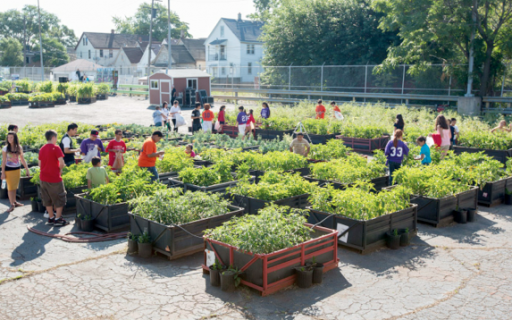
One possible solution for people living in these rural food deserts or people working to fix these situations is to create gardens and non-commercial farms that provide local, fresh food that allow them to remain in their area with a self-sufficient, healthy diet.


Food Choice In A Community


In the video, each of the stories showed a way to encourage your community to make wiser, healthier decisions when it comes to shopping and eating.


In the video, the Philadelphia nonprofit worked to provide incentives for low-income shoppers to buy fresh produce, such as food stamp and food coupon bonuses at farmer’s markets. This was one effective way of encouraging healthy choices, because it made fresh food, usually the more expensive option, cheaper.


Image result for the happy kitchen
In Texas, they had another approach. The food nonprofit The Happy Kitchen invested in training normal people to be cooking educators, who then continued educating their community in an effective and engaging manner.


The final approach mentioned in the video was in multiple stories -- public money was put towards a Fresh Financing Initiative. This money was leveraged to make more money, which could be put to ensuring those communities had better access to fresh food.


These ideas inspired me to come up with my own ideas to encourage better food choices in communities. One way that might be successful would be to work with officials to regulate the distribution of fast food restaurants vs. organic grocery stores throughout a city, making the grocery store the easier, close option for the neighborhoods where there are currently none.


Another method, inspired by last week’s video, “What’s On Your Plate?” is the idea of a mass printed cookbook pamphlet, detailing easy-to-make, healthy meals, that can be distributed throughout the community.


Lastly, you could host food fairs, where farmer’s markets, organic grocery stores, and chefs could come together to create an event where the community could come together and sample and buy foods made from local produce, along with recipe cards that they could take home to try the healthy dish themselves.

School Food


In the video, two of the stories in the video were set in California -- both about school lunch.
In Claremont, for a long time, the food they provided for students every day was always prepackaged, processed, and frozen. The school district announced that given financial constraints and the need for minimal effort, they “couldn’t buy local food." In Riverside, however, the school is part of a food hub -- a system that connects farmers and school districts to provide thousands of children with fresh, locally grown food for lunch. These two schools provided examples of two ends of a spectrum -- the easy way, and the healthy way.


Image result for health vs unhealthy school lunch
Unfortunately, here at LJA, school lunch is closer to the Claremont side, though an effort has been made to make it otherwise. To students, it’s usually unappetizing -- under or overcooked, because of prepackaging and pre-freezing, the meat is often unidentifiable, and the milk is sometimes expired. However, an effort has definitely been made -- we do have a salad bar, minimal fast food, and food sourced in Minnesota.

The lunch, however, should be changed to a caterer that doesn’t just claim to be nutritious and palatably pleasing, but one that actually is. A major obstacle here is money. Currently, LJA can only afford our current caterer and quality of food, and unlike in Riverside, we live in Minnesota -- we’re not next door to a fruit orchard. To remedy the situation, students could help fundraise for LJA, or specifically raise awareness and funds for improving school lunch in particular. They could identify a local farm or organic caterer and use these funds to improve the health and taste of school lunch without straining the rest of the school’s budget.

What's On Your Plate?

...
Image resultThis week in class we watched a film called What’s On Your Plate, following the story of Sadie and Safiyah, two girls exploring how the food options in Brooklyn impact the health and happiness of many different communities. In class, we’ve been learning about food environments and individual responsibility for food choices, so the video added a lot to our in-class learning. One interesting part of the film made me want to learn more about local CSAs -- my family goes to a weekly farmer’s market in the summer, but we haven’t looked for a CSA since we moved to the Twin Cities. One way I can make individual changes to my food impact would be to see whether we can find a new local CSA.

Food Environment

An important concept we learned about in class this week is the idea of a food environment. A food environment is a collection of factors that impact an individual’s food choices. They range from the individual level to the national level and can be separated into four specific aspects.

The first aspect is the individual factor. This can range from an individual’s food preferences -- for example, if you hate avocado, you won’t eat it, even if you know it’s good for you -- and their dietary restrictions: if you are lactose intolerant, for example, individual factors might prevent you from getting calcium from the usual sources.

The second aspect is the social environment. This can be your family, your friends, or any other community that creates an environment that impacts your food choices. For instance, if you like to go out to eat with your friends, you’re likely to eat at whatever fun place you go to, even if it might not be the healthiest, or, on the flipside, if all your friends are becoming vegetarians, you might as well. Another example of the social environment is the difference between how different families eat -- while another family might eat a more a traditional American meal, my family tends to eat different food, with, say, lentils and fish over bread and beef.
Image result for food environment

The third aspect is the physical environment. This refers to what, geographically, you have access to. If you live in a warmer climate, you might have better access to fresh fruits and vegetables year round. Or, maybe, you live on the coast, and therefore have easy access to fresh fish.

The fourth and final aspect is the policy environment. This is how the government impacts your food. One example of how the government impacts an individual’s food is school lunches -- many children, for twelve years of their life, attend schools that provide them with lunch and often breakfast as well. However, in public schools, it’s the government funding these school lunch programs and therefore basically deciding what is served -- usually the cheapest and most efficient foods rather than the healthiest. The government is also responsible for regulating the health and safety of food production -- they’re the ones who get say whether or not this chemical is safe in processed foods, or whether that farming practice should be legal.

One statement brought up in class, before and after we learned about food environments, was this idea that “individuals are responsible for their own food choices.” Originally, I agreed wholehearted with this statement -- after all, it seems that saying we aren’t is just an excuse to sit back and be lazy about our own health and food decisions. And, after learning about food environments, I still say that yes, I agree with this statement, but with a lot more thought behind that claim.

After all, three out of four of the aspects of the food environment seem out of our control. It’s not our decision what our family eats, at least when we’re children, or what our school serves us or where we live. Looking at it like that, it’s easy to say no, actually, individuals aren’t responsible for their food choices -- all these outside factors are.

However, for two reasons, I believe that they are. First, I want to highlight a key word in the statement: “individuals are responsible for their own food choices.” One definition of ‘responsible’ is ‘in control of,’ and yes, it’s possible to argue that we aren’t completely in control of the food available to us. However, the definition I prefer is ‘accountable.’ Even if we step back and say yes, there’s this and this and this that I can’t control, there’s still space for individual choice within all that. Your school lunch may be unhealthy, but why not go to the salad bar? Your friends may want to go out to a fast food place, but what’s the healthiest thing you can find on the menu?

Or, better yet, don’t go to the fast food place at all. The second part of my answer is that while we have these outside environments impacting our food environments, we still have the individual power to try to change them. You could convince your friends to go somewhere else or to come over and cook dinner with you instead. You could petition for better school lunches -- maybe not even at the school level but at the city government level. If the area you live in is impacting your food, you could move, or see how you could change that -- if you live near a corn or wheat farm, maybe start a community vegetable garden, or if you live in a cold place, figure out ways to preserve or store healthier foods for the winter.

For me, agreeing or disagreeing with the statement comes down to choosing between the active and the passive mindsets. I choose the former because to me, that’s the only path to constructive change.

Food Revolution

In the film we watched this week, Sadie and Safiyah talked to two administrators from the New York City Department of Education about school lunches and how the American diet -- basically, the policy environment -- has changed since post-WWI America.

Related image

Originally, after issues with malnutrition in soldiers, there was a focus on food that got you the calories you needed -- ‘mystery meat,’ some kind of vegetables, and bread, was the standard fare.Then, in the 1960s, the focus shifted away from nutrition to anti-hunger programs, which came alongside the rise of fast food, fatty foods, and carbohydrate-rich foods, the foods that are still a staple of the American diet today. Now, moving forward, there’s a movement for the balance of the two -- filling and nutritional, focusing on organic, low-fat, low-sodium, non-artificial foods.

The trend most surprising to me was how the American diet actually went downhill. The earlier diets were, out of necessity, healthy enough. It was when people were getting richer and people were finding ways to make food taste better, regardless of actual nutritional value, that the least healthy of the three examples of the American diet occurred.

In my family, as I said, we usually try to avoid the lingering influence of the second American diet. We rarely go to fast food places and tend to eat, as I mentioned previously, mostly quinoa-type grains or pasta, various vegetables, and chicken or fish. However, one thing we don’t monitor quite as much is the sodium or fat in our foods -- even though our homemade things won’t have the same extreme problems there packaged food often does, we still eat some of those and only sometimes get the low-fat or low-sodium version of things.

Later in the video, Sadie and Safiyah showed statistics about how obesity rates in America have steadily increased in America since the 1970s. This shows how all four food environments have changed since then -- individual taste preferences change when they realized everything seemed better fried or with high fructose corn syrup, social environments changed as everyone started getting into fast food and it became a quick and easy way to feed the family, policy environments changed as fast food was served as school lunch and fast food corporations gained the ear of the government, and even physical environments changed as fast food places spread and suddenly there was one just down the street… for everyone.

Why Bother?

...
This week in class I read an article called “Why Bother?” an opinion piece by New York Times author Michael Pollan about why (or why not) we should care about combating climate change on an individual level, and what we could do to do so (gardening). In class, we just finished a quarter on climate change and are beginning one on urban gardening, so this article was very relevant to our in-class article. Something I found very interesting in the article was the almost dystopian mindset of the author -- this idea of the market conditioning us to be helpless and inextricably interdependent definitely rang true in many ways, but seemed to present a problem or reality for which the only real solution would be to return to the post-Neolithic Revolution model for human civilization, and moderation or compromise weren't really presented as alternatives.

Too Late?


In the article, Pollan first outlined a very familiar mindset for the average citizen -- the idea that “no matter what we do, it will only be too little too late.” This is particularly for the individual; when people contemplate going completely green, they’re dissuaded by the knowledge that really, their biking to work every day is not going to have much impact on the large scale, and anyway, the vast majority of people are doing nothing, so why should they?


Image result for climate change disbelieversThere is also the thought that our inaction thus far has already led to negative feedback loops (warming leads to melting ice caps which leads to more warming, for example), increasing the rate of change so we are no longer able to do anything to stop this cycle of climate change.


However, I feel that the latter mindset is, to some extent, just an excuse not to do anything -- after all, how do we know we can’t stop it until we’ve tried? -- and that the former, while reasonable enough, ignores an important truth. Large scale change can only be made by many small-scale changes.   


Because of this, yes, individual changes in lifestyle can create greater change. This is, in fact, the only way that greater change can happen. In fact, the issue of too-small scale may be solved by the power of behavioral chain reactions -- if enough people do it, it becomes the new normal. “No,” you might say, “if they make a law about it, then those other people might do it, not when they see me do it…” However, laws do not begin with politicians, they begin with a people’s movement of change -- therefore, for legalized change to happen, enough individuals must take personal initiative first.


What We Think vs. What We Can Do


Later in the article, Pollan quotes Wendell Berry’s statement about another main obstacle for mass action against climate change: “the split between what we think and what we do.” He’s referring to the phenomenon found in many people -- for example, they might support environmental organizations, but waste fossil fuels without a thought.


In many ways, this is a symptom of general lack of will to act. We know, in theory, that climate change is real and will have a major impact on the future, but can’t work up the motivation to actually make change in our everyday lives. Another example is food -- usually, people want to ‘eat healthily,’ and know that eating local and organic food will be better for both their body and the environment, but when it comes to paying more for organic foods or gardening themselves, they make excuses or “want to, but never get around to it.”


Cheap Energy Mindset


Another concept Berry comes up with is the idea of a “cheap energy mindset.” The cheap energy mind relies on market-based solutions, specialization, and consumerism. This mindset, as implied by the name, is made possible by cheap energy, specifically fossil fuels, because they allow us to specialize in one area of production and then delegate literally everything else to experts, as well as give monetary value to this specialize. This mindset has probably been what has allowed human civilization to reach where it is today, but Berry shows its downside.


Image result for fossil fuelsSay, for example, you’re a dentist. Your contribution to society is an important one, and you protect people from the horrors of cavities and root canals. When you were in school, you left your education to your teachers. When you want to eat, you go to a grocery store, relying on agriculture and food companies. When you’re sick, you go to a doctor. All reasonable, right? After, it’s impossible for an individual to meet all their needs as well as a number of experts in each area can. That’s how human society functions, so of course, people are okay with it. And it’s only natural to pay experts for their work. So far, the cheap energy mindset works.


But what about politics and leadership? Should people be so caught up in the efficiency of this interdependence that they barely know what their representatives in government are doing, let alone making their voice heard in the system that creates laws for our entire country? Berry says no, and that this a huge reason that mass environmental change hasn’t happened. Basically, people are waiting for change in the form of policy and law from the government -- after all, we should leave politics to the politicians and lobbying for environmental protection to the environmentalists.


Urban Garden


The article concludes with a solution to the problems it brings up - gardening. In class, as well, we’ve discussed the urban gardening, with a video from Nourish: Food + Community. Both sources conclude that urban gardening is extremely beneficial, from the individual to global level. In fact, the article says “it’s one of the most powerful things an individual can do.”


Image result for urban gardenA significant benefit of urban gardening is to the environment. Food you’ve grown yourself is the freshest and the most local food you can eat, which of course takes away from the carbon footprint of other, processed foods. Planting more plants means more carbon dioxide is taken from the air and replaced with oxygen. As well, time spent working in the garden is time not spent with fossil fuel-powered entertainment or other carbon footprint-increasing activities.

Another benefit is individual health and happiness. Gardening provides exercise and keeps you fit. It also, according to the Nourish video, fosters community by bringing neighbors, fellow gardeners, and even farmers together in backyards, community gardens, and farmer’s markets.

Renewable Materials

...
Image source: www.pinterest.com
In class, I've been studying sustainability in the various components of green architecture. This week we read article about how to choose a renewable material based on a lot of different factors. This article relates to what I'm learning because it's important to know what makes a material green when choosing which material to use in a green home design. It is important to think and learn about these things because they enable us to begin to reverse the damage we've done to our environment.

Image source: www.arup.com
When choosing what material to use in an environmentally friendly home, there are many different factors and ideas to consider. For example, all products made from petrochemicals have a  large environmental impact not only during their use but also as they remain in the environment - in landfills, mostly - long after their actual use. Heat should also be considered because the more heat used in the production of a material, the higher its impact -they consume more fuel, therefore creating more pollution. Manufacturing is another fairly straightforward idea - the more complex the manufacturing process, the more environmental impact it has. Products tat contain toxins are,, for obvious reasons, both unhealthy and non-renewable. These products will have effects both during the manufacturing process and after their use in the building.

Image source: blog.wallstreetsurvivor.com
Planned obsolescence, complexity, and human vs. machine labor should also be considered. Planned obsolescence is when companies produce consumer goods that will become obsolete, or age and break down in such a way that they can't be repaired, only replaced. "Maintenance-free" products do require no maintenance - because after a while they become obsolete beyond repair. Those products that aren't maintenance-free do require regular refurbishment but because of this they can last centuries. Complexity is, in this case, quite a common-sense principle: the more parts a product has, the more opportunity there is for it to malfunction or breakdown, becoming waste. As far as human vs. machine-labor goes in environmental terms, human labor is much less impactful than a machine's. A person applying by hand a product made locally is much more sustainable than having to ship a machine-manufactured product from a distant factory. 

Image source: www.millergrpva.com
Overall design is a "green consideration that is often overlooked when it comes to designing a sustainable home - a well-built conventional home will probably outlast a poorly built sustainable one. Another pretty obvious thing you should consider doing when designing a green home is setting sustainable goals and making informed choices about your chosen material. If a material earns many green points in one area, it probably has drawbacks in others. The best way to find the right or the "greenest" material is to take advantage of third-party certification. As well, even if a building is extremely green/sustainable/uses only renewable materials and resources, if it's ugly or not likely to make people care about it, it won't be cared for through future generations, once again outlived by more beautiful conventional homes. When picking a material, you should also look out for greenwashing. Greenwashing is falsely advertising products as green, and has a very negative effect on the environment, because people motivated to make green choices may, as a result of greenwashing, think they are making those choices when they aren't. Overall, there are three categories environmental merit can be judged in:
  • low overall energy consumption, which can be achieved by using energy-efficient appliances and systems.
  • reduced toxins or environmental impacts, a large category which includes recycling, responsibly harvesting producing, durability, reduced waste, and more.
  • creation of a non-toxic indoor environment, which is just what it sounds like - keeping harmful toxins our of the inside of your house.
Transportation impacts are also important to think about. The distance your material must travel, the weight of that material, and mode of transportation all contribute towards the transportation impact. The lower the transportation impact, the better.

Image source: cleantechnica.com
An interesting concept mentioned in the article was "Comparing Like To Like." This means that once you've chosen your renewable material, its impact can still vary based on the supplier you choose. Whether or not the chosen material was harvested and/or processed sustainable should definitely affect a material's overall "green points" With the current trend towards green home design, a lot of new products are entering the market. They all share a common goal - to improve upon their competitors' environmental performance, affordability, durability, and ease of installation. It is up to each individual buyer to judge for themselves, with the help of trustworthy third-party certifications, which material is green enough to use in a sustainable home design.

The Race to Carbon Neutral

...
 Image credit: www.transsolar.com
In class I've been designing green homes and choosing the city where my home would be located. This week we read an article about carbon neutral cities and the cities that aspire to that title. This article relates to what I'm learning because a city's carbon footprint should be factored into a decision about the location of a green home.

To become a completely green city, with absolutely no carbon footprint is the ultimate environmental goal for any city. Right now, in Abu Dhabi, the United Arab Emirates, Masdar City is being built to fulfill these requirements, which include using only renewable energy sources like solar and wind energy and relying solely on smart design elements. Abu Dhabi was chosen specifically for develop
ment because the country has made it's fortune on fossil fuels like oil, but the country's officials are well aware that their oil wells will run out and are therefore highly in favor of using their money to invest in the construction of the environment-friendly Masdar City. Because of this development, green city design organizations have decided Abu Dhabi is a perfect place to build a completely carbon-neutral city.

Image credit:  www.masdar.ae
However, building a completely carbon-neutral city is a complicated process, with lots to consider. One major consideration for the city planners of Abu Dhabi is the city's heat - they had to come up with dozens of small solutions whose collective impact replaced the need for air conditioners.Another consideration was water conservation, because of Abu Dhabi's arid climate. The solution to the water conservation difficulties was to purify then recycle greywater, or the water left over from washing machines, sinks, baths, and showers. Another solution that helped conserve both water and energy was the decision to replace faucet handles and switches with motion-activated sensors. Another innovation implemented by the city planners, this time to reduce air pollution, is to ask that no cars be used in the city, to be replaced by underground electric pod shuttles. Solving these difficulties was an expensive but effective undertaking, which was only made possible because of the city's oil drilling fortune and determination to "go green."

Image credit: inhabitat.co
As I mentioned, building carbon-neutral cities like Masdar City is an extremely expensive process. This is because of all the practices and renovation that must be implemented citywide for each problem. However, each of these practices could be individually implemented in older cities to make them more sustainable with minimal trouble.

Thge South Australian government has set themselves a new goal - to make Adelaide the world's first carbon-neutral city. Their hope is to remedy the federal Coalition's approach to environmental issues by implementing a variety of different renewable energy projects. These include a focus on transportation, efficiency (for example, a trial of driverless cars) and better waste managements and recycling. These are all excellent ways to make their city energy efficient, and, if successful, will be a role model for green cities everywhere.

Rooftop Views

...
In class, I have been studying different types of green roofs. this week we read an article about the growth and benefits of rooftop farms and gardens in Chicago. This article relates to what I'm learning because rooftop gardens and farms are excellent examples of green roofs. It is important to learn about these topics so we can be properly informed while designing our own homes, whether for a project or real life, as well as generally understanding what may well be the future of agriculture.

Green Roofs for Healthy Cities (GRHC), an organization that promotes green roofs, has decided to target the city of Chicago for development for a number of reasons. One reason is that Chicago was already known for its green development and rooftop gardens, so the organization had a start to work from. Another reason is that there were already green organizations reaching out to the city and they could be even more successful in their green developments by forming partnerships. These reasons, among others, were deciding factors in GRHC’s choice of Chicago.

The phenomenon known as the Urban Heat Island Effect describes how an urban area is warmer than a rural one. It is caused by a variety of factors, including lack of vegetation that would otherwise filter and cool the air, artificial materials and vibrant colors that absorb and radiate heat, and the exhaust from our cars and factories. The Urban Heat Island Effect affects humans by amplifying the amount of energy we need to cool our buildings, which in turn has a significant effect on our economy and by increasing health hazards such as heatstroke. It also affects the environment as a whole, since the increased need of energy uses up resources and the overall increase in heat contributes to global warming.

Albedo is the amount of light or radiation reflected by a surface. The albedo of a surface ranges from 0 to 1, 0 representing a surface that absorbs all the light that reaches it while 1 represents a surface that reflects all the light that reaches it. Albedo affects communities in relation to the Urban Heat Effect - a rooftop or wall with lower albedo will absorb heat, contributing to a warmer urban area, while a surface with higher albedo will reflect it. So, if as a builder and/or consumer you are designing or choosing the roof of your house, it makes sense to consider the albedo of the surface material you choose.

A rooftop farm is pretty much what it sounds like - a green way to grow food on your roof. There are many benefits to having them, such as much greater efficiency in food production, opportunity for city-dwellers to reconnect with nature and agriculture, and reduced seasonal limitations. Because of these reasons, rooftop farms are becoming more and more popular. 

Overall, rooftop gardens and farms and a firm understanding of how the Urban Heat Effect and the concept of albedo affect these green rooftops is a great way to learn how to improve the green quality of the home you're buying or designing. 

Why Green Homes Matter

...
In class I have been studying green architecture. This week I read an article about why green homes matter. This article relates to what I'm learning because it's important to understand why the green homes you're designing matter and how affect the world we live in. It is important to learn about these topics because they teach us how to contribute to the conservation of our resources and our environment.

Image credit: www.casaverdenm.com
There are many ways in which living in a green home or building benefits human health. One reason is indoor air quality - a green home contains less allergens, pollutants, and environmental contaminants than a non-green home, which enables the resident of a green home to be less likely to contract asthma, allergies, or other respiratory diseases. A second reason is that it has been proven that living or working in a green building can also impact mental health, because it has been shown that working a green building results in higher productivity and a lower rate of employee turnover. The only area green homes did not score well on was acoustics, which means they don't usually have good sound quality. This is because it's sacrificed to allow better insulation, efficiency, and general sustainability. The two positive reasons are just two among many, but they show that even with sub-optimal sound quality, it is much healthier to live in a green home than a conventional one.

Image credit: www.opuc.texas.gov
There are five main ways you can enhance 'green' qualities in your home. These are energy efficiency, water conservation, indoor air quality, resource conservation, and livable communities. Three areas we should particularly focus on are livable communities, energy efficiency, and resource conservation. We should focus on livable communities because it is both an important and easy change that minimizes greenhouse gas emissions - it can implemented easily by simply living in a well-clustered community with close access to stores, schools, parks, and restaurants where you can walk or bike to most necessities. Energy efficiency should also be a focus because it both conserves valuable energy sources and lessens the amount due for people's utility bills. We can implement this by checking the energy performance of our appliances and using renewable energy sources like solar heating when we can. Resource conservation is another area we should focus on because it once again reduces initial  and maintenance costs, as well as preventing deforestation and keeping waste our of landfills. It can be implemented while building your home by using less wood and reusing existing materials. Implementing each of these areas is a great way to begin making our home sustainable and environmentally friendly.

I've heard in many places different ways I can make sustainable choices, but one memorable suggestion was at my first overnight camp, where I was asked to minimize my food waste as much as possible, during my duration at the camp as well as afterwards.I choose to make an effort to do that as much as possible, because I think it is a reasonable way to contribute to resource conservation. My choice impacts the environment positively, because it is conserving all the resources that would be wasted in uneaten food.