Sony Announces IPELA - New HD + HDR ISP for Security Applications

...
Sony announces "IPELA ENGINE", capable of the industry’s first 130dB WDR in full HD quality at 30fps speed. The "IPELA Engine" is the general term of Sony's integrated signal processing system for high picture quality which combines the company's unique signal processing and video analytics technologies. The “IPELA Engine” is composed mainly of the four components below:

1. View-DR:

This is Sony name for locally tuning contrast and adaptively correcting tone for light and dark areas through the combination of images taken at varying shutter speeds within a single frame.

2. High Frame Rate:

Full HD (1920 x 1080) video is possible at 60fps.

3. DEPA Advanced:

The functions for detection of moving objects, humans and any objects blocking the view among others have been enhanced through an alarm detection function using image processing.

4. XDNR (Excellent Dynamic Noise Reduction):

The detection and removal of noise within a single frame is combined with the reduction of noise from differential signals in the consecutive frames.

The "IPELA ENGINE" will be equipped into new security camera products from Fall 2012.

1:27 AM

Yet Another Fast Sensor Application

...
MIT Camera Culture group published a paper proposing a way to see around the corners. MIT 3D range camera is said to be able to look around a corner using diffusely reflected light that achieves sub-millimetre depth precision and centimeter lateral precision. Youtube video shows its principle:

1:00 AM

Fujifilm Redesigns Sensors Due to Excessive Blooming

...
Imaging Resource reports that Fujifilm intends to re-design its latest sensors due to excessive blooming. The sensors are used in Fujifilm X10 and Fujifilm X-S1 cameras. Fujifilm USA said that this redesigned sensor should arrive in late May. A nice picture below shows 33-pixel sized blooming orbs in some conditions:

A real-world example (100 pct. crop) of the
'white orbs' problem, from Imaging Resource's
upcoming Fuji X10 review. IR also encountered
the problem in the preliminary testing of the
Fuji X-S1. Copyright Imaging Resource.

Thanks to KP for sending me the link!
9:43 AM

Image Sensors 2012 Conference Report, Day 1

...
Albert Theuwissen reports from Intertech-Pira Image Sensors 2012 conference being held these days in London, UK.

Nobukazu Teranishi of Panasonic talked about "Dark Current and White Blemishes" in sensors. After talking about different gettering techniques : internal gettering, external gettering and proximity gettering, Nobukazu-san presented a new dark current generation model for the pinned photodiodes. His conclusion was that the best dark current is achieved by using channel-stop diffusions in place of LOCOS and STI isolation.
8:36 AM

e2v Increases Sensors Production at TowerJazz

...
PR Newswire: e2v and TowerJazz announce the increased production of e2v's Ruby low light CMOS image sensors and the ELiiXA+ high speed multi-line scan camera using TowerJazz's CIS technology.

Officially introduced in Q4 2011, the ELiiXA+ camera range and the Ruby image sensor family are demonstrating the successful relationship between e2v and TowerJazz. The new product families join several of e2v's products already running in volume production at TowerJazz's Fab 2, including sensors for industrial, medical, scientific and space applications. With a strong relationship of over six years, e2v has been progressively increasing production at TowerJazz to match demand for these advanced sensor solutions.

According to Yole Development's Image Sensor market research, the machine vision market is expected to be $88M by 2015 with a CAGR of 23%.

Globes' market source told: "The increase in production by this customer will boost Tower's revenue by $10 million a year within two years."

Thanks to JG for sending me the news!
7:25 AM

e-con Launches Stereo Camera Reference Design with TI OMAP and Aptina WVGA

...
PRWeb: e-con Systems an embedded design services company specializing in development of advanced camera solutions announces what is says to be the world’s first Stereo Vision camera reference design based on TI’s OMAP/DM37x family of processors and Aptina's 1/3-inch Global Shutter monochrome WVGA image sensors MT9V024. The Capella reference design aims to machine vision, robotics, 3D object recognition and other applications.


Youtube demo tells more about the reference design:

6:47 AM

Structural Analysis of a Washing Machine through its Loading Cases (Mechanical Project)

...

This project is focused in the determination of different loading cases and the application of their results to the optimization of two parts of a washing machine, the tripod and the front cover.
The first step in this report is to obtain a numerical model of a washing machine. It includes the assembly in a mechanical software program (Abaqus), and the assignment of the specific boundary conditions and material properties for the problem. Simulation parameters such as mesh size; types of elements, and number of iterations used in the calculations will also be decided.
A study of the different loading cases is carried out with the intention of having a general view of the problem and selecting four specific cases for its application to the reconstruction of the aimed parts (tripod and front cover). This study includes the calculation of the worst relative angle between the tripod and the resultant force for two opposite loads inside the drum. This angle results to be 35º between the arm and the direction of the resultant force.
Through the application of these different loading conditions to this model, the mechanical behaviour of the parts will be obtained and this information will be used in the reconstruction. By mechanical behaviour it is meant to know the maximum level of stress (tension, compression and shear), and deformation (displacement and strain).
Once it is well known which are the most suffering points of the tripod and in the front cover, several different new shapes are created. The parameters considered in this reconstruction were the decrease of volume, the reduction of the level of stress and the deformations. Two of these shapes are chosen and tested in the numerical model, as a checkout.
Source: University of Skövde

8:55 AM

Employee Work Management

...

This system makes the process of scheduling much easier and computerized. By this system the manager or top level designated employee can fix the schedule of any employee working under him, he even can check whether the employee is free in the particular time or in other times. Thus the top level management can easily fix the process of scheduling, and even can change the appointment which is reflected immediately to the related employee avoiding direct contact of the employee resulting in saving lot of time and work overhead.
The system even has the option for only viewing the employee’s activities or appointments. This feature avoids direct contact to the respective employee’s database and activities. There is an option where only the supervisor (the top-level manager) can have direct access to the employee’s activities, he can change the appointments of the employees working under him. No other employee of the same designation or same level of hierarchy can do this.
Project Description:
The main objective of the Calendar / Scheduler package is to display a Calendar for the current month & the preceding month, and allow the employee to select a date from the displayed calendar to schedule & view his appointments. This package is divided into three sub-modules.
1. Supervisor
2. Employee
3. Read Only
The first sub module is authenticated only to supervisor (who belongs to top level management). A supervisor can schedule / view / postpone / cancel a particular employee’s activities.
The second sub module is authenticated only to existing employee’s and a new employee’s working under top level management of the organization. This module allows any employee to register himself into the scheduler who is new for the organization. It also enables the employee to view scheduled work assigned to him and also allows him to schedule his own activities.
The third sub module enables all the employees who are working in the organization enable them only to view the schedules/appointments for a selected employee.
2:34 AM

Bookshop Automation (Computer Project)

...


The Bookshop Automation System is to automate all operations in a bookshop. Generally it includes the Order Processing, Stock Management and Accounts Management.
Before automating a bookshop we have to understand the concept of automation. In automation of any operation we make a system which do work automatically as the respective events occurs, for which it is meant.
There are the some common examples of the automation like that auto pilot system in the aircraft, automatic home systems (electric system, water system, fire alarm system, doors system etc). These are best examples of the automation systems.
Here we are try to develop such type system which is provide the automation on the any type of the bookshop. That means a shop which has the type system which provides the facility to the customers of the shop to purchase the books from the shop without any complexity.
For example any customer want to purchase any book from the shop than first of all customer just choose the stream of the book than he/she can see the more then one type of books there and than he/she can choose the specific book from there. And then purchase it by paying price on bookshop cash counter and receives its invoice.
2:03 AM

Samsung Call to Universities

...
The Global Research Outreach Program is Samsung Electronics annual call for best and novel ideas. In image sensors, 6 areas of interest are identified:

1. High Resolution Computational Imaging based on Camera 2.0

Scope
We are interested in high resolution computational imaging with the following properties
  • Methods to refocus and estimate depth from computational (plenoptic) camera and Camera 2.0 platform
  • Methods to get high resolution output image and/or depth from plenoptic camera.
  • Methods to operate computational camera in low power-consumption
Research questions
  • When implementing plenoptic camera as very thin camera module, are there any problem expected?
  • There may be trade-off between output resolution and refocusing performance. How can we increase output resolution while keeping refocusing performance?
  • Can super-resolution techniques increase output resolution? Are there any artifact or resource limitation from super-resolution?


Subject 2: Development of High Performance in Sub-1um Pixel and Simulation Environment

Scope
Challenges that significantly advance the state-of-the-art in pixel technologies include:
  • New microlens structure to reduce diffraction and enhance light gathering efficiency in the submicron pixel sensor
  • New methods to enhance light absorption power in the submicron pixel sensor
  • New methods include new material as well as new optical structure
  • Novel concepts (e.g. surface plasmon, multiple electron generation, etc.) are also welcomed.
  • New color filter material and structure to improve SNR with good color accuracy
  • Simulation method to increase speed and accuracy
Research questions
  • How can we control the diffraction of the lens between pixels to reduce the crosstalk in the submicron pixel sensor?
  • How can the light gathering power of microlens be improved in the sub-micron pixels?
  • How to remove loss of power in sub-micron pixels?
  • Additional Structures to enhance the absorption power in the submicron pixel sensor.
  • What is the ideal color filter spectrum to improve SNR?
  • What is the best simulation method to improve speed and accuracy?


Subject 3: Energy Efficient Column Parallel Two Step ADCs for High Speed Imaging

Scope
We are interested in a two step ADC regarding the embodiment of low power & high speed CIS:
  • Optimization of CIS readout architecture to overcome the two step ADC’s weakness
  • ADC type to improve the productivity as well as size, speed, and power
  • Structure innovation for energy-efficient two-step ADC having ultra low noise
Research questions
  • How can we get over all the obstacles, especially the trade-off relation between power, speed, and noise when designing a next CIS ADC?
  • How can we secure the uniformity and productivity as well as IP’s performance?
  • How can we get over the size competitiveness of original single slope ADC as well as power efficiency?


Subject 4: Resolution Enhancement of Image from Low Resolution Image

Scope
Challenges that significantly advance the state-of-the-art in image upscaling technologies include:
  • Image upscaling based on self-similarity of an input image.
  • Reducing artifacts and improve naturalness of the upscaled image
  • Reducing required line memory and computational complexity of upscaling algorithm
Research questions
  • How to reduce artificial and unnatural representation of upscaled image to complex textured input image?
  • How to define similarity among similar patterns? If we have similarity measure, how to use this similarity to stitch and upscale high resolution image?
  • How to reduce computational redundancy in cascaded processing of self-similarity based upscaling?


Subject 5: Smart Image Sensor

Scope
  • Advanced smart functional imaging technologies, especially in the field of health-care, natural user interface, virtual reality, etc.
  • Pixel, circuit, image signal processing, optics, module and any other system level architectures covering the above mentioned area.
  • Unprecedented pixel, circuit, and system level core technologies, such as three dimensional imaging, cognitive imaging, imaging in non-visible wavelength range, infrared-to-visible converting imaging, single transistor CMOS imaging, etc.
  • Image signal processing algorithm which accounts for effectiveness in smart functionalities, such as smart pattern and motion recognition, etc.
  • Methodology of analysis and characterization in pixel and system level for advanced smart imaging devices.
Research questions
  • Why do the new smart functionalities of proposition bear technological impact and possibly open new consumer electronics markets in regards of image sensor?
  • How can the proposition be realized with new architectures?
  • How can the proposition be realized in practice? For instance, is the proposition achievable with current CMOS technologies? Would the power of electrical consumption and operational speed be acceptable?
  • Why do the methodology of analysis and characterization of proposition bear academic and technological importance and effectiveness?


Subject 6: Si Photonic Biosensor for Healthcare

Scope
  • Smart biosensor technologies, especially in the area of disease detection such as cancer, virus, glucose and DNA sequencing for health-care
  • Biosensing element and bio-processing, circuit and system level architectures covering the above mentioned area.
  • Biomarker discovery for lung cancer diagnosis
  • Photonics integrated circuits for biosensor, such as micro-optical spectrometer, WDM devices and optical ring resonator, etc.
  • Circuit architectures, such as resonant wavelength sensing readout with low noise, etc.
  • Methodology of analysis and characterization in bio-processing and system level for advanced smart biosensor.
  • Measurement of the shift in resonant wavelength
  • Miniaturized photonic components and biosensor element
  • Compatibility with standard CMOS process
  • Bio data processing algorithm which accounts for effectiveness in detection and DNA sequencing.
Research questions
  • Why the new functionalities of proposition should be realized with new architecture?
  • How effectively the proposition can be realized in practice?

Interesting to note that 2012 is the first year program having a large image sensor section. The previous years programs had no CIS content.
8:57 AM

Samsung SVP on Sensor Development Process

...
Imaging Resource published an interview with Samsung Imaging Business execs. Few interesing quotes:

Byungdeok Nam, SVP, R&D Team, Digital Imaging Business says: "It usually takes about a year and a half to two years to develop sensors, and we have what are called test vehicles, where on a wafer we can try different samples of sensors with different technologies. Of all these different sensors, we see which is most strong, appropriate or optimal for us, and then we concentrate our development of that technology with that sensor. So in the beginning, we would have many different samples of sensors, and we would then do the evaluation , and decide on one sensor, and then do the development on that sensor."

Byungdeok Nam responds on smartphones vs. digital cameras question: "Well, basically, the OS for cameras and the OS for smartphones are different. Right now, phones have more processing power and they have more memory, So semiconductor companies are providing products that are needed by the smartphone companies, but I think that the same goes for cameras. I guess that in a year or two, cameras can have the same processing power or memory as smartphones."
1:17 AM

NHK Interview on HiVision Progress

...
Image Sensors 2012 interviews Hiroshi Shimamoto who will present NHK 8K/120fps sensor on the upcoming conference. Few quotes:

"Super Hi-Vision (SHV) is a future broadcast system that will give viewers a great sensation of reality. SHV consists of an extremely high-resolution (16 times of HDTV) imagery system and 22.2 channel super surround multi-channel sound system.
We are now proposing to extend its frame frequency from 60 Hz to 120 Hz to improve the motion picture quality, and to have a wide-gamut colorimetry for better color reproduction. We call this new SHV system "full-spec SHV".
"
1:05 AM

Chipworks Finds Omnivision Sensors Inside the New iPad

...
Chipworks was quick revealing Omnivision OV5650 5MP BSI sensor inside the main camera of the new iPad. This is the same 1.75um pixel sensor used in iPhone 4:


The secondary VGA camera uses Omnivision's OV297AA 3um pixel sensor. The same sensor is used in iPod Nano and iPad 2:


Thanks to EK for sending me the news! Looks like Needham was wrong predicting Samsung sensors in iPad in January.
12:29 PM

TI Licenses Apical's HDR ISP Cores

...
EETimes: Apical announced a licensing agreement with TI in which TI will use Apical’s iridix ISP IP cores in future products.

iridix acts as a central component in high dynamic range imaging and also helps address several imaging design challenges for converged mobile imaging devices.

The iridix image processing IP cores will be integrated into TI products targeting digital imaging and display applications. Apical also licensed its ISP IP to Samsung in 2009, Hynix in 2010, HiSense in 2011, and HiSilicon in 2012.
1:01 AM

Microsoft Research Presented Depth-Mapping Webcam

...
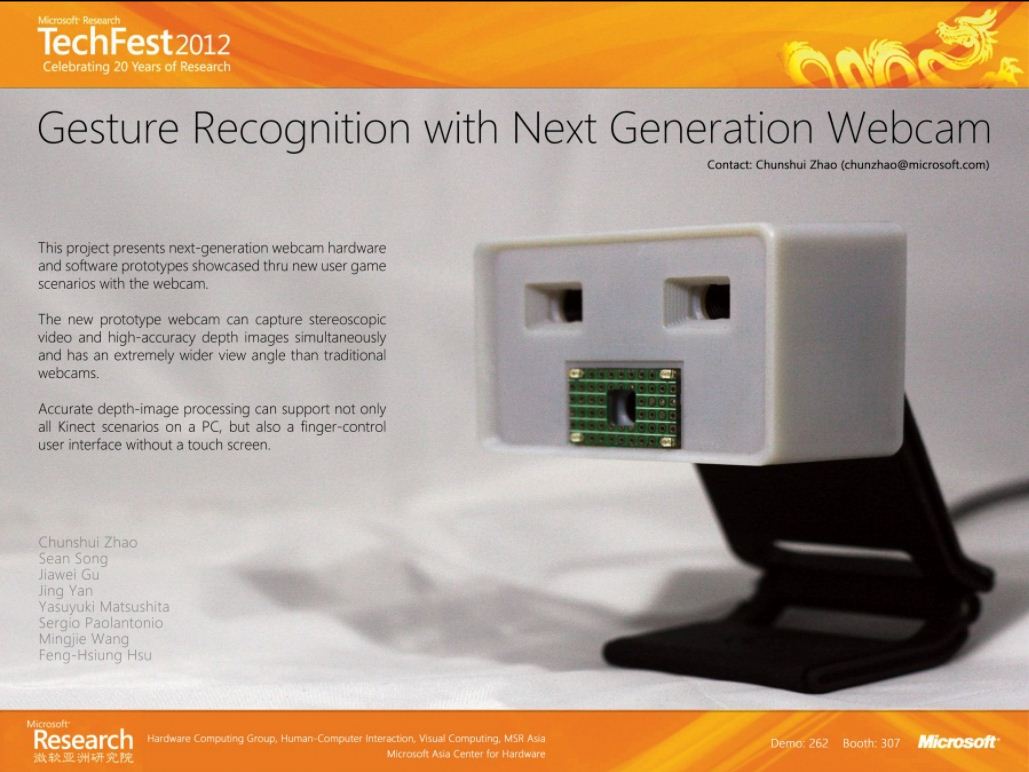
Microsoft Research had held a TechFest event on March 6, 2012 where it presented a new 3D-mapping webcams, shown in this Youtube video (a higher resolution version directly from Microsoft site is here):


Microsoft says: "This project presents next-generation webcam hardware and software prototypes. The new prototype webcam has an extremely wider view angle than traditional webcams and can capture stereo movie and high-accuracy depth images simultaneously."


Update: The zoomed face of Microsoft's 3D Webcam from the slide above (click to enlarge):


Another zoomed version under slightly different angle and better resolution:

9:06 AM

IMS: Apple Needs to Embrace Vision-Based User Interface Technology

...
IMS Research believes Apple will need to embrace embedded vision-based technologies in its next product releases in order for the company to maintain its competitive edge.

Competitors such as Samsung and Microsoft have steadily begun integrating these technologies in recent releases and several more have products slated for debut in the next year, as competitive differentiators to employ against Apple. These technologies will also become commonplace in the years to come.

Apple’s competitors are also more aggressively deploying camera-based gesture recognition applications. Microsoft has already shown its commitment to gesture control with the Xbox 360 and upcoming Windows 8 platforms, along with gesture-friendly common interfaces across devices. Windows 8-based laptops and tablets incorporating gesture control with either standard or enhanced front-facing cameras are debuting this year. Android-based smartphones and tablets incorporating gesture control will debut in volume in late 2012. In the home video arena, where Apple has significant aspirations, Samsung is only the first of several major consumer electronics companies to debut camera-based gesture recognition this year in its Smart TVs. Vision-based applications are thus expected to be a competitive differentiator going forward.
8:17 AM

Mixel and Graphin Demo M-PHY MIPI Products

...
Business Wire: Mixel and Graphin announce what they call the world’s first end-to-end video transmission over a MIPI M-PHY link. In 2010, the two companies established a strategic partnership to address the emerging M-PHY and to produce a “Golden M-PHY” IC to be used in Graphin’s evaluation system. As a result of that collaboration, Mixel achieved first-silicon success with its M-PHY test chip supporting all use cases, and was the first and only IP provider to demonstrate that capability in the MIPI face-to-face meeting in Copenhagen in June 2011. The companies will now be demonstrating end-to-end video transmission using the Mixel chip in the MIPI Alliance face-to-face meeting in Seoul, Korea on March 13th.

Mixel’s M-PHY IP supports both TYPE I and TYPE II operation, A and B data rates, and all current and future MIPI M-PHY use-cases, such as DigRF v4, UniProSM 1.4, CSI-3, LLI, and JEDEC’s UFS. The MXL-MIPI-M-PHY-HSG2 supports High-Speed (HS) Gear1 (G1), Gear2 (G2), as well as Low-Speed Gear 0 (LS-G0) through LS-G7. The IP supports 1.0 version of the M-PHY specifications, and has been silicon proven for over a year now.

Update: Youtube video of the demo:

8:06 AM

TowerJazz Announced 0.11um Pixel Platform, Easy Migration from 0.18um Process

...
PR Newswire: TowerJazz announces its TS11IS hybrid CIS process, a combination of 0.11um and 0.16um platform. The TS11IS combines TowerJazz's 0.16um CMOS for periphery circuits and its 0.11um pushed design rules for the pixel array. The process is targeted for applications in high end photography, machine vision, 3D imaging and security sensors.

The new platform, based on Tower's 0.16um CMOS shrink process, will allow easy re-use of existing customers' 0.18um circuit IP which will save them from investing in resources to redesign existing blocks, and increase the probability for first time success. The TS11IS offers improved pixel performance, smaller pixel pitch, higher resolution, improved sensitivity, and improved angular response. It allows up to 50% reduction of pixel size, mainly for high-end global shutter pixels.

The platform includes a new local interconnect layer to allow denser metallization routing in pixels while maintaining good QE. It also includes tighter design rules for all metal layers and implant layers as well as provides a "Bathtub" option for lower stack height, improving the sensors' angular response.

"By allowing significantly smaller pixels, higher resolution and enhanced pixel performance, our new platform ideally serves our customers' needs for the professional CIS markets, allowing them to create new business opportunities, expand the span of applications accessible for their designs, and enlarge their market share," said Jonathan Gendler, Director of CIS Marketing. "We have received enthusiastic feedback from all of our customers on the opportunity to keep working with our established process environment and reuse their design block IP, while being able to shrink the pixel array and die size. This new platform not only improves the cost model of their products, but at the same time enhances device performance."

The new hybrid CIS process platform will be offered for prototyping for select customers in Q3 2012, and for production towards the end of 2012. The new process and other advances will be showcased at the Image Sensors (IS) conference in London on March 20-22, 2012.

According to Yole Development, the forecast for high-end CMOS image sensors is expected to be ~$2B in 2015 with a CAGR of 13%.
3:18 AM