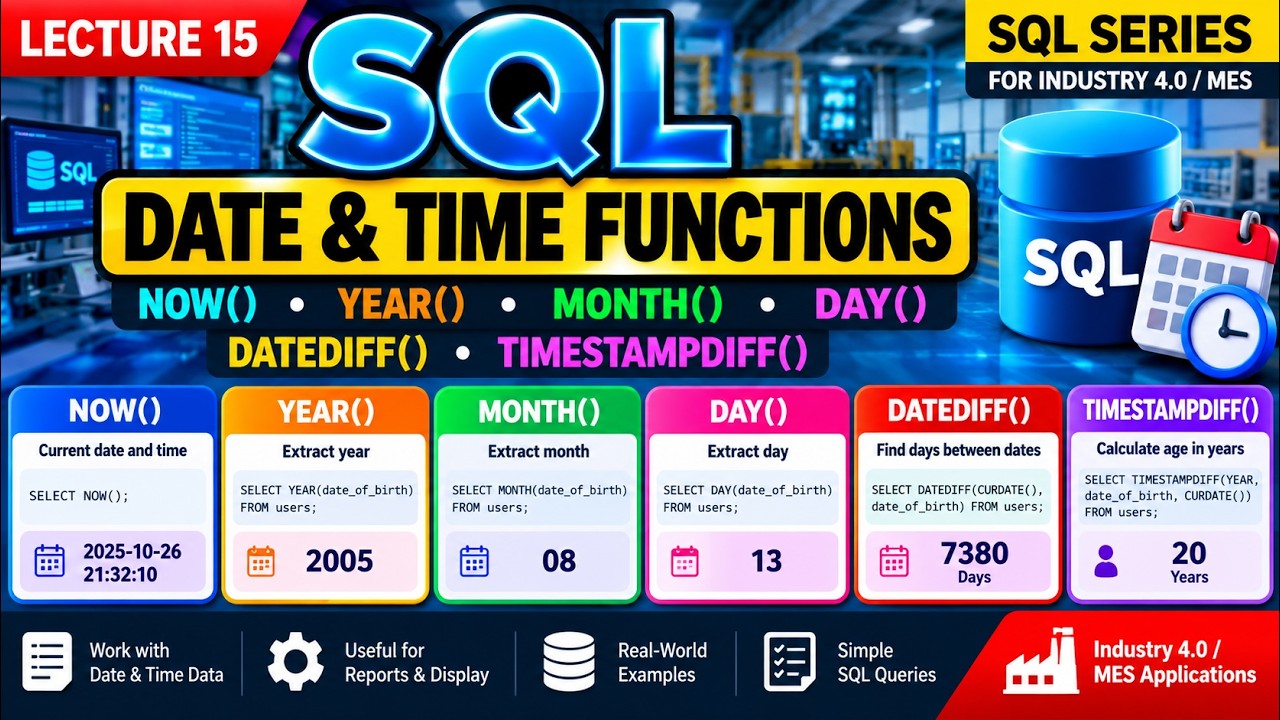
Mastering MySQL Date & Time Functions for Industry 4.0 Applications
This article provides an in-depth exploration of Industry 4.0, covering foundational concepts, practical applications, and engineering insights.
In the modern data-driven landscape, managing temporal data efficiently is vital for building scalable and robust database systems. As smart technologies transform global operations, data generated by smart devices and automated processes relies heavily on precise timestamps. Understanding how to handle temporal values using MySQL date and time functions is an essential skill for any developer or data analyst preparing for Industry 4.0.
The Importance of Date and Time Functions in MySQL
MySQL offers a comprehensive suite of built-in date and time functions designed to manipulate, format, and calculate time-based values effortlessly. Whether you are tracking transactional logs, building time-series reports, or monitoring real-time operational metrics, these functions simplify complex SQL queries.
Key functions every data professional should master include:
- NOW() & CURDATE(): Retrieve the current date and system timestamp instantly.
- DATE_FORMAT(): Reformat raw date outputs into customized, readable strings for visualization dashboards.
- DATEDIFF() & TIMEDIFF(): Compute precise time intervals and duration between two timestamps.
- DATE_ADD() & DATE_SUB(): Dynamically adjust time windows by adding or subtracting intervals.
Real-World Applications in Smart Systems
Timestamped data serves as the backbone of predictive analytics and automated monitoring. Within the ecosystem of Industry 4.0, connected devices, smart factories, and IoT networks continuously stream time-stamped telemetry data. Using MySQL date and time functions enables developers to aggregate sensor inputs, analyze machine downtime, and generate shift-by-shift performance metrics.
For example, combining functions like DATE_SUB() with conditional filtering allows database administrators to create queries that highlight failing equipment based on historical performance windows—preventing costly operational delays.
Conclusion
Mastering MySQL's temporal functions provides you with the analytical tools needed to handle complex datasets with confidence. As modern businesses continue to build and refine their Industry 4.0 architectures, the ability to clean, query, and transform time-series data will make your database management skills truly indispensable. Start experimenting with these functions today to supercharge your SQL expertise!


