Showing posts with label IIoT. Show all posts

Unlocking Industry 4.0: Your Ultimate Guide to IIoT and Assignment Solutions

...
engineering information technology
Unlocking Industry 4.0: Your Ultimate Guide to IIoT and Assignment Solutions

Unlocking Industry 4.0: Your Ultimate Guide to IIoT and Assignment Solutions

This article provides an in-depth exploration of Industry 4.0, covering foundational concepts, practical applications, and engineering insights.

The global manufacturing and tech sectors are undergoing a massive transformation. As smart factories and interconnected systems become the standard, Industry 4.0 has emerged as a critical field of study for engineers, students, and technology enthusiasts alike. Combining automation, big data, cloud computing, and the Industrial Internet of Things (IIoT), this technological evolution is reshaping how modern enterprises operate worldwide.

Understanding the Core of Industry 4.0 and IIoT

At its foundation, Industry 4.0 represents the fourth industrial revolution—a shift toward fully automated, intelligent digital systems. By integrating sensor networks, machine learning, and advanced cyber-physical infrastructure, modern facilities can achieve unprecedented levels of operational efficiency, predictive maintenance, and real-time decision-making.

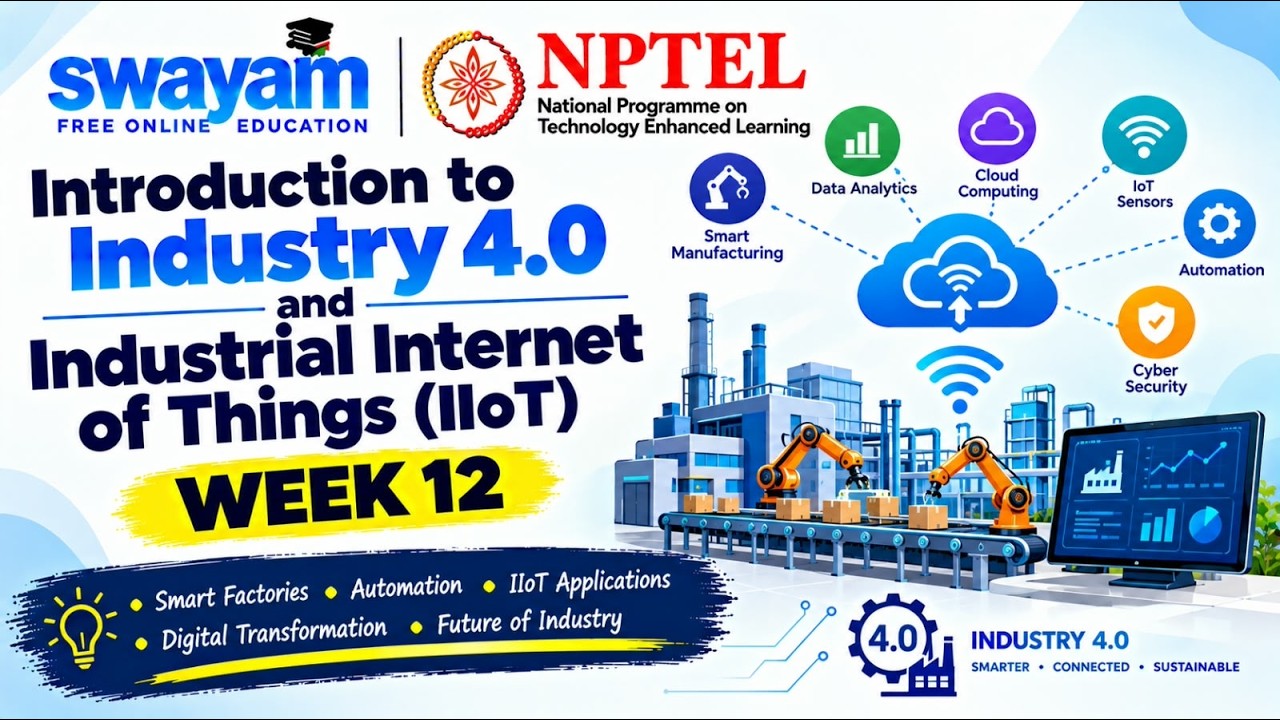
For learners enrolled in specialized courses such as the NPTEL "Introduction to Industry 4.0 and Industrial Internet of Things," grasping these concepts requires a solid understanding of both hardware integration and software communication protocols.

Key Concepts Covered in Week 12

Reaching the final week marks a significant milestone in mastering this course. This concluding module ties together various complex subjects introduced throughout the curriculum, focusing heavily on:
- Advanced application scenarios in smart manufacturing plants
- Security, privacy, and operational reliability in industrial networks
- Integration of edge computing with centralized cloud architectures
- Practical case studies illustrating modern digital transformations

Reviewing these core topics thoroughly is essential not only for answering your weekly coursework accurately but also for building practical knowledge applicable to modern workplace environments.

Tips for Navigating Assignment Answers and Final Prep

To maximize your learning outcome and excel in your final submissions, keep these helpful strategies in mind:
1. Revisit Core Course Materials: Double-check key definitions, architecture layers, and protocol standards before finalizing your answer choices.
2. Analyze Real-World Use Cases: Connect abstract theoretical models to practical industrial scenarios to solidify your comprehension.
3. Engage in Peer Discussions: Collaborating with fellow learners helps clarify challenging questions and broadens your perspective on Industry 4.0 applications.

Whether you are completing your coursework for academic certification or aiming to stay ahead in today's automated workforce, mastering these concepts will set a strong foundation for your professional future in smart technology.


🎬 Related Video Reference

Smart Factory Blueprint: Mastering Energy Management in Industry 4.0

...
engineering information technology
Smart Factory Blueprint: Mastering Energy Management in Industry 4.0

Smart Factory Blueprint: Mastering Energy Management in Industry 4.0

This article provides an in-depth exploration of Industry 4.0, covering foundational concepts, practical applications, and engineering insights.

Manufacturing is undergoing a massive transformation, moving from traditional machinery to connected, automated ecosystems. At the heart of this evolution is Industry 4.0, a paradigm shift that integrates cutting-edge technologies like the Industrial Internet of Things (IIoT), real-time data analytics, and smart automation. One of the most critical applications of this revolution lies in energy management, helping industrial facilities cut operational waste while dramatically increasing their bottom line.

Strategic Energy Management Through IIoT

Energy efficiency is no longer just a sustainability goal; it is a direct driver of profitability. In traditional manufacturing, unmonitored energy consumption leads to costly downtime, operational waste, and reduced equipment lifespans. By deploying IIoT sensors across power grids, heavy machinery, and production lines, plant managers gain real-time visibility into their total energy footprint.

These intelligent engineering solutions collect actionable data on voltage fluctuations, machinery load, and peak usage hours. With this strategic blueprint, energy management transforms from a passive expense into an active, optimized operational strategy. Automated systems can instantly balance power loads, flag inefficiencies before component failures occur, and optimize overall utility usage without disrupting active production schedules.

Maximizing ROI with Industry 4.0 Innovation

Transitioning to a smart factory requires initial capital investment, but the long-term financial returns are both rapid and scalable. By leveraging Industry 4.0 frameworks, enterprise leaders can achieve a tangible return on investment through several key advantages:

  • Predictive Maintenance: Early detection of energy anomalies prevents severe machinery breakdown and eliminates unplanned operational outages.
  • Resource Optimization: Granular tracking ensures that every kilowatt of power contributes directly to optimized production output.
  • Data-Driven Strategy: Engineering teams can utilize historical energy trends to optimize facility workflows and negotiate better utility rates.

Building the Smart Factory of Tomorrow

Adopting a strategic energy roadmap is essential for remaining competitive in modern manufacturing. By merging engineering precision with advanced digital connectivity, facilities can lower their carbon footprint, stabilize operational expenses, and future-proof their infrastructure. Embracing Industry 4.0 is the definitive blueprint for achieving sustainable, high-yield smart operations today.


🎬 Related Video Reference

Approach to Risk Assessment in Smart Factory Systems

...

In the era of Industry 4.0, integrating IoT, AI, and automation has transformed traditional manufacturing into highly efficient ecosystems. However, these advancements introduce complex vulnerabilities. A systematic Approach to Risk Assessment in Smart Factory Systems is no longer optional; it is a critical necessity for operational resilience.

Understanding the Landscape of Smart Factory Risks

Risk assessment in a smart factory environment differs significantly from legacy systems. It requires a holistic view that combines cybersecurity, functional safety, and data integrity. The interconnected nature of Industrial Control Systems (ICS) means that a breach in one sensor can escalate into a full-scale production halt.

Step-by-Step Approach to Risk Assessment

To effectively manage threats, organizations should follow a structured methodology:

  • Asset Identification: Catalog all hardware, software, and data flows within the IIoT network.
  • Threat Modeling: Identify potential threats, ranging from cyber-attacks (malware, ransomware) to physical hardware failures.
  • Vulnerability Analysis: Scrutinize system weaknesses, such as unpatched firmware or unsecured communication protocols.
  • Impact Evaluation: Determine the potential consequences of a risk event on production downtime and worker safety.

Integrating Proactive Mitigation Strategies

A robust Smart Factory Risk Management plan involves continuous monitoring. Unlike static assessments, digital factories require real-time data analytics to detect anomalies. Implementing a Zero Trust Architecture ensures that every device and user is verified before accessing the network, drastically reducing the attack surface.

Conclusion

Adopting a proactive Approach to Risk Assessment in Smart Factory Systems allows manufacturers to embrace innovation without sacrificing security. By identifying vulnerabilities early and implementing automated defense mechanisms, businesses can ensure sustainable growth in the digital manufacturing age.

Technique for Scaling Predictive Maintenance Across Factories

...

Scaling Predictive Maintenance (PdM) from a single pilot plant to a global network of factories is a significant challenge for modern manufacturers. While the ROI of preventing unplanned downtime is clear, the transition requires more than just installing sensors; it demands a robust strategic framework.

The Core Pillars of Scalable Predictive Maintenance

To successfully expand your PdM capabilities across multiple sites, focus on these three essential techniques:

1. Standardizing Data Architecture with IIoT

The foundation of scaling is Standardization. Different factories often use varied legacy equipment. By implementing a unified Industrial IoT (IIoT) gateway, you can normalize data formats before they reach the cloud. This ensures that your Machine Learning models can interpret data from a pump in Germany just as easily as one in Thailand.

2. Leveraging Transfer Learning in AI Models

Building a new model for every machine is inefficient. Use Transfer Learning—a technique where a model developed for one task is reused as the starting point for a model on a second task. This allows you to deploy baseline predictive models quickly across similar assets (like motors or compressors) and fine-tune them with site-specific data later.

3. Centralized "Center of Excellence" (CoE)

Scaling is as much about people as it is about technology. Establishing a Digital Center of Excellence allows a central team of data scientists to manage model health across all factories, while local maintenance teams focus on executing the "prescribed" actions. This centralized-decentralized hybrid approach ensures consistency and fast troubleshooting.

Benefits of Enterprise-Wide Scaling

  • Reduced Maintenance Costs: Lowering spare parts inventory through global visibility.
  • Asset Longevity: Extending the lifecycle of critical machinery across the entire fleet.
  • Data-Driven Culture: Empowering factory managers with actionable insights rather than raw data.
"Scaling Predictive Maintenance is not about a single 'perfect' algorithm; it’s about building a repeatable digital ecosystem."

By focusing on interoperability, modular AI, and organizational alignment, companies can transform their maintenance strategy from reactive to proactive on a global scale.

Approach to Edge-to-Cloud Integration for Predictive Maintenance

...

In the era of Industry 4.0, the synergy between Edge Computing and Cloud Platforms has become the backbone of modern manufacturing. This article explores the strategic approach to Edge-to-Cloud integration for Predictive Maintenance, a methodology that transforms raw sensor data into actionable insights to prevent costly equipment failures.

The Architecture of Predictive Maintenance

To implement an effective predictive maintenance system, a hybrid architecture is required. While the Cloud offers vast storage and heavy processing power, the Edge provides real-time responsiveness at the source of data generation.

1. Edge Layer: Real-time Data Acquisition

The process begins at the Edge. Sensors attached to industrial assets (such as motors or turbines) collect high-frequency data including vibration, temperature, and pressure. By processing this data locally, we can:

  • Reduce latency for critical alerts.
  • Filter "noise" to save bandwidth.
  • Execute immediate fail-safe protocols.

2. Data Transmission and Integration

The bridge between Edge and Cloud is crucial. Using protocols like MQTT or OPC UA, the filtered data is securely transmitted to the cloud. This Edge-to-Cloud integration ensures that only high-value data is sent for long-term analysis, optimizing operational costs.

Leveraging the Cloud for Predictive Analytics

Once the data reaches the Cloud, Machine Learning (ML) models take over. This is where Predictive Maintenance truly shines. By analyzing historical trends across multiple machines, the system can identify subtle patterns that precede a breakdown.

Key Benefits of this Integrated Approach:

  • Extended Asset Lifespan: Identifying wear and tear before it leads to catastrophic failure.
  • Cost Reduction: Shifting from reactive repairs to scheduled, data-driven maintenance.
  • Scalability: Easily adding new sensors and machines to the existing cloud infrastructure.

Conclusion

Adopting a robust approach to Edge-to-Cloud integration is no longer optional for businesses aiming for digital transformation. By balancing the speed of the Edge with the intelligence of the Cloud, companies can achieve a seamless Predictive Maintenance strategy that ensures maximum uptime and efficiency.

Approach to Low-Latency Failure Detection in Smart Factories

...

In the era of Industry 4.0, the margin for error in manufacturing is razor-thin. As production lines become more automated, the need for an Approach to Low-Latency Failure Detection in Smart Factories has transitioned from a luxury to a critical necessity.

The Critical Need for Low-Latency in IIoT

Traditional cloud-based monitoring often suffers from propagation delays. In a high-speed smart factory, a delay of even a few hundred milliseconds in detecting a mechanical glitch can lead to catastrophic hardware damage or costly downtime. To achieve real-time failure detection, engineers are moving processing power closer to the source.

Key Strategies for Minimizing Detection Latency

1. Edge Computing Integration

By deploying Edge Computing nodes directly on the factory floor, data does not need to travel to a central server for analysis. This drastically reduces the Round Trip Time (RTT), allowing for instantaneous shut-off commands if an anomaly is detected.

2. Lightweight Machine Learning Models

Running heavy AI models can introduce computational latency. Modern smart factories utilize lightweight neural networks or TinyML. These models are optimized to run on low-power microcontrollers, identifying patterns of failure (such as abnormal vibrations or heat spikes) in microseconds.

3. High-Speed Communication Protocols

The choice of protocol is vital. Shifting from standard Wi-Fi to 5G Private Networks or TSN (Time-Sensitive Networking) ensures that critical failure signals are prioritized over routine operational data, guaranteeing ultra-reliable low-latency communication (URLLC).

The Benefits of Proactive Failure Detection

  • Reduced Downtime: Identify issues before the machine actually breaks.
  • Cost Efficiency: Minimizes the waste produced during a malfunctioning cycle.
  • Worker Safety: Instantaneous stops prevent industrial accidents.

Conclusion

Implementing a robust approach to low-latency failure detection is the backbone of a resilient smart factory. By combining Edge AI, 5G connectivity, and localized processing, manufacturers can ensure peak performance with minimal risk.

Effective Approach to Signal Conditioning for Machine Health Monitoring

...

In the era of Industry 4.0, Machine Health Monitoring has become the backbone of predictive maintenance. However, the journey from a physical vibration or temperature change to a digital insight isn't direct. This is where Signal Conditioning plays a critical role.

What is Signal Conditioning?

Signal conditioning is the process of manipulating an analog signal in such a way that it meets the requirements of the next stage for further processing, usually an Analog-to-Digital Converter (ADC). In machine health monitoring, raw signals from sensors are often noisy, weak, or distorted.

Key Steps in the Signal Conditioning Approach

To ensure high data integrity for Predictive Maintenance, follow these essential steps:

  • Amplification: Boosting the signal-to-noise ratio by increasing the voltage level of the raw sensor output.
  • Filtering: Removing unwanted frequency components. For instance, using low-pass filters to eliminate high-frequency electronic noise that isn't related to machine vibration.
  • Linearization: Sensors often produce non-linear signals. Conditioning circuits correct these to ensure the output is proportional to the physical measurement.
  • Isolation: Protecting the monitoring system from high voltage surges or ground loops that could damage expensive DAQ (Data Acquisition) hardware.

Why it Matters for Industrial IoT (IIoT)

Without proper signal conditioning, your AI and Machine Learning models will suffer from "Garbage In, Garbage Out." Clean signals lead to:

  1. Accurate Failure Prediction.
  2. Reduced false alarms in monitoring systems.
  3. Extended lifespan of industrial assets.
"The precision of your Machine Health Monitoring system is only as good as the signal conditioning that precedes it."

Conclusion: Implementing a robust signal conditioning approach is not just a technical necessity; it's a strategic investment in industrial reliability and data accuracy.

Approach to Handling Noisy Sensor Data in Smart Factories

...

In the era of Industry 4.0, Smart Factories rely heavily on a continuous stream of data from IoT sensors. However, real-world environments are far from perfect. Electromagnetic interference, mechanical vibrations, and power fluctuations often introduce "noise" into the data. Handling noisy sensor data is critical for maintaining predictive maintenance accuracy and operational efficiency.

The Challenge of Sensor Noise

Unfiltered data can lead to false alarms, incorrect automated decisions, and degraded machine learning model performance. To ensure high-quality industrial data analytics, engineers must implement robust signal processing techniques.

Top Strategies for Handling Noisy Sensor Data

1. Moving Average Filters

A fundamental approach where the current data point is averaged with a window of previous points. This smooths out short-term fluctuations and highlights longer-term trends in smart manufacturing processes.

2. Kalman Filtering

The Kalman Filter is an optimal mathematical algorithm used for predicting the state of a system. It is highly effective in Smart Factories for tracking moving parts or temperature changes where the sensor readings are known to be imprecise.

3. Savitzky-Golay Filter

Unlike simple moving averages, the Savitzky-Golay filter uses local polynomial regression. It is excellent for predictive maintenance because it smooths the data while preserving the important features of the signal peaks.

Implementation in Smart Factories

Effective noise reduction starts at the edge. By processing data directly on the IoT gateway before it reaches the cloud, factories can reduce latency and bandwidth costs. Integrating these algorithms ensures that your Industrial Internet of Things (IIoT) ecosystem remains reliable and precise.

"Clean data is the foundation of any successful AI implementation in modern manufacturing."

Conclusion

Addressing noisy sensor data is not just a technical necessity; it is a competitive advantage. By applying the right filtering techniques, Smart Factories can achieve unprecedented levels of automation and insight.