Showing posts with label Project Management. Show all posts

No Central Office? How an Engineering Project Handbook Drives Decentralized Success

...

In today’s rapidly evolving technological landscape, the traditional central office is quickly becoming a relic of the past. Modern engineering teams are increasingly distributed, operating across different time zones and localized hubs. But how does critical technical work continue uninterrupted when there is no central headquarters or immediate top-down oversight? The secret lies in explicit documentation, distributed responsibility, and a structured engineering project handbook.

Keeping Momentum Without Central Headquarters

When teams operate in a decentralized environment, sustained productivity relies on clarity rather than constant supervision. High-value engineering work must continue seamlessly, even if important leadership seats remain temporarily vacant. By establishing peer-to-peer connection protocols, individual contributors can collaborate directly, solve blockers, and keep project pipelines moving forward without waiting for permission from a centralized authority.

Essential Roles of an Engineering Project Handbook

To maintain high quality across remote nodes, organizations need a single, reliable source of truth. Implementing a detailed engineering project handbook provides the necessary structure to guide asynchronous workflows. It outlines technical standards, deployment workflows, testing practices, and communication expectations. When every engineer understands the underlying operational playbook, they can make confident decisions independently.

A complete handbook typically covers: - Asynchronous Communication Standards: Defining how and where technical discussions, bug reports, and updates take place. - Architectural Standards & Conventions: Ensuring code quality and system design remain consistent across disparate teams. - Incident Escalation & Decision Guidelines: Empowering engineers to resolve urgent issues when central managers are unavailable.

Empowering True Team Autonomy

Decentralization is not merely about working from distinct locations; it is about building resilient systems that function independently of single points of failure. By investing time into creating a comprehensive engineering project handbook, organizations transform silent dependencies into proactive execution. Even if the central office chair remains empty, your development momentum stays unbroken.
SSC JE 2026 Civil Prep: Master PERT and CPM in This Engineering Methods Course

...

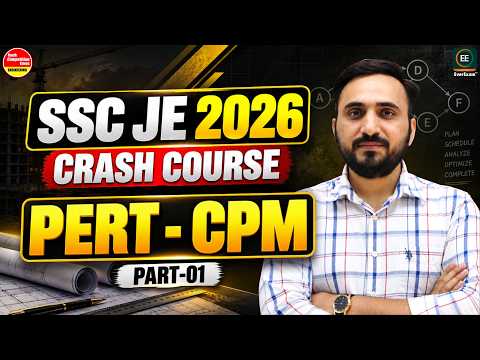
Preparing for the SSC JE 2026 exam requires a smart, structured approach, especially when tackling critical project management topics like PERT (Program Evaluation and Review Technique) and CPM (Critical Path Method). Designed specifically for Civil Engineering aspirants, this crash course module breaks down complex construction planning concepts into easy-to-understand lessons.

Understanding PERT and CPM in Civil Engineering

In civil engineering, project planning and scheduling form the backbone of successful infrastructure execution. For competitive exams like SSC JE, questions on network techniques carry significant weightage. PERT focuses on probabilistic time estimates suitable for unpredictable project conditions, while CPM uses a deterministic approach ideal for routine construction activities. Mastering the distinction between activities, events, slack, float, and critical paths is essential to scoring high in the technical section.

Key Highlights of This Engineering Methods Course

Taking a well-designed engineering methods course allows candidates to build strong conceptual clarity while learning time-saving problem-solving tricks. In Part 01 of this crash course series, you will cover:

  • Fundamental Definitions: Clear distinctions between activities, events, dummy activities, and basic network rules.
  • Time Estimates: How to calculate optimistic, pessimistic, and most likely time durations in PERT networks.
  • Network Construction: Step-by-step methods to draw and analyze project networks efficiently without logical errors.

Boost Your Preparation with Expert Guidance

While self-study is crucial, structured guidance accelerates your learning curve. Participating in a focused engineering methods course ensures you cover the syllabus systematically, practice high-yield exam questions, and avoid common pitfalls on test day.

Whether you are revising fundamental concepts or learning PERT and CPM for the first time, this session provides the perfect groundwork to boost your score. Stay consistent with your preparation and take a confident step toward cracking SSC JE 2026!

Master the ARE 5.0 Project Management (PjM) Division: A Guide to Success and Value Engineering Practices

...

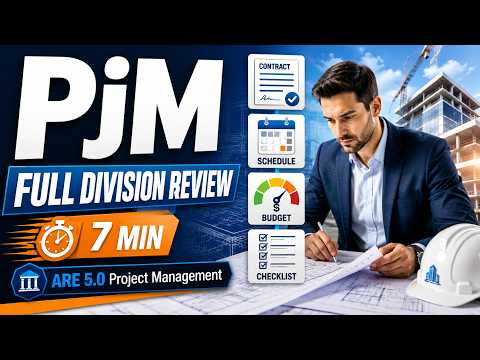
Preparing for the ARE 5.0 Project Management (PjM) division can feel like a daunting task for many aspiring architects. As one of the core professional practice exams, PjM focuses on the management of architectural projects, including professional services, the execution of project tasks, and the administrative technicalities of a contract. To pass this division, you need more than just a surface-level understanding; you need a strategic approach to project delivery.

Understanding the PjM Scope

The PjM division covers several critical areas: resource management, project work planning, contracts, and quality control. Unlike the Practice Management (PcM) division, which looks at the firm as a whole, PjM is laser-focused on the individual project. You must be comfortable navigating AIA contracts—specifically the B101 and A201—and understanding how those documents dictate the relationships between the owner, architect, and contractor.

Integrating Value Engineering Practices

A key component of successful project management is balancing the client’s budget with the project’s functional and aesthetic requirements. This is where a deep understanding of value engineering practices becomes essential. In the context of the ARE 5.0, you are expected to know how to optimize the value of a project by analyzing its functions and seeking lower-cost alternatives without compromising quality or performance.

Effective value engineering practices are not just about "cutting costs"; they are about smart decision-making during the design and documentation phases. As a project manager, you must identify opportunities to streamline the construction process or suggest alternative materials that provide the same longevity at a better price point. Mastering these concepts will help you answer complex scenario-based questions on the exam that deal with budget constraints and scope alignment.

Strategies for Exam Success

To conquer the PjM division in record time, follow these three steps: 1. Analyze the NCARB Objectives: Focus heavily on Objective 2.1 (Resource Management) and Objective 3.1 (Project Work Planning). These areas carry significant weight. 2. Learn the Contracts: You cannot pass PjM without knowing the roles and responsibilities outlined in the standard AIA agreements. 3. Think Like a Manager: When faced with a question, ask yourself: "What is the most professional and ethically responsible way to keep this project moving forward?"

By combining a structured study plan with a firm grasp of value engineering practices and contract administration, you will be well on your way to earning your license. Stay focused, stay organized, and approach the PjM division with the confidence of a lead architect.

Mastering the Agile Manifesto: Why It’s the Secret to Success in Engineering Software

...
engineering information technology
Mastering the Agile Manifesto: Why It’s the Secret to Success in Engineering Software

Mastering the Agile Manifesto: Why It’s the Secret to Success in Engineering Software

This article provides an in-depth exploration of Engineering software, covering foundational concepts, practical applications, and engineering insights.

In the fast-paced world of modern development, technical skill alone isn't enough to guarantee a successful product launch. To truly excel, development teams must master the methodology behind the code. While many developers focus solely on syntax and architecture, the real breakthrough occurs when you understand how to build engineering software using the core principles of the Agile Manifesto.

The Foundation: Understanding Agile Core Principles

The Agile Manifesto was born from a need to move away from rigid, "waterfall" structures that often led to bloated budgets and missed deadlines. It prioritizes individuals and interactions over tools, and working software over comprehensive documentation. For any team building high-performance engineering software, these aren't just abstract suggestions—they are the foundation of a sustainable and scalable workflow.

By valuing customer collaboration over contract negotiation and responding to change over following a strict plan, teams can pivot quickly. This flexibility is essential in a market where user needs and technological capabilities evolve almost daily.

Putting Theory Into Practice

Applying the secrets of Agile to your daily routine starts with radical prioritization. Instead of trying to tackle every feature at once, Agile encourages an iterative approach. This means breaking down complex tasks into manageable "sprints" or work cycles.

When developing complex engineering software, this iterative approach significantly reduces risk. It allows engineers to test small increments of code, gather feedback early, and ensure that the most valuable features reach the end-user first. When you stop treating the development process as a straight line and start seeing it as a cycle of continuous improvement, your productivity will naturally soar.

The Power of the Retrospective

Finally, the secret to long-term Agile success lies in the "Retrospective." At the end of every cycle, teams must take the time to reflect on what worked and what didn’t. This isn't about assigning blame; it’s about refining the process.

Success in engineering is a marathon, not a sprint. By embracing the Agile mindset, you aren't just writing better code—you are building a more resilient, responsive, and successful engineering culture. Focus on the principles, prioritize the value, and watch your development projects transform.

Visual Insights & Illustrations

Engineering software