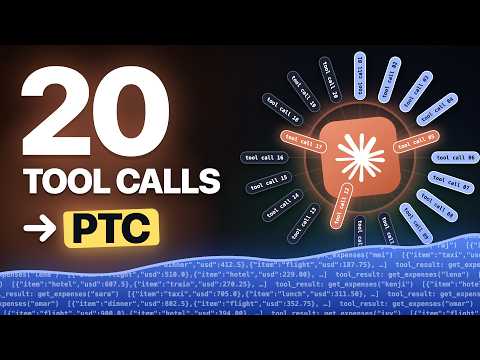
Building autonomous AI agents with models like Anthropic's Claude opens up incredible possibilities for automation. However, if you are not careful, your agentic workflows can quickly consume thousands of unnecessary tokens. When an agent makes dozens of tool calls in a single execution loop, every raw output gets dumped directly into the context window.
To build cost-effective and high-performing agentic systems, developers must focus on smarter engineering tool utilization. Here is how context bloat happens and how Programmable Tool Calls (PTC) can solve it.
The Hidden Cost of Unfiltered Context Windows
Imagine your Claude agent needs to solve a complex task that requires 20 distinct tool calls. In a traditional agent setup, each step follows a rigid loop: the model requests a tool, receives the raw response, appends that response to its context window, and then determines the next action.
If those tool calls return large JSON payloads or verbose API responses, your context window expands exponentially. You end up paying for thousands of input tokens on every subsequent step just to pass along intermediate data the model does not actually need to read. Without strategic engineering tool utilization, your API bill will skyrocket while model latency noticeably degrades.
Programmable Tool Calls (PTC): A Smarter Approach
The solution to this token waste is rethinking how tools execute and transfer data. By implementing Programmable Tool Calls (PTC), you give your agent environment the ability to execute code or control logic locally between tool steps rather than routing every intermediate state back through the LLM.
Instead of appending every raw result to the prompt context, PTC allows the execution environment to filter, transform, and aggregate data programmatically. Only the refined, essential summary is passed back into the model's context window. This modern approach to engineering tool utilization drastically reduces context bloat, keeps your token count low, and speeds up overall execution times.
Take Control of Your Agent Workflows
Token bloat is one of the biggest bottlenecks in modern AI agent architecture. By moving away from dumping raw tool results into the context window and embracing concepts like PTC, you can optimize your workflows for speed, cost efficiency, and accuracy. Rethinking how your tools interact with LLMs is essential for building scalable, enterprise-grade AI applications.


