Showing posts with label Construction Tech. Show all posts

10 Essential Pre-Brickwork Checks: How Engineering IT Enhances Site Management

...

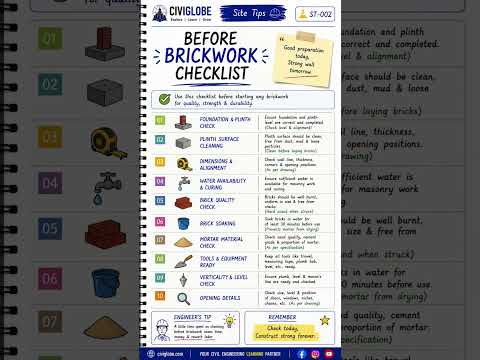
Starting brickwork is a critical milestone in any construction project. A single oversight during this phase can lead to structural defects, water seepage, and costly rework down the line. To maintain high quality standards, civil engineers must execute a meticulous pre-brickwork inspection on-site. Today, modern site management relies heavily on advanced Engineering IT solutions to digitize site checklists, streamline reporting, and ensure precise execution.

Here are the essential things every civil engineer must check before brickwork begins:

1. Foundation & Plinth Level Checks

Before laying a single brick, verify that the plinth beam level is even and structurally sound. Ensure the Damp Proof Course (DPC) is properly laid to prevent future capillary action and moisture ingress through the masonry walls.

2. Surface Cleaning and Base Preparation

The concrete base beneath the masonry must be thoroughly cleaned of dust, oil, and loose debris. Wetting the base prior to mortar application ensures optimal adhesion and prevents the concrete from prematurely absorbing water from the mortar.

3. Material Quality Inspection

Inspect the quality of bricks or concrete blocks. Bricks should be uniform in size, sharp-edged, free from cracks, and well-soaked in clean water before placement. Additionally, ensure the mortar mix ratio strictly adheres to structural specifications.

4. Column Hacking and Layout Alignment

Concrete columns coming into contact with brickwork must be properly hacked (chipped) to create a rough surface for mortar bonding. Furthermore, re-verify reference grid lines, door/window openings, and wall thickness against approved structural drawings.

Digitizing Quality Control on Modern Sites

By integrating smart Engineering IT tools—such as cloud-based site-inspection apps and BIM-integrated management software—engineers can photograph site conditions, log checklist approvals, and sync live data instantly with off-site managers. This digital transformation reduces human error and accelerates decision-making on active construction sites.

Conclusion

A rigorous pre-brickwork check is non-negotiable for delivering durable, safe structures. Combining traditional civil engineering best practices with modern Engineering IT workflows guarantees superior quality control, keeping your building projects efficient, compliant, and on schedule.


Engineering IT

Work Smart, Not Hard: How Engineering IT is Transforming Modern Infrastructure

...

In today's fast-paced technical world, the phrase "work smart, not hard" has evolved from a popular catchphrase into a vital strategy for long-term success. Whether managing complex site builds, optimizing structural blueprints, or streamlining field communications, achieving efficiency relies heavily on utilizing the right digital tools. This is precisely where modern Engineering IT steps in, revolutionizing how traditional projects operate from start to finish.

The Shift Toward Digital Optimization

Traditionally, engineering and construction management relied heavily on manual oversight, physical blueprints, and localized communication. While these methods built the modern world, they frequently resulted in project delays, budget overruns, and unexpected bottlenecks.

By integrating robust Engineering IT solutions into daily operations, organizations gain access to real-time data tracking, automated safety monitoring, and cloud-based design management. Engineers no longer need to rely solely on manual tracking. Advanced computing infrastructure allows technical teams to predict potential structural risks long before ground is even broken.

Key Advantages of Working Smart

Embracing specialized information technology within engineering fields offers distinct operational benefits:

  • Enhanced Precision: Building Information Modeling (BIM) and spatial software eliminate design mismatches across cross-functional teams.
  • Automated Task Routines: Intelligent software handles scheduling, resource allocation, and progress tracking, freeing experts to focus on problem-solving.
  • Streamlined Collaboration: Field workers and office technicians stay synchronized through secure cloud platforms, drastically reducing costly miscommunications.

Building a Smarter Technical Future

Working smart is not about cutting corners; it is about leveraging modern technology to eliminate friction and elevate work quality. Implementing modern Engineering IT strategies enables firms to deliver safer, higher-quality projects on time and under budget.

By upgrading legacy workflows and adopting digital-first techniques, industry leaders can ensure their teams remain agile, efficient, and ready for future challenges.

Engineering IT