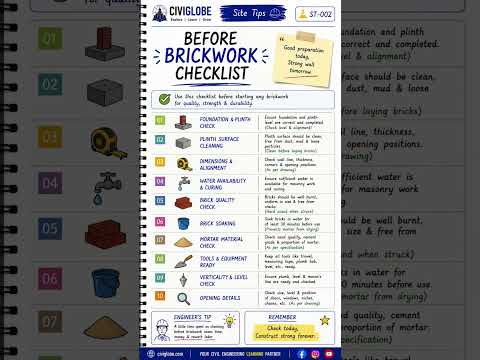
Starting brickwork is a critical milestone in any construction project. A single oversight during this phase can lead to structural defects, water seepage, and costly rework down the line. To maintain high quality standards, civil engineers must execute a meticulous pre-brickwork inspection on-site. Today, modern site management relies heavily on advanced Engineering IT solutions to digitize site checklists, streamline reporting, and ensure precise execution.
Here are the essential things every civil engineer must check before brickwork begins:
1. Foundation & Plinth Level Checks
Before laying a single brick, verify that the plinth beam level is even and structurally sound. Ensure the Damp Proof Course (DPC) is properly laid to prevent future capillary action and moisture ingress through the masonry walls.
2. Surface Cleaning and Base Preparation
The concrete base beneath the masonry must be thoroughly cleaned of dust, oil, and loose debris. Wetting the base prior to mortar application ensures optimal adhesion and prevents the concrete from prematurely absorbing water from the mortar.
3. Material Quality Inspection
Inspect the quality of bricks or concrete blocks. Bricks should be uniform in size, sharp-edged, free from cracks, and well-soaked in clean water before placement. Additionally, ensure the mortar mix ratio strictly adheres to structural specifications.
4. Column Hacking and Layout Alignment
Concrete columns coming into contact with brickwork must be properly hacked (chipped) to create a rough surface for mortar bonding. Furthermore, re-verify reference grid lines, door/window openings, and wall thickness against approved structural drawings.
Digitizing Quality Control on Modern Sites
By integrating smart Engineering IT tools—such as cloud-based site-inspection apps and BIM-integrated management software—engineers can photograph site conditions, log checklist approvals, and sync live data instantly with off-site managers. This digital transformation reduces human error and accelerates decision-making on active construction sites.
Conclusion
A rigorous pre-brickwork check is non-negotiable for delivering durable, safe structures. Combining traditional civil engineering best practices with modern Engineering IT workflows guarantees superior quality control, keeping your building projects efficient, compliant, and on schedule.

