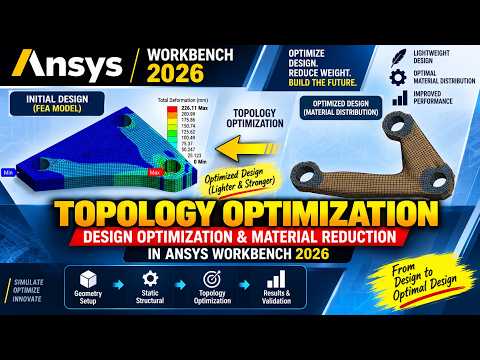
In the rapidly evolving landscape of modern manufacturing, efficiency is no longer just a goal—it is a requirement. As we look toward the future of manufacturing, industrial engineering optimization has become the cornerstone of sustainable and cost-effective product development. One of the most powerful tools currently leading this charge is ANSYS Workbench 2026, specifically through its advanced Topology Optimization capabilities.
The Power of Topology Optimization in 2026
Topology optimization is a mathematical approach that optimizes material layout within a given design space for a specified set of loads and boundary conditions. The goal is to maximize the performance of the system while minimizing mass. With the release of ANSYS Workbench 2026, this process has become more intuitive and powerful than ever. By utilizing these tools, engineers can transition from traditional "guess-and-check" design methods to a data-driven approach that identifies the most efficient structural shape automatically.
A Streamlined Workflow for Maximum Efficiency
The latest tutorial for ANSYS Workbench 2026 provides a comprehensive, step-by-step guide to mastering this technology. The process begins with defining the design domain and identifying frozen regions that must remain unchanged. From there, users set specific optimization objectives—such as minimizing compliance or maximizing stiffness—while adhering to strict manufacturing constraints.
The software’s solver then iterates through thousands of variations to "carve away" unnecessary material. This results in organic, lightweight structures that are often impossible to design manually but are perfectly suited for additive manufacturing (3D printing) or advanced casting techniques.
Why This Matters for Modern Manufacturing
Implementing these techniques is a vital component of industrial engineering optimization. By reducing the volume of material required for a part, companies can significantly lower raw material costs and decrease the carbon footprint of their logistics chain due to lighter shipping weights. Furthermore, the ability to maintain structural integrity while shedding weight is critical in aerospace, automotive, and heavy machinery industries.
Whether you are a seasoned simulation engineer or a student looking to stay ahead of the curve, mastering ANSYS Workbench 2026 is essential. Embracing these optimization tools ensures that your designs are not only functional but are also at the peak of engineering excellence. By integrating industrial engineering optimization into your daily workflow, you turn complex design challenges into streamlined, high-performance solutions.
