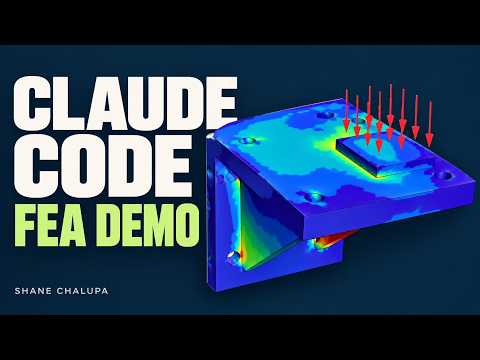
Modern engineering demands both extreme precision and fast iteration cycles. Finite Element Analysis (FEA) remains one of the most critical methodologies for evaluating mechanical stress, deformation, and overall structural integrity. In this practical demonstration, we explore how AI-driven tools like Claude Code can accelerate the end-to-end FEA process—taking you directly from a raw 3D STEP model to a clear, actionable engineering analytics report.
From STEP CAD Models to Gusseted-Bracket Analysis
Transitioning complex 3D CAD geometries into validated numerical simulations has traditionally been a time-consuming bottleneck. By utilizing Claude Code, engineers can automate repetitive setup scripts, parse STEP files, and configure finite element models with unprecedented efficiency.
In our detailed demonstration, we analyze a load-bearing gusseted bracket. Claude Code assists in setting up meshing parameters, applying material properties, and defining boundary conditions and load vectors. This automated approach ensures that potential structural vulnerabilities are caught early in the design cycle long before physical prototypes are manufactured.
Automated Data Extraction and Results Presentation
Evaluating mechanical performance under real-world loads requires accurate visualization and structured data metrics. Claude Code excels at capturing raw simulation outputs—such as Von Mises stress distributions, strain patterns, and maximum displacement limits—and converting them into formatted summaries.
By integrating these simulation outputs into an automated workflow, you can generate a standardized engineering analytics report in minutes. This comprehensive documentation provides key performance indicators and safety factor evaluations that can be easily shared with design teams, project managers, and clients.
Transforming Engineering Workflows with AI
Integrating AI coding assistants into structural engineering workflows is not about replacing domain expertise; it is about eliminating manual repetitive tasks and reducing potential human error. Automated script generation allows mechanical engineers to focus on high-level decision-making, result interpretation, and design optimization.
Ultimately, combining advanced language models with FEA solvers changes how engineering teams document their findings. Producing a reliable, repeatable engineering analytics report is no longer a tedious post-processing task, but a seamless, automated extension of the design process itself.


