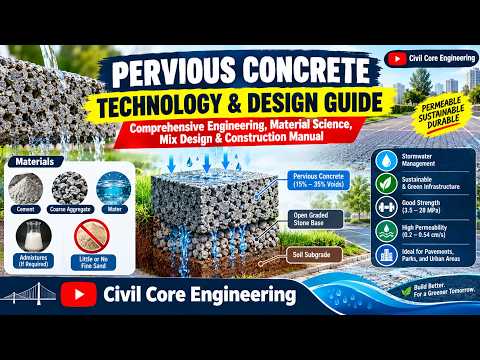
As urban environments continue to expand, managing stormwater runoff and mitigating flood risks have become critical challenges for civil engineers. Pervious concrete has emerged as an innovative, eco-friendly solution that allows water to percolate directly through its porous matrix. Whether you are an infrastructure developer or a practicing engineer, utilizing a comprehensive engineering design guide for pervious concrete is essential for designing resilient, environmentally responsible paving systems.
Understanding Pervious Concrete Material Science
Pervious concrete—often referred to as porous or permeable concrete—is a specialized mix of coarse aggregate, Portland cement, water, and specialized admixtures. Unlike standard concrete mixes, pervious concrete eliminates fine aggregates (sand) almost entirely. This creates an interconnected network of open voids, usually between 15% and 25% by volume, allowing water to pass through at impressive rates.
Core Principles of Structural and Hydrological Design
Designing a permeable pavement system requires a careful balance between permeability and structural load-bearing capacity. Implementing a reliable engineering design guide helps engineers balance these competing factors effectively. Key design elements include:
- Aggregate Selection and Grading: Utilizing uniform, single-sized aggregates optimizes void ratio while maintaining structural cohesion.
- Water-Cement Ratio Control: Keeping the water-cement ratio tightly controlled (typically between 0.27 and 0.34) ensures the cement paste coats the aggregates without draining to the bottom and clogging the voids.
- Sub-base Storage Capacity: Designing an open-graded crushed stone sub-base provides crucial temporary storage for heavy rainfall before it infiltrates into the underlying native soil.
Construction Techniques and Maintenance
Proper installation is vital to the success of pervious concrete. Standard vibratory screeds and specialized compaction rollers are used to compress the material without sealing the top layer. Furthermore, because dust and organic sediment can clog the void system over time, routine maintenance—such as periodic power vacuuming or pressure washing—is essential to maintain long-term infiltration capacity.
Conclusion
Pervious concrete is a cornerstone of modern green infrastructure. By referencing a well-structured engineering design guide, civil engineering professionals can successfully mitigate urban heat island effects, reduce stormwater pollution, and build sustainable pavements built to last.


