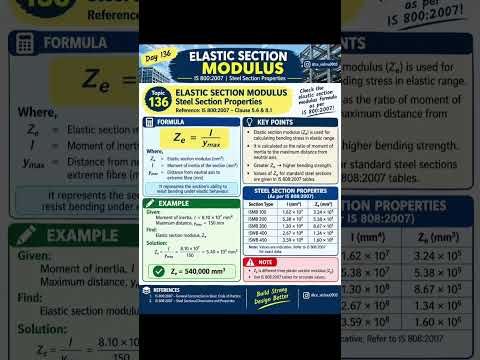
In structural design, evaluating how a beam resists bending under load is fundamental to ensuring safety and integrity. When performing a fundamental structural engineering calculation, understanding steel section properties—specifically the elastic section modulus—is one of the most vital steps an engineer can take.
What is the Elastic Section Modulus ($Z_e$)?
The elastic section modulus ($Z_e$) is a geometric property of a cross-section used to measure its resistance to bending moments. It characterizes how efficiently a shape resists flexural stress before reaching the material's elastic limit (yield point).
The mathematical formula to derive the elastic section modulus is expressed as:
$$Z_e = \frac{I}{y_{\max}}$$
Where: * $I$ is the Second Moment of Area (Moment of Inertia) about the neutral axis. * $y_{\max}$ is the distance from the neutral axis to the outermost (extreme) fiber of the section.
The larger the section modulus, the more resistant the beam is to bending under applied loads.
Why Section Modulus Matters in Steel Design
Steel sections come in various standard shapes—such as I-beams, channels, and hollow structural sections (HSS). Each geometry distributes material differently relative to its neutral axis.
By determining the elastic section modulus, engineers can easily calculate the maximum bending stress ($\sigma$) experienced by the section using the flexure formula:
$$\sigma = \frac{M}{Z_e}$$
Here, $M$ represents the applied bending moment. Mastering this concept ensures that every structural engineering calculation you perform leads to safe, efficient, and cost-effective structural designs without unnecessary over-engineering.
Practical Steps for Calculation
- Locate the Neutral Axis: Identify the centroidal axis where the internal bending stresses are zero.
- Determine the Moment of Inertia ($I$): Calculate the second moment of area for the specific geometric cross-section.
- Identify $y_{\max}$: Find the maximum distance from the neutral axis to the top or bottom extreme edge.
- Apply the Formula: Divide $I$ by $y_{\max}$ to obtain the final elastic section modulus value.
Whether you are a student or a practicing professional, refining your structural engineering calculation workflow with solid section property fundamentals will elevate your overall design accuracy and analytical skills.


