Under the Hood of Apache Airflow: A Guide for Data Engineering
This article provides an in-depth exploration of Data engineering, covering foundational concepts, practical applications, and engineering insights.
Have you ever wondered what actually happens after you write a Python DAG file and save it to your repository? You set a schedule, and like magic, your tasks execute seamlessly every night. However, behind this simple automation lies a powerful, multi-layered architecture that powers modern orchestration.
In the realm of data engineering, Apache Airflow has become the industry standard for managing complex workflows. But to write better pipelines and troubleshoot issues effectively, you need to understand how Airflow works under the hood. Here is a quick breakdown of its core internal components.
1. The DAG Parser: Reading Your Code
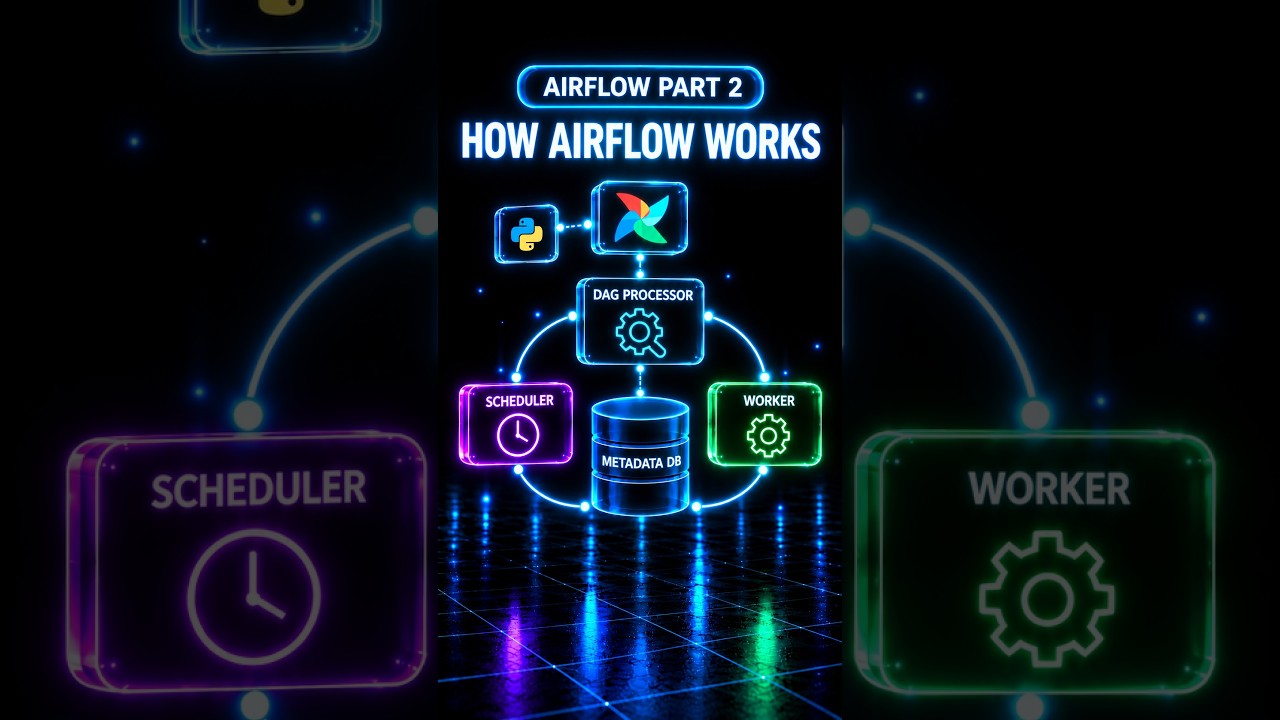
When you save a Python file containing a Directed Acyclic Graph (DAG), Airflow doesn't immediately execute your business logic. Instead, the DAG Processor continuously scans your designated DAG folder. It parses the Python script, extracts task dependencies and execution rules, and writes this metadata directly into Airflow’s central metadata database.
2. The Scheduler: The Brain of the Operation
The Airflow Scheduler is the core engine. It constantly monitors the metadata database to check if any tasks are ready to run based on their schedule intervals and upstream dependencies. When a task’s execution time arrives and all prerequisites are satisfied, the Scheduler marks the task as "queued" and hands it off for execution.
3. Executors and Workers: Doing the Heavy Lifting
The Scheduler itself doesn't execute your task code—that responsibility belongs to the Executor and Workers. Depending on your environment (such as Celery or Kubernetes Executors), the Executor determines how task instances are distributed. Worker nodes then pick up the queued tasks, execute the code, and report the final status (success or failure) back to the database.
4. The Webserver: Visualizing the Pipeline
Finally, the Airflow Webserver reads the metadata database to render a clean, interactive user interface. It allows you to inspect DAG structures, monitor real-time execution states, view detailed logs, and trigger manual reruns whenever necessary.
Conclusion
Understanding this continuous cycle—from code parsing to scheduling, execution, and monitoring—is essential for anyone building a career in data engineering. By mastering how these internal components interact, you can design more reliable, scalable, and resilient data pipelines with confidence.


