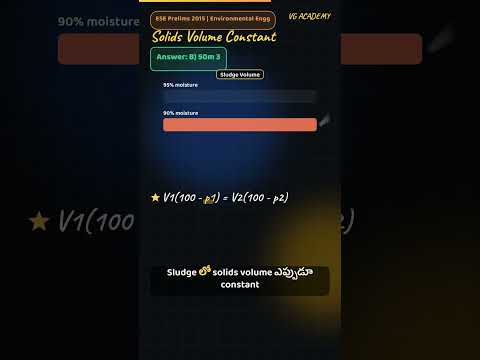
Preparing for competitive exams like the Engineering Services Examination (ESE) requires not just fundamental technical knowledge, but also the ability to quickly spot and dodge clever conceptual traps. A classic example from the ESE Prelims 2015 Environmental Engineering paper involves sludge volume calculations. Navigating these tricky numerical questions efficiently is vital for candidates seeking reliable environmental engineering solutions during their exam preparation.
Understanding the Sludge Volume Trick Question
Sludge volume determination is a core concept in biological wastewater treatment. In activated sludge processes, evaluating the Sludge Volume Index (SVI) helps engineers assess how well the sludge settles in a secondary clarifier. A typical exam trick question tests your understanding of the mathematical relationship between the settled sludge volume, the Mixed Liquor Suspended Solids (MLSS) concentration, and the final index.
Examiners frequently manipulate unit representations—such as switching between milligrams per liter (mg/L) and grams per liter (g/L), or giving non-standard sample volumes—to confuse candidates under exam pressure. Identifying these minor parameter shifts is essential to delivering accurate environmental engineering solutions when every second counts.
Breaking Down the Problem Step-by-Step
To successfully solve sludge volume problems from ESE Prelims and similar competitive exams, keep this simple checklist in mind:
- Extract Key Variables: Clearly list the given settled sludge volume (typically measured after 30 minutes of settling in a 1-liter cylinder) and the MLSS concentration.
- Standardize Your Units: Apply the standard formula for SVI: $$\text{SVI (mL/g)} = \frac{\text{Settled Sludge Volume (mL/L)}}{\text{MLSS Concentration (g/L)}}$$ Always convert MLSS into grams per liter before running the calculation to avoid order-of-magnitude errors.
- Filter Out Distractions: Do not be misled by extraneous test data included in the question prompt purely to test your core conceptual clarity.
Boost Your Exam Readiness
Mastering these numerical tricks does more than just secure valuable marks in the ESE Prelims; it builds a strong foundation for practical design and field operations. By continuously practicing past exam questions and applying structured environmental engineering solutions, you can sharpen both your problem-solving speed and confidence. Keep testing yourself with timed practice questions to ensure you stay ahead on exam day!


