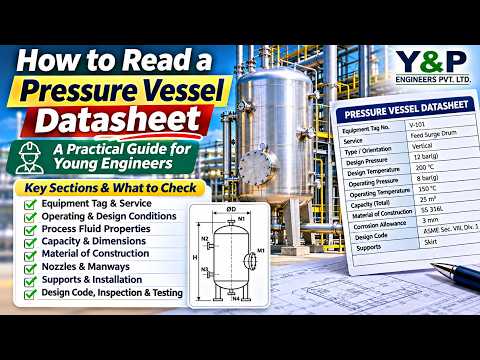
Designing industrial equipment requires a thorough understanding of operational demands, safety protocols, and fluid dynamics. For young engineers starting their careers, reading a pressure vessel datasheet is one of the most critical skills to master. Pressure vessels serve as vital components within a modern chemical engineering process, safely containing liquids and gases at pressures significantly different from ambient conditions. Before any physical fabrication or 3D modeling begins, you must know how to translate raw datasheet values into actionable design decisions.
Key Elements of a Pressure Vessel Datasheet
A pressure vessel datasheet acts as the primary communication bridge between process design and mechanical engineering. As a young engineer, the essential sections you must carefully review include:
- Operating and Design Parameters: Pay close attention to maximum operating pressure (MOP), design pressure, design temperature, and minimum design metal temperature (MDMT). These figures dictate wall thickness, head selection, and flange ratings.
- Process Fluid Characteristics: Chemical composition, fluid density, toxicity, and phase behavior dictate the material of construction (e.g., carbon steel, stainless steel, or special alloys) and corrosion allowance.
- Nozzle Schedules: Verify the orientation, size, rating, and purpose of inlet, outlet, vent, and drain connections to ensure seamless integration into the overall chemical engineering process.
How to Interpret Process Requirements Correctly
To avoid costly design revisions or safety hazards, follow a systematic approach when reading the equipment datasheet:
- Confirm Design Codes and Standards: Check whether the vessel must comply with ASME Section VIII, EN 13445, or specific site specifications.
- Account for Environmental & Mechanical Loads: Look for notes on wind loads, seismic activity, thermal relief, and cyclic operations that could affect structural integrity.
- Cross-Reference with P&IDs: Always cross-check the equipment datasheet against the Piping and Instrumentation Diagram (P&ID) and Process Flow Diagram (PFD). This ensures that vessel operation aligns perfectly with every stage of the chemical engineering process.
Final Thoughts
Learning to read and interpret a pressure vessel datasheet is a fundamental milestone for any engineering professional. By mastering operating limits, fluid properties, and mechanical constraints early in your career, you ensure safe, reliable, and efficient plant operations.


