Boom is a prototype for a new supersonic passenger aero-plane that will be able to fly New York to London in 3.5 hours, slightly quicker than Concorde used to. But that's not the clever bit.
The smart thing about Boom is that it uses existing technologies to keep costs low, and the business model is based on flights being about the same price as Business Class is today.
Apparently Boom is already in development and test flights are planned for late 2017
No, I haven't gone off my nut with blind patriotism toward my native state.Yes, I know that ex-governor Rick Perry said in 2014, "Calling CO2 a pollutant is doing a disservice [to] the country, and I believe a disservice to the world."But the fact of the matter is that Texas has the most installed wind-generation capacity of any state, more even than California, and shows no signs of turning back.How we got here is a lesson in the effects of government regulation, and shows that sometimes less is more.
In an Associated Press article, reporter Michael Biesecker points out the irony that three of the leading wind-generation states—Texas, Oklahoma, and Kansas—are also home to state and federal lawmakers who have been the most critical of climate-change ideas and most supportive of fossil fuel businesses such as oil and coal.He shows that in both 2014 and 2015, U. S. utilities spent more money installing renewable-energy sources such as wind and solar than they did building fossil-fueled power plants.And the fossil-fuel plants they did build mostly burn natural gas, which contributes less to the carbon-dioxide burden of the atmosphere than coal does.The fact that natural gas is so popular is largely because it's cheaper these days, and that's because the largely Texas-based oil-and-gas-extraction industry figured out how to do fracking, which has made more natural gas available now than we've had for a long time.
A few years ago we were hearing calls for carbon taxes, heavy regulation of fossil-fuel industries, and draconian mandates for Federal- and state-funded renewable energy projects imposed from Washington and other centers of governmental power.Largely because Washington has been gridlocked for the last five or six years, no significant Federal laws were passed, although the Obama administration has done what it could through executive actions in those directions.
Meanwhile, in Texas we enjoy some peculiar advantages when it comes to doing new things with electric power.Because years ago, Texas refused to interconnect in a major way with the electric grids in the rest of the country, most of the state gets power from an entity called ERCOT—the Electric Reliability Council of Texas.Both physically and legally, ERCOT is independent from both the rest of the U. S. power grid and from the tangle of regulatory requirements that the rest of the country has to deal with whenever a power utility wants to do something different.
As Kyle Downey points out in an article at lawstreetmedia.com, this freedom from outside utility regulations has allowed Texas to pass innovative laws such as the Renewable Portfolio Standard in 1999, which created mandates and funded incentives for utilities to develop renewable energy sources such as wind and solar.Modified over the years and threatened with repeal but never revoked, the Standard has succeeded beyond most people's expectations.From barely 1,000 MW of installed wind-generation capacity in 2002, wind power has grown to the extent that about ten percent of all power produced in the state is generated by wind farms—some 17,000 MW as of 2015.Many Texas utility customers can choose to "buy" only wind power through a trading system that gives choices of sources and pricing plans, and this has also allowed private individuals to vote for wind power with their wallets, rather than much more indirectly at the ballot box.
The other factor Downey mentions that has made Texas a wind-power leader is that we have a lot of land in the Panhandle where the wind blows steadily almost all the time, and even conveniently gets stronger at night when other renewables such as solar conk out.That everlasting wind on the prairie that early settlers often found so annoying is finally turning out to be a money-making asset.The state has also provided a fund to connect the remote wind-generation farms to the demand centers in populated areas of the eastern and central part of the state with transmission lines, an essential ingredient of the process that legislatures often overlook when planning renewable-energy futures for their constituents.Overall, the wind-power picture has never looked brighter in Texas, and there are more wind farms yet to be built.One study has shown that even without government incentives, building a wind farm is now the cheapest way to install new generating capacity—even cheaper than fossil-fuel plants.
What are the implications of this story for the current debate over carbon emissions and global climate change?For one thing, it tells me that predicting what people are going to do is hard, unless you restrict them with so many regulations that they don't have much choice.Few forecasters a decade ago would have foreseen the U. S. getting to a point where it is nearly independent of oil imports, as we are now.And even I thought that when certain wind-power subsidies came to an end, that the bottom would fall out of wind-generation growth in Texas.I was wrong, obviously, and not for the first time.
On a personal level, much of what an individual worries about does not in fact come to pass.Something like this may be the case with carbon emissions.In researching this article, I came across a chart showing that in 2013, China built more wind-generating power plant capacity than nuclear-powered plants.China is still one of the world's largest offenders when it comes to carbon emission because of its huge number of coal-fired power plants, but it is an encouraging sign that even a highly autocratic government such as China's recognizes the good sense in encouraging renewable energy sources.
All that carbon dioxide in the atmosphere isn't going to go away overnight, and we will be dealing with the consequences of burning fossil fuels, whatever they turn out to be, for many decades.But those who would like to empower a world government with the means of forcing people to quit burning fossil fuels should take a look at Texas, where climate-change deniers are happily building wind farms, making money, and thumbing their noses at regulators who are everywhere else but in Texas.It's paradoxical, but it seems to work.
Job Description Send me Jobs like this Piping Layout&Handling-Design & modeling by using PDMS. Equipment modeling by using PDMS. Support Marking & modeling by using MDS. IFC Isometric Checking . Clash checking. Isometric Extraction Using PDMS. Salary:Not Disclosed by Recruiter Industry:Oil and Gas / Energy / Power / Infrastructure Functional Area:Engineering Design , R&D Role
Job Description - Responsible in preparation and issuance of all Piping & layout design deliverables such as equipment layout, plot plans, piping isometrics, pipe support detail drawings etc.- Model Piping and Equipments using PDMS / PDS software. - Design & Model pipe supports using MDS / Pelican forge software- Responsible for the model area assigned, needs to liaise with other discipline
"So we have talked three sensor modalities, they are cameras, radars, and LADARS. Cameras are the only sensor that can also sense appearance, texture in addition to sensing shape. The other two sensors are primarily focused on sensing shape. Each sensor modality is anticipated to grow, cameras would be growing towards added resolution. We are working with a camera with imagery suppliers on a new design by 2019, we'll have 7.4 megapixel imagers for supporting autonomous driving."
ON Semi's KAE-02150 EMCCD sensor was named a Gold-level winner of the Vision Systems Design 2016 Innovators Award, which recognizes the most innovative products and services in the Vision and Image Processing industry.
IC Insights: CMOS sensors are in the middle of an unprecedented string of record-high annual sales thanks to the rapid spread of embedded digital imaging technology into a wide range of end-use applications that go far beyond smartphones and stand-alone cameras. According to IC Insights’ 2016 O-S-D Report—A Market Analysis and Forecast for Optoelectronics, Sensors/Actuators, and Discretes, automotive systems are forecast to be the fastest growing application for CMOS image sensors with worldwide sales rising by a compound annual growth rate (CAGR) of 55% in the next five years to $2.2 billion in 2020, or about 14% of the market’s projected $15.2 billion total.
After the automotive segment, the highest growth rates for CMOS image sensor sales in the next five years are expected to be in security and surveillance (a CAGR of 36% to $912 million), medical/scientific applications (a CAGR of 34% to $867 million), toys/video games (a CAGR of 32% to $274 million), and industrial systems (a CAGR of 18% to $897 million). Automotive electronics is the next major market opportunity for CMOS sensors.
Camera phones image sensor segment is expected to grow by a CAGR of just 1% to $7.3 billion in 2020, or 48% of the market total versus 70% in 2015. Revenues for CMOS sensors in camera modules used in PCs and tablet computers are projected to rise by a CAGR of about 6% to $973 million in 2020, while sensor sales for stand-alone digital cameras are expected to shrink by a CAGR of -2% to 623 million in five years, according to IC Insights’ report.
Worldwide CMOS image sensor revenue grew 12% in 2015 to $9.9 billion, which was the fifth consecutive record-high annual sales volume achieved by this product category since 2011. CMOS image sensors continue to set record-high sales levels for at least another five years in a row, growing by a CAGR of 9.0% from 2015 to 2020. In the previous five-year period (2010-2015), CMOS sensor sales increased by a CAGR of 17.0% with much of that strong annual growth rate being driven by the market’s recovery from the severe economic recession in 2008-2009 and the emergence of new embedded camera applications and image-recognition system interfaces, which are now fueling the next wave of growth in imaging devices.
e2v Onyx CMOS sensor was awarded Gold by the judges of the annual Vision Systems Design Innovators Awards program. The judging panel consisted of esteemed experts from system integrator and end-user companies. The Onyx 1.3MP high speed CMOS sensor allows discernible images to be produced at extremely low light levels and through diffusing environments (e.g. fog and smoke) by range-gating for use in Intelligent Traffic Systems (ITS) and security cameras.
Gareth Powell, CMOS Sensors Marketing Manager at e2v, comments, “We are very proud to receive recognition for our innovative CMOS capabilities that make our sensors stand out from the crowd. Our heritage and expertise in imaging technology enables us to differentiate our products with unique features and functions that our customers can exploit to add real value to their end products.”
Varioptic, a Business Unit of Parrot Drones SAS, announces a new variable focus liquid lens with extended operating temperature range, the Arctic 25H series.
“This lens benefits from the latest improvements in the Liquid Lens technology – in addition to unique resistance to mechanical shocks and vibrations, our lens features now an operating temperature which will allow us to broaden the number of applications using our technology, as well as qualification standards in line with the toughest standards of the industry,” says Samuel Grand, Varioptic Business Unit Director.
“The feedback from our beta testers is extremely positive, this new liquid lens will open new markets for Varioptic which we could not reach today, such as the growing automotive camera business,” says Frédéric Laune, Varioptic Sales & Marketing Director
Graduate / Post Graduate in Mechanical / Chemical Engineering & having 07 to 20 years experience in detail engineering/ Consultancy Services in leading the team of piping engineers/ designers for execution of refinery/ petrochemicals/ fertilizers projects in PDS/ PDMS/ SP3D. Candidates with experience in plot plan development,Piping routing planning, Support design, preparation of PMS / VMS,
"The repetitive non-destructive readout (RNDR) DEPFET is an ideal central element for an active pixel sensor (APS) pixel. The theory has been derived thoroughly and results have been verified on RNDR-DEPFET prototypes. A charge measurement precision of 0.18 electrons has been achieved. The device is well-suited for spectroscopic X-ray imaging and for optical photon counting in pixel sensors, even at high photon numbers in the same cell."
The concept of a DEPFET: The signal electrons are collected in a potential minimum (internal gate) located below the channel of a FET located on top of the fully depleted bulk.
We have urgent requirement for PIPING DESIGNER for Japan Location(Yokohama). Number Of Position: 5 Salary : Negotiable Term Of Contract: 6 Months Job Location: Japan (Yokohama) Job Description: 1. Shall undertake the duties regarding piping layout related work or limited area in refinery plant as per the instruction of piping lead engineer. 2. Check Isometric
PRNewswire: Cadence announces the Tensilica Vision P6 DSP extending the Tensilica product portfolio into the fast-growing vision/deep learning applications areas. New instructions, increased math throughput and other enhancements set a new standard in imaging and computer vision benchmarks, increasing performance by up to 4X compared to the Tensilica Vision P5 DSP.
"Cadence is investing heavily on advanced vision and deep learning," said Chris Rowen, CTO for the IP Group at Cadence. "We are devoting intense efforts to discovering improved structures and training for neural networks, providing rich software environments for fast application development and offering breakthrough vision DSP architectures for embedded vision and learning deployment. The Tensilica Vision P6 design is the direct result of this investment and significantly raises the bar in both vision efficiency and scalability."
"Devices that are more aware of the world around them are more capable, more autonomous, safer and easier to use," said Jeff Bier, founder of the Embedded Vision Alliance. "By enabling widespread deployment of deep learning and computer vision, processors like the Tensilica Vision P6 DSP are making the promise of more intelligent devices a reality."
Wildfires are starting to break out in British Columbia, Canada. The wildfire on the image below started on May 1, 2016 (hat tip to Hubert Bułgajewski).
The coordinates of the wildfire are in the bottom left corner of above map. They show a location where, on May 3, 2016, it was 26.0°C (or 78.8°F). At a nearby location, it was 27.6°C (or 81.8°F) on May 3, 2016. Both locations are indicated on the map on the right.
These locations are on the path followed by the Mackenzie River, which ends up in the Arctic Ocean. Wildfires aggravate heat waves as they blacken the soil with soot. As the Mackenzie River heats up, it will bring warmer water into the Arctic Ocean where this will speed up melting of the sea ice.
Moreover, winds can carry soot high up into the Arctic, where it can settle on the sea ice and darken the surface, which will make that more sunlight gets absorbed, rather than reflected back into space as before.
The danger of wildfires increases as temperatures rise. The image on the right show that temperatures in this area on May 3, 2016 (00:00 UTC) were at the top end of the scale, i.e. 20°C or 36°F warmer than 1979-2000 temperatures.
Extreme weather is becoming increasingly common, as changes are taking place to the jet stream. As the Arctic warms up more rapidly than the rest of the world, the temperature difference between the Equator and the North Pole decreases, which in turn weakens the speed at which the north polar jet stream circumnavigates the globe.
This is illustrated by the wavy patterns of the jet stream in the image on the right, showing the situation on May 3, 2016 (00:00 UTC), with a loop bringing warm air high up into North America and into the Arctic.
In conclusion, warm air reaching high latitudes is causing the sea ice to melt in a number of ways:
Warm air makes the ice melt directly.
Warmer water in rivers warms up the Arctic Ocean.
Wildfires blacken land and sea ice, causing more sunlight to be absorbed, rather than reflected back into space as before.
[ click on images to enlarge ]
The situation doesn't appear to be improving soon, as illustrated by the image on the right. Following the record high temperatures that hit the world earlier this year, the outlook for the sea ice looks bleak.
Further decline of the snow and ice cover in the Arctic looks set to make a number of feedbacks kick in stronger, with methane releases from the seafloor of the Arctic Ocean looming as a huge danger.
NSIDC scientist Andrew Slater has created the chart below of freezing degree days in 2016 compared to other years at Latitude 80°N. See Andrew's website and this page for more on this.
Below is a comparison of temperatures and emissions for the two locations discussed above. Such fires are becoming increasingly common as temperatures rise, and they can cause release of huge amounts of carbon dioxide, carbon monoxide, methane, sulfur dioxide, soot, etc.
May 3, 2016, at a location north of Fort St John, British Columbia, Canada.
May 4, 2016, near Fort McMurray, Alberta, Canada.
The video below shows methane levels (in parts per billion or ppb) on May 3, 2016, pm, starting at 44,690 ft or 13,621 m and coming down to 5,095 ft or 1,553 m altitude. In magenta-colored areas, methane is above 1950 ppb.
Wildfires are also devastating other parts of the Earth. Below is an image showing wildfires over the Amur River on May 7, 2016.
The image below shows carbon monoxide levels over the Amur River as high as 22,480 ppb on May 9, 2016. Hat tip to Grofu Antoniu for pointing at the CO levels. According to this Sputniknews report, a state of emergency was declared in the Amur Region as fires stretched across 12,200 acres.
The video below shows carbon monoxide emissions in eastern Asia from May 1 to May 26, 2016.
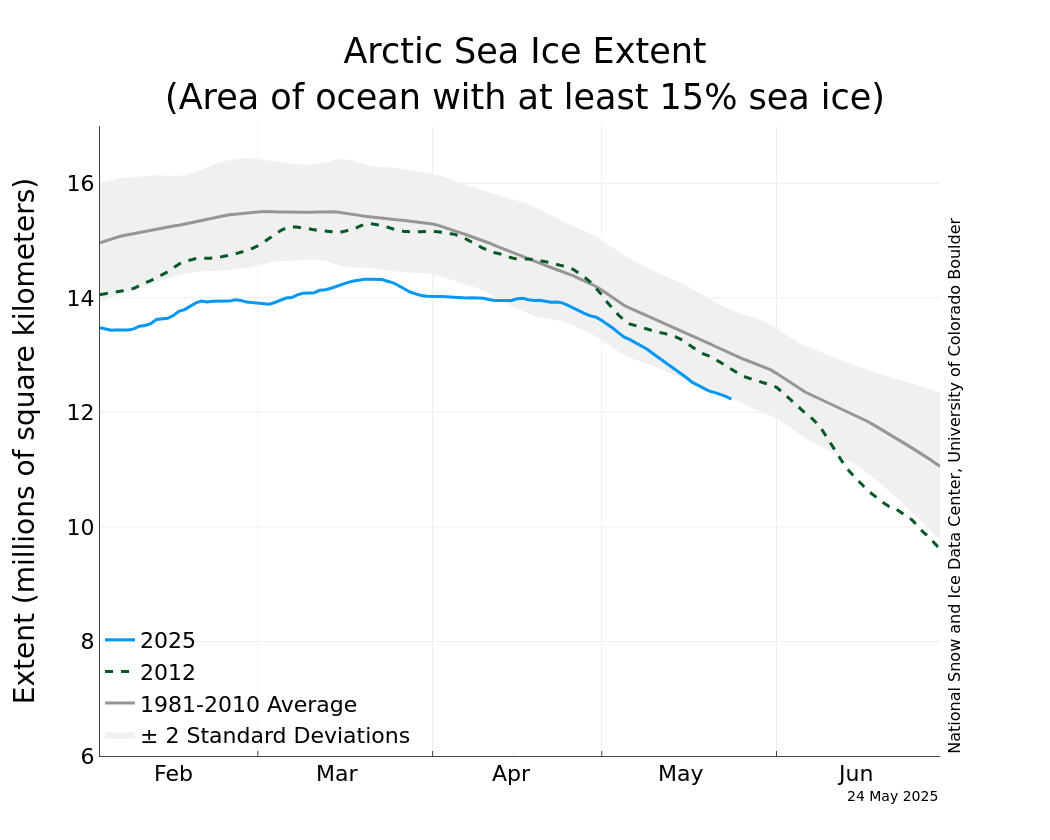
Meanwhile, the National Snow and Ice Data Center (NSIDC) has resumed daily sea ice extent updates with provisional data. The image below is dated May 5, 2016, check here for updates.
As illustrated by the image below, from JAXA, sea ice extent on May 6, 2016, was under 12 million square km, more than 15 days ahead on extent in the year 2012, which was 12 million square km on May 21, 2012.
The situation is dire and calls for comprehensive and effective action as described in the Climate Plan.
Most natural processes on the Earth are run by convection including plate tectonics that moves the continental and oceanic plates across the surface of the planet. Mother Earth has been able to hold its atmospheric temperature within certain limits and maintain an ocean for more than 3 billion years because each time there was a build up of carbon dioxide in the atmosphere which produced a global fever, Mother Earth it eliminated the living creatures with a massive Arctic methane firestorm that fried them alive. This giant Arctic methane firestorm is a natural antibiotic the Earth uses to rid itself of those creatures that have overproduced carbon dioxide and caused a global fever. Essentially mankind has again caused a massive build up of fossil fuel carbon dioxide in the atmosphere and Mother Earth has already started to respond with the predicted massive Arctic methane blow out (since 2010) which will lead to an Earth engulfing firestorm in 5 to 8 years. The giant fires in the Fort McMurray region are a result of atmospheric methane induced heating of the Arctic and 93.5% global warming of the oceans that has generated a massive El Nino event this year. Hot winds moving away from these high pressure areas have generated high temperatures and massive fires in Alberta which is a giant fever spot on Earth where mankind has produced the maximum amount of dirty fossil fuel extraction and pollution in Canada. Mother Earth will continue to respond more vigorously with her Arctic methane antibiotic to eliminate the humans from her system as we represent nothing more to her than a larger version of an influenza virus which has seriously retarded her oceanic and atmospheric temperature range functioning systems. If we do not immediately stop fossil fuel extraction worldwide and control the Arctic methane emission sites we will all be stardust before a decade is past.
PRNewswire: Frost & Sullivan recognizes PMD with the 2016 European Frost & Sullivan Award for Technology Innovation. pmd's ToF technology employs a combination of its patented suppression of background illumination (SBI) technology and an on-chip application processing feature. The SBI technology distinguishes active light transmitted from the object against other non-correlated light sources such as sunlight.
The on-board application processing feature sets pmd's ToF technology apart from peer solutions, as it helps ToF sensors capture depth image without the use of a separate application processing unit. "By enabling intelligent processing of ToF images on a single chip, pmd is able to deliver an extremely efficient and high-resolution ToF system, in which the illuminator and the image sensor can be placed as close as possible," said Frost & Sullivan Research Analyst Karthik Vishal Lakshmanan. "This gives ToF chips an extremely small form factor for easy deployment in smartphones and tablets."
Furthermore, the resolution of pmd's ToF solution is said to be highly scalable. The imager can enable one pixel or a few pixels, up to its full capacity of 100K pixels. The ToF system can be easily tuned to any resolution in between through software control.
It will be used later this year in smartphones and tablets, from 2017 the technology will see immense application in augmented reality and virtual reality systems, and from 2018 for in-vehicle warning systems as well as vehicle navigation systems.
Significantly, as this ToF technology does not require a vast external application processor, it consumes much less power than competing solutions. This makes pmd's ToF solution well suited for low-power applications.
Owing to its technological achievements in the ToF sensors market and its ability to cultivate application opportunities, pmdtechnologies ag is said to fully earn Frost & Sullivan's 2016 European New Technology Innovation Award for 3-D ToF sensor technology.
Update: EleTimes publishes Infineon article on automotive use of its REAL3 ToF sensors, based on PMD technology.
IS&T Electronic Imaging Symposium publishes GoPro's T. Macmillan and D. Newman presentation on Cinematic Camera Arrays, which might become a big market for image sensors:
Last Friday, President Obama announced a series of actions aimed at making smart guns a reality, rather than a lab curiosity that has never gotten beyond the demonstration stage.A smart gun is one that in principle can be used only by its authorized owner.If we had a magic smart-gun-making wand that we could wave and thereby grant the beneficences of intelligence and the moral judgment of St. Thomas Aquinas to every gun in the U. S., well, I suppose we would no longer have to worry about any gun being wrongly used ever again.But that would require that guns have more smarts and judgment than the owners, and nobody's expecting the technology to go that far.Even if the technology worked perfectly, it's easy to see that smart guns would eliminate only a fraction of the accidental and intentional shootings that gun regulations are intended to reduce, because no gun can tell whether its owner is using it for good or bad purposes.And you can rest assured that if the only kinds of guns available were smart guns, that's the kind that criminals would use.
Admittedly, accidental shootings such as the ones involving small children are the most tragic and unnecessary ones.And almost any kind of smart-gun technology would go far to prevent gun accidents involving children who gain access to guns.But this kind of accident is a small proportion of the annual gun-fatality roll in the United States, making up less than 5% of the 12,000 or so gun-related deaths in 2014.
The President has stopped short of measures that would put the purchasing power of the federal government in play.Without any enabling legislation, for example, he could have mandated that all future gun purchases by the U. S. government would be smart guns only.He probably realized that such a mandate would seriously handicap the FBI and other federal domestic law-enforcement personnel, because right now, there is no generally available smart-gun technology, because basically, nobody wants to buy one.
Anytime U. S. gun laws are discussed, the National Rifle Association has to be considered.The NRA's official position is that they do not oppose smart-gun technology per se, but do not want it mandated by legal fiat.Instead, the NRA prefers to let market forces lead the technological development.This is a little bit like saying, "Let the market decide how many Ferraris we should make with speed-control governors keeping them from exceeding a speed of 60 miles an hour (100 km/hr)."The whole point of buying a Ferrari is to be able to go fast, and the NRA knows very well that if the matter is left to the market, the market will go on rejecting the idea of smart guns, as it has for the last twenty-five years or more.
There are two main reasons that smart guns and smart-gun laws have not proved popular:one pertaining to the technology itself, and the other having to do with the legislators who would have to make the smart-gun laws.
The technological reason is that none of the dozen or more different approaches to making smart guns seems to work very well.Some of them use biometric sensors—these are not yet advanced enough to be used for routine computer-ID purposes.And a law-enforcement officer wants a gun that's at least as reliable as getting money out of an ATM.Others depend on the user wearing some kind of wireless ID bracelet or RFID chip.Well, gosh, what if you leave it at home with your other pair of trousers?Or what if the crooks figure out a way to jam the RFID chip (that's not hard, incidentally)?And so on.Every single smart-gun technology idea has some potential for failure, which adds to the chances that a gun won't be usable when it's most needed.To most potential gun purchasers, the incremental value added of knowing that unauthorized users can't fire the gun is not worth the complications of carrying around an RFID bracelet or hoping that your gun will recognize you despite your recent haircut, or whatever means it uses.
The second reason that most gun owners (and in reality, the NRA) detest the idea of smart-gun legislation is pointed out ably by Jon Stokes, a blogger at TechCrunch.com.It turns out that the legislators who are most enthusiastic about gun regulation tend to know the least about guns.He cites the example of the 1994 Federal legislation banning "assault weapons."Now in order to ban something, you have to have at least a vague idea of what it is you're banning.So the law had a kind of laundry list of features that made a gun an assault weapon, including such things as a vertical foregrip.This is a kind of stick-like doohickey that extends down from the middle or so of the barrel and gives you something to do with your non-trigger hand.The presence of that one little optional feature made the gun an assault weapon, and ipso facto illegal.The 1994 law has been superseded since then, but Stokes points out that any smart-gun law will face the same problem:what makes a gun smart?What design features specifically qualify it to be a smart gun?And inevitably, the lawmakers will be forced into the nitty-gritty of gun design, for which activity they are dubiously qualified at best.
Guns have a special place in the American psyche.Here in Texas, they are part of the culture to a degree that is unimaginable in San Francisco or Boston, and while I do not personally have any truck with guns, I have several friends who do own and use them responsibly.Maybe the fact that President Obama is directing more federal R&D funds to the problem will uncover a single technology that will make smart guns as easy and reliable to use as the "safety" that keeps a gun from going off when set that way by the user, and which has been a standard feature of many firearms since at least 1911.And maybe state or federal legislators will educate themselves enough on how guns really work and are used to pick the best smart-gun technology to require gunmakers to install.But right now, I'm not seeing a lot of speed-controlled Ferraris on the road, and I would not risk a bet on smart-gun legislation getting very far any time soon.
Above image shows that 2016 Arctic sea ice extent has been very low, if not at record low, up to April 30, 2016. This situation doesn't appear likely to improve, due to high ocean heat causing melting from below and high air temperatures that cause melting from above and that also cause water to warm up in rivers ending up in the Arctic Ocean.
The image below shows that on April 28, 2016, sea surface off the coast of North America was as much as 12.3°C or 22.1°F warmer than in 1981-2011. The Gulf Stream will make that much of this heat will arrive in the Arctic Ocean over the next few months.
The image below compares April 30 sea surface temperature anomalies between 2015 (left panel) and 2016 (right panel), showing that the sea surface in many areas is warmer in 2016 than it was in 2015.
Next to sea surface temperatures, air temperatures are rising, as illustrated by the image on the right, showing temperatures over Alaska as high as 14.6°C or 58.4°F at 64.5°N and as high as 10.8°C or 51.4°F at 66.5°N on May 1, 2016. Such rising temperatures over land will warm up rivers that will in turn warm up the Arctic Ocean.
The Google reference map below shows a large part of the Arctic Ocean, including Alaska on the left and the Beaufort Sea at the bottom. The map has an added red square inset that indicates the outlines of the map further below, which zooms in further on the Beaufort Sea.
The April 26, 2016, NASA map below shows that, while it is in places still relatively thick, the sea ice in the Beaufort Sea is strongly fractured with much water showing up in the fractures, and even more water along the coast.
Worryingly, high methane peaks have been recorded recently, as high as 2810 ppb on April 29, 2016, as illustrated by the image below, showing a large area with high methane levels east of Greenland.
Meanwhile, the heatwave in South-East Asia continues, with temperatures as high as 49°C or 120.1°F recorded on April 27, 2016, as illustrated by the image on the right.
As the image below shows, temperatures do not appear to be coming down, with temperatures as high as 49.4°C or 120.8°F forecast to hit India on May 2, 2016 (at the location marked by the green circle).
As global warming continues, this will make humidity levels rise. A 3°C warming will cause about 25% increase in absolute humidity, which will make it feel at least 6°C hotter. Moreover, water vapor is a potent greenhouse gas, further accelerating global warming.
The situation is dire and calls for comprehensive and effective action, as described at the Climate Plan.