Showing posts with label STEM Learning. Show all posts

Mastering the Basics: Key Engineering Physics Concepts and Core Formulas You Need to Know

...

Physics forms the bedrock of modern technology, driving innovations across mechanics, electronics, and materials science. Whether you are a student preparing for competitive exams or a curious learner trying to understand how things work, a solid grasp of fundamental engineering physics concepts is essential for building a strong analytical toolkit.

Key Physics Formulas Every Learner Should Know

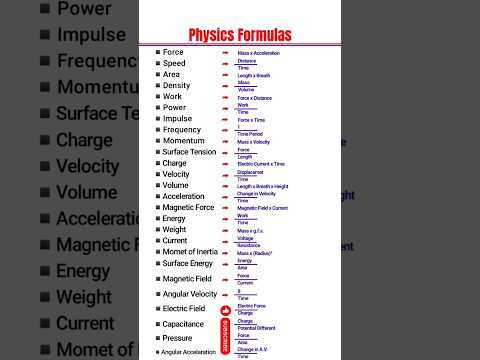
Physics formulas are much more than memorized mathematical equations—they represent the fundamental laws governing our universe. Here are a few vital areas where core formulas play an indispensable role:

  • Classical Mechanics: Equations governing force ($F = ma$), kinetic energy, and momentum are crucial for understanding motion, structural stability, and mechanical design.
  • Thermodynamics: Laws explaining heat transfer, work, and energy conservation serve as the backbone for power generation, propulsion systems, and HVAC systems.
  • Electromagnetism: Fundamental equations like Ohm’s Law ($V = IR$) and Faraday’s Law enable engineers to design circuit boards, electrical grids, and modern telecommunications.

Why Conceptual Understanding Matters

Simply memorizing a list of formulas is rarely enough to solve real-world problems. By deeply analyzing the underlying engineering physics concepts, learners can effortlessly adapt basic formulas to complex situations, optimize mechanical efficiency, and troubleshoot technical failures. Bridging the gap between mathematical theory and practical application is what transforms a student into an effective problem solver.

Elevate Your Physics Knowledge

Mastering essential formulas alongside core engineering physics concepts provides the ultimate foundation for success in science and technology disciplines. By breaking down intimidating scientific theories into quick, digestible insights, you can steadily build confidence and excel in your studies. Keep practicing, explore visual guides, and continue expanding your scientific horizon!

How Virtual Labs Improve Engineering Education

...

Virtual labs are transforming modern engineering education by creating immersive learning experiences that help students practice real-world skills. As academic institutions integrate virtual lab technology into their programs, learners gain hands-on experience without the limitations of physical equipment.

1. Enhanced Accessibility for All Learners

One of the major benefits of virtual labs is accessibility. Students can perform engineering simulations anytime and anywhere, allowing flexible learning opportunities. This makes engineering education more inclusive and efficient.

2. Safe and Risk-Free Experimentation

Virtual environments let learners run complex engineering experiments without safety concerns. Whether testing mechanical systems, circuits, or chemical reactions, a virtual engineering lab removes hazards while still delivering realistic results.

3. Cost-Effective Learning Tools

Traditional lab equipment is expensive and requires constant maintenance. Virtual labs help institutions reduce costs while still providing high-quality engineering simulations. This improves the overall sustainability of engineering training systems.

4. Real-Time Analytics and Learning Feedback

Many virtual lab platforms offer instant feedback, performance analytics, and detailed experiment tracking. These features help students better understand complex engineering concepts and improve their problem-solving skills.

5. Supporting Modern Engineering Curriculum

With the growth of digital learning tools, virtual labs now integrate seamlessly with online courses and engineering programs. They help educators deliver interactive lessons that increase student engagement and learning outcomes.

Conclusion

Virtual labs are becoming essential in enhancing modern engineering education. They make learning more accessible, safe, interactive, and cost-effective. As technology continues advancing, virtual lab systems will play an even more significant role in shaping the future of engineering learning.