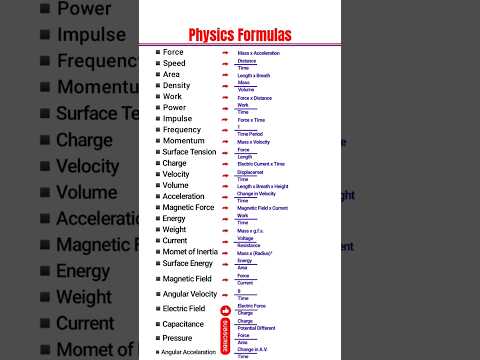
Physics forms the bedrock of modern technology, driving innovations across mechanics, electronics, and materials science. Whether you are a student preparing for competitive exams or a curious learner trying to understand how things work, a solid grasp of fundamental engineering physics concepts is essential for building a strong analytical toolkit.
Key Physics Formulas Every Learner Should Know
Physics formulas are much more than memorized mathematical equations—they represent the fundamental laws governing our universe. Here are a few vital areas where core formulas play an indispensable role:
- Classical Mechanics: Equations governing force ($F = ma$), kinetic energy, and momentum are crucial for understanding motion, structural stability, and mechanical design.
- Thermodynamics: Laws explaining heat transfer, work, and energy conservation serve as the backbone for power generation, propulsion systems, and HVAC systems.
- Electromagnetism: Fundamental equations like Ohm’s Law ($V = IR$) and Faraday’s Law enable engineers to design circuit boards, electrical grids, and modern telecommunications.
Why Conceptual Understanding Matters
Simply memorizing a list of formulas is rarely enough to solve real-world problems. By deeply analyzing the underlying engineering physics concepts, learners can effortlessly adapt basic formulas to complex situations, optimize mechanical efficiency, and troubleshoot technical failures. Bridging the gap between mathematical theory and practical application is what transforms a student into an effective problem solver.
Elevate Your Physics Knowledge
Mastering essential formulas alongside core engineering physics concepts provides the ultimate foundation for success in science and technology disciplines. By breaking down intimidating scientific theories into quick, digestible insights, you can steadily build confidence and excel in your studies. Keep practicing, explore visual guides, and continue expanding your scientific horizon!
