Blackmagic Cancels Global Shutter Mode on its Newest Cameras

...
Blackmagic Design CEO, Grant Petty, posted an update on the global shutter problems in its newest cameras URSA Mini 4.6K and the Micro Cinema Camera, originally expected to ship in Oct. 2015, but delayed up to now:

"We have really appreciated everyone’s patience in waiting for these cameras and apologize for the delay. It took much longer than we had thought to get the cameras to where we needed them to be, but I am incredibly proud to bring 15 stop, Super 35 true digital film cameras to everyone...

However the big reason for the delay is the problems we were having with the global shutter feature in both of these cameras. The problems are different between the models and on the Micro Cinema Camera we have been seeing random bad pixels when in global shutter mode. On the URSA Mini 4.6K we have been seeing problems with sensor calibration when using global shutter.

Our engineers have been killing themselves working on this for months, but the performance is just not where it needs to be for us to feel comfortable shipping with global shutter, and so we have had to remove the global shutter feature from both these cameras to allow them to ship.

Obviously this is very upsetting for us, as we really wanted to produce high dynamic range cameras that also had a global shutter for an all in one design. The reality is that this is just one feature on cameras that are ready right now to shoot with and get incredible results. So we have made the decision to ship now.
"

The Micro Cinema Camera
Image sensor area magnified

Thanks to TG for the info!
3:20 AM

Off Shore

...
1:32 PM

Analog Devices Acquires Swiss Image Sensor Company

...
EETimes-Europe: Analog Devices Inc. has acquired Snap Sensor SA (Neuchatel, Switzerland), a maker of HDR and other specialized image sensors, for an undisclosed some of money.

Snap Sensor was founded in 2011 as a spin-off from an 8-year research program at Swiss research and technology organization CSEM. "SNAP Sensor’s cutting-edge optical technology and vision software and algorithm expertise allow us to continue unlocking new possibilities for our customers in a wide range of IoT applications such as building automation, building security, city management, transportation, and more,” said Michael Murray, GM of Industrial Sensing, Analog Devices. “This acquisition further enhances our sensing portfolio and ensures that we’re helping customers realize the best possible outcomes from IoT solutions.”

The SNAP Sensor team will remain in Switzerland to establish a new Analog Devices R&D center and continue its close collaboration with CSEM. The acquisition will enhance Analog Devices’ Blackfin Low Power Imaging Platform (BLiP). “Our team is very enthusiastic about joining Analog Devices,” said Pascal Dorster, CEO of SNAP Sensor. “This provides us access to the engineering, supply-chain, and commercialization resources needed to accelerate our growth and continue advancing our technology vision.”

2:38 PM

Caterpillar Self-Driving Trucks

...
AutoSens Conference to be held on Sept. 20-22, 2016 in Brussels, Belgium, publishes an interview with Bibhrajit Halder, a Software Technical Specialist in the ADAS and Self-Driving team, Faraday Future automotive startup. The interview touches Caterpillar work on self-driving vision-based mining trucks:

Caterpillar self-driving track weights 390 tonnes
(860,000 lb) fully loaded
3:38 PM

31st ICHSIP

...
The 31st International Congress on High Speed Imaging and Photonics (ICHIP) will be held in Osaka, Japan on Nov. 7-10, 2016. So far, the list of 20 invited speakers has been announced, most of them showing previews of their work:

Liang Gao (University of Illinois, USA)
Compressed Ultrafast Photography: Catching photons on the fly by Compressed Ultrafast Photography


Keisuke GODA (University of Tokyo)
Sub-picosecond Imaging of “Propagating Phonons”


and many more on the Congress web site.

Thanks to RT for the link!
2:26 PM

Movidius and DJI Bring Vision-Based Technology to DJI Phantom 4

...
MarketWired: Movidius and DJI announce that Movidius Myriad 2 vision processor is used in DJI’s flagship Phantom 4 aircraft, giving it the ability to sense and avoid obstacles in real time and hover in a fixed position without the need for a GPS signal.

The agreement is said to mark an industry first in making advanced visual guidance systems a standard feature for consumer drones.

“Movidius’ vision processor platform, Myriad 2, met the rigorous requirements we set for our flagship product, and we look forward to continued collaboration with Movidius as we push the boundaries in the drone market,” said Paul Pan, Senior Product Manager at DJI.

“DJI has set the direction for the future of the drone market and we are excited to incorporate Movidius’ low power artificial vision intelligence technology into DJI drones moving forward,” said Sean Mitchell, COO of Movidius. “Moving the technology from a demonstration to a highly reliable production worthy stage was a tremendous effort for both DJI and Movidius. The DJI Phantom 4 launch represents a milestone for the future of visually aware devices. We believe we are entering the golden age of embedded computer vision and our technology has placed Movidius at the forefront of this trend.”


Movidius publishes a Youtube video explaining Phantom 4 vision features:

6:40 AM

Caeleste & SPIE Workshop

...
Caeleste presents "The future of high-end imaging" workshop to be held on Wednesday, April 6, 2016 from 13:30 – 17:40 at the Square meeting Center, Kunstberg – Mont des Arts in Brussels. This seminar will run in conjunction with the SPIE Photonics Europe Conference.

Caeleste brought together experts in the field and they provide their view on the trends in future high-end image sensors:
  • Jan Bosiers, Teledyne-Dalsa: Wafer-scale CMOS imagers for medical X-ray imaging
  • Benoit Dupont – Pyxalis: 20 bit image sensors using dual processor architectures
  • Gert Finger, ESO: Large format, high speed sub-electron noise image sensors for ground-based astronomy
  • Jochem Hermann, Adimec: CCD is history, CMOS is the future: ‘Still many challenges ahead!’
  • Ajit Kumar Kalgi, Caeleste: High Dynamic Range, shot noise limited Image sensors with global shutter.
  • Nick Nelms, ESA-ESTEC: High-performance image sensors in space – the shape of things to come.
  • Karsten Sengebusch, Eureca: Prediction of the performance and image quality of CMOS image sensors.
1:14 PM

EETimes Interviews Invisage CEO

...
EETimes-Europe publishes an interview with Jess Lee, Invisage CEO. Few quotes:

"We have not said to much about the material structure of QuantumFilm. There are concerns over cadmium in quantum dots so the first thing to say is there is no cadmium. What we have said is that it is a metal-chalcogenide material, similar to a II-VI material surrounded by ligands in a matrix.

The dots are of a diameter of between about 3-micron and 5-micron and it is these dimensions that affect the electron band structure and govern the sensitivity to light.

We are limited by the state of silicon I/O and analog-to-digital converters. As that rises we can go at hundreds, even thousands of frames per second. There is no difference between us and comparable CMOS image sensors.

We see QuantumFilm as a platform used by us as the first and second customer. To have third and fourth customers is better for us. We are prepared to work with partners to enable them, with QuantumFilm. We wouldn't license the technology out but there are a number of other ways to enable partners.

...we are on a mature silicon platform – 110nm. It's a very different capital investment process there. We have our own fab in Taiwan but it is only focused on a couple of processes – a spin-on process to add the film and the definition of the pixels.
"

Invisage white paper linked on the last page of the article discusses NIR imaging applications:

SparkP2 product overview
10:34 AM

PIDA on CMOS Sensor Market

...
CTimes quotes Photonics Technology & Industry Development Association (PIDA) saying that "in 2014 the total global CMOS sensor shipments amounted to 4.65 billion units. Chinese manufacturer Galaxycore was the top company, accounting for 21% of the shipments; whereas Japan’s Sony and the United States’ Omnivision made the second highest number of shipments at 19%. Meanwhile, low pixel VGA products showed the most rapid growth during the past few years.

Chinese cell phone manufacturers are winning over CMOS sensors that were manufactured by Sony, which has resulted in Sony’s proposed early expansion of investment.
"
10:04 AM

Hot Feet from Hoverboards

...

Not long after my university went back in session in January, I saw a couple of young men tooling along a sidewalk on campus on two-wheeled things that looked like Segways, but without the vertical handle.  They turned out to be hoverboards, a gadget that packs two high-power motors, some gyros and accelerometers, some electronics, and high-capacity lithium-ion batteries into a space smaller than a skateboard.  Evidently if your balance is good enough and you can pay the roughly $300 and up the thing costs, you can have the sensation of standing on your own private moving sidewalk.  But a few users have had a more exciting time with their hoverboards than they bargained on:  their units have caught fire.  One family in Petaluma, California reported that after fifteen minutes of charging, their daughter's hoverboard "exploded" into flames, making a noise like a small bomb and sending burning embers around the room.  Fortunately, someone was around to put out the fire, but a hoverboard was possibly responsible for a house fire in Santa Rosa that did extensive damage and killed two of the family's pet dogs. 

Also in January, the U. S. Consumer Product Safety Commission (CPSC) launched an investigation after receiving more than 40 reports of fires involving these devices.  Although many of the units were purchased through Amazon.com, evidently for Christmas presents, Amazon has since quit selling hoverboards and carries only accessories for them now.  But you can still find independent sellers online who carry the things, along with answers to questions like, "Will my hoverboard catch fire?"

All sources I consulted agree that the fire problem is traceable to the lithium-ion batteries in the units.  The motors can draw as much as 300 watts apiece, and no other type of battery currently available on the consumer market can supply that much power and still fit in a hoverboard that doesn't weigh more than the rider.  Lithium-ion battery technology is a carefully calibrated technological dance along the line between success and failure, where failure is usually spectacular.  Charging the batteries too much can cause the already pressurized cell to rupture, it can heat the thin insulating separator between the cell's cathode and anode to cause a short circuit and further heating, and can lead to the lithium compounds inside the cell to burn vigorously when exposed to air. 

Over a dozen different brands of hoverboards have come on the market, and some companies may be using inferior-quality batteries that are especially prone to catch fire.  In reaction to the posting of vivid videos of hoverboard fires on Youtube, some companies have started boasting that they use only genuine Samsung or other name-brand batteries.  But they still advise against leaving the room while a hoverboard is charging, just in case something goes wrong. 

Fortunately, no human has died as a result of a hoverboard fire.  And considering the already rather self-limited market for these things—you have to be young and flexible enough to both balance on one and survive any falls, plus be able to afford to blow $300 or more on a thing you may never learn to use—hoverboard fires don't rank up there with issues like the onboard lithium-battery fires that plagued the Boeing 787 back in 2013 and caused a couple of potentially deadly incidents before the fleet was grounded to fix the problem.  Still, the fact that we are aware of at least 40 fires caused by hoverboards shows what can happen when a flock of fast-moving manufacturers, probably all based in Asia, try to exploit a short-fuse market opportunity without taking the time and effort to do thorough safety testing.

Some would call for the heavy hand of government regulation to make sure that all consumer products pass standardized safety inspections before they can be sold.  The private Underwriters Laboratories, which is responsible for the "UL" symbol borne by many consumer products that pass its rigorous safety tests, has been trying to find a hoverboard that is worthy of the UL label, but so far all the ones they have tested have flunked. 

What we see in the hoverboard situation is how the rapid pace of information exchange on the Internet has dealt with the problem while the government is still pulling its pants on, so to speak.  As I mentioned, somewhere between January and today (March 13) Amazon quit selling hoverboards and offered a money-back exchange for those already sold, no questions asked.  Anyone googling "hoverboard fire" can find a lot of privately posted videos of smoking hoverboards, which the younger population is sure not to miss.  And many of those who are still selling the units are using the fear of fires as a selling point for the higher-quality name-brand batteries they use in the particular models of hoverboard they sell. 

Of course, even name-brand batteries can catch fire if abused, and there are warnings about not subjected the batteries to excessive shocks.  That would seem a little hard to avoid in the case of a consumer product that is likely to be flipped around underfoot by the user, at least a few times, until he or she gets the hang of it.  And who knows?  maybe hoverboards will form the basis of a new sport.  San Marcos, the Texas town where I live, happens to be a hotbed of activity for, believe it or not, unicycle football.  There are regular tournaments downtown and clubs and the whole bit.  Anybody who can play unicycle football isn't going to have much of a problem riding a hoverboard, and keeping it protected from undue shock and vibration.  Watch out, unicycle football.  Hoverboard football may not be far behind.

Eventually, the CPSC will come up with conclusions from its investigation, but by then hoverboards may either have become a routine part of the way we get around, or a forgotten fad like the Hula-Hoop.  The worst that you could do with a Hula-Hoop was to throw your back out.  But if you did, you probably shouldn't have been fooling with the thing in the first place.  The long-term solution is to find a battery technology that isn't as much like playing with fire as lithium-ion batteries are.  In the meantime, enjoy your hoverboards, but don't leave them alone when they're charging.  You might be in for an unpleasant surprise.

Sources:  I referred to a couple of reports on KGO's website (the ABC-TV outlet in San Francisco) at http://abc7news.com/news/childs-hoverboard-explodes-catches-fire-inside-petaluma-home/1174234/and http://abc7news.com/news/hoverboard-likely-sparked-bay-area-house-fire-that-killed-dogs/1166917/.  The information about UL and hoverboards is from the Chicago Tribuneon Feb. 23, 2016, at http://www.chicagotribune.com/business/ct-hoverboard-testing-ul-0224-biz-20160223-story.html.  I also referred to a story posted on the CBS News Interactive site www.cnet.com on Jan. 20, 2016 at http://www.cnet.com/news/feds-urge-you-to-buy-fire-extinguisher-with-your-hoverboard/and the Wikipedia article on lithium-ion batteries.  My blog on the Boeing 787 battery fires appeared on Jan. 28, 2013 at http://engineeringethicsblog.blogspot.com/2013/01/boeings-787-battery-eggs-all-in-one.html.

Correction:  
--> In an earlier version of this article, I referred to Underwriters Laboratories (UL) as "insurance-company funded."  That is not correct.  UL (LLC) is a private for-profit company as of 2012, and presumably makes money by charging companies who want the UL label for its certification services.  And while it is still true that no hoverboard has passed the requirements for UL certification, the organization has only had a month or so to start the process, and so it is possible that at least one such device will eventually pass.  I thank Brooke Higginbotham of UL for this information.

DJI Phantom 4 Drone Features 5 Cameras

...
Drones quickly become a sizable camera market. The latest DJI Phantom 4 drone has 5 cameras (1 for remote viewing and recording plus 4 for vision processing: follow me, depth , object recognition and tracking, visual navigation). DJI is the world's largest drone manufacturer, based in Shenzhen, China.


Thanks to FS for the info!
12:24 PM

PDAF Pixel Report Update

...
Albert Theuwissen has updated his PDAF pixel characterization report with additional measurements focused on :
  • the influence of the exposure time on the PDAF pixel signals and the possibility to extract useful focusing information from it,
  • angular light dependency of the PDAF pixels.

The Harvest Imaging site look is also updated and is much nicer now.
12:12 PM

February Temperature

...

The February 2016 land and ocean temperature anomaly was 1.35°C (2.43°F) above the average temperature in the period from 1951 to 1980, as above image shows (Robinson projection).

On land, it was 1.68°C (3.02°F) warmer in February 2016, compared to 1951-1980, as the image below shows (polar projection).


The image below combines the above two figures in two graphs, showing temperature anomalies over the past two decades.


Below are the full graphs for both the land-ocean data and the land-only data. Anomalies on land during the period 1890-1910 were 0.61°C lower compared to the period from 1951 to 1980, which is used as a reference to calculate anomalies. The blue line shows land-ocean data, while the red line shows data from stations on land only.


At the Paris Agreement, nations committed to strengthen the global response to the threat of climate change by holding the increase in the global average temperature to well below 2°C above pre-industrial levels and to pursue efforts to limit the temperature increase to 1.5°C above pre-industrial levels.

To see how much temperatures have risen compared to pre-industrial levels, a comparison with the period 1951-1980 does not give the full picture. The image below compares the February 2016 temperatures with the period from 1890 to 1910, again for land only.


Since temperatures had already risen by ~0.3°C (0.54°F) before 1900, the total temperature rise on land in February 2016 thus is 2.6°C (4.68°F) compared to the start of the industrial revolution.

There are a number of elements that determine how much the total temperature rise on land will be, say, a decade from now:

Rise 1900-2016: In February 2016, it was 2.3°C (4.14°F) warmer on land than it was in 1890-1910.

Rise before 1900: Before 1900, temperature had already risen by ~0.3°C (0.54°F), as Dr. Michael Mann points out (see earlier post).

Rise 2016-2026: If levels of carbon dioxide and further greenhouse gases do keep rising, there will additional warming over the next ten years. Even with dramatic cuts in carbon dioxide emissions, temperatures can keep rising, as maximum warming occurs about one decade after a carbon dioxide emission, so the full wrath of the carbon dioxide emissions over the past ten years is still to come. Moreover, mean global carbon dioxide grew by 3.09 ppm in 2015, more than in any year since the record started in 1959, prompting an earlier post to add a polynomial trendline that points at a growth of 5 ppm by 2026 (a decade from now). This growth took place while global energy-related CO2 emissions have hardly grown over the past few years, indicating that land and oceans cannot be regarded as a sink, but should be regarded as source of carbon dioxide. On land, carbon dioxide may be released due to land changes, changes in agriculture, deforestation and extreme weather causing droughts, wildfires, desertification, erosion and other forms of soil degradation. Importantly, this points at the danger that such emissions will continue to grow as temperatures keep rising. New studies on permafrost melt (such as this one and this one) show that emissions and temperatures can rise much faster in the Arctic than previously thought. Furthermore, a 2007 study found a 25% soil moisture reduction to result in 2°C warming. Altogether, the rise over the next decade due to such emissions may be 0.2°C or 0.36°F (low) to 0.5°C or 0.9°F (high).

Removal of aerosols: With the necessary dramatic cuts in emissions, there will also be a dramatic fall in aerosols that currently mask the full warming of greenhouse gases. From 1850 to 2010, anthropogenic aerosols brought about a decrease of ∼2.53 K, says a recent paper. In addition, more aerosols are likely to be emitted now than in 2010, so the current masking effect of aerosols may be even higher. Stopping aerosol release may raise temperatures by 0.4°C or 0.72°F (low) to 2.5°C or 4.5°F (high) over the next decade, and when stopped abruptly this may happen in a matter of weeks.

Albedo change: Warming due to Arctic snow and ice loss may well exceed 2 W per square meter, i.e. it could more than double the net warming now caused by all emissions by people of the world, as Professor Peter Wadhams calculated in 2012. The temperature rise over the next decade due to albedo changes as a result of permafrost and sea ice decline may be 0.2°C or 0.36°F (low) to 1.6°C or 2.9°F (high).

Methane eruptions from the seafloor: ". . . we consider release of up to 50 Gt of predicted amount of hydrate storage as highly possible for abrupt release at any time," Dr. Natalia Shakhova et al. wrote in a paper presented at EGU General Assembly 2008. Authors found that such a release would cause 1.3°C warming by 2100. Such warming from an extra 50 Gt of methane seems conservative when considering that there now is only some 5 Gt of methane in the atmosphere, and over a period of ten years this 5 Gt is already responsible for more warming than all the carbon dioxide emitted by people since the start of the industrial revolution. The temperature rise could be higher, especially in case of large abrupt release, but in case of small and gradual releases much of the methane may be broken down over the years. The temperature rise due to seafloor methane over the next decade may be 0.2°C or 0.36°F (low) to 1.1°C or 2°F (high).

Water vapor feedback:
 "Water vapour feedback acting alone approximately doubles the warming from what it would be for fixed water vapour. Furthermore, water vapour feedback acts to amplify other feedbacks in models, such as cloud feedback and ice albedo feedback. If cloud feedback is strongly positive, the water vapour feedback can lead to 3.5 times as much warming as would be the case if water vapour concentration were held fixed", according to the IPCC. In line with the above elements, this may result in a temperature rise over the next decade of 0.2°C or 0.36°F (low) to 2.1°C or 3.8°F (high).

The image below puts all these elements together in two scenarios, one with a relatively low temperature rise of 3.9°C (7.02°F) and another one with a relatively high temperature rise of 10.4°C (18.72°F).


Note that the above scenarios assume that no geoengineering will take place.

The 2.3°C warming used in above image isn't the highest figure offered by the NASA site. An even higher figure of 2.51°C warming can be obtained by selecting a 250 km smoothing radius for the on land data.

When adding the 0.3°C that temperatures rose before 1900, the rise from the start of the industrial revolution is 2.81°C (5.06°F), as illustrated by the image on the right.

The image also shows that this is the average rise. At specific locations, it is as much as 16.6°C (30°F) warmer than at the start of the industrial revolution.

Furthermore, temperatures are higher on the Northern Hemisphere than on the Southern Hemisphere. This is illustrated by the image below showing NASA temperature anomalies for January 2016 (black) and February 2016 (red) on land on the Northern Hemisphere. The data show that it was 2.36°C (4.25°F) warmer in February 2016 compared to 1951-1980.


How much of the rise can be attributed to El Niño? The added trendlines constitute one way to handle variability such as caused by El Niño and La Niña events and they can also indicate how much warming could be expected to eventuate over the years to come.

The February trendline also indicates that the temperature was 0.5°C lower in 1900 than in 1951-1980, so the total rise from 1900 to February 2016 is 2.86°C (5.15°F). Together with a 0.3°C rise before 1900, this adds up to a rise on land on the Northern Hemisphere of 3.16°C (5.69°F) from pre-industrial levels to February 2016. Most people on Earth live on land on the Northern Hemisphere. In other words, most people are already exposed to a temperature rise that is well above any guardrails that nations at the Paris Agreement pledged would not be crossed.


Temperatures may actually rise even more rapidly than these trendlines indicate. As above image illustrates, the largest temperature rises are taking place in the Arctic, resulting in a rapid decline of snow and ice cover and increasing danger that large methane eruptions from the seafloor will take place, as illustrated by the image on the right, from an earlier post. This could then further lead to more water vapor, while the resulting temperature rises also threaten to cause more droughts, heatwaves and wildfires that will cause further emissions, as well as shortages of food and fresh water supply in many areas.

Adding the various elements as discussed above indicates that most people may well be hit by a temperature rise of 4.46°C or 8.03°F in a low rise scenario and of 10.96°C or 19.73°F in a high rise scenario, and that would be in one decade from February 2016. Since it is now already March 2016, that is less than ten years from now.

The image below shows highest mean methane readings on one day, i.e. March 10, over four years, i.e. 2013, 2014, 2015 and 2016, at selected altitudes in mb (millibar). The comparison confirms that the increase of methane in the atmosphere is more profound at higher altitudes, as discussed in earlier posts. This could indicate that methane from the Arctic Ocean is hardly detected at lower altitudes, as it rises in plumes (i.e. very concentrated), while it will then spread and accumulate at higher altitudes and at lower latitudes.


The conversion table below shows the altitude equivalents in mb, feet and m.

57016 feet44690 feet36850 feet30570 feet25544 feet19820 feet14385 feet 8368 feet1916 feet
17378 m13621 m11232 m 9318 m 7786 m 6041 m 4384 m 2551 m 584 m
 74 mb 147 mb 218 mb 293 mb 367 mb 469 mb 586 mb 742 mb 945 mb

Meanwhile Arctic sea ice area remains at a record low for the time of the year, as illustrated by the image below.


Next to rising surface temperatures in the Arctic, ocean temperature rises on the Northern Hemisphere also contribute strongly to both Arctic sea ice decline and methane releases from the seafloor of the Arctic Ocean, so it's important to get an idea how much the Northern Hemisphere ocean temperature can be expected to rise over the next decade. The NOAA image below shows a linear trend over the past three decades that is rising by 0.19°C per decade.

The image below, using the same data, shows a polynomial trend pointing at a 1.5°C rise in ocean temperature on the Northern Hemisphere over the next decade.


Below is an interactive version of the graph.
The situation is dire and calls for comprehensive and effective action, as described in the Climate Plan.


There are a number of elements that determine how much the total temperature rise on land will be, say, a decade from...
Posted by Sam Carana on Sunday, March 13, 2016

Interview with Paul Beckwith

...


1) Hi Paul. Thanks for agreeing to do this interview. First of all, could you tell us a bit about your background, how long you’ve been involved in climate science, and what areas of climatology you specialize in?


Hello Sam. Thank you. It is my pleasure to have this interview with you.

I am an Engineer with a Bachelor of Engineering Degree in Engineering Physics (often called Engineering Science) from McMaster University in Hamilton, Ontario, Canada. I finished at the top of my class and received many scholarships and awards during my studies. My CV can be found on my website http://paulbeckwith.net under the About Me section.

I am a Physicist with a Master of Science Degree in Laser Physics. My research area was blowing molecules apart with high-powered CO2 lasers and measuring all the chunks flying off with low-power tunable diode lasers. This involved the science of molecular spectroscopy in the infrared region.

I worked in industry for many years, as a Product Line Manager for optical switching devices in high speed fiber optic communication systems, on high powered Excimer laser research and tunable laser research, and also on software quality assurance for various tech companies.

I have been interested in climate science my entire life. I decided to formally study it after becoming concerned with the lack of urgency by the public, scientists (literally everybody) about 6 years ago or so.

I am a part time professor in the Laboratory for Paleoclimatology in the Geography Department at the University of Ottawa. I have taught many courses including climatology, meteorology, oceanography and the geography of environmental issues. My research work in my PhD program is abrupt climate system change in the past and present, to determine what will happen in the near future. I am very active on educating the public about the grave dangers that we face from abrupt climate change, using primarily videos and blogs and public talks (see my website link above). My research is self-funded, apart from my teaching, and I greatly welcome financial contributions at the Please Donate button on the main task bar on my website.

2) It’s clear that the Arctic is melting rapidly and this trend is likely to continue. When do you predict the Arctic will start to have ice-free conditions? At what point during the year will it disappear, and how long for? How will these conditions develop in future decades, and could we reach a point where the Arctic is free of ice all year round?

I think that the Arctic will start to have ice-free conditions at the end of the melt season (Septembers) as early as 2020 or before (possibly even the summer of 2016). It is hard to predict a single year, since the loss of Arctic sea ice greatly depends on local Arctic wind and ocean conditions in the summer melt season. These local conditions determine how much ice is lost to export via the Fram Strait and Nares Strait, which makes a huge difference to ice loss amounts during the Northern summer period. When there is less than 1 million square kilometers of sea ice left, we have essentially a “blue-ocean” event in the Arctic.

For the sake of argument, lets pick September, 2020, for the first “blue-ocean” event in the Arctic (essentially no sea ice left). This would occur for about a month, call it the month of September. Within 2 or 3 years it is highly likely that the duration of this “blue-ocean” state would be 3 months or say, thus occur for August, September and October in 2023. Within an additional few years, say by 2025 it is highly likely that the “blue-ocean” event would be extended for another few additional months, and we would have ice free conditions from July through to and including November; namely for 5 months of the year. Then, within a decade or two from the initial 2020 event we can expect to have an ice free “blue-ocean” Arctic year round; that would be some year between 2030 and 2040.

Of course if the first “blue-ocean” event occurred in 2016 this timeline would be advanced accordingly.

3) In recent years, there’s been a lot of talk about methane eruptions in the Arctic and Siberia. How serious is this, in terms of its potential for adding to global warming? Can you give us some idea of the timescales involved? What’s the level of certainty about these future effects?

Once the Arctic is essentially ice free for ever increasing durations in the summer months, and then over the entire year there are two enormous feedback risks that we face. Methane and Greenland.

Methane is the mother of all risks. The Russians have measured large increases in emissions from the continental shelf seabed in the Eastern Siberian Arctic Shelf (ESAS). Over the timespan of a few years they observed that methane bubbled up in vast numbers of plumes that increased in size from tens of meters in diameter to hundreds and even thousands of meter diameter plumes in the shallow regions of ESAS. Global atmospheric levels of methane are rapidly rising, and although they average about 1900 ppb or so there have been readings over 3100 ppb in the atmosphere over the Arctic. Since the Global Warming Potential (GWP) of methane versus carbon dioxide is 34x, 86x and close to 200x on timescales of 100 years, 20 years and a few years, respectively a large burst of methane can virtually warm the planet many degrees almost overnight.

Recently, we have passed about 405 ppm of CO2, with a record rise of 3.09 ppm in 2015 alone. When accounting for methane and other greenhouse gases (GHGs) and putting them into CO2-equivalent numbers, we are at about 490 ppm CO2 – equivalent. We are literally playing with fire, and the outcome will not be pretty.

Greenland ice melt is the next enormous feedback risk. When we lose snow and ice in the Arctic, and the cascading feedbacks like albedo-destruction kick in, and the methane comes out then the enormous warming over Greenland and in the water around and under the Greenland ice will viciously destroy the ice there and greatly accelerate sea level rise. I refer people to my video from several years ago on the great risk of realizing 7 meters of global sea level rise by 2070 from Greenland and Antarctica melt.

The level of certainty over these future effects is close to 100% if we continue to be stupid and do nothing. If we are smart we need to have a Manhattan – Marshall plan like emergency status to:
a) Zero emissions as-soon-as-possible, i.e. by 2030;
b) Cool the Arctic to keep the methane in place and restore jet stream stability; and
c) Remove CO2 from the atmosphere/ocean system and remove methane from the atmosphere.
There is no other choice. I use the metaphor of a three legged bar stool with legs a), b) and c) as above.

Barstool approach (slightly different from text in that SRM and methane
removal are included with adaptation and conservation in bottom leg)


4) What new satellites, monitoring stations, and other science projects are being planned for the future (if any)? How will these improve our knowledge of the Arctic and the various climatic processes in the region?

NASA, the ESA and the Russians and Chinese are always launching new satellite with better high tech sensors to gather more information on the changes in the Earth System. We need to have a massive increase in scientific study in the Arctic to better quantify what is happening there. However, we know enough to see that if we do not deploy the three-legged barstool approach immediately then our chances are halting our ongoing abrupt climate change will vanish, and emissions from the Earth System will dwarf all cumulative anthropogenic emissions throughout human history. We need the US military budget of $700 to $800 billion dollars per year to be applied to saving human civilization from abrupt climate change.

5) What can be done to save the Arctic and reverse the melting trend? How long would it take to restore the ice cover to, say, mid-20th century levels? Is this even possible with current technology?

We must cool the Arctic as soon as possible using Solar Radiation Management (SRM) technologies. We can deploy SRM very quickly if we treat this Arctic temperature amplification as an existential threat to humanity and put billions of dollars into deployment. It will take many years, perhaps a decade to restore the ice cover but we must start now. If we wait until we have “blue-ocean” events before we deploy then our ability to restore the ice will be much harder and perhaps even futile.

Deployment is possible with current technology. I am specifically referring to Marine Cloud Brightening (MCB) methods. I am working today with people on these technologies.

6) How does the melting in the Arctic compare to its southern polar opposite, the Antarctic?

The Arctic is rapidly losing snow cover (mostly in the spring months) and sea ice cover, and is thus the average albedo (reflectivity) of the region is rapidly decreasing. This if feeding back into additional Arctic Temperature Amplification and further darkening and warming, until we have no snow and ice in the region. These vicious feedback cycles have not kicked in to the same extent in the Antarctic. The ice cap there is losing ice causing a rise in sea level mostly from the warming of the seawater undercutting the ice on land that is grounded below sea level. However, since the Arctic is warming so fast due to increased solar radiation absorption (from darkening) there is less heat transported there via the atmosphere and oceans. Thus, jet streams and ocean currents are slowing. Thus, more heat is moving from the equator to the southern hemisphere, making it to Australian latitudes and increasing the temperature gradient to Antarctica and thus increasing the speed of the jet streams there.

7) Finally, what’s your message to climate change deniers who reject the science and believe the whole thing is a giant hoax?

Climate change deniers cannot be tolerated by society any longer. They are threatening the future of everybody on our planet. Send them all to Guantanamo for intensive and mandatory climate science basic training, and when they get clued in they can be reintroduced into society.


Interview with Paul Beckwith http://arctic-news.blogspot.com/2016/03/interview-with-paul-beckwith.html
Posted by Sam Carana on Saturday, March 12, 2016

Samsung S5K2L1 ISOCELL vs Sony IMX260 Comparison

...
Phonearena quotes Finnish-language Taskumuro site making an unscientific comparison of Samsung Galaxy S7 equipped with Sony IMX260 and Samsung S5K2L1 dual-pixel AF sensors. One can judge the differences on real-life subjects with HDR mode off (many more pictures on the original site):

Sony sensor, click & download for full resolution
Samsung sensor, click & download for full resolution

More PhoneArena thoughts on the comparison is here.
1:20 AM

Ten Degrees Warmer In A Decade?

...
In 2015, mean global carbon dioxide grew by 3.09 parts per million (ppm), more than in any year since the record started in 1959. An added polynomial trendline points at a growth of 5 ppm by 2026 (a decade from now) and of 6 ppm by 2029.

NOAA data, added trend points at 5 ppm growth a decade from now
There are a number of elements that determine how much the total temperature rise will be, say, a decade from now:

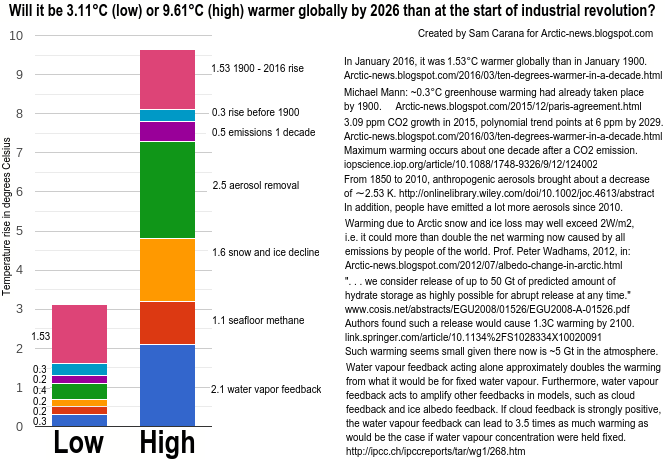
Rise 1900-2016: In January 2016, it was 1.92°C (3.46°F) warmer on land than in January 1890-1910, as discussed in an earlier post that also featured the image below.

Rise before 1900: Before 1900, temperature had already risen by ~0.3°C (0.54°F), as Dr. Michael Mann points out.

Rise 2016-2026: The image at the top shows a trend pointing at 5 ppm growth a decade from now. If levels of carbon dioxide and further greenhouse gases keep rising, then that will account for additional warming over the next ten years. Even with dramatic cuts in carbon dioxide emissions, temperatures will keep rising, as maximum warming occurs about one decade after a carbon dioxide emission, so the full wrath of the carbon dioxide emissions over the past ten years is still to come.

Removal of aerosols: With dramatic cuts in emissions, there will also be a dramatic fall in aerosols that currently mask the full warming of greenhouse gases. From 1850 to 2010, anthropogenic aerosols brought about a decrease of ∼2.53 K, says a recent paper. In addition, people will have emitted a lot more aerosols since 2010.

Albedo change: Warming due to Arctic snow and ice loss may well exceed 2 W per square meter, i.e. it could more than double the net warming now caused by all emissions by people of the world, calculated Professor Peter Wadhams in 2012.

Methane eruptions from the seafloor: ". . . we consider release of up to 50 Gt of predicted amount of hydrate storage as highly possible for abrupt release at any time," Dr. Natalia Shakhova et al. wrote in a paper presented at EGU General Assembly 2008. Authors found that such a release would cause 1.3°C warming by 2100. Note that such warming from an extra 50 Gt of methane seems conservative when considering that there now is only some 5 Gt of methane in the atmosphere, and over a period of ten years this 5 Gt is already responsible for more warming than all the carbon dioxide emitted by people since the start of the industrial revolution.

Water vapor feedback: Water vapour feedback acting alone approximately doubles the warming from what it would be for fixed water vapour. Furthermore, water vapour feedback acts to amplify other feedbacks in models, such as cloud feedback and ice albedo feedback. If cloud feedback is strongly positive, the water vapour feedback can lead to 3.5 times as much warming as would be the case if water vapour concentration were held fixed, according to the IPCC.

The image below puts these elements together in two scenarios, one with a relatively low temperature rise of 3.5°C (6.3°F) and another one with a relatively high temperature rise of 10°C (18°F).

Temperature rise on land a decade from now (without geoengineering)
Note that the above scenarios assume that no geoengineering will take place within a decade.
[ click on images to enlarge ]

As described above, the January 2016 temperature anomaly on land compared to January 1890-1910 was 1.92°C (3.46°F). Globally, the anomaly was 1.53°C (2.75°F), as shown by the image top right.

Putting the elements together for two global scenarios will result in a total rise of 3.11°C (5.6°F) for a relatively low global temperature rise and 9.61°C (17.3°F) for a relatively high global temperature rise, as shown by the image bottom right.

So, will climate catastrophe occur in a decade or later? There are many indications that the odds are large and growing rapidly. Some say climate catastrophe is inevitable or is already upon us. Others may like to believe the odds were rather small. Even so, the magnitude of the devastation makes it imperative to start taking comprehensive and effective action now.


The situation is dire and calls for comprehensive and effective action, as described in the Climate Plan.


In 2015, mean global CO2 grew by 3.09 parts per million, more than in any year since the record started in 1959. An...
Posted by Sam Carana on Wednesday, March 9, 2016

Wind Direction that influence the Plot plan

...


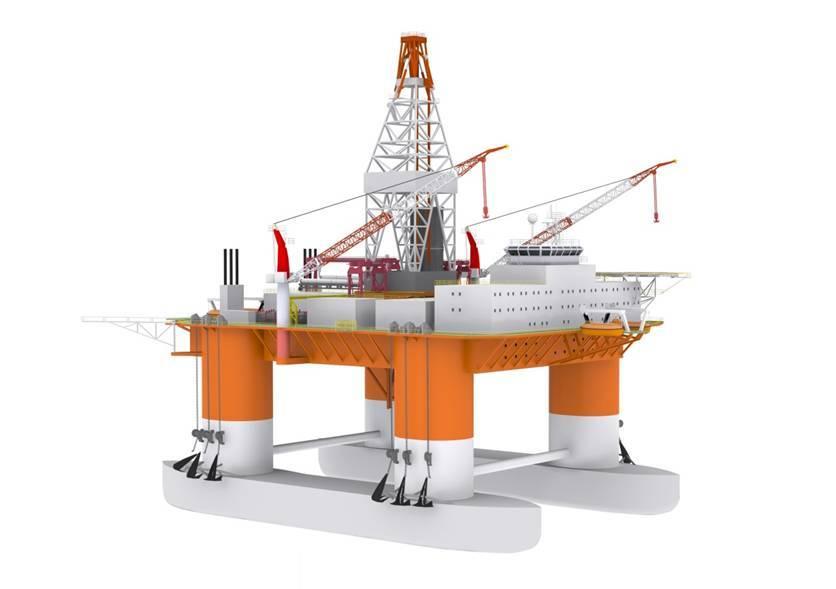
Wind Direction that influence the Plot plan

 Wind Direction


·        
Prevailing wind conditions influence the design
considerations for the location of the flare or vent stack.  It is important that reliable wind data is
obtained for the proposed location of the facility.  In this respect, safe design requirements
will typically require the following:
3:21 AM

MEMS Drive and OPPO Joint PR

...
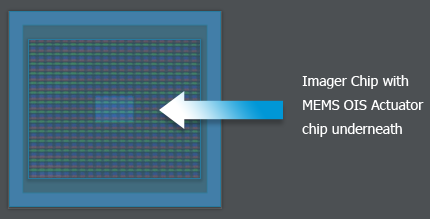
PRWeb: MEMS Drive and OPPO come up with a joint press release on their MEMS-based SmartSensor, the first image sensor-based image stabilizer for smartphones, also said to be the industry’s first sub-pixel-level optical image stabilizer.

While VCM smartphone cameras are limited to shake compensation on just two axes of movement, the new MEMS-based approach compensates for motion on three axes. This additional degree of mobility is said to vastly outperform traditional OIS technologies for smartphones, because it is faster – compensating for vibrations in 15 ms compared to 50 ms for lens-based technologies – and more accurate, and it allows for significantly lower power consumption.

MEMS Drive was founded to develop and advance the field of MEMS OIS technology for smartphone cameras. “The collaboration with OPPO has been very successful. The fact that OPPO is taking such an active role in co-developing this technology with MEMS Drive is accelerating our roadmap, and will ultimately come to benefit smartphone users sooner,” said Colin Kwan, CEO and founder of MEMS Drive.

“OPPO recognized that the MEMS Drive OIS actuator could vastly improve the end users’ camera experience. We therefore decided to invest in MEMS Drive and to co-develop the SmartSensor image stabilizer, and bring yet another significant advance in smartphone technology to market,” said King Liu, VP of Product Development at OPPO.

The advantages of MEMS Drive OIS are:
  • 3 Axis stabilization: pitch, yaw and roll
  • Fast (MEMS advantage)
  • Low power consumption
  • High precision
  • Built-in 2 Axis accelerometer
  • Compatible with any existing AF, shutter and Zoom actuators
  • 3D capture
  • Super resolution

11:12 PM