ResearchInChina on ADAS Transition to Stereo Cameras

...
ResearchInChina's "Global and China Vision ADAS Industry Report, 2015-2020" report forecasts that ADAS systems will adapt stereo cameras and abandon mono ones:

"Camera-based vision ADAS systems can be divided into several categories of applications: 1) Lane Detection, i.e., LDW/LKA/LCA (Lane Centering Assist) to prevent the car from deviating in the working state of either ACC or TJA (Traffic Jam Assist); 2) Obstacles Detection and Recognition, i.e., FCW (Forward Collision Warning)/AEB (Autonomous Emergency Braking); 3) Surroundings Display, i.e., Parking Assist, including Rear View and 360°Surround View. 4) BSD (Blind Spot Detection); 5) HBA (High Beam Assist) and Night Vision.

In application field, warning-only ADASs will gradually exit market, while the ADASs with actuator represent the mainstream in the future. For example, it is hard for drivers to take prompt countermeasures, as the warning time of FCW is no more than 3 seconds. Moreover, AEB (Autonomous Emergency Braking) may become the most important ADAS application. AEB will be a mandatory safety function across the world during 2021-2025.

Future orientation of development will be stereo camera rather than mono camera, especially in AEB field. As AEB concerns human life, there must be as much performance redundancy as possible, thus ensuring the safety of drivers to the utmost extent. Stereo camera has an overwhelming advantage over mono camera in the aspect of pedestrians recognition. However, the majority of companies (OEMs & Tier 1 suppliers) still adopt mono camera, as AEB is largely an optional component rather than a standard one, and the costs of stereo camera are much higher, resulting in higher price and low popularity.

Pedestrians Recognition will be a must of next-generation AEB, meaning that stereo camera has to be employed. Mercedes-Benz, Subrau, Jaguar, and Suzuki have adopted stereo camera from the very beginning, while VW, Toyota, Honda, and Nissan all employ stereo camera in their experimental models. As to Tier 1, Hitachi Automotive System has used stereo camera at the very start, while Continental, Bosch, Denso, and Fujitsu Ten see stereo camera as the priority of development. These companies are iconic ones in automobile industry and their moves represent the direction of automobile industry as a whole.

Global automotive camera module shipments approximated 50.3 million pieces in 2015 and are expected to reach 62.1 million pieces in 2016, 141 million pieces in 2020, and 246 million pieces in 2025. There are three cameras on each light vehicle on average, respectively for LKA, AEB, and Parking. Unlike mobile phone camera modules, automotive camera modules are highly demanding on reliability and range of operating temperature. Major vendors are Panasonic, Sony, Valeo, Fujitsu Ten, MCNEX, Magna, Gentex, Continental, and Hitachi. Panasonic ranks first globally in terms of market share and is far ahead of the second place.

Global automotive vision system market size was worth about USD3.1 billion in 2015 and is expected to hit USD6.1 billion in 2020. Magna, TRW (ZF), Hitachi Automotive System, and Continental are in the first camp, with Magna being the world’s largest, and Autoliv, Valeo, Denso, Fujitsu-ten, and Bosch are in the second camp. As the demand from carmakers varies greatly, the market concentration has been lower and this will continue for a considerable time.
"
1:15 PM

Hamamatsu Publishes Camera Simulator

...
Hamamatsu publishes a camera simulator showing an expected camera output for various image sensor and camera setups. Unfortunately, many image sensor imperfections are omitted, such as all color effects, hot and bad pixels, lens shading, RTN, PRNU, etc. Still a nice simulator, though:

11:57 AM

Rumor: Sony Low Cost Security Sensor for Less than $3

...
Sony low cost STARVIS sensor, IMX323, for security and surveillance applications is reportedly offered for less than $3 in volume in China. The 1080p30 1/2.9-inch sensor is based on 2.8um pixels. A complete datasheet of the new sensor can be downloaded here.

10:03 AM

BSI CMOS Sensor Market Reasearch

...
P&S Market Research publishes "Global Industry Insight: BSI CMOS Image Sensor Market Size, Share, Development, Growth and Demand Forecast to 2020." Few insights from the report:

"North America leads the backside illumination (BSI), complementary metal oxide semiconductor (CMOS) image sensor market, due to several design and technological improvements in this technology... The Asia-Pacific BSI CMOS image sensor market is expected to grow at the highest rate, in the coming years, due to which, it is expected to become the largest market, in the coming years. One of the key reasons for high growth of Asia Pacific in this market is its swift transition from analog to digital systems...

BSI CMOS image sensors eliminate the bulk substrate in the devices to decrease diffusion component of dark current and electrical crosstalk. BSI CMOS image sensors have higher quantum efficiency, which in turn enhances the production of output images with similar signal to noise ratio (SNR). However BSI CMOS image sensors are mechanically weaker, due to wafer thinning, which results in more chances of breakage for a large BSI CMOS image sensor.
"
10:56 AM

Drone Delivers to Doorstep: What Next?

...

Last Friday, Mar. 25, the Nevada startup Flirtey announced that it had made the first successful package delivery to a residential area in the U. S. with an autonomous drone (not steered by a person on the ground).  The demonstration flight, which was completed Mar. 10, carried a package of emergency supplies half a mile through the air to the porch of a vacant house outside Reno, Nevada.  Although large corporations such as Amazon and Wal-Mart have been toying with the idea of drone deliveries, Flirtey attributed its first to experience it has gained with similar tests in Australia and New Zealand.  It turns out that several other countries are more welcoming to commercial drones than the U. S., where strict FAA rules are still in place that are limiting commercial drone operations involving deliveries to test flights such as this one.

What does this achievement mean for a number of groups that may be affected by it:  consumers, companies in the delivery business, and people who earn a living delivering packages?

First, the consumer.  Whenever I thought of drone delivery in the past, I couldn't help but imagine how things could go wrong:  inadvertent haircuts from the propeller blades, for example.  Flirtey plans to avoid this sort of thing by keeping the drone itself at an altitude of around 40 feet (12 meters) while the package itself is lowered to the ground on a retractable cord leading to some sort of grappling hook that releases when the package hits the ground.  So unless you're asleep on the porch and the drone happens to land your box of live Maine lobsters on your head, chances are small that the drone will run afoul of living creatures on the ground.  Birds are another matter, of course, but I'm sure the Flirtey engineers have ways of dealing with them too. 

Although an engineer was killed in an accidentinvolving a large experimental drone in 2013, no injuries or fatalities have so far resulted from a civilian drone colliding with a standard aircraft.  The FAA would like to keep it that way, and news reports of the Flirtey flight also mention that NASA is working on air-traffic-control software for drones.  It's possible that the authorities will work out something like the present direction-altitude rules for large-scale aircraft, but on a smaller scale.  Commercial pilots follow the "odd north east" rule:  if your plane's heading is anywhere from north to east to south, your altitude must be an odd number of thousand feet plus 500 feet, and if your bearing is westerly, you have to be at an even number of thousand plus 500.  So it would be easy to make a similar rule for tens of feet instead of thousands for drones.  It wouldn't solve every potential collision problem, but it would help.

Large organizations whose business includes deliveries of small packages are eagerly awaiting the day when they can take advantage of drones.  While computerized scheduling and routing has improved the efficiency of manned delivery operations, the actual physical delivery process of packages to homes hasn't changed much since the invention of the automobile.  Currently, the FAA rules require that delivery drones always be within sight of the operator.  That's going to involve an operator for a while yet, but you can picture one delivery guy getting a lot more done with the help of two or three drones in a densely populated neighborhood.  Of course, a package on a string can't go into an apartment complex and take the elevator to the 14th floor, but you've got to start somewhere.  So the initial operations will probably be a hybrid thing, with the delivery driver going to a central location, loading drones, and sending them to do the last run of a few hundred feet to individual houses.

Inevitably, that will lead to layoffs among delivery personnel, although with the seasonal nature of the delivery business, at first it might just mean that UPS and similar services won't hire as many temps during the Christmas rush as they used to—they'll just add more drones.  But if the rules eventually allow more nearly autonomous operation of drones, the unattended parts of the flights will be longer, and fewer live drivers will be needed.  And one more type of job that is currently open to someone with only a high-school education will become history.

This is not unalloyed bad news.  The nation survived the demise of the milkman in most parts of the country, and before that the iceman.  But as the current election cycle is demonstrating, for some time now the U. S. economy has been doing a fairly poor job of employing people with less than a college education, and there are lots of people out there who feel that they have gotten the short end of the economic stick.  And a good many college-educated workers with degrees in non-professional areas are underemployed, doing jobs for which they are overqualified.  This is not the place to go into this complex and many-faceted problem, but we simply note that technology is often a destabilizing force.  If you are stably under the thumb of a dictatorship, destabilizing can be good.  But just making things less stable by itself is not always helpful. 

It doesn't look like we will be getting packages from Federal Express floating down from the sky any time soon.  For whatever reason, the FAA has decided to make haste slowly on commercial drones, while other countries speed ahead.  That may give time for the job market to readjust more gradually to the future realities of the delivery business, however it is affected by the advent of drones.  The fact that the first package delivered was emergency supplies reminds us that there are disaster scenarios for which delivery drones will be a Godsend.  And nobody should resent that.

Sources:  Numerous outlets carried the news of Flirtey's accomplishment. I referred to reports on the websites of the Christian Science Monitor at http://www.csmonitor.com/Business/2016/0326/Startup-Flirtey-drone-delivery-is-good-news-for-nacent-industry(by the way, the word meaning budding or fledgling is spelled "nascent," not "nacent"), and Fortune at http://fortune.com/2016/03/25/flirtey-drone-legal-delivery-urban/.  I also referred to the Lapeer Aviation website http://www.lapeeraviation.com/odd-north-east/ for information about the "odd-north-east" rule. 

Chemoluminescence

...

In class I've been studying different chemical reactions through a number of different labs. This week we read an article about chemoluminescence, especially in glow sticks. This article relates to my learning because chemoluminescence is a particularly useful and efficient tool in everything ranging from emergency workers to crime scene investigators to medical researchers. It is important to learn about Chemoluminescence because of both the efficient and helpful uses for it that we've already found, as well as the possibly life-saving prospects of what it could be used for in the future.

Because of how important Chemoluminescence is, it's also to understand the words used to describe it. To fully understand the topic, you need to know the terms defined below:

Chemoluminescence: Light emitted by the decaying of an unstable product of a chemical reaction.

Product: A substance formed by a chemical reaction.

Stable: When a system is in it's lowest energy state and isn't going to decay.

Unstable: Liable to decay and to deteriorate.

Emitted: Exuded or produced.

Next, I will discuss the following topics: early uses of chemoluminescence, glow sticks, chemoluminescence in forensics and efficiency, and how chemoluminescence is being used to help diabetics.

All Chemoluminescence reactions create an unstable product that decays, producing light. For example, when the element phosphorus is exposed to damp air, an atom of phosphorus is released and absorbed into the air. This causes the molecules to return to a more stable state, emitting a greenish light while it does so. The light is formed by the atoms being released.

Glow sticks, also known as light sticks, are used by a number of different people, such as emergency workers, military personnel, rave dancers, and Halloween trick-or-treaters. They are generally used when it would be impractical or unsafe to use electricity to generate light. There are two chemicals in glow sticks — usually hydrogen peroxide and cyalume — separated by a glass separator. To 'activate' the glow stick, you 'snap' the separator, allying the two chemicals to mix, causing a chemical reaction.  This excites the dye inside the stick, which then causes the stick to glow the color of the dye in the stick.

Chemoluminescence can also be used for forensics by crime scene investigators. One chemical, luminal, is used to detect blood at crime scenes. This is because it reacts on contact with hemogoblin (red blood cells), glowing a greenish-blue color. This means that the investigators can simply sweep the area with luminal, and if it glows greenish-blue anywhere, they've detected blood. Chemoluminescence is also surprisingly efficient compared to our electric lights. For example, a light bulb has 10% efficiency in transferring energy to light, while a firefly has 88% efficiency.

Chemoluminescence can even be used in medical science. Researchers have been recently experimenting with alternatives to what is currently the only way to diabetics' health - constant finger pricks to test glucose levels and inject insulin. What they've come up with utilizes Chemoluminescence, and looks like it may be a much less irritating and safer alternative. Tiny implants can be injected into the skin without surgery, where they monitor glucose levels by immediately reacting and glowing if blood pressure increases. They're estimated to last about 140 days, because that's how long they've lasted in mice before requiring replacement. The implants can be replaced as easily as they're implemented, with no surgery - quickly and fairly painlessly removed with tweezers. It looks like they'll be a safe alternative for humans, as long as they use well-sealed, with  safe chemicals in the implants.

Overall, Chemoluminescence is an important and useful concept to understand, with a variety of current and possibly uses, all of which are interesting to learn and write about.


InVisage vs InvenSense

...
EETimes publishes an article "What Do InVisage & InvenSense Have in Common?" by Peter Clarke, comparing Invisage and Invensense business models. While Invensense is successful at MEMS inertial sensors market, licensing its process to others does not bring much income for the company. So, the article questions whether this approach can work for Invisage.
1:10 PM

Brookman Announces 33MP 120fps Super35mm UHDTV Sensor

...
Brookman Technology delivers engineering samples of 33MP, 120fps BT3300N for 8K Super Hi-Vision broadcast, which was co-developed with NHK and Prof. Kawahito's Group of Shizuoka University. BT3300N is said to be the only image sensor (as of January 2016) that meets the full specifications of the Super Hi-Vision (8K, 120fps) and its optical format is Super 35mm. The new sensor is based on 3.2um pixels and features 14b 2-stage ADC.

8K Super Hi-Vision is set to begin test broadcasting in 2016 and roll out full broadcasting by 2018.

Brookman BT3300N

MarketWired: Silvaco announces that Brookman has adopted Silvaco's power integrity tool suite InVar Power-IR-Thermal for the design and development of its CMOS sensor products. InVar Power analyzes dynamic power consumption; InVar IR analyzes voltage drops in power sources and signal networks; and InVar Thermal performs thermal analysis at the full chip level. Concurrent observations of power, IR and thermal make it possible to perform real-time analysis, considering the effect of heat generation.

Brookman Technology's President, Satoshi Aoyama, stated, "8K standard demands the challenging specs to sensors, which are 33Mega-pixel resolution, 120 frames/second speed and 12-bit image gradation. This large and high-speed sensor is facing the issue of voltage drops so critically that the analysis by InVar IR is extremely helpful. In addition, as for the problem regarding the degradation of image due to intra-chip heat generation, we expect that InVar Thermal contributes effectively to the shortening of development TAT, as well as the improvement of design quality."
12:33 PM

Panasonic Thermal Sensing Solution

...
BusinessWire: Panasonic develops a thermal sensation estimation method using its infrared array sensor Grid-EYE. The thermal sensation estimation method recognizes the human sensations of hot and cold by calculating heat loss based on the difference between human surface temperature and ambient temperature. The thermal sensing solutions Panasonic provides are a super-resolution algorithm using Grid-EYE, an infrared array sensor, to measure the temperature distribution in detail and detect objects, thereby achieving air conditioning suitable for sensed temperature by combining the obtained data and thermal sensation estimation method.


The 2014 company video explains Grid-Eye imager features:

11:50 AM

VLSI Symposia Accepted Papers

...
VLSI Circuit and Technology Symposia to be held on June 13-17, 2016 in Honolulu, HI, publishes accepted paper list, with quite a few image sensor papers:
  • A 220pJ/Pixel/Frame CMOS Image Sensor with Partial Settling Readout Architecture, Ji, Stanford University
  • An 8.3M‐pixel 480fps Global‐Shutter CMOS Image Sensor with Gain‐Adaptive Column ADCs and 2‐on‐1 Stacked Device Structure, Oike, Sony
  • A Dead‐time Free Global Shutter CMOS Image Sensor with in‐pixel LOFIC and ADC using Pixel‐wise Direct Connections, Sugo, Tohoku Univ.
  • White Spots Reduction by Ultimate Proximity Metal Gettering at Carbon Complexes Formed underneath Contact Area in CMOS Image Sensors, Yamaguchi, Renesas Electronics Corporation
  • Enabling monolithic 3D image sensor using large-area monolayer transition metal dichalcogenide and logic/memory hybrid 3D+IC, Yang, National Nano Device Laboratories
  • Back‐illuminated voltage‐domain global shutter CMOS image sensor with 3.75µm pixels and dual in‐pixel storage nodes, Stark, University of Edinburgh, UK
  • Broadband THz Spectroscopic Imaging based on Fully Integrated 4×2 Digital‐to‐Impulse Radiating Array with Full‐Spectrum of 0.03‐1.03THz in Silicon, Assefzadeh, Rice University
  • Novel Pixel Structure with Stacked Deep Photodiode to Achieve High NIR Sensitivity and High MTF, Takahashi Hiroki, TowerJazz
Also, the Circuit Symposium plenary session features Sony talk:

“Accelerating the Sensing World through Imaging Evolution”, Tetsuo Nomoto, VP and SGM, SONY
The evolution of CMOS Image Sensors (CIS) and the future prospect of a “sensing” world utilizing advanced imaging technologies promise to improve our quality of life by sensing anything, anywhere, anytime. Charge Coupled Device image sensors replaced video camera tubes, allowing the introduction of compact video cameras as consumer products. CIS now dominates the market for digital still cameras created by its predecessor and, with the advent of column-parallel ADCs and back-illuminated technologies, outperforms them. CIS’s achieve better signal to noise ratio, lower power consumption, and higher frame rate. Stacked CIS’s continue to enhance functionality and user experience in mobile devices, a market that currently comprises over one billion new image sensors per year. CIS imaging technologies promise to accelerate the progress of sensing world by continuously improving image quality, extending detectable wavelengths, and further improving depth resolution and temporal resolution.
12:36 PM

Basler Improves on Demosaicing Algorithms

...
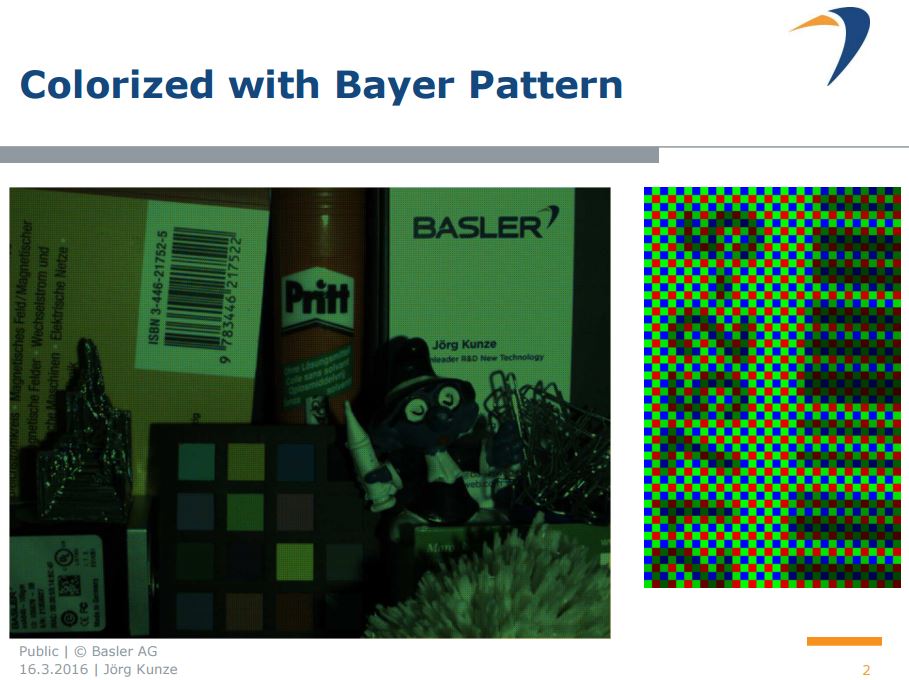
Jörg Kunze from Basler AG kindly allowed me to publish few slides from his presentation at the London Image Sensors 2016 conference about his novel Debayering algorithm called PGI.

His implementation is a hardware-efficient single-step 5x5 pixel algorithm, which performs a zipper-free high-quality Bayer-pattern interpolation up to the theoretical frequency limit, color-anti-aliasing, sharpness enhancement and noise reduction together. The pictures look very convincing. Basler has currently a single-lane FPGA implementation with a throughput of 140 MPix/s using 880 Cyclone V logic cells and a quad lane implementation with a throughput of 400 MPix/s using 2600 logic cells. Jörg says, Basler is interested in licensing, cross-licensing or technology exchange.

1:09 PM

Lead Piping Designer (PDS / PDMS) - Singapore

...


Lead Piping Designer - Singapore

Posting Date: 16-Mar-2016
Closing Date: 15-Apr-2016

JOB-2016-0054181

Description:
Senior  Piping Designers hands-on experience of using PDMS / PDS suite of applications

Job Requirements:
Shall have a minimum of 15 years of piping design experience covering equipment for onshore/offshore platforms.


Shall be able to lead / work harmoniously in a team of

Principal Technical Professional-Piping

...


Principal Technical Professional-Piping KBR Saudi Arabia


Location: Sadui Arabia-Jazan

Job Number: 1037659

Under general supervision, independently applies advanced engineering techniques, makes decisions on engineering problems and methods, and represents the organization in conferences to resolve important questions or to negotiate with key engineers and officials of other organizations.
1:17 AM

Pancakes

...
In class, I've been learning about chemical formulas and how to determine them, as well as continuing to cover types of bonds. This week we read an article about pancakes and the chemical reactions that make them what they are. It relates to my learning because it gives me a deeper understanding of various aspects of chemical reactions.

The article we read this week talked about a number of compounds with several different chemical bonds. I have chosen two compounds, sugar and salt, to go into more detail about. Salt is an ionic bond, because chlorine steals sodium's valence electron to form the bond. Sugar forms a covalent bond because oxygen, carbon, and hydrogen share their valence electrons equally between them.

Pancakes rise, like my other baked goods, because carbon dioxide gets trapped in the batter when you mix it, helping fluff the pancakes out. In pancakes, most of the protein comes from eggs and the gluten in flour. The chewable texture is formed by the carbon dioxide bubbles trapped in the batter by mixing, and the tenderness formed by the sugar and butter. It is mainly the fluids in the batter tat allow all the chemical reactions to occur.

Sodium bicarbonate (NaHCO3) is made up of both ionic and covalent bonds, which occurs when positively charged sodium bonds with the negatively charged oxygen and carbon. When you mix acid with a carbonate (such as baking soda with vinegar) you get lots of fizzing as the two react. It is important to remember when adding buttermilk to pancakes that since buttermilk is slightly acidic, it will react with the carbonates. Because of this, if you leave buttermilk pancake batter out for a while, the batter will go flat, like soda when it's left out.

The Maillard reaction is caused by a chemical reaction bet
ween hot sugar and amino acids. During the reaction, small molecules are let out, creating the delicious smells that reach our noses. Two examples of the Maillard reaction or furanones and thiophenes. Furanones create a sweet, caramelly burnt smell while thiophenes generate more of a meaty, burnt smell. An example of something that undergoes the Maillard reaction is onions when they are caramelized - they exude furanones.

All in all, pancakes have a lot of chemical reactions to thank - the ingredients in the batter, the properties of sodium bicarbonate, and the browning process caused by the Maillard reaction. Together, they make pancakes look, smell, and taste good.

Honda to Release Autonomous Driving Civic

...
WSJ: Honda is releasing automated highway driving features on its entry-level vehicle Civic LX sedan. With price tag of $20,440 it makes it accessible to significantly more buyers, including younger ones.

As auto makers offer the components needed to power these functions in option packages as low as $1,800, they are being snapped up at a far higher rate than electrified vehicles.


Via Videantis news.
2:12 PM

Mediatek Launches Imagiq ISP

...
MediaTek announces the Imagiq ISP foir Helio high-end smartphone chipset solution.

As dual cameras are becoming standard on high-end smartphones, MediaTek Imagiq offer features enhancing the dual photography:
  • Real-Time Large Aperture Depth-of-Field Effect – With the built-in 3D sensor, the ISP can capture depth mapping in real-time, and with a large aperture of greater than f/0.8, it can produce large aperture depth-of-field effects in real-time even for previews.
  • Reality Depth of Field (DOF) – Users can map objects and backgrounds to multiple layers with a DOF feature. The smartphone can smartly position the object and background and apply creative effects to each layer in real time to produce photos or videos with DOF effects.
  • Bayer and Mono Cameras – This multiple-sensor design can capture three times the light of a traditional single-bayer sensor, thus reducing image noise and increasing quality.
  • Dual Camera Zoom – The ISP is equipped with a wide-angle lens and a telescope in its dual camera system. Imagiq combines these wide-angle and zoomed captured images into one image.
Other ISP features include:

  • Hybrid Autofocus (PDAF and Laser Auto Focus) – Combining PDAF and Laser AF to realize a faster autofocus speed, which is also applicable in dimly lit environments.
  • Pixel-Level Auto Focus – A focus speed is four times that of traditional autofocus, making it especially suitable for shooting fast-moving objects in real-time.
  • New De-Mosaic and Sharpness Engine – With its large-scale texture recognition and implementation of adaptive color image abilities, Imagiq produces smoother and sharper images when taking photos in dimly lit environments.
  • New Adaptive De-Noising Engine – Imagiq reduces image noise even in low-light environments
  • Automatic Image Stabilization (AIS) – Imagiq can rapidly combine four consecutively captured images into one image, eliminating blur effects from camera shake.
  • TrueBright Engine – With first-time RWWB sensor support, Imagiq powers twice the sensitivity to light of a traditional RGB sensor.
  • EIS and Gyro – Using a hardware engine to predict motion, Imagiq eliminates a video’s camera shake and distortion.
  • 1/32 Super-Slow Motion – In addition to supporting 720p video, Imagiq can shoot 1080p video at 480 fps in 1/32 super-slow motion playback, resulting in a 960 FPS video. Users are also able to edit videos using super-slow motion.
  • Temporal Noise Reduction – Imagiq uses temporal noise reduction to locate and reduce pixel movement in videos, resulting in cleaner and more detailed video quality in both video previews and filming.
  • 4K HDR Shooting – Support 4K HDR video shooting for the first time.
2:00 PM

AlphaGo Defeats Human Go Champion: Go Figure

...

First it was chess:  world champion Garry Kasparov lost a contest of five games to an IBM computer named Deep Blue in 1997.   And now it's the game called Go, which has been popular in Asia for centuries.  Earlier this month, Korean Go champion Lee Sedol lost four out of a series of five games in a match with AlphaGo, a computer program developed by Google-owned London firm DeepMind.  But Sedol says he now has a whole new view of the game and is a much better player from the experience.  This development raises some perennial questions about what makes people human and whether machines will in fact take over the world once they get smarter than us.

As reported in Wired, the Go match between Lee Sedol and AlphaGo was carried on live TV and watched by millions of Go enthusiasts.  For those not familiar with Go (which includes yours truly), it is a superficially simple game played on a 19-by-19 grid of lines with black and white stones, sort of like an expanded checkerboard.  But the rules are both more complicated and simpler than checkers.  They are simpler in that the goal is just to encircle more territory with your stones than your opponent encircles with his.  They are more complicated in that there are vastly more possible moves in Go than there are in checkers or even chess, so strategizing takes at least as much brainpower in Go as it does in chess. 

It's encouraging to note that even when Sedol lost to the machine, he could come up with moves that equalled the machine's moves in subtlety and surprise.  Of course, this may not be the case for much longer.  It seems like once software developers show they can beat humans at a given complex task, they lose interest and move on to something else.  And this shows an aspect of the situation that so far, few have commented on:  the fact that if you go far enough back in the history of AlphaGo, you find not more machines, but humans.

It was humans who figured out the best strategies to use for AlphaGo's design, which involved making a lot of slightly different AlphaGos and having them play against each other and learn from their experiences.  Yes, in that sense the computer was teaching itself, but it didn't start from scratch.  The whole learning environment and the existence of the program in the first place was due, not to other machines, but to human beings. 

This gets to one of the main problems I have with artificial-intelligence (AI) proponents who see as inevitable a day when non-biological, non-human entities will, in short, take over.  Proponents of what is called transhumanism, such as inventor and author Ray Kurzweil, call this day the Singularity, because they think it will mark the beginning of a kind of explosion of intelligence that will make all of human history look like mudpies by comparison.  They point to machines like DeepBlue and AlphaGo as precursors of what we should expect machines to be capable of in every phase of life, not just specialized rule-bound activities like chess and Go. 

But while the transhumanists may be right in certain details, I think there is an oversimplified aspect to their concept of the singularity which is often overlooked.  The mathematical notion of a singularity is that it's a point where the rules break down.  True, you don't know what's going on at the singularity point itself, but you can handle singularities in mathematics and even physics as long as you're not standing right at the point and asking questions about it.  I teach an electrical engineering course in which we routinely deal with mathematical singularities called poles.  As long as the circuit conditions stay away from the poles, everything is fine.  The circuit is perfectly comprehensible despite the presence of poles, and performs its functions in accordance with the human-directed goals set out for it. 

All I'm seeing in artificial intelligence tells me that people are still in control of the machines.  For the opposite to be the case—for machines to be superior to people in the same sense that people are now superior to machines—we'd have to see something like the following.  The only way new people would come into being is when the machines decide to make one, designing the DNA from scratch and growing and training the totally-designed person for a specific task.  This implies that first, the old-fashioned way of making people would be eliminated, and second, that people would have allowed this elimination to take place. 

Neither of these eventualities strikes me as at all likely, at least as a deliberate decision made by human beings.  I will admit to being troubled by the degree to which human interactions are increasingly mediated by opaque computer-network-intensive means.  If people end up interacting primarily or exclusively through AI-controlled systems, the system has an excellent opportunity to manipulate people to their disadvantage, and to the advantage of the system, or whoever is in charge of the system. 

But so far, all the giant AI-inspired systems are all firmly under the control of human beings, not machines.  No computer has ever applied for the position of CEO of a company, and if it did, it would probably get crossways to its board of directors in the first few days and get fired anyway.  As far as I can tell, we are still in the regime of Man exerting control over Nature, not Artifice exerting control over Man.  And as C. S. Lewis wrote in 1947, ". . . what we call Man's power over Nature turns out to be a power exercised by some men over other men with Nature as its instrument." 

I think it is significant that AlphaGo beat Lee Sedol, but I'm not going to start worrying that some computerized totalitarian government is going to take over the world any time soon.  Because whatever window-dressing the transhumanists put on their Singularity, that is what it would have to be in practice:  an enslavement of humanity, not a liberation. And as long as enough people remember that humans are not machines, and machines are made by, and should be controlled by, humans, I think we don't have to lose a lot of sleep about machines taking over the world.  What we should watch are the humans running the machines.

Sources:  The match between Lee Sedol and AlphaGo was described by Cade Metz in Wired at http://www.wired.com/2016/03/two-moves-alphago-lee-sedol-redefined-future/.  I also referred to the Wikipedia articles on DeepBlue, Go, and AlphaGo.  The quotation from The Abolition of Man by C. S. Lewis is from the Macmillan paperback edition of 1955, p. 69. 

Sony Presents 9MP and 12.4MP Global Shutter Sensors

...
Sony 3.45um global shutter pixel, said to be the smallest in the industry, is the base of two new sensors: IMX253LLR/LQR 1.1-inch 12.37MP and IMX255LLR/LQR 1-inch 8.95MP, available in both monochrome (LLR) and color (LQR) versions.


The company's Youtube video shows global shutter advantages:

1:33 PM