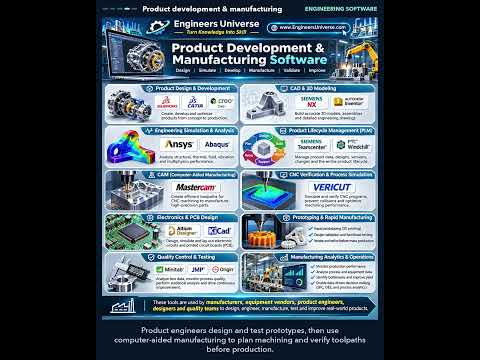
Engineering education lays a strong theoretical foundation, but applying those abstract concepts to real-world infrastructure requires powerful technological tools. Transitioning from textbook equations to tangible blueprints often hinges on mastering engineering software operation. Modern engineers rely on sophisticated digital platforms to model, test, and execute complex systems long before physical construction begins.
Bridging Academic Concepts and Real-World Applications
In the classroom, students learn the core laws of physics, mathematics, and structural design. However, real-world variables—such as dynamic thermal loads, material stress, and fluid dynamics—are nearly impossible to calculate manually at scale.
Getting comfortable with hands-on engineering software operation allows students and young professionals to simulate these dynamic conditions accurately. By following visual guides and structured walkthroughs, emerging engineers can see firsthand how raw mathematical formulas translate into functional computer-aided design (CAD) models and predictive simulations.
Key Advantages of Software-Driven Engineering
Leveraging modern software platforms delivers critical advantages across the entire lifecycle of a project:
- Enhanced Precision: Sophisticated algorithms significantly reduce human error in complex structural and mechanical calculations.
- Cost and Time Efficiency: Digital testing minimizes the need for expensive physical prototypes and speeds up the iterative design phase.
- Seamless Collaboration: Multi-disciplinary teams can work concurrently on unified digital models, streamlining communication and project handoffs.
Scaling from Visual Guides to Operational Systems
Seamless engineering software operation empowers teams to scale ideas from simple conceptual sketches into fully operational real-world systems. Whether designing smart electrical grids, advanced mechanical assemblies, or sustainable urban infrastructure, software serves as the vital link between conceptual theory and physical reality.
Embracing these digital tools early in your engineering career ensures a smooth, confident transition from student to industry leader—making complex system design faster, safer, and far more effective.


