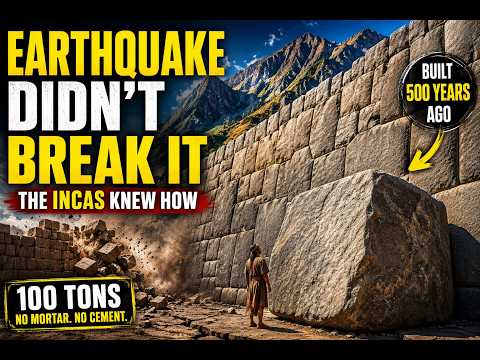
High in the rugged peaks of the Andes Mountains sits a structural marvel that has baffled architects and scientists for centuries. While modern concrete structures often crumble under intense seismic pressure, the ancient stone walls of the Inca Empire—most notably at Machu Picchu and Cusco—remain standing. How did a civilization without modern machinery build structures that can survive the most violent earthquakes on Earth?
The secret lies not in resisting the earth’s movement, but in dancing with it.
The Art of the "Dancing" Stones
Unlike European masonry of the time, which relied heavily on mortar to glue stones together, the Incas perfected a technique known as "ashlar" masonry. They carved massive granite blocks to fit together with such precision that even a razor blade cannot fit between the joints.
When an earthquake strikes, these mortar-less stones are free to vibrate and shift individually. This movement dissipates the energy of the seismic waves. Once the ground stops shaking, the weight of the stones and their L-shaped interlocking joints guide them back into their original positions. To understand the complexity of these movements, modern researchers often turn to advanced Engineering IT solutions. By using digital twins and 3D simulations, experts can visualize how these modular systems maintain equilibrium under stress.
Geometry as a Safety Feature
Beyond the stones themselves, the Incas integrated seismic resistance into the very shape of their buildings. They utilized trapezoidal doors and windows, which are wider at the bottom than at the top. This design lowers the center of gravity and provides additional stability during lateral shifts.
The integration of these physical principles into modern data models is a primary focus within the field of Engineering IT. By digitizing ancient architectural logic, contemporary engineers can develop software-defined infrastructure that mimics this natural resilience.
Ancient Logic for a Modern World
The Inca walls serve as a powerful reminder that "high-tech" doesn't always require electricity. It requires a deep understanding of materials and environment. Today, we are seeing a resurgence of interest in these ancient techniques. Through the lens of Engineering IT, we are finally able to quantify the genius of the Incas, using their "moving" walls as a blueprint for the sustainable, earthquake-proof cities of the future.


