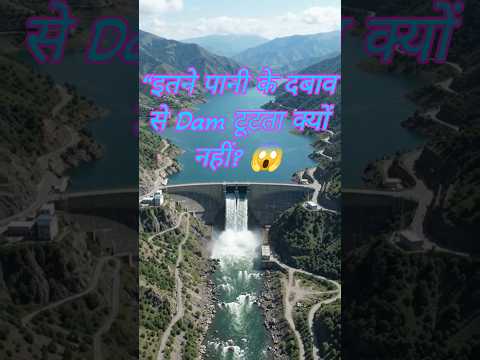
Have you ever stood at the edge of a massive reservoir and wondered how a single wall of concrete manages to hold back millions of gallons of water? The sheer force of water pressure is enough to crush steel, yet dams stand firm for decades without breaking. The secret lies in a fascinating blend of physics, materials science, and the precision of modern technology.
The Physics of Water Pressure
The primary challenge in dam construction is "hydrostatic pressure." Unlike a solid object, water exerts pressure in all directions, and this pressure increases significantly as you go deeper. At the base of a 500-foot dam, the weight of the water is immense. To counter this, engineers don't just build thick walls; they design shapes that use the water's own weight to their advantage.
Gravity dams, for instance, are built with such massive weight that the horizontal force of the water cannot push them over. Arch dams, on the other hand, use a curved shape to redirect the water’s pressure into the canyon walls, effectively using the earth itself as a structural support.
The Role of Engineering IT in Modern Safety
In the past, engineers relied on manual calculations and physical scale models. Today, the landscape has changed. The field of Engineering IT has revolutionized how we design and maintain these structures. Using advanced Finite Element Analysis (FEA), engineers can simulate extreme weather events, earthquakes, and maximum capacity scenarios in a virtual environment.
In the modern era, the integration of Engineering IT allows designers to create high-fidelity 3D models to simulate these pressures before a single stone is laid. This ensures that every curve and thickness is mathematically optimized to handle the specific geography of the site.
Real-Time Monitoring and Structural Integrity
Building the dam is only half the battle; maintaining it is where technology truly shines. Thousands of sensors are embedded within the concrete of modern dams to monitor internal temperature, moisture, and micro-vibrations. Furthermore, ongoing maintenance is managed through advanced Engineering IT systems that monitor structural integrity in real-time, alerting operators to the slightest shift in the foundation long before it becomes a hazard.
Conclusion
A dam doesn’t break because it is a masterpiece of balance. By combining the raw strength of reinforced concrete with the analytical power of computer science, we have mastered the art of taming nature’s most powerful force. It is the perfect marriage of heavy industry and digital intelligence that keeps our reservoirs full and our valleys safe.


