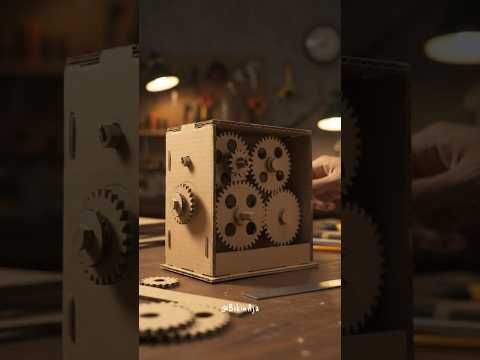
Have you ever looked at a stack of discarded cardboard boxes and seen a complex machine waiting to happen? In the world of modern Engineering IT, the line between simple DIY projects and advanced mechanical simulation is blurring. A recent AI-assisted visualization has sparked a fascinating debate: Could a series of gears made from recycled Indomie boxes actually spin together in perfect harmony?
The Complexity of Mechanical Synchronization
At first glance, a gear system looks straightforward. However, the physics behind it requires precise calculations of tooth pitch, diameter, and friction. When we introduce gears of varying sizes into a single interconnected web, the mechanical challenge increases exponentially. This is where the intersection of traditional mechanics and Engineering IT becomes essential.
By utilizing AI-assisted visualizations, designers can explore "what-if" scenarios. In this concept, the use of Indomie boxes adds a layer of rustic charm, but the underlying logic is purely mathematical. For these gears to spin together, every single point of contact must be synchronized to prevent the system from seizing—a puzzle that has fascinated engineers for centuries.
Bridging the Gap with Digital Simulation
Why use AI and digital tools for something as simple as cardboard? The answer lies in efficiency. Engineering IT allows us to simulate the structural integrity of unconventional materials like corrugated paper. We can predict where the teeth might bend or where the torque might be too high before we ever pick up a pair of scissors.
This visualization isn't just about making something move; it’s about understanding the limits of materials. It demonstrates how digital transformation can take a mundane object—a noodle box—and turn it into a case study for mechanical synchronization and load distribution.
The Future of Creative Engineering
This project serves as a reminder that engineering is as much about creativity as it is about calculations. Whether you are a student exploring DIY projects or a professional working in high-tech manufacturing, the ability to visualize complex systems is a superpower.
By combining the principles of upcycling with the power of modern simulation tools, we can reimagine the world around us. These cardboard gears represent more than just a "Shorts" video; they represent the endless possibilities when human curiosity meets the analytical power of technology.


