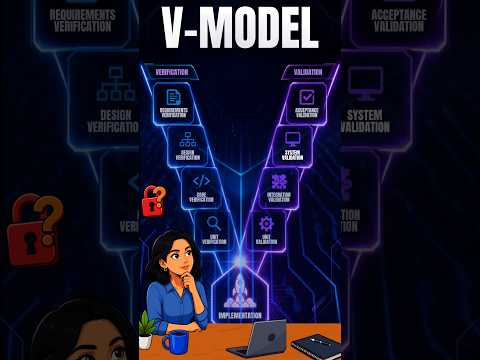
In today’s fast-paced tech landscape, building dependable, defect-free systems requires a disciplined approach to the Software Development Life Cycle (SDLC). Whether you are developing complex corporate tools or specialized engineering software, maintaining rigorous quality standards from day one is critical. This is where the V-Model—also known as the Verification and Validation Model—comes into play.
What is the V-Model?
The V-Model is a structured SDLC framework where every development phase has a corresponding testing phase. Unlike traditional linear models, the V-Model emphasizes parallel planning for testing right alongside early system design. Graphically shaped like the letter "V", the model is split into three main parts:
- The Left Arm (Verification Phase): Focuses on requirement analysis, system architecture, and module design.
- The Bottom Tip (Implementation): The coding phase where developers build the actual application components.
- The Right Arm (Validation Phase): Focuses on executing tests, moving upward through unit testing, integration testing, system testing, and final acceptance testing.
Verification vs. Validation: Understanding the Core Difference
To successfully apply this framework when building complex engineering software, it is essential to understand the distinction between its two main concepts:
- Verification: Asks the question, "Are we building the product right?" It involves static reviews, code walkthroughs, and inspections to verify that designs meet baseline specifications before code is run.
- Validation: Asks the question, "Are we building the right product?" It involves dynamic testing of the running application against actual functional requirements to ensure it delivers the expected user experience.
Key Benefits of the V-Model
Adopting the V-Model offers several strategic advantages for development teams:
- Early Defect Detection: Test cases are designed alongside requirements, uncovering flaws early before they become expensive to fix.
- Clear Structure and Traceability: The paired phases make progress easy to track and manage throughout the project lifecycle.
- High Reliability: Because every development milestone has a matched validation gate, it ensures high-stakes engineering software achieves maximum stability, safety, and performance.
Final Thoughts
By aligning development tasks directly with quality assurance, the V-Model eliminates guesswork and minimizes technical risk. For projects with well-defined requirements, embracing this disciplined model is one of the most effective ways to guarantee software excellence.
