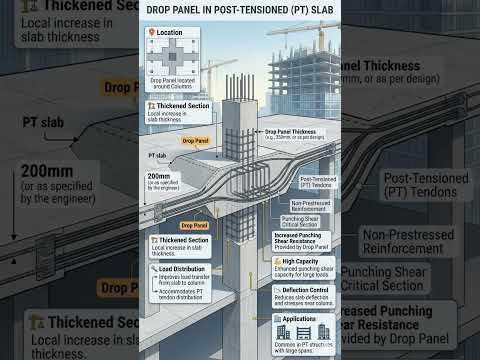
In the modern world of structural design, Post-Tension (PT) slabs have become a gold standard for creating long-span floors with reduced thickness. However, as slabs become thinner and more efficient, structural engineers must address specific localized stresses. One of the most critical components in managing these forces is the "Drop Panel."
What is a Drop Panel?
A drop panel in a PT slab is a locally thickened portion of the concrete slab provided specifically around the support columns. While the rest of the floor maintains a uniform, slender profile, the area immediately surrounding the column is cast deeper. This geometric adjustment is not just for aesthetics; it serves a vital structural purpose.
The Role of Punching Shear Resistance
The primary reason engineers specify drop panels is to improve "punching shear" resistance. In a flat slab system, the concentrated load from the floor can act like a heavy weight on a thin sheet of paper, potentially causing the column to "punch" through the slab.
By increasing the thickness at the column-slab interface, the drop panel increases the shear perimeter. This distributes the stress over a larger area, significantly reducing the risk of structural failure. With the advancement of Engineering IT, modern civil projects can now simulate these stress points with incredible accuracy before a single drop of concrete is poured.
Precision Design through Engineering IT
The integration of Engineering IT has revolutionized how we calculate the dimensions and reinforcement requirements for drop panels. Gone are the days of purely manual approximations. Today, sophisticated structural analysis software—a core pillar of Engineering IT—allows engineers to model complex PT tendon layouts and visualize shear force distributions in real-time. This ensures that drop panels are neither undersized (which is dangerous) nor oversized (which is wasteful).
Key Benefits of Drop Panels in PT Slabs
- Enhanced Stiffness: They reduce the deflection of the slab, providing a more stable floor.
- Material Efficiency: They allow the rest of the slab to remain thin, saving on total concrete volume.
- Moment Resistance: They help in resisting negative moments at the supports, which are highest at the column locations.
Conclusion
Drop panels are an essential feature for any high-performance Post-Tension slab. By combining traditional structural wisdom with the analytical power of modern Engineering IT, construction professionals can build safer, more efficient, and more ambitious structures than ever before. Understanding these "locally thickened" sections is key to mastering the art of modern civil engineering.


