Showing posts with label Programming. Show all posts

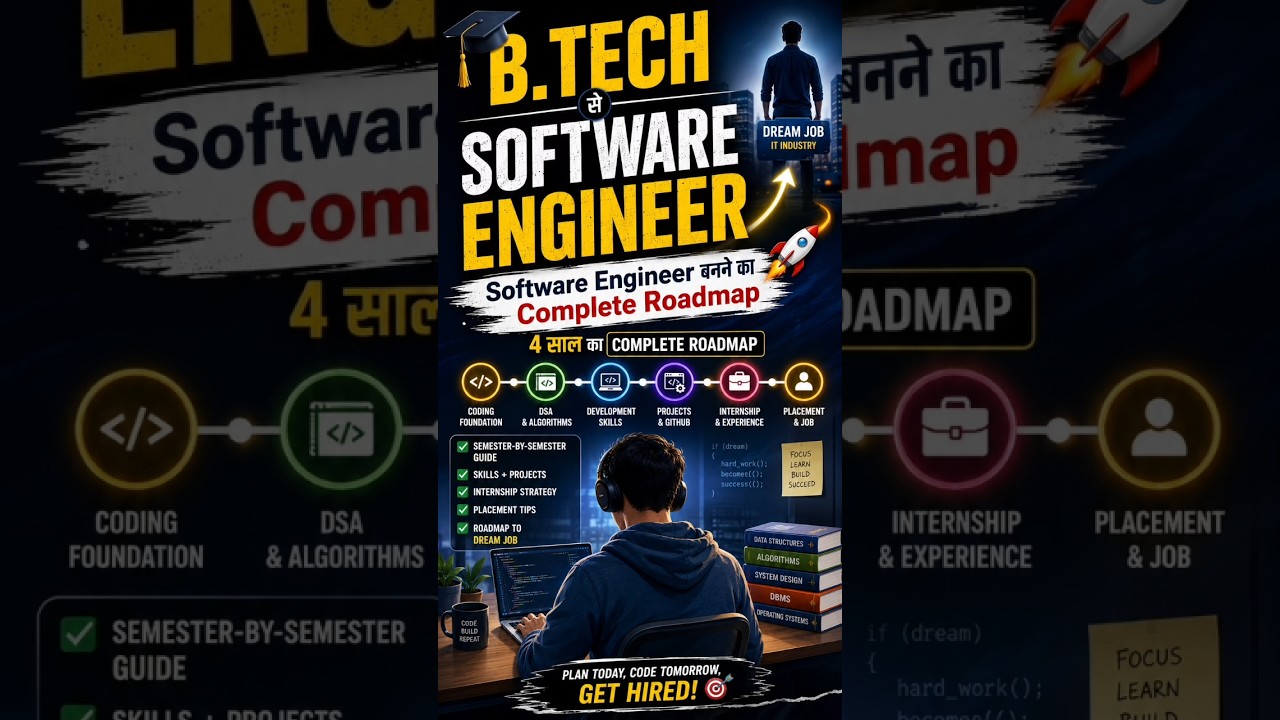
B.Tech to Tech Pro: The Ultimate 4-Year Roadmap for Engineering Software Careers

...
engineering information technology
B.Tech to Tech Pro: The Ultimate 4-Year Roadmap for Engineering Software Careers

B.Tech to Tech Pro: The Ultimate 4-Year Roadmap for Engineering Software Careers

This article provides an in-depth exploration of Engineering software, covering foundational concepts, practical applications, and engineering insights.

Transitioning from a B.Tech student to a high-paying software developer requires more than just attending college lectures. Without a clear plan, navigating four years of engineering can quickly become overwhelming. To stand out in today's competitive tech industry, you need a structured, semester-by-semester strategy that builds practical skills from day one.

Here is the ultimate 4-year roadmap to guide your journey from student to professional developer.

Year 1: Mastering Fundamentals and Logical Thinking

Your first year is all about breaking the ice with technology and developing a strong problem-solving mindset.
* Learn a Core Language: Pick one foundational language—such as C++, Java, or Python—and master its syntax and core logic.
* Understand Tech Ecosystems: Start exploring how modern engineering software works under the hood, including basic computer networks and operating system concepts.
* Build Consistency: Practice basic coding regularly on platforms like HackerRank or GeeksforGeeks.

Year 2: Data Structures, Algorithms, and Core CS Concepts

Year two is where serious technical preparation begins.
* Master DSA: Focus heavily on Data Structures and Algorithms (DSA). This is the backbone of almost all technical hiring interviews.
* Core CS Subjects: Pay close attention to Object-Oriented Programming (OOP), Database Management Systems (DBMS), and Operating Systems.
* Git & GitHub: Learn version control to manage and showcase your code repositories efficiently.

Year 3: Specialization and Hands-On Projects

By year three, it is time to move beyond theoretical knowledge and start building real-world applications.
* Pick a Tech Stack: Choose a domain such as Full-Stack Web Development, Mobile App Development, Cloud Computing, or Machine Learning.
* Build Projects: Create 2–3 end-to-end projects. Hands-on experience in building, debugging, and deploying applications demonstrates your practical ability to construct reliable engineering software.
* Open Source & Internships: Apply for summer internships and contribute to open-source projects on GitHub to gain industry exposure.

Year 4: Interview Prep, System Design, and Placement

Your final year is dedicated to conversion—turning your preparation into top job offers.
* Advanced DSA & Mock Interviews: Practice competitive programming and learn fundamental System Design principles. Conduct mock interviews to build confidence.
* Resume & Networking: Craft a clean, high-impact resume highlighting your best projects and internship experience. Optimize your LinkedIn profile and reach out for job referrals.
* Target the Right Companies: Apply for roles across tech startups and established enterprises that specialize in developing cutting-edge engineering software.

Final Thoughts

Consistency is the true key to transforming your B.Tech journey into a successful tech career. By breaking down your 4 years into clear semester-wise goals, you can build industry-ready skills step-by-step. Start today, stay disciplined, and take control of your engineering future!

Visual Insights & Illustrations

Engineering software

Only True Developers Will Get This: Unpacking the Quirks of Software Engineering Life

...

Image Credit:

Programming Meme Thumbnail

Welcome to the Inner Circle of Code!

Ever felt like you're speaking a secret language that only a select few understand? If you're entrenched in the world of programming, software development, or engineering, you know exactly what we're talking about. The daily grind is filled with unique challenges, triumphs, and, let's be honest, hilarious moments that only fellow tech enthusiasts truly appreciate.

This particular clip, titled "Solo pocos entenderán :(" (Only a few will understand :(), perfectly encapsulates those universal experiences. It's more than just lines of code; it's the late-night debugging sessions, the inexplicable bugs, the joy of a clean compile, and the shared understanding that binds the global developer community. Are you one of the chosen few who will truly 'get' it?

Get ready to nod in agreement, share a knowing smile, and maybe even a chuckle, as we delve into a moment that truly speaks volumes to those living and breathing software engineering and technology every single day. Watch the video below and see if you're part of the elite who share this unique perspective!

The Universal Language of Developers

Whether you're a seasoned software engineer, a budding programmer, or an IT professional, there's a certain camaraderie that comes with navigating the complex landscape of technology. From obscure error messages to the satisfaction of solving a particularly tricky problem, these are the moments that define our professional lives. This video serves as a perfect reminder of that shared journey.

So, did you understand it? If you did, welcome to the club! Share your thoughts in the comments below and let us know what programming or engineering moment you've experienced that only a few others would truly comprehend. Let's celebrate the unique insights that come with being part of the incredible world of software development!

How to Become a Professional IT Engineer: Steps and Tips

...

Becoming a professional IT engineer requires a combination of formal education, practical experience, and continuous learning. In this article, we will guide you through the essential steps and tips to build a successful career in the IT industry.

Step 1: Obtain Relevant Education

Most IT engineers start with a bachelor's degree in Computer Science, Information Technology, or related fields. Courses in programming, networking, cybersecurity, and databases are highly recommended. Obtaining certifications such as CompTIA, Cisco, or Microsoft can boost your employability.

Step 2: Gain Practical Experience

Hands-on experience is crucial. Participate in internships, coding projects, or volunteer work. Platforms like GitHub or GitLab allow you to showcase your projects and contribute to open-source initiatives, making your resume stand out.

Step 3: Specialize in a Niche

IT engineering has many specializations, including cloud computing, cybersecurity, AI, and software development. Identifying a niche early can help you gain deep expertise and increase your market value.

Step 4: Develop Soft Skills

Technical knowledge alone is not enough. Communication, teamwork, problem-solving, and project management skills are highly valued in IT roles. Attend workshops or join professional networks to enhance these skills.

Step 5: Stay Updated with Technology

The IT industry evolves rapidly. Subscribe to tech blogs, participate in webinars, and attend conferences to stay current with the latest trends. Continuous learning is key to maintaining a professional IT career.

Tips for Career Growth

  • Build a strong online presence on LinkedIn and GitHub.
  • Obtain advanced certifications in your chosen specialization.
  • Network with industry professionals and mentors.
  • Practice problem-solving through coding challenges and competitions.

By following these steps and tips, you can become a professional IT engineer capable of excelling in a competitive and evolving industry.

IT Engineer, Professional IT Career, IT Certifications, Career Tips, Networking, Programming, Cybersecurity, Cloud Computing, AI, Software Development, Technology Trends


What Is Information Technology Engineering? A Complete Beginner’s Guide

...

Information Technology (IT) Engineering is a rapidly growing field that combines computer science, software development, and network management to design, implement, and maintain digital systems. For beginners, understanding the fundamentals of IT engineering can open doors to careers in software development, cybersecurity, cloud computing, and more.

Core Concepts in IT Engineering

IT Engineering covers a wide range of concepts including programming languages, database management, system architecture, network infrastructure, and cybersecurity protocols. These concepts help IT engineers solve complex problems and optimize technology solutions for businesses.

Skills Needed to Become an IT Engineer

To start a career in IT engineering, you need skills in coding (Python, Java, C++), knowledge of databases (SQL, NoSQL), familiarity with networking (LAN, WAN, TCP/IP), and an understanding of cybersecurity principles. Problem-solving, analytical thinking, and continuous learning are also crucial.

Applications of IT Engineering

IT engineering plays a vital role in software development, cloud computing, mobile app creation, artificial intelligence, and IT infrastructure management. Companies rely on IT engineers to ensure their systems are efficient, secure, and scalable.

How to Start Learning IT Engineering

Beginners can start by learning programming basics, exploring online tutorials, joining coding bootcamps, or pursuing formal IT degrees. Practical experience through projects, internships, and certifications will help you gain the necessary skills to thrive in this field.

Information Technology, IT Engineering, Beginner's Guide, IT Skills, Software Development, Cybersecurity, Programming, Database Management, Network Infrastructure


Top Websites for Learning Programming in Engineering

...

Learning programming in engineering is becoming more essential as modern industries continue to integrate automation, simulation, and data-driven technologies. This guide highlights the top websites that provide high-quality resources for engineers who want to improve their programming skills. These platforms are known for offering practical tutorials, project-based learning, and courses designed specifically for engineering applications.

1. Coursera

Coursera offers a wide range of engineering programming courses created by top universities. Engineers can learn Python, MATLAB, C++, and specialized skills like control systems programming and machine learning for engineering. The platform is ideal for learners who want structured programs and certification.

2. edX

edX provides high-quality engineering programming courses from institutions like MIT and Harvard. Topics include computational engineering, robotics programming, and numerical simulation. Its professional certificates make it a trusted platform for engineers seeking advanced development.

3. MIT OpenCourseWare

MIT OCW is a free resource offering full engineering programming courses including lecture notes, assignments, and projects. Engineers can explore subjects like algorithms, embedded systems programming, and computational design at no cost. It is one of the best free learning platforms.

4. Udemy

Udemy features thousands of practical programming courses tailored to engineering applications. Popular courses include Python for engineers, PLC programming, MATLAB projects, and C++ for embedded systems. The project-based format makes it useful for hands-on learning.

5. Khan Academy

Khan Academy provides beginner-friendly programming lessons in JavaScript, HTML, SQL, and computer science fundamentals. Although not engineering-specific, it is excellent for engineers who need a strong foundation before advancing to more technical subjects.

6. MATLAB Academy

MATLAB Academy is dedicated to engineers working with simulations, data analysis, and automation. The platform includes tutorials and courses focused on engineering workflows, numerical computation, and real-world projects using MATLAB and Simulink.

7. FreeCodeCamp

FreeCodeCamp offers a completely free and interactive platform for learning programming. Engineers can learn Python, data analysis, and web development—skills increasingly valuable in modern engineering fields such as IoT, automation, and digital manufacturing.

Conclusion

These top websites for learning programming in engineering provide valuable resources for building technical skills required in today’s industry. Whether you prefer structured courses, self-paced learning, or hands-on projects, each platform offers unique strengths that support your engineering journey.