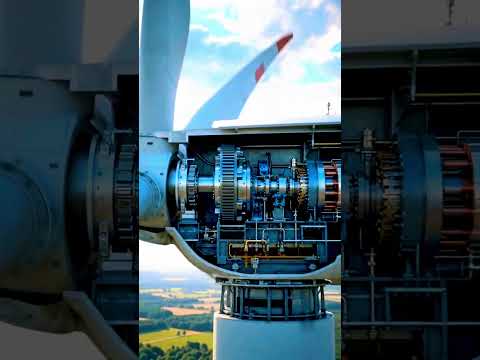
Harnessing the power of the wind is a feat of modern physics and mechanical design. When you look at a wind farm, the massive turbine blades often appear to be spinning gracefully at a seemingly leisurely pace. However, there is an incredible transformation happening inside the nacelle—the housing atop the tower. Understanding how slow wind speed becomes high-speed electricity is essential for anyone interested in the intersection of renewable energy and Engineering IT.
The Challenge: From 15 to 1,500 RPM
The primary challenge in wind energy production is the speed discrepancy. Most large-scale wind turbine blades rotate at a speed of roughly 10 to 20 revolutions per minute (RPM). While this is enough to capture massive amounts of kinetic energy, it is far too slow for a standard electrical generator to produce power efficiently. Most generators require speeds of 1,500 RPM or higher to create a steady flow of electricity.
This is where the gearbox comes into play. Acting as the "transmission" of the turbine, the gearbox bridges the gap between the slow-moving blades and the high-speed generator. By applying sophisticated Engineering IT principles to monitor torque and rotational stress, engineers can design systems that handle this massive jump in velocity.
The Magic of the Planetary Gear System
To achieve such a high gear ratio in a compact space, wind turbines typically utilize a planetary gear system. In this setup, a central "sun gear" is surrounded by multiple "planet gears," all housed within a "ring gear."
As the slow-moving main shaft (driven by the blades) turns the large gears, the internal arrangement accelerates that motion through multiple stages. By the time the energy reaches the high-speed shaft connected to the generator, the rotation has been magnified nearly a hundred times. This mechanical advantage is what allows a "slow" turbine to produce enough frequency for the power grid.
The Role of Engineering IT in Modern Turbines
In the modern era, mechanical gears are only half the story. High-tech sensors and Engineering IT solutions are now integrated into these gearboxes to monitor heat, vibration, and lubrication levels in real-time. This data-driven approach allows for predictive maintenance, ensuring that the gears don't fail under the immense pressure of high-wind conditions.
By combining heavy-duty mechanical engineering with smart information technology, we can maximize the efficiency of every gust of wind, turning a simple breeze into the high-speed rotation required to power our world.
