Modern Data Engineering: How to Analyze Sentiment with Snowflake AI_SENTIMENT
This article provides an in-depth exploration of Data engineering, covering foundational concepts, practical applications, and engineering insights.
In today’s data-driven ecosystem, customer reviews, support tickets, and feedback forms contain a goldmine of business insights. However, extracting actionable value from unstructured text has traditionally required complex machine learning pipelines. Modern data engineering has evolved, making advanced AI capabilities directly accessible within cloud data warehouses through simple SQL queries.
Unlocking Unstructured Text with Snowflake Cortex AI
Snowflake introduced Cortex AI to bring powerful, built-in machine learning models straight to your data environment. One of its most versatile features is the AI_SENTIMENT function, designed specifically to analyze text and return a numeric sentiment score indicating whether a review is positive, negative, or neutral.
Historically, processing raw customer feedback meant exporting data to external Python scripts or third-party NLP services, running models, and re-importing the results back into your database. By integrating AI functions natively into the SQL engine, contemporary data engineering workflows eliminate data security risks, reduce operational overhead, and dramatically decrease time-to-insight.
How to Analyze Customer Reviews Using SQL
Analyzing thousands of customer reviews is now as straightforward as running a standard SELECT query. You can pass unstructured review text directly into the AI_SENTIMENT function alongside your standard database columns.
For example, a basic implementation looks like this:
SELECT
    review_id,
    product_id,
    review_text,
    SNOWFLAKE.CORTEX.AI_SENTIMENT(review_text) AS sentiment_score
FROM customer_reviews;
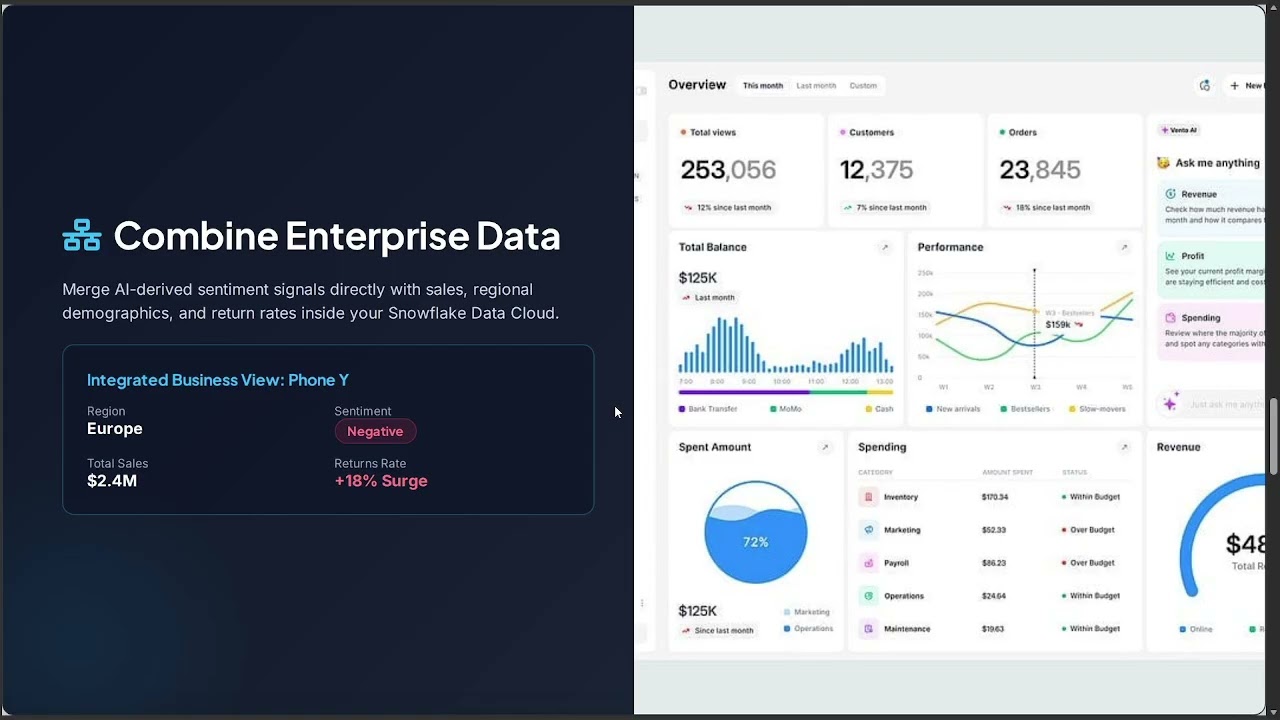
This simple approach enables analysts and engineers to aggregate sentiment trends across product lines, customer segments, or timeframes without writing a single line of complex Python code or leaving the Snowflake interface.
Transforming Feedback into Real-Time Value
By bridging the gap between SQL and artificial intelligence, organizations can build automated sentiment dashboards, flag dissatisfied customers in real time, and route negative feedback to support teams instantly. As cloud platforms continue to merge AI and core infrastructure, mastering these integrated tools is becoming a core capability for high-performing data engineering teams looking to maximize the value of their cloud data stack.
